Technical note - grow light selection
Can Regular LED Shop Lights Grow Plants? Spectrum and Efficacy Differences
A 40 W LED shop light from a hardware store will keep basil alive on a kitchen counter. Put the same fixture over a bench of fruiting tomatoes and the crop stalls, stretches, or flowers late. Both results come from the same physics: a shop light is specified in lumens, and lumens describe light as the human eye sees it, not as a leaf absorbs it.
This note sets out what actually differs between an architectural LED fixture and a horticultural one, which numbers can be compared, and the point at which the cheap fixture stops being cheap.
Short answer
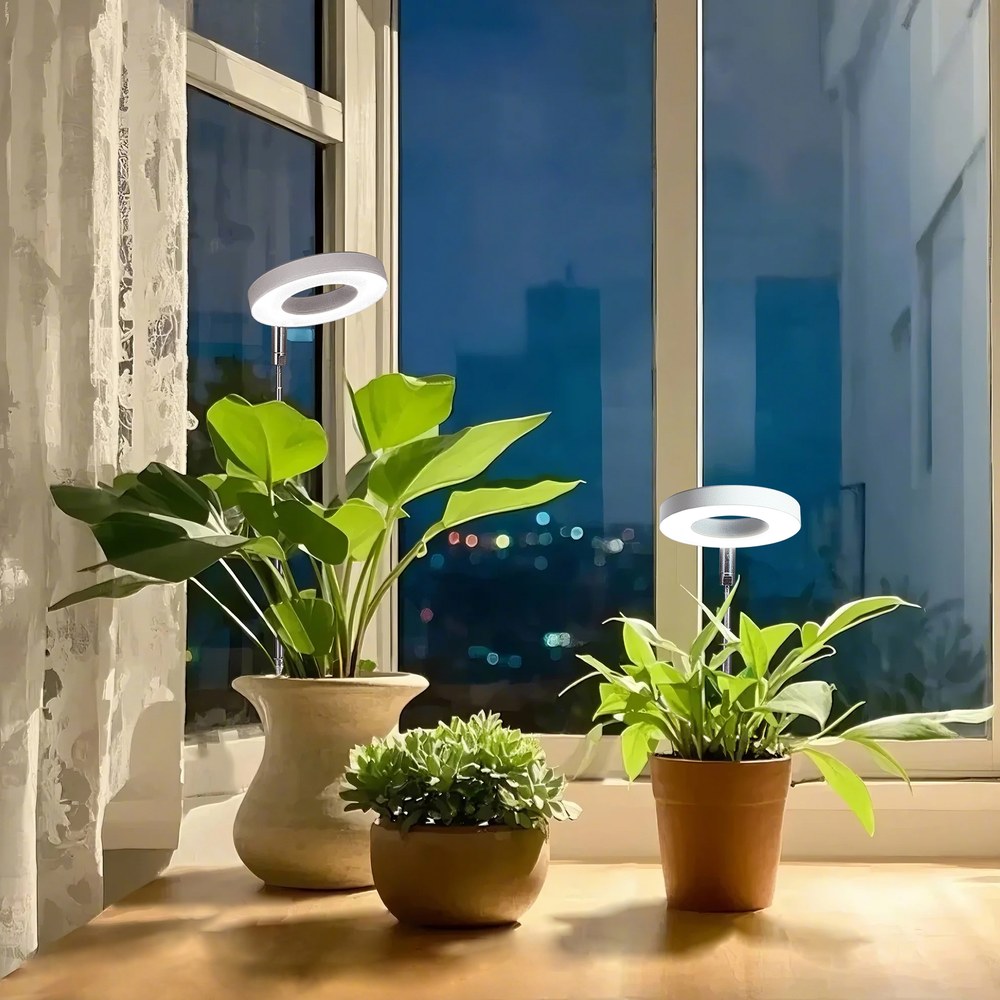
Yes, for low-light crops and for seedling stages, a white LED shop light can carry a crop through weeks of growth. No, it is not an interchangeable substitute for a horticultural fixture, because three things are missing from the specification: a photon flux number, a spectrum defined for plants, and an ingress rating that survives a wet grow room.
The practical test is not the fixture type but the delivered daily light integral (DLI). If you can state the PPF of the fixture, the area it covers and the hours it runs, you can compute the DLI and compare it with the crop target. If the datasheet only gives lumens, you cannot.
What a shop light is optimised for
Architectural LED fixtures are tuned for photopic vision. The lumen is weighted by the CIE photopic luminous efficiency function, which peaks near 555 nm and falls away quickly in the deep red and violet. A 4000 K shop light therefore spends its blue peak near 450 nm and a broad phosphor band across the rest of the visible range, with a colour rendering index chosen so that paint, fabric and faces look correct.
Plants do not evaluate colour rendering. They absorb across 400-700 nm and respond to the red to far-red ratio through phytochrome, which is why a spectrum that looks neutral white to a person can still be a workable plant spectrum, and why two fixtures with identical lumen output can produce different stem extension. The DesignLights Consortium's horticultural technical requirements exist precisely because the lighting industry needed a specification written in photon terms rather than in lumens.
The second difference is thermal and mechanical. A shop light is designed for a dry ceiling plenum at 25 C. A grow room runs at 60-80% relative humidity, with sprayers, condensate and occasional leaf contact. An IP20 housing with an unsealed driver compartment will fail there long before its rated life is reached.
The three numbers that decide whether a light can grow a crop
Horticultural lighting is specified in photons, and the arithmetic is simple once the units are fixed.
- PPF (photosynthetic photon flux) is the total photon output in the 400-700 nm waveband, in micromoles per second (umol/s). It is a property of the fixture alone.
- PPFD is PPF divided by the illuminated area, in umol/m2/s. It is a property of the installation, so it changes with mounting height and reflector design.
- DLI is PPFD multiplied by the photoperiod: PPFD x hours x 0.0036 = mol/m2/day.
Worked example with real numbers
Take a 150 W bar fixture rated at 2.6 umol/J. Its photon output is 150 x 2.6 = 390 umol/s. Hung over a 1.2 m x 1.2 m bench (1.44 m2), the ideal average PPFD is 390 / 1.44 = 271 umol/m2/s. Run for 16 hours a day, that is 271 x 16 x 0.0036 = 15.6 mol/m2/day - a defensible target for lettuce and many herbs, before any wall losses.
The same calculation for a 15 W screw-in grow bulb at roughly 2.0 umol/J gives 30 umol/s. Over a 0.3 m2 tray that is 100 umol/m2/s, or 5.8 mol/m2/day at 16 hours: enough for microgreens and propagation, and about a third of what the bar delivers.
A 40 W shop light at 4,000 lumens has no published PPF, and this is the point. Lumen-to-photon conversion is not a fixed ratio: it depends on the spectrum, and the two quantities answer different questions. Any vendor who quotes only lumens for a plant light is asking you to guess the DLI.
Dimension comparison: three fixture classes
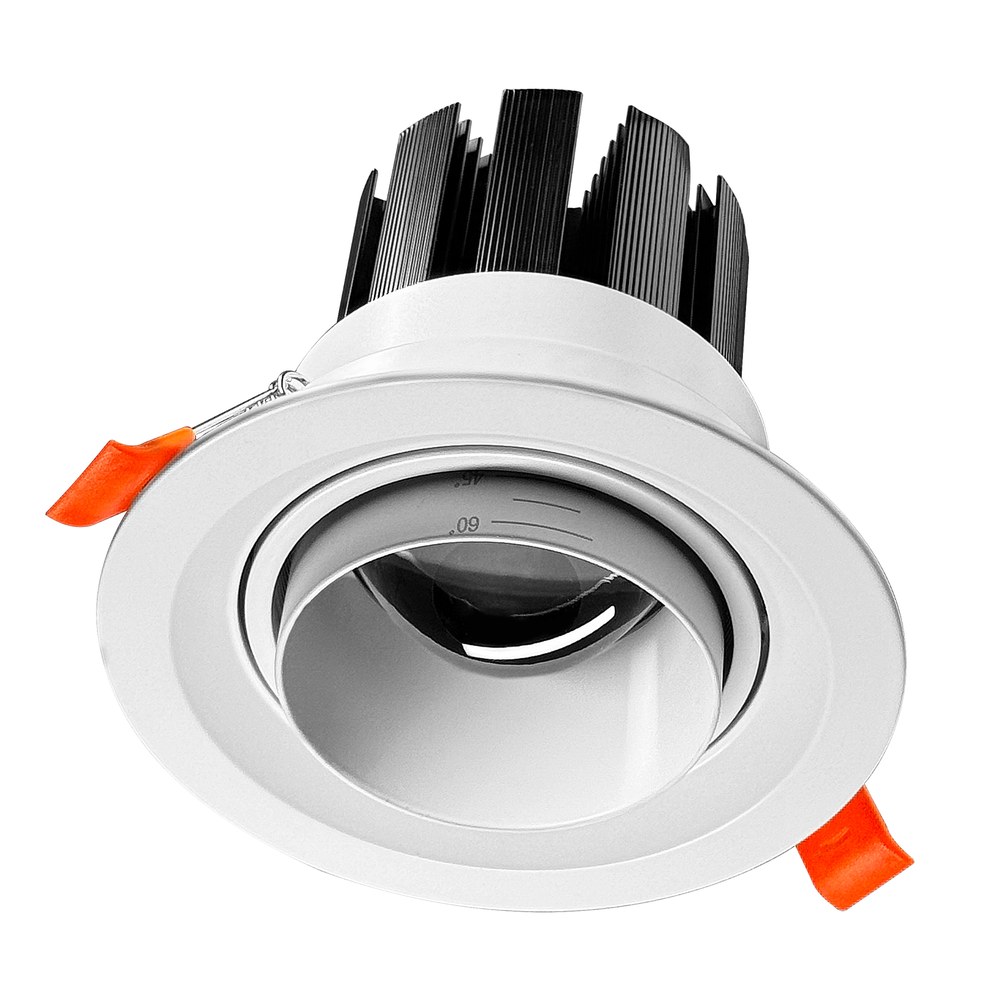
The table compares typical values for three classes of LED product sold for plant use. Treat the numbers as planning defaults and confirm against the actual datasheet, because the spread within each class is wide.
| Dimension | Integrated LED shop light | Horticultural LED bar | Screw-in LED grow bulb |
|---|---|---|---|
| Typical input power | 40 W | 150 W | 15 W |
| Rated output unit | 4,000 lm (lumens) | 390 umol/s (PPF) | 30 umol/s (PPF) |
| Photon efficacy | not published | 2.6 umol/J | 2.0 umol/J |
| Spectrum | 4000 K white, CRI-led | white plus 660 nm red, some far-red | red-heavy, low blue |
| Coverage at usable PPFD | 0.3-0.5 m2 at low PPFD | 1.2 m x 1.2 m | 0.3 m2 |
| Dimming | usually none | 0-10 V or PWM | none |
| Ingress protection | IP20 | IP54-IP65 | IP20 |
| Rated life basis | L70, 25,000 h | L90 with TM-21 projection | L70, 25,000 h |
| Data for DLI planning | none | PPF, sometimes PPF map | PPF only |
| Reasonable use | seedlings, herbs, supplementary | bench and rack production | single pots, accents |
Values are typical of each product class, not of a specific model. Verify power, PPF and IP rating on the datasheet of the fixture you intend to buy.
Where a shop light is good enough, and where it is not
Shop lights work for propagation, microgreens, lettuce seedlings and overwintering houseplants, because those crops reach a useful DLI at low PPFD and are forgiving of spectrum. They also work as supplementary light in a greenhouse, where daylight supplies most of the integral.
They fail in four situations. Fruiting crops that need more than roughly 20 mol/m2/day run out of photon flux at the canopy. Tall canopies need vertical spread that a bare linear batten does not deliver, so lower leaves drop below compensation point. Humid rooms destroy unsealed housings. And photoperiod control - short-day flowering, far-red manipulation - is not available on a fixture with a fixed white spectrum and no timer input.
What to check on the datasheet instead of the lumen number
Five lines decide whether a fixture is a plant light or a repurposed luminaire.
- PPF in umol/s, and the efficacy in umol/J at a stated drive current and case temperature.
- A PPF maintenance claim with a test basis - L90 at 36,000 h from an LM-80 dataset is checkable; a bare '50,000 hours' is not.
- Ingress protection of IP54 or better, and a driver compartment that is sealed separately from the LED chamber.
- Dimming protocol and the lowest stable dimming level, if you plan to control DLI by intensity rather than by hours.
- Mounting and coverage data: the PPF map or the recommended height for a stated average PPFD.
For a humid bench or a multi-tier rack, a sealed bar fixture with published PPF and a slim profile is the appropriate class of product; XineLam builds linear and bar fixtures for that role, and the same selection rules apply to them. For a few pots in a dry room, a consumer bulb is the rational purchase and the bar is over-specified.
About the publisher
XineLam is the lighting brand of Zhongshan City Ruixian Electronics Factory, an LED manufacturer with 17 years of experience and 300+ patents in China and internationally. The company produces architectural LED luminaires and horticultural LED fixtures, and publishes photon-based specifications for the grow light range.
This article is a technical explainer. It does not recommend a specific model for a crop; the calculation shown above can be repeated with the datasheet of any fixture.
Frequently asked questions
Will a 4000 K LED shop light flower a tomato plant?
Almost certainly not on its own. A 40 W shop light delivers too little photon flux over a mature tomato canopy to reach the 20-30 mol/m2/day that fruiting tomatoes are usually grown at, and the fixture has no far-red control. It can raise seedlings and keep plants alive, which is a different job.
Do I need a special spectrum, or is white light enough?
White light is enough to grow a crop, because white phosphor LEDs already emit across the red and blue bands that chlorophyll absorbs. A dedicated spectrum adds control: more red for compact internode length, a defined far-red fraction for stem extension, and less wasted green if the canopy is dense. The gain is real but secondary to getting the DLI right.
How do I convert lumens to PPF?
You cannot do it reliably without the spectral power distribution. The conversion factor depends on the spectrum: a 3000 K white and a red-blue blend with the same lumen output can differ by tens of percent in PPF. Ask for PPF in umol/s, or measure it with a quantum sensor.
Does a higher wattage shop light solve the problem?
It raises PPF, but it also raises heat inside an unsealed housing and it does nothing for ingress protection or dimming. Two 40 W shop lights over a bench cost more in hardware and cabling than one 150 W bar, deliver light from the wrong distribution pattern, and cannot be dimmed as a group.
Sources
- DesignLights Consortium, Technical Requirements for LED-Based Horticultural Lighting — https://designlights.org/our-work/horticultural-lighting/technical-requirements/
- Michigan State University Extension, Lighting metrics and what matters — https://www.canr.msu.edu/resources/lighting_metrics
- Ohio State University Extension, Ohioline ANR-99, Ever-Evolving Aspects of Cannabis Production — https://ohioline.osu.edu/factsheet/anr-99