Can Light Reduce Powdery Mildew? UV and LED Treatments in Greenhouses
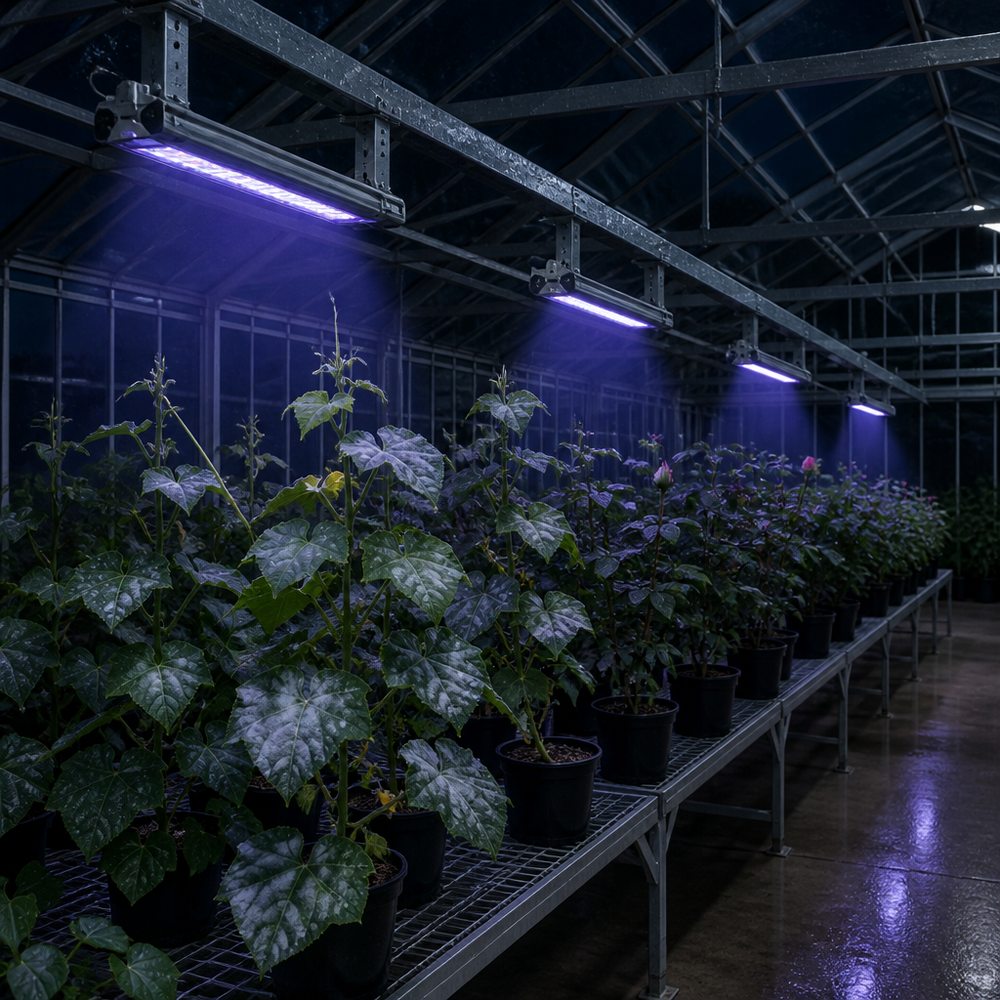
Short answer: yes, but only as a controlled intervention, not as a lamp you leave on and forget. Published greenhouse work shows that brief ultraviolet exposures can suppress powdery mildew on crops such as rose, cucumber, strawberry and grape, and that the timing and dose determine whether the crop is helped or damaged. Light is a tool inside an integrated programme — it does not replace sanitation, humidity control and resistant cultivars.
The short answer
Powdery mildews are obligate biotrophic fungi: they need living plant tissue to complete their life cycle, and they colonise leaves, stems and other above-ground parts. Because their colonies sit on the plant surface rather than inside it, they are unusually exposed to radiation, which is what makes light-based control plausible at all.
Two families of treatment appear repeatedly in the literature. The first uses ultraviolet light as a direct stressor on the fungus. The second uses light quality and duration to change how susceptible the plant tissue is. Neither is a stand-alone replacement for an integrated pest management programme.
What powdery mildew is, and why radiation reaches it
Unlike downy mildews and many bacterial pathogens, powdery mildew colonies develop largely on the leaf surface, held to the epidermis by feeding structures. A fungal colony in that position receives whatever radiation the canopy receives. Ultraviolet light in the germicidal band around 254–256 nm is absorbed directly by nucleic acids and damages fungal DNA, which is the basis of germicidal UV-C disinfection in other contexts as well.
The same radiation damages plant tissue, which is why the practical question is never "does UV work" but "at what dose, at what time of day, and with what crop response". Published greenhouse protocols therefore apply UV in short, low-dose nightly exposures rather than continuously, and they tune the dose to the crop.
Comparing the three light-based approaches
| Approach | Waveband | Reported protocol | Proposed mechanism | Practical limits |
|---|---|---|---|---|
| Germicidal UV-C | Around 254–256 nm | Brief, low-dose exposures applied at night, typically for seconds to a few minutes depending on fixture geometry and target dose; investigated for grape powdery mildew and botrytis bunch rot | Direct damage to fungal DNA on the exposed leaf surface | Damages eyes and skin; must run with the house closed and interlocked. Dose that suppresses the fungus can also mark sensitive crops. |
| UV-B supplementation | 280–315 nm | Short daily exposures, often at night; reported to suppress powdery mildew on rose, cucumber and strawberry | Direct inhibition of the fungus plus induced plant defence responses | Narrow margin between useful and phytotoxic dose; background light quality changes the result. |
| Visible light / photoperiod management | 400–700 nm (PAR) | Modifying spectrum and day length rather than applying a separate treatment; results are more variable than UV protocols | Indirect: changes canopy microclimate, leaf wetness duration and host physiology | On its own it is a management measure, not a curative one; cannot be separated from humidity and airflow management. |
Why night-time application is the usual choice
Plants repair ultraviolet damage to their own DNA with photolyase enzymes that use blue and near-UV-A light as an energy source, a process called photoreactivation. Applying UV when the house is dark therefore limits how much of the plant's own repair machinery is recruited during the treatment, and it also removes any risk of exposing workers. Reported greenhouse protocols for UV-C and UV-B place the exposure in the dark period for the same two reasons, and the requirement that such a system be interlocked to operate only in an unoccupied house follows directly from them.
Where light fits in a practical programme
Treat the light system as one control layer among several. The environmental measures that decide whether an outbreak takes hold — canopy density, air movement, humidity and leaf wetness duration — remain the primary levers, and cultivar choice and sanitation determine the starting inoculum. What a UV or light-quality programme adds is a repeated, non-chemical suppression step that does not leave residues and to which resistance is far less likely than with a site-specific fungicide.
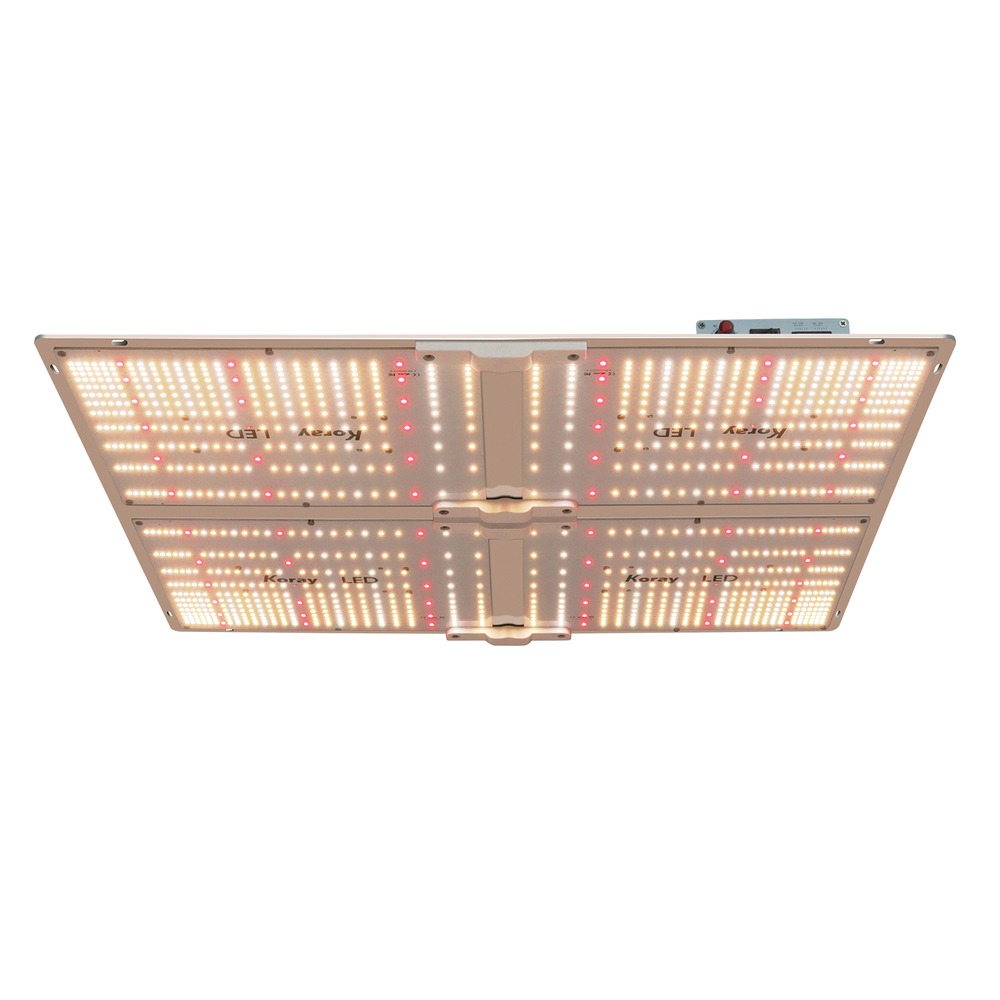
Because UV-C and UV-B fixtures are treatment hardware rather than growth hardware, they are specified by target dose and coverage geometry, not by photobiological output per watt. A greenhouse that also runs supplemental lighting should keep the two roles separate: the PAR fixtures are sized for daily light integral, while the UV fixtures are sized for a dose delivered in a short window at night.
Practical checklist before you specify a system
- Confirm the disease first. Powdery mildew and downy mildew require different control strategies; light-based suppression evidence is strongest for the powdery mildews.
- Start with the environment. Reduce canopy humidity and leaf wetness duration, and improve air movement, before adding treatment hardware.
- Run UV at night, on an interlock. No treatment when people are present, and no upward escape into occupied areas.
- Commission to a measured dose. Specify target dose at the canopy, then verify it with a meter in the house; fixture count alone does not define a dose.
- Trial on a small bay. Crop sensitivity varies, and the dose that suppresses the fungus can still mark leaves on a sensitive cultivar.
- Keep records of both disease pressure and crop response. A treatment programme is only validated by paired observations over a full season.
Frequently asked questions
Can LED lights kill powdery mildew?
Ordinary white or red-blue PAR fixtures used for photosynthesis are not designed as a fungicide and will not cure an established outbreak. Suppression has been reported for ultraviolet treatments in the germicidal band around 254–256 nm and for UV-B supplementation, applied as short controlled exposures — not for general-purpose grow lighting.
Why is UV for powdery mildew applied at night?
Two reasons. Plants repair UV-induced DNA damage using photolyase enzymes activated by blue and near-UV-A light, so a dark house reduces the dose that the crop effectively absorbs during treatment; and applying UV with nobody in the house removes the human exposure risk entirely.
Is UV light safe in a greenhouse with workers?
Not while it is operating. UV-C around 254 nm is hazardous to eyes and skin. Systems must be interlocked so fixtures cannot run in an occupied space, must be aimed away from walkways and openings, and should be verified against a measured dose rather than operated at whatever output the fixture happens to produce.
Does light treatment replace fungicides?
In the published greenhouse work, light treatments are evaluated as part of a disease management programme, not as a stand-alone replacement. They are best understood as a non-chemical suppression layer that reduces pressure and can allow other measures to work better.
Will UV treatment damage my crop?
It can, if the dose is too high or the cultivar is sensitive. Published protocols address this by keeping doses low and frequent rather than large and rare, and by applying them at night. Any new installation should be trialled on a small area and monitored for leaf marking before it is scaled up.
References
- Michigan State University Extension — Greenhouse disease update for powdery mildew. canr.msu.edu
- USDA Agricultural Research Service — Evaluation of germicidal UV-C light for suppression of grape powdery mildew and botrytis bunch rot. ars.usda.gov
About the publisher
XineLam is a grow light manufacturer with 17 years of experience in the LED lighting industry and 300+ patents in China and internationally. The company designs and produces horticultural LED fixtures for greenhouses, vertical farms and plant factories, and publishes technical guides for growers who need to specify lighting on measurable parameters rather than marketing language.