Is a Long Photoperiod at Low PPFD Really Equal to a Short Photoperiod at High PPFD?
The arithmetic says yes: the same daily light integral can be delivered by 200 µmol/m²/s for 17 hours or by 500 µmol/m²/s for 7 hours. The plant does not read the arithmetic. It responds to the rate, the duration and the dark period separately, and the differences are large enough to change a crop plan.
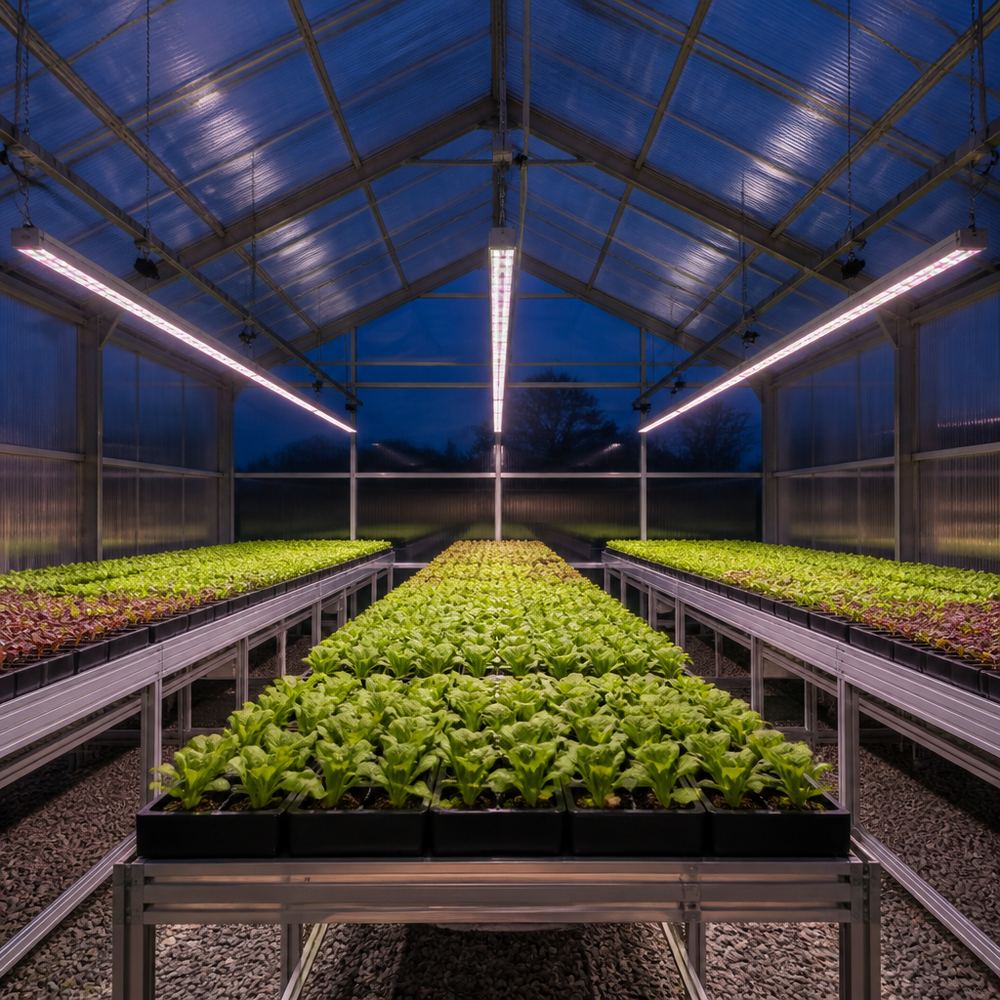
PPFD, photoperiod and DLI in one paragraph each
PPFD is the photosynthetic photon flux density reaching a surface, in micromoles per square metre per second (µmol·m⁻²·s⁻¹). It is an instantaneous rate, measured at a specific point and height.
Photoperiod is how many hours per day the canopy is lit. It is a control variable, not a plant response.
DLI is the daily light integral, the total number of photons delivered per square metre per day, in moles (mol·m⁻²·d⁻¹). It is the integral of PPFD over the photoperiod, which is why one DLI value can be produced by infinitely many combinations.
What the conversion looks like in practice
Table 1 solves the equation for two common targets. It makes the central trade-off visible: as PPFD falls, the hours required rise quickly, and a weak fixture can run out of clock before it runs out of target.
| PPFD (µmol·m⁻²·s⁻¹) | Hours for DLI 12 | Hours for DLI 16 |
|---|---|---|
| 150 | 22.2 h | 29.6 h — not achievable |
| 200 | 16.7 h | 22.2 h |
| 250 | 13.3 h | 17.8 h |
| 300 | 11.1 h | 14.8 h |
| 400 | 8.3 h | 11.1 h |
| 500 | 6.7 h | 8.9 h |
| 600 | 5.6 h | 7.4 h |
| 800 | 4.2 h | 5.6 h |
Two practical warnings follow from the same table. First, PPFD is measured at a point: the canopy average is lower than the centre reading, and the edges lower still, so the DLI delivered to the weakest plants is what limits the crop. Second, the hours in the table are hours of useful light at the canopy, not hours on a timer.
Why equal DLI is not equal growth
Four mechanisms break the equivalence.
1. The light-response curve is not a straight line
Photosynthesis rises steeply at low PPFD and flattens as light increases. Doubling PPFD from 200 to 400 µmol·m⁻²·s⁻¹ buys a large gain; doubling from 800 to 1,600 buys much less per photon. Concentrating the same daily dose into a short, intense window therefore pushes part of the light into the flat part of the curve, where it is used less efficiently and increasingly dissipated as heat.
2. Duration changes development, not just dose
Photoperiod is a signal as well as a resource. A Wageningen University & Research publication on optimal photoperiods for indoor leafy vegetables documents that the suitable photoperiod differs between species and cultivars rather than following a single rule.[3] Extending hours is not a neutral way to add photons; it also changes the length of the dark period that regulates development.
3. The dark period does work
Darkness is when starch is exported, growth in extension is organised and, in some species, when flowering is determined. Some crops tolerate continuous light, others show chlorosis or leaf deformation. Treating 24 hours as a free multiplier is one of the most common mistakes in small indoor farms.
4. Heat and uniformity follow the schedule
A high-PPFD schedule places fixtures closer to the canopy or drives them harder, which concentrates heat in the crop zone and reduces uniformity across the tray. A low-PPFD schedule spreads the same energy over more hours, which is gentler on the canopy but keeps the room's heat load running longer and can interfere with a dark period that the crop needs.
What the trials actually show
The direct evidence is asymmetric, which is worth stating plainly. Published work is much stronger on the effect of adding light than on the exact equivalence of two matched-DLI schedules.
One widely cited study compared 16-hour and 24-hour daily radiation in lettuce and reported that extending the photoperiod from 16 to 24 hours, a 50 percent increase in total radiation at the same PPFD, doubled the fresh weight of all loose-leaf cultivars tested.[2] That result supports the value of more hours when DLI rises. It does not show that a 24-hour weak schedule equals a 12-hour strong one at the same DLI.
For scheduling in a greenhouse, the University of New Hampshire Extension publishes a worksheet that calculates how long supplementary lights should run to make up the difference between natural and target DLI.[1] The logic is the same as Table 1, applied to a moving natural baseline: measure what the sun delivers, subtract it from the target, and convert the remainder into run time at the fixture's measured PPFD.
Choosing between the two schedules
| Dimension | Long photoperiod, low PPFD | Short photoperiod, high PPFD |
|---|---|---|
| Fixture count and capex | More fixtures or more layers; higher installed cost per m² | Fewer, higher-output fixtures; lower fixture count |
| Canopy uniformity | Easier — lower output per fixture spreads light more evenly | Harder — hotspots near the centre, steep edge fall-off |
| Leaf temperature and VPD | Moderate, sustained; less radiative heating per hour | Higher local heating; transpiration spikes under the fixture |
| Dark period | Compressed; risk for species that require a minimum night | Long night; safer for photoperiod-sensitive crops |
| Heat load timing | Spreads HVAC load across the day and night | Concentrates heat in a shorter window; may coincide with peak tariff |
| Typical fit | Leafy greens, propagation, multi-layer benches | High-wire crops, fruiting crops, tall canopies |
The decision usually comes down to the crop's photoperiod ceiling and the room's heat rejection capacity. If the species tolerates 18 hours and the room can remove the heat, the long, weak schedule is the more uniform and often the more forgiving option. If the crop needs a defined long night, or the canopy is tall enough that low-PPFD light cannot penetrate it, the short, intense schedule wins.
A five-step procedure for a real room
- Set the photoperiod from the crop, not from the fixture. Start with the species' known tolerance and the greenhouse or room's climate control limits.
- Calculate the required average PPFD from the target DLI and the chosen hours, then add 10 to 20 percent to cover edge losses and lamp ageing.
- Measure, do not assume. Take a grid of readings at canopy height, at the actual mounting distance, and use the lowest value for planning.
- Check the delivery — a quantum sensor logging for a full day gives the true DLI, including any sunlight contribution.
- Review the crop, not just the number. Leaf colour, internode length and fresh weight tell you whether the schedule is working; a DLI target that produces pale, compact plants is the wrong target for that cultivar.
Frequently asked questions
Is daily light integral the only number that matters?
No. DLI describes the daily photon dose, but the plant also responds to the rate at which that dose arrives and to the length of the dark period. Two schedules with the same DLI can differ in leaf temperature, canopy uniformity and morphology, especially when one pushes PPFD close to light saturation.
Can I run lights 24 hours a day to reach the target DLI with a weak fixture?
It is technically possible and occasionally used in research, but continuous light is not universally safe. Responses vary by species and cultivar, and some crops show leaf injury or reduced quality. A long photoperiod is a compromise to be tested on the crop, not a default.
How do I convert a PPFD measurement into DLI?
Multiply PPFD in µmol·m⁻²·s⁻¹ by the photoperiod in hours and by 3,600, then divide by one million. A steady 300 µmol·m⁻²·s⁻¹ for 11 hours gives about 11.9 mol·m⁻²·d⁻¹. For sunlight or any fluctuating source, log PPFD and integrate it over the day instead of using a single reading.
Does a longer photoperiod use more electricity at the same DLI?
Roughly the same photon energy is delivered either way, so the lighting load is similar. The differences appear elsewhere: driver efficiency changes with load, heat is released over a longer window, and the interaction with off-peak tariffs and heating schedules can shift operating cost by a meaningful margin.
About the publisher
XineLam is a LED lighting manufacturer with 17 years of experience and 300+ patents in China and internationally. The company produces horticultural luminaires and linear fixtures for greenhouse, indoor farm and research applications. This article is educational; scheduling decisions should be validated on the specific crop and room.
References
- University of New Hampshire Extension. Supplemental Lighting Run Time Worksheet (PDF). https://extension.unh.edu/sites/default/files/migrated_unmanaged_files/Resource008045_Rep11744.pdf
- PubMed record 11539771. Effect of 16 and 24 hours daily radiation (light) on lettuce growth. https://pubmed.ncbi.nlm.nih.gov/11539771/
- Wageningen University & Research. Optimal photoperiod for indoor cultivation of leafy vegetables. https://edepot.wur.nl/535488