Do LED Grow Lights Work in Cold Rooms? Low-Temperature Effects Explained
Short answer: a fixture rated for the ambient temperature will start and run in a cold room. What changes is the quality of the result. Cold air alters the fixture's thermal behaviour, it changes where moisture condenses, and it usually exposes the real limiting factor in winter, which is not the lamp but the daily light integral reaching the canopy.
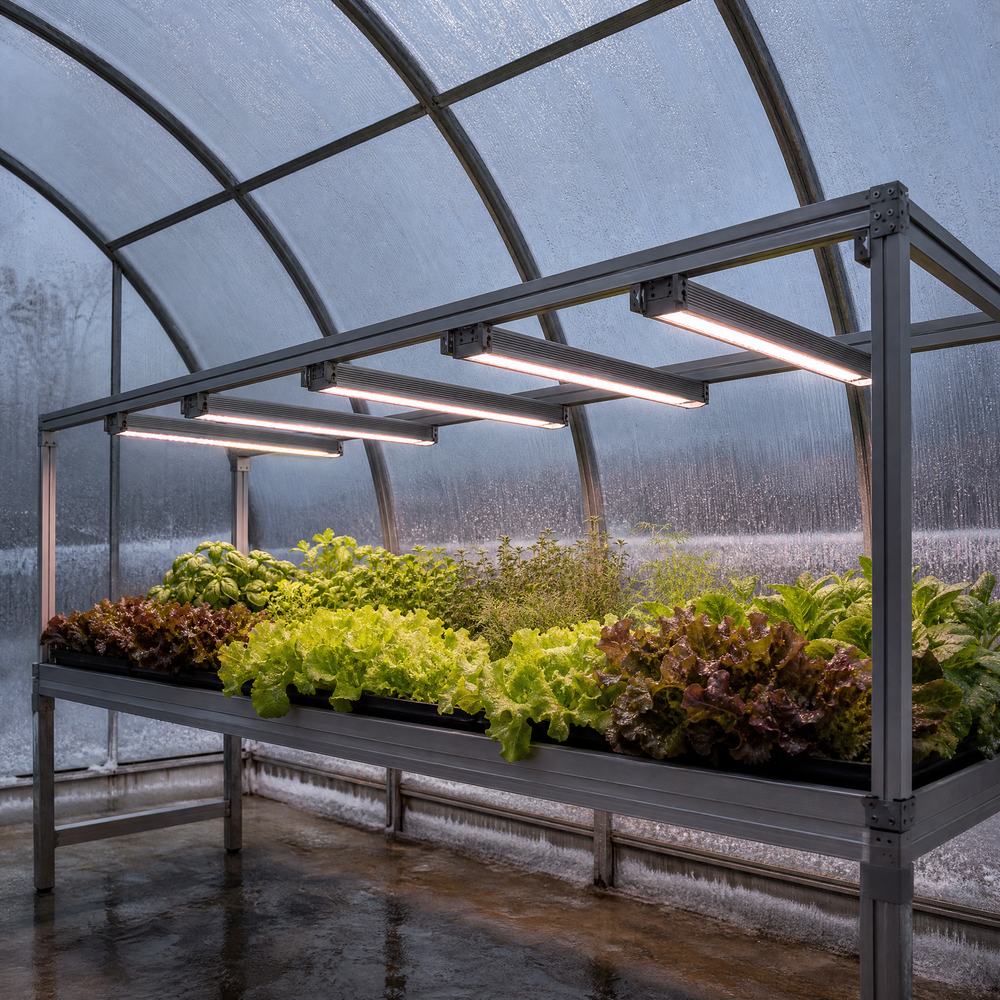
Cold rooms, chillers, unheated polytunnels and frost-protected glasshouses all raise the same question: can the lighting hardware be installed there at all, and does it still deliver the light the crop needs? The two questions have different answers, and mixing them up is how projects end up with fixtures that switch on reliably but leave the crop short of light.
What cold air actually does to an LED fixture
The light-emitting diode itself is not the part that struggles in the cold. According to the U.S. Department of Energy's fact sheet on thermal management, only 15% to 25% of the electrical input of a white LED is converted to visible light, with the remaining 75% to 85% leaving as heat that must be conducted away from the die. Junction temperature is set by three things: drive current, the thermal path, and ambient temperature. A colder ambient lowers junction temperature for the same drive current, which is thermally favourable to the die.
What does move is colour and output. The same fact sheet notes that excess heat produces short-term, reversible colour shift and reduced output, and that different colours respond at different rates, with amber and red most sensitive. Running well below the temperature at which a fixture was characterised therefore does not simply scale brightness up: it can shift the spectrum mix, which matters when a recipe depends on a red-to-blue ratio.
The components that usually set the cold limit are the driver and the seals, not the diodes. Ask three questions before specifying anything:
- Rated ambient range of the driver, not of the LED package. Electrolytic capacitors and startup circuitry are the usual constraint, and a driver rated from 0 °C upwards is a different product from one rated from −20 °C.
- Cold-start behaviour. Some constant-current drivers strike at reduced output and only reach full current after a warm-up period. If the photoperiod is short, that warm-up is a measurable share of the delivered light.
- Ingress protection and breather design. A sealed IP65 or IP66 luminaire with a pressure-equalising breather resists internal condensation far better than a housing with open cable entries.
Why condensation, not temperature, is the real hardware risk
A cold room is a dew-point problem. Every time a door opens, warm humid air enters and meets cold lens surfaces; the water that condenses there sits directly in the optical path and, over repeated cycles, can wick into unsealed joints. The same mechanism runs in reverse in an unheated greenhouse, where glazing and metalwork fall below the dew point overnight and drip onto fixtures and canopy.
Three practical measures reduce it: mount fixtures so the lens face is not the coldest surface in the room, keep cable entries pointing downwards with a drip loop, and specify a breather rather than a fully potted but unvented housing. Where the room is washed down, the relevant rating is the one for jets rather than splashes. None of this is exotic, but it has to be written into the purchase specification, because it cannot be retrofitted cheaply.
The constraint that usually decides the project: daily light integral
In winter, the light available inside a greenhouse is far below what most crops need. Purdue Extension measured the daily light integral (DLI) inside a greenhouse in West Lafayette, Indiana at roughly 5 mol/m²/day during winter, with values normally below 10 mol/m²/day from November through February. Set that against crop requirements from the same publication: 8 to 10 mol/m²/day for propagation material, 10 to 15 for potted plants, 15 to 20 for leafy greens, and more than 20 for tomatoes and strawberries.
The gap is the design target. A cold room or unheated tunnel that supplies 5 mol/m²/day of natural light to a lettuce crop needing 15 to 20 is short by 10 to 15 mol/m²/day, and no amount of fixture efficiency closes that gap without electric light.
| Space | Typical air temperature, lights on | Fixture-side issue | Crop-side issue | Check first |
|---|---|---|---|---|
| Cold store or chiller | 2–8 °C | Condensation on lens at every door opening; driver minimum ambient | Only cold-tolerant greens and sprouts are viable | Driver ambient rating, IP rating, breather |
| Unheated tunnel, winter night | 0–8 °C | Overnight condensation on housing and cable entries | DLI far below target; slow growth, pale or purple leaves | DLI gap, not fixture wattage |
| Frost-protected house | 8–15 °C | Minor; occasional drips from structure | Light, not temperature, limits yield | Photoperiod and PPFD uniformity |
| Heated house or indoor room | 18–26 °C | Heat removal from the fixture, not cold | Heat stress and stretch if PPFD is uneven | Junction temperature and air movement |
What cold does to the plant under the light
Cold and high light interact. Michigan State University Extension reports that leaves of some petunia and begonia cultivars turn purple when LED intensity is too high and greenhouse temperature is too low at the same time, and recommends reducing intensity to 60 to 75 µmol/m²/s in those propagation cases. The lesson generalises: a PPFD level that is appropriate at 22 °C is not automatically appropriate at 6 °C, because the enzymatic reactions that use the captured light run slower in cold tissue.
Root-zone temperature deserves separate attention. In a cold room the air may be held at 8 °C while the nutrient solution or substrate sits at the same temperature, which slows water and nutrient uptake independently of the light. Lighting a cold root zone harder mostly produces thinner, longer stems rather than more dry matter.
The same publication also puts a useful ceiling on supplemental light: for most ornamental crops, vegetable transplants and culinary herbs, the economic benefit of electric lighting diminishes once average DLI inside the greenhouse exceeds 10 to 12 mol/m²/day. Above that, adding more light buys very little.
How to size the fixture for a cold space
Work backwards from the light the crop needs, not from the wattage on the box. The conversion between an average PPFD over the photoperiod and the DLI it delivers is:
DLI (mol/m²/day) = PPFD (µmol/m²/s) × hours × 3,600 ÷ 1,000,000
Two worked examples, both for one square metre of canopy:
- To add 10 mol/m²/day over a 16-hour photoperiod, the average PPFD must be 10 × 1,000,000 ÷ (16 × 3,600) = 174 µmol/m²/s.
- To add 5 mol/m²/day over 18 hours, the average PPFD must be 5 × 1,000,000 ÷ (18 × 3,600) = 77 µmol/m²/s.
For scale, a fixture delivering a measured 500 µmol/m²/s at canopy level over 16 hours supplies 500 × 16 × 3,600 ÷ 1,000,000 = 28.8 mol/m²/day, which is more than a lettuce crop needs on top of winter sunlight. That is why dimming and a quantum sensor usually save more money than a smaller fixture.
Running cost can be estimated per mole of delivered light. Purdue Extension works an example with a 320 W LED fixture costing $750, rated 50,000 hours and delivering 500 µmol/m²/s at 1.2 m, with electricity at $0.13/kWh: 0.8 cents per mole for the fixture's fixed cost and 2.3 cents per mole for electricity, or 3.1 cents per mole in total. At that rate, adding 10 mol/m²/day to one square metre for 30 days costs about 300 × $0.031 = $9.30 in fixture depreciation and power.
Both the DLI targets and the cost per mole above are quoted from Purdue Extension publication HO-283-W. Your own electricity tariff, fixture price and measured PPFD will change the result; the arithmetic is the part worth copying.
Choosing a fixture for a cold room: a short checklist
- Driver ambient range covers the coldest night the room will see, not the average.
- IP65 or better with a pressure-equalising breather if washdown or repeated door openings occur.
- Dimming that is rated over the same temperature range as the driver, so a cold room can be tuned to the DLI target.
- A published PPFD chart at a stated mounting height and a stated ambient temperature, so the number you design to is the number you will measure.
- Mounting hardware rated for the condensation environment, in stainless or coated steel rather than bare galvanised parts.
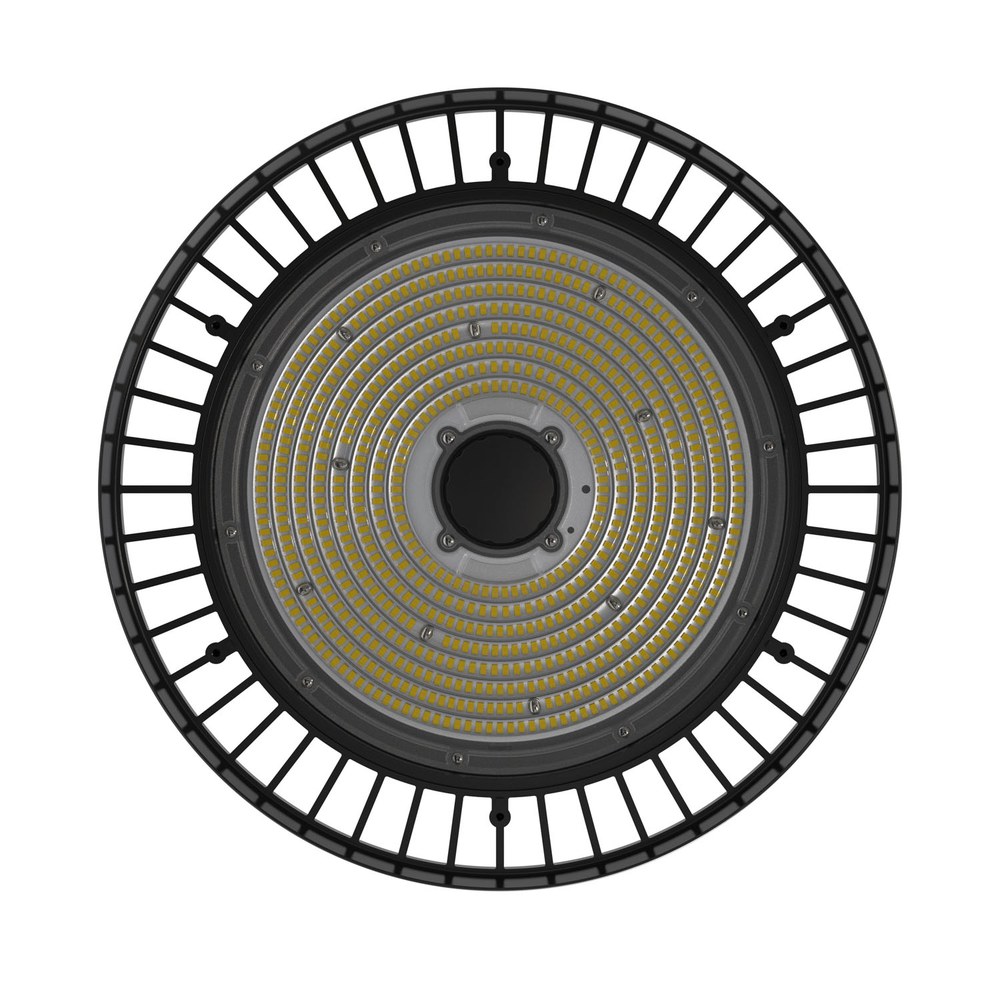
XineLam builds sealed round and bar-format fixtures for room-scale and greenhouse mounting, including models with finned aluminium housings and replaceable drivers. Which format suits a particular cold room depends on mounting height and the number of light points the layout needs; the calculation above, not the catalogue, should decide the wattage.
Frequently asked questions
Can I use an ordinary indoor grow light in a 5 °C cold room?
Only if the driver is rated for that ambient and the housing is sealed against condensation. The diodes will run happily at 5 °C, but a driver specified for 0 °C and above may fail to start, and an unsealed housing will collect water on the lens. Check the driver's ambient range on its datasheet rather than the fixture's marketing page.
Does cold make LEDs less efficient?
No. For a fixed drive current, a lower ambient temperature lowers junction temperature, and the Department of Energy's thermal fact sheet describes reduced light output and colour shift as effects of excess heat, not of cold. What cold does change is colour balance, because different LED colours respond to temperature at different rates, so a spectrum tuned at 25 °C may look slightly different at 5 °C.
Will condensation damage an IP65 fixture?
A correctly sealed IP65 or IP66 luminaire with a breather resists external water and internal condensation. The failures usually come from cable entries that point upwards, damaged gaskets, or a housing that is sealed but not pressure-equalised, which draws moist air in as the fixture heats and cools. Mount with drip loops and inspect gaskets at each service interval.
How many hours should the light run in winter?
Long enough to reach the crop's DLI target without exceeding the photoperiod the crop tolerates. At 174 µmol/m²/s, 16 hours delivers about 10 mol/m²/day; at 77 µmol/m²/s, 18 hours delivers about 5. Measure PPFD at canopy level and calculate, rather than extending hours until the plants look better.
About the publisher
XineLam is the grow-light brand of Zhongshan City Ruixian Electronics Factory, an LED lighting manufacturer with 17 years of experience and 300+ patents in China and internationally. The company produces sealed and finned luminaires for greenhouses, vertical farms and room-scale cultivation, and publishes application notes on sizing, spectrum and thermal design.
References
- Nemali, K. and Langenhoven, P. Determining the Economic Value of Providing Supplemental Light to Lettuce During Winter Production. Purdue Extension HO-283-W. https://www.extension.purdue.edu/extmedia/HO/HO-283-W.pdf
- Runkle, E. Supplemental lighting: Common pitfalls and practical solutions. Michigan State University Extension. https://www.canr.msu.edu/floriculture/uploads/files/Supplemental%20lighting%20tips.pdf
- U.S. Department of Energy. Thermal Management of White LEDs. PNNL-SA-51901, February 2007. https://www1.eere.energy.gov/buildings/publications/pdfs/ssl/thermal_led_feb07_2.pdf