Do LED Grow Lights Work With Smart Plugs and Timers?
In most cases, yes. A timer or a smart plug is simply a switch in the mains supply, and an LED grow light will run from one. The complication is not whether the fixture will light up, but whether the switch that controls it can survive the first few milliseconds after it closes, when the driver draws its inrush current.
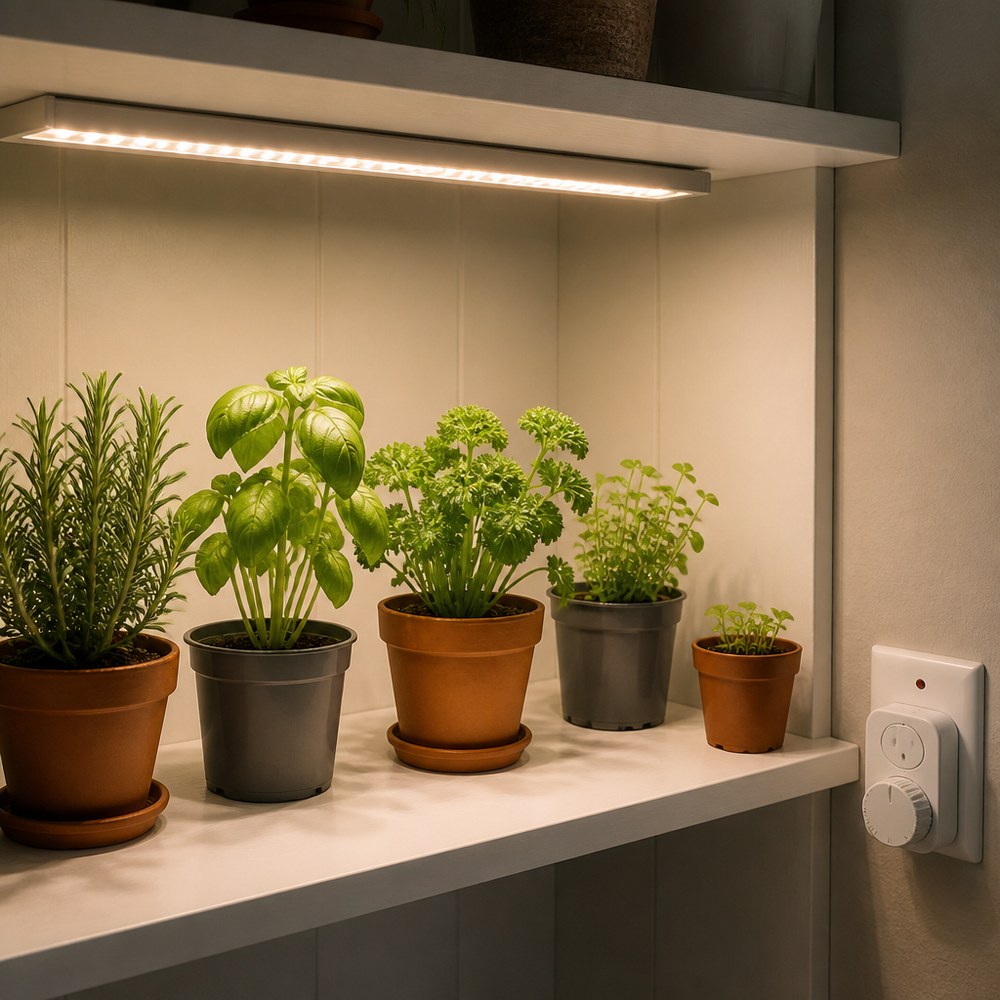
The short answer
An LED grow light is controlled by a driver, which is a switched-mode power supply. Every one of those contains capacitors on the input side. As a technical note from the LED driver supplier ADLT explains, inrush current is the short-duration input current that flows into the driver at start-up in order to charge the capacitors on the input side; its amplitude is much greater than the operating, or steady-state, current, and it arises from the EMC filter on the input and the bulk capacitor on the boost circuit.
So the practical question when buying a timer or a smart plug is not "is it rated for this many watts?" but "is it rated for this many amps of surge, repeatedly, for years?"
Why switching an LED driver is not like switching an old light bulb
The magnitudes involved are larger than most people expect. A technical article from Ametherm, which manufactures inrush current limiters, puts it directly: for a typical LED driver the capacitors charge in less than one millisecond after power is turned on, and this rapid charging creates an inrush current that can be 100 times the driver's continuous current rating. The same article compares that with older lighting, at roughly six times the inrush current of an incandescent lamp and four times that of the magnetic ballast used in fluorescent lighting.
Independent measurements reported by the Australian supplier LED Drivers Australia are of the same order. For smaller power supplies the inrush current is typically around 40 to 70 amperes lasting 1 to 2 milliseconds, with a peak just over 50 amperes for about 1.5 milliseconds in the trace shown. The article also makes a point that particularly matters for multi-fixture grow rooms: when several drivers are switched by the same control, their inrush currents coincide, and the combined surge can trip a lighting circuit breaker that is not undersized in any steady-state sense.
The surge is also phase dependent. Because the current depends on where in the mains cycle the switch closes, a fixture may start cleanly many times and trip the breaker occasionally. Intermittent faults of that kind are characteristic of inrush rather than of a wiring defect.
Control methods compared
Table 1 compares the four common ways of putting a grow light on a schedule. It is a comparison of switching mechanisms, not of brands; a well-rated device of any type will outperform a poorly rated one of another.
| Dimension | Mechanical timer | Digital plug-in timer | Wi-Fi smart plug | Dedicated lighting controller |
|---|---|---|---|---|
| Switching element | Motor-driven cam and mechanical contacts | Relay driven by a digital clock | Relay or solid-state switch driven over Wi-Fi | Contactor or purpose-built control gear |
| Typical rating basis | Often stated for resistive or incandescent loads | Usually stated for resistive loads | Usual rating is continuous current; surge data not always published | Rated for the specific luminaire or channel type |
| Inrush handling | Poor; contacts are the weak point | Better than mechanical, still relay-limited | Varies widely between models; solid-state versions generally tolerate surges better than relays | Designed for it, which is why installations at scale use it |
| Scheduling resolution | Coarse, typically 15-minute pins | Usually one minute | One minute or better, set from a phone | Programmable, often with multiple zones |
| Remote control and monitoring | None | None | Yes; many models log power consumption | Yes, plus central monitoring |
| Dimming support | None; on and off only | None; on and off only | Usually none; a few models offer a control output | Commonly yes, via the control protocol the driver supports |
| Failure mode to watch for | Contacts pit, then weld shut or fail to open, holding the light on | Clock drift or battery failure; relay contact wear | Loss of network means loss of schedule; firmware and cloud dependency | Higher cost and complexity; correct commissioning required |
| Best fit | A single low-power fixture, no remote need | One or two fixtures with a fixed daily schedule | Home and small-room grows wanting remote control and logging | Multi-fixture rooms where coordinated switching matters |
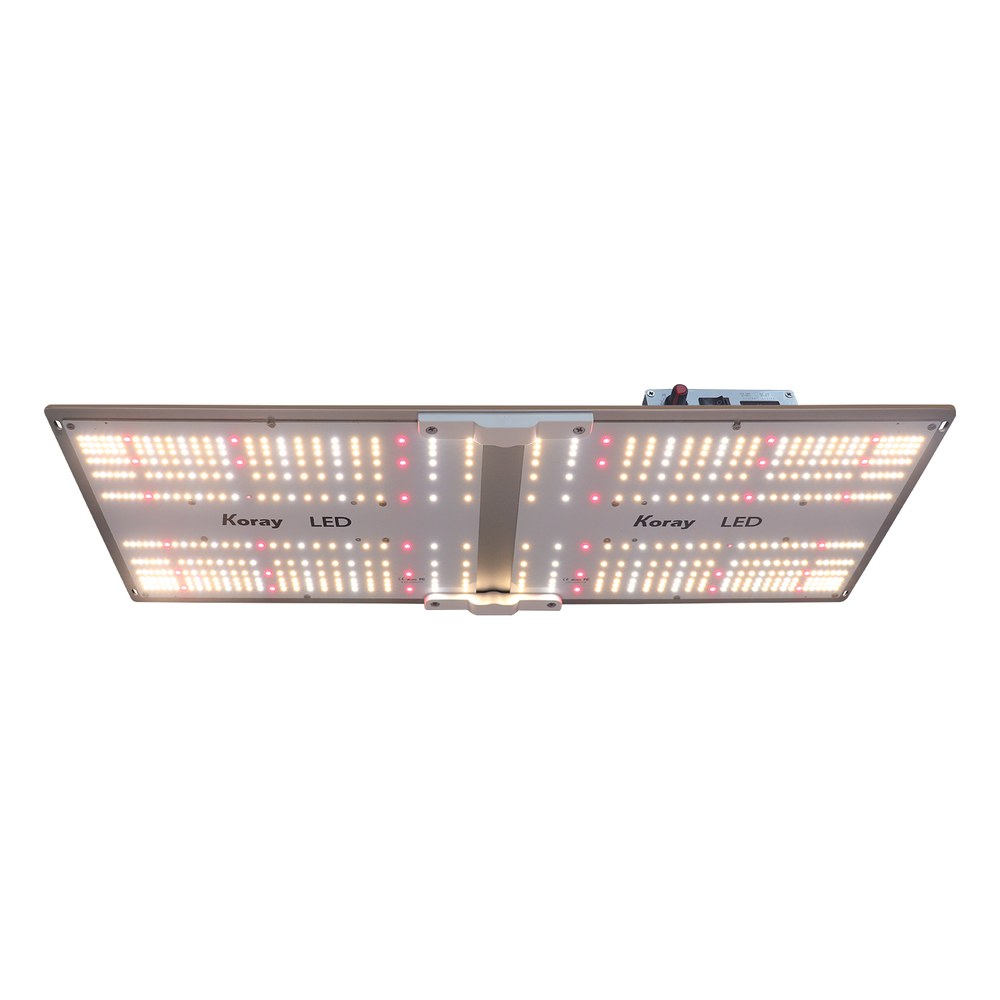
Checklist before you put a grow light on a timer
- Add the rated input power of every fixture that the device will control, and keep the total comfortably below the device's continuous rating.
- Look for a surge, inrush or lamp-load figure in the specification. If the manufacturer publishes only a resistive-load rating, treat the device as marginal for a large driver.
- Prefer switching fewer, larger drivers per timer over many small ones, and stagger the switch-on if the controller allows it.
- Avoid daisy-chaining plug strips behind one smart plug. Every additional contact in the chain is another place for a surge to do damage.
- Check whether the driver needs anything more than mains on and off. If it is designed to be dimmed, on and off switching will not use that feature.
- Mount the switching device where its own heat can escape. A plug block tucked behind insulation runs hotter than one in open air.
About the publisher
XineLam is an LED lighting manufacturer with 17 years of experience in LED lighting and 300+ patents in China and internationally. The company designs and produces LED modules and luminaires, including horticultural lighting, at its facilities in Zhongshan, China.
Sources
- Ametherm — Inrush Current Protection for LED Lighting Retrofits. Source of the figures used above: input capacitors charging in less than one millisecond, inrush up to 100 times the driver's continuous current rating, and the comparison with incandescent lamps and magnetic ballasts.
- ADLT — LED Driver Inrush Currents. Definition of inrush current in the LED driver context and its origin in the input EMC filter and bulk capacitor.
- LED Drivers Australia — Resolving Inrush Current Problems With LED Drivers. Measured magnitudes for smaller power supplies and the effect of coincident inrush when several drivers are energised together.
- DesignLights Consortium — Horticultural Lighting. An independent non-profit providing data and resources on quality lighting, controls and integrated building systems.
Frequently asked questions
Will a mechanical timer work with an LED grow light?
Mechanically it will switch the circuit, but the contacts have to survive the driver start-up surge rather than just the running current. A timer whose rating is stated for resistive loads may be far below what the driver demands at switch-on, which is why contacts can pit, weld shut, or fail to open over time.
Do smart plugs handle LED grow lights?
Wi-Fi smart plugs are usually rated by continuous current, and the important question is whether the manufacturer also publishes a surge or inrush figure. A plug rated for 10 A continuous may still chatter or weld if it is asked to close into a driver whose start-up current is many times its running current. Choose a plug with a higher current rating than the fixture needs, and avoid daisy-chaining.
Why does my breaker trip when the grow light turns on?
Because a switched-mode driver charges its input capacitors very quickly at switch-on, the instantaneous current can be far above the steady-state figure. If several drivers are energised by the same timer at the same instant, their surges coincide and can trip a circuit breaker whose thermal rating looked perfectly adequate.
Can I use a dimmer switch with an LED grow light?
Only if the driver is designed for that dimming method. Mains phase-cut dimmers change the shape of the supply waveform and are not the same thing as the low-voltage control signal used by dimmable drivers. A driver that is not rated for the dimmer in question may flicker, buzz, drop out of regulation, or refuse to start; the compatibility statement must come from the driver documentation.