Do Plants Need UV and Far-Red Light? What the Evidence Shows
Neither waveband is required for a crop to finish, and neither is a free yield bonus. Both change how a plant grows, and both are dose-dependent.
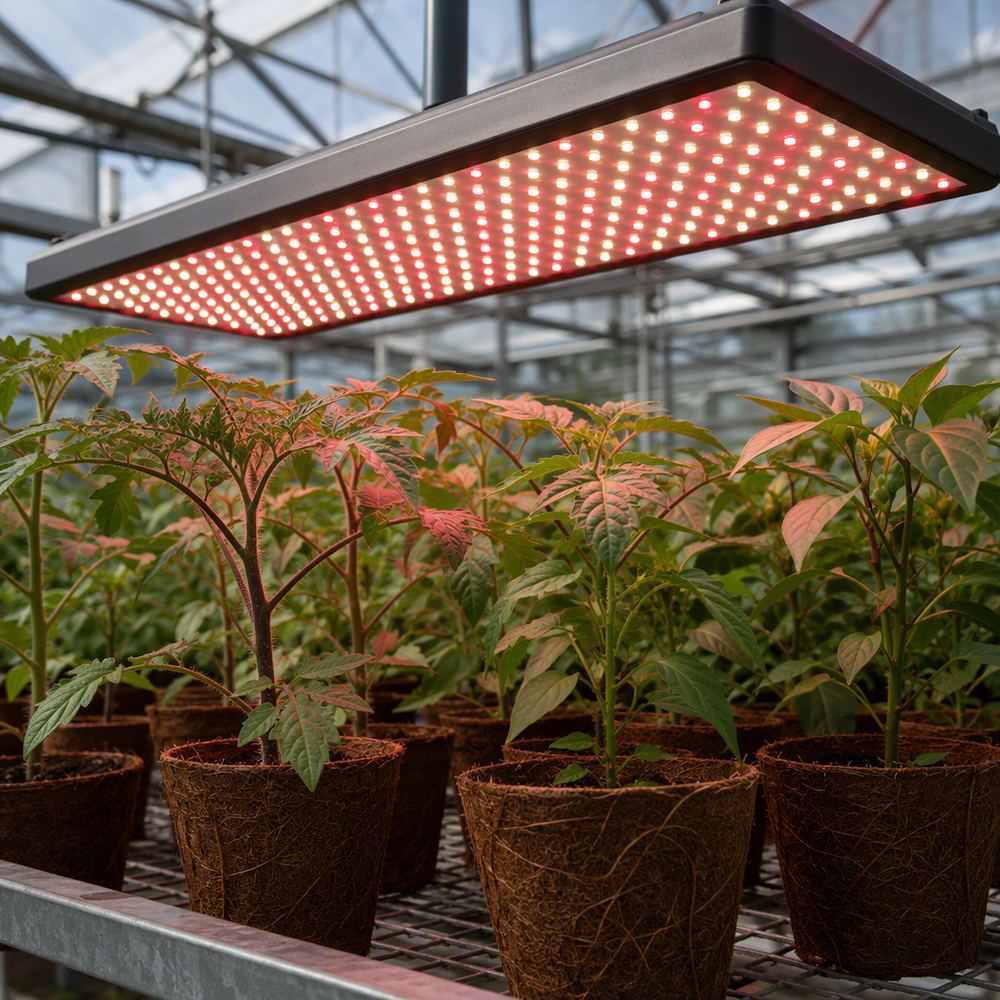
Grow light marketing now routinely promises ultraviolet for resin and far-red for yield, and the two claims are usually presented together as if they belonged to the same mechanism. They do not. Far-red participates in photosynthesis directly, through a well-described interaction with shorter wavelengths. UV mostly acts as a signal and a stressor, and its useful effects sit inside a narrow dose window. Understanding the difference prevents paying for diodes that do nothing in a particular crop.
What PAR includes and what it leaves out
Photosynthetically active radiation is conventionally defined as the waveband from 400 to 700 nm, and quantum sensors are built to match that definition. The boundary is a convention, not a physical cliff: chlorophyll still absorbs beyond 700 nm, and there is a body of work arguing that far-red photons in the 700 to 750 nm range belong in a revised definition, often called extended PAR or ePAR.2 In practice this means a fixture's PPFD number is silent about whatever it emits above 700 nm, which is exactly where far-red diodes sit.
Far-red and the Emerson enhancement effect
The classical observation is that photosynthesis under far-red light alone is poor, yet adding far-red to shorter-wavelength light increases the quantum yield beyond what the two beams would produce separately. This is the Emerson enhancement effect, first described in the 1950s, and it reflects the two photosystems working in series: light that preferentially drives one of them is more useful when the other is also being driven.1
The practical consequence is that far-red is best evaluated as an addition to a spectrum rather than as a substitute for part of it. A review of far-red effects distinguishes short-term enhancement of photochemistry from longer-term effects on plant architecture and development, which do not necessarily point in the same direction.1 When a supplier quotes a yield gain from far-red, the useful questions are how much was added, in what ratio to the rest of the spectrum, and at what point in the photoperiod.
Phytochrome: form, stretch and the red to far-red ratio
Far-red also carries information. Phytochrome switches between a red-absorbing form and a far-red-absorbing form, and the balance between the two forms tells the plant whether it is in open sky or under a leaf canopy, where red has been filtered out and far-red enriched. A low red to far-red ratio typically triggers shade-avoidance responses: stem extension, longer internodes and thinner leaves.
This is why far-red is a morphology tool as much as a photosynthesis tool. In a dense canopy the signal is already present; adding far-red diodes on top can push stretching further, while removing it in the last hours of the photoperiod is a technique some propagators use to keep transplants compact. Neither direction is universally right, and the response differs between species and even between cultivars.
UV is a dose, not an ingredient
Ultraviolet radiation is conventionally split into UV-B (280 to 315 nm) and UV-A (315 to 400 nm). Horticultural reviews describe a consistent set of responses at low doses: inhibited extension growth, shorter stems and smaller leaves, thicker leaves with more wax, and increased secondary metabolites.3 Those are quality and architecture effects, not photosynthesis effects, and they are exactly what a controlled stress treatment is supposed to produce.
At higher doses the same waveband damages photosystem II, proteins and DNA. There is no deficiency syndrome for UV in the way there is for a mineral nutrient, which is the clearest answer to whether plants "need" it: they do not need it to complete a lifecycle, but some crops respond usefully to a controlled dose. Whether that response is worth the electrical cost and the safety controls is a commercial decision, not a biological necessity.
| Waveband | Primary absorber | Documented response | Strength of evidence | Practical note |
|---|---|---|---|---|
| UV-B, 280–315 nm | UVR8, DNA and proteins | Leaf thickening, more wax and flavonoids at low dose; tissue and DNA damage at high dose | Dose-response well described; yield benefit not established | Never a yield tool; use only with dose control and eye and skin protection |
| UV-A, 315–400 nm | Chlorophyll tails, cryptochrome, phototropin | Morphological and phytochemical shifts that depend on dose and duration | Mixed across species and doses | Rarely justifies dedicated diodes in a production spectrum |
| Blue, 400–500 nm | Chlorophyll a and b, cryptochrome | Stomatal opening, compact growth, phototropism | Strong | Present in essentially every white or full spectrum |
| Red, 600–700 nm | Chlorophyll a and b, phytochrome in its red-absorbing form | Principal driver of photosynthesis in many crops | Strong | Core of most horticultural spectra |
| Far-red, 700–750 nm | Phytochrome in its far-red-absorbing form; photosystem I | Emerson enhancement with shorter wavelengths; shade-avoidance signalling; contribution counted in ePAR | Strong for photochemistry; crop-specific for morphology | Worth adding with separate control where stem length matters |
What this means when you choose a fixture
- Fix the base spectrum first. Blue and red coverage at adequate PPFD and a defensible efficacy figure matter more than any add-on band. A fixture with weak red output does not become a good fixture by adding far-red.
- Treat far-red as an addition with its own control. If stem length is a commercial risk, far-red needs to be switchable or dimmable separately; if the fixture only offers a fixed share of far-red, you have bought a morphology decision along with the light.
- Do not buy UV for yield. The documented effects are morphological and phytochemical. Justify UV only if a specific quality target, such as a measured increase in a secondary metabolite, pays for it in your market.
- Ask for the spectrum, not just the PPFD. A single PPFD number cannot describe what happens above 700 nm, and two fixtures with identical PPFD can differ substantially in far-red content.
Measuring light that a PAR meter under-reports
A conventional quantum sensor stops at 700 nm, so a room receiving a meaningful far-red addition will read lower than the light the plants actually use. Two practical consequences follow. First, DLI calculated from a standard meter is a conservative number in a far-red-supplemented room, and comparing it directly with a room without far-red overstates the difference in delivered light. Second, when far-red is used, record the spectrum alongside the PPFD so that a later comparison between batches, or between rooms, is not being made on an incomplete number.
Questions growers ask
Do plants need UV light to grow?
No. Most crops complete their lifecycle without ultraviolet radiation. UV acts mainly as a signalling and stress factor: at low doses it thickens leaves and increases wax and secondary metabolites, and at high doses it damages photosystems and DNA. It is a tool with a dose window, not a nutrient that must be supplied.
Does far-red light increase yield?
Far-red can raise the quantum yield of photosynthesis when added to light rich in shorter wavelengths, which is the Emerson enhancement effect. Whether that becomes extra yield or extra stem length depends on crop, timing and the red to far-red ratio, so the outcome is crop-specific rather than a general rule.
Will a standard PAR meter read far-red output?
No. A conventional PAR sensor responds from 400 to 700 nm and stops before 700 nm, so far-red photons are invisible to it. If a fixture includes far-red, ask for the spectrum and for extended-range ePAR data rather than relying on the PPFD figure alone.
Can UV light burn plant leaves?
Yes, at sufficient dose. The same waveband that triggers useful hardening responses at low exposure damages tissue at high exposure, and the threshold varies with species and with how acclimated the plants already are. Ramp exposure gradually, and treat UV-emitting fixtures as an occupational safety item as well.