Do Plants Use Green Light? How Green Wavelengths Work in a Canopy
Green is the part of the spectrum a leaf reflects most strongly, which is why foliage looks green. Reflected, however, is not the same as unused. Careful single-leaf measurements put green light absorption at roughly 80%, against about 90% for blue and red, and about 10% of green light is transmitted straight through the leaf rather than being absorbed at the surface.
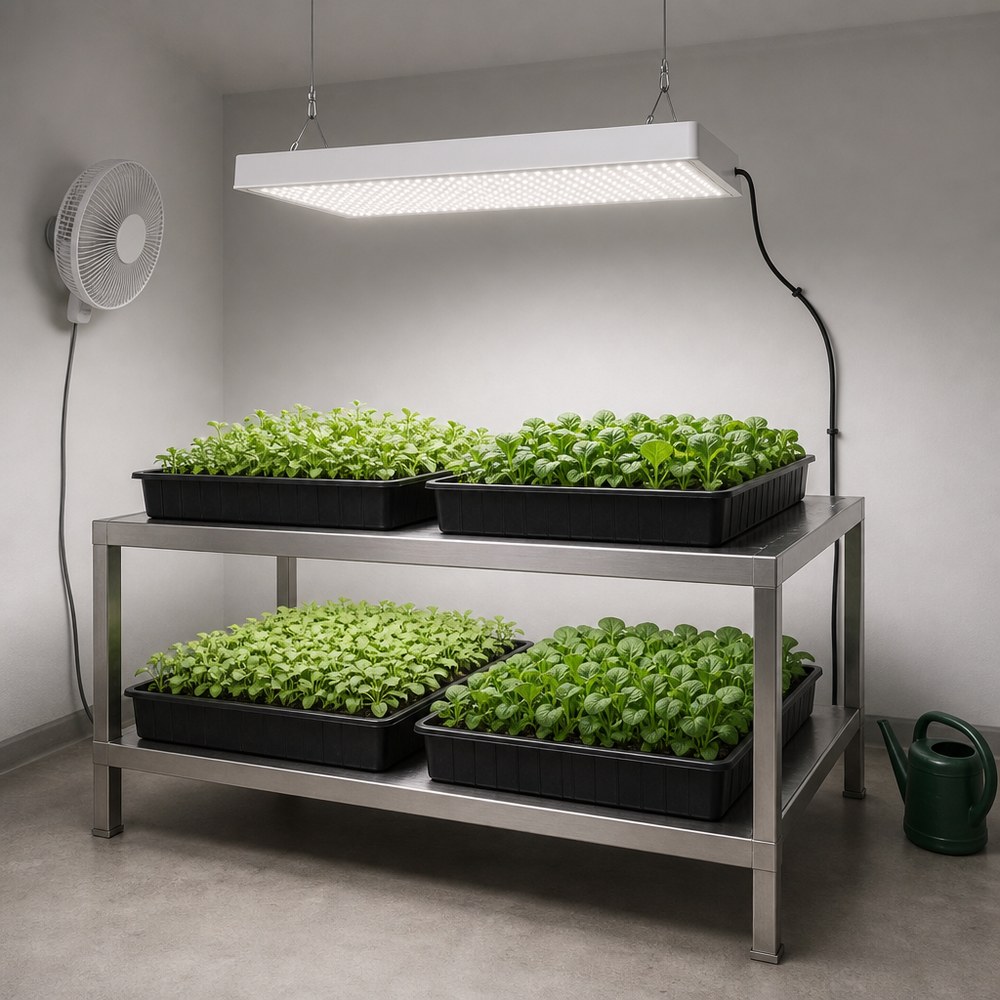
Why leaves look green in the first place
Chlorophyll absorbs blue and red photons strongly and green photons less strongly. The fraction of green light that is not absorbed is scattered back out of the leaf, which is what our eyes register as green colour. The mistake is to read that reflectance as proof of irrelevance. In practice the leaf absorbs most of the green light that reaches it, and the small share that escapes is the visible clue to a much subtler optical behaviour inside the leaf.
Because green photons are absorbed less aggressively than red or blue, they are also scattered and re-scattered as they travel. The result is a different vertical pattern of absorption: red and blue are largely deposited in the first chloroplast layers they meet, while green is absorbed more evenly through the thickness of the mesophyll. That difference in distribution, not a difference in which pigment is used, is what makes green light interesting for growers.
Is green light as efficient as red and blue?
The honest answer depends on how much light the leaf is receiving. Under weak light, red and blue deliver more photosynthesis per photon absorbed, which is why most narrow-band horticultural spectra are built around red with a smaller blue component. Under strong light the picture changes. Work published in Plant and Cell Physiology showed that in strong white light, green light drove leaf photosynthesis more efficiently than red light of comparable absorbed irradiance. The proposed reason is intra-leaf light gradients: in the upper layers, red light saturates the photosynthetic apparatus, and additional red photons are wasted there, whereas green light is delivered further down where the chloroplasts are still below saturation.
What this means across a real canopy
A single leaf is not a crop. In a dense canopy, red and blue photons are intercepted almost entirely by the uppermost leaves, so the lower leaves operate in deep shade. Green light, being absorbed less abruptly, continues through the upper leaf layers and provides irradiance to leaves further down. Greenhouse measurements taken at several heights in a rose canopy illustrate how the spectral composition changes with depth, not just the total light level.
| Waveband | Absorbed by a leaf | Transmitted through the leaf | Where it is absorbed | Practical consequence |
|---|---|---|---|---|
| Blue, approx. 400–500 nm | About 90% | Only a few percent | Mainly in the upper chloroplast layers | Strong morphogenic signal; large share consumed near the surface |
| Green, approx. 500–560 nm | About 80% | About 10% | Distributed more evenly through the mesophyll | Reaches lower leaves; improves light distribution in deep canopies |
| Red, approx. 600–700 nm | About 90% | Only a few percent | Mainly in the upper chloroplast layers | Dominant photosynthetic driver; least penetrating in a dense canopy |
The design implication is straightforward. Where the canopy is shallow and every photon must convert, a red-heavy spectrum with a blue component is the efficient choice. Where leaves are stacked, whether in a tall greenhouse crop or on multi-tier racking, a spectrum containing green light spreads irradiance more uniformly through the crop instead of concentrating it at the top.
Matching a spectrum to the job
Three questions decide the balance more reliably than any single "best" recipe. First, how deep is the canopy: a seedling tray or microgreen flat has one effective leaf layer, while a fruiting crop or a vertical rack has several. Second, how much irradiance are you delivering: the higher the PPFD, the more useful a broader, white-like spectrum becomes, because more of the leaf volume can operate below saturation. Third, what is the crop worth protecting near the surface: strong blue fractions shape compact growth, while green and white fractions spread the load down the profile.
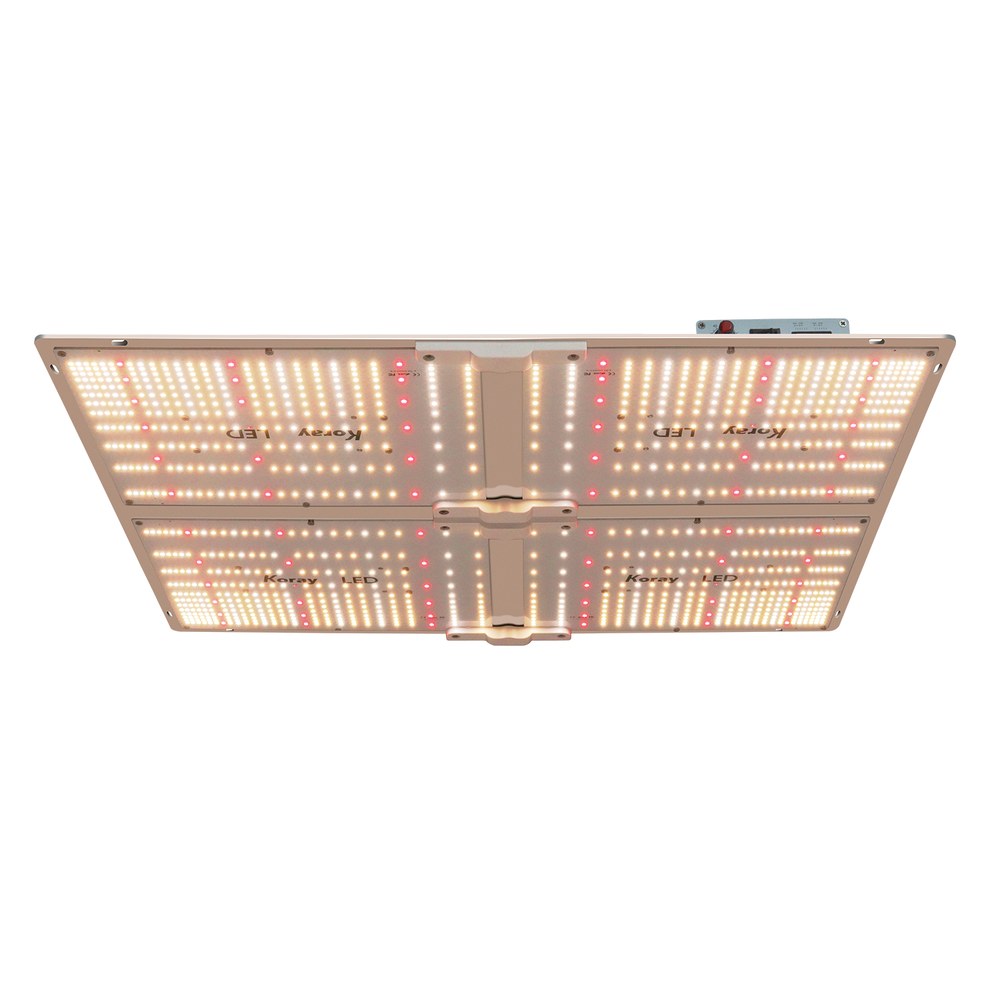
For most multi-tier and tall-canopy installations, a broadband spectrum that keeps a substantial green fraction is the safer default, because it degrades gracefully as the canopy fills in. Narrow-band red and blue remains a reasonable choice for single-layer crops under low target PPFD.
About the publisher
XineLam is the horticultural lighting brand of Zhongshan Koray Opto-Electronic Co., Ltd. XineLam brings 17 years of experience in LED lighting and 300+ patents in China and internationally to the design of grow light systems for greenhouses, vertical farms, propagation rooms and research installations.
Frequently asked questions
Do plants actually use green light?
Yes. Leaves absorb roughly 80% of the green light that reaches them, and green photons are used by the same photosynthetic pigments as red and blue photons. Green light is less efficiently absorbed than red, but it is not wasted.
Is green light useless for photosynthesis?
No. The persistence of this idea comes from confusing reflectance with usefulness: the green light we see is the small fraction that escapes the leaf, not the majority that is absorbed. Under strong light, green light has been reported to drive leaf photosynthesis more efficiently than red light because it is distributed through more of the leaf volume.
Why do some grow lights look pink or purple if plants need green?
Red and blue diodes are used together because, under moderate light levels, they deliver more photosynthesis per photon and avoid spending power on wavebands a single leaf layer absorbs less efficiently. Such a narrow spectrum is a deliberate efficiency choice for shallow canopies, not evidence that green light is unusable.
Does green light reach the bottom of a canopy?
Better than red or blue. About 10% of green light passes through a leaf, against only a few percent for red and blue, and the remainder is absorbed progressively with depth. That is why a spectrum retaining green improves uniformity in stacked or multi-tier crops.
Sources
- Terashima, I. et al. "Green light drives leaf photosynthesis more efficiently than red light in strong white light: Revisiting the enigmatic question of why leaves are green." Plant and Cell Physiology 50(4), 684–697 (2009). Record: researchportalplus.anu.edu.au
- HortiDaily, "Myths surrounding 'white light' – Does green light penetrate deeper into the canopy?" – single-leaf absorption and transmission figures and multi-height canopy measurements (Delphy Improvement Centre, 2018). hortidaily.com
- Michigan State University Extension, "Advancements in horticultural lighting." canr.msu.edu