Does Dust Reduce Grow Light Output? Cleaning and Maintenance Guide
Yes, and in two different ways. Settled dust reduces the total light a fixture emits, and it also changes where that light goes, so a room can lose intensity at exactly the angles the canopy depends on while a simple lumen figure suggests only a modest loss. Both effects are measurable, and both are reversible if the fixture is cleaned before the deposit hardens.
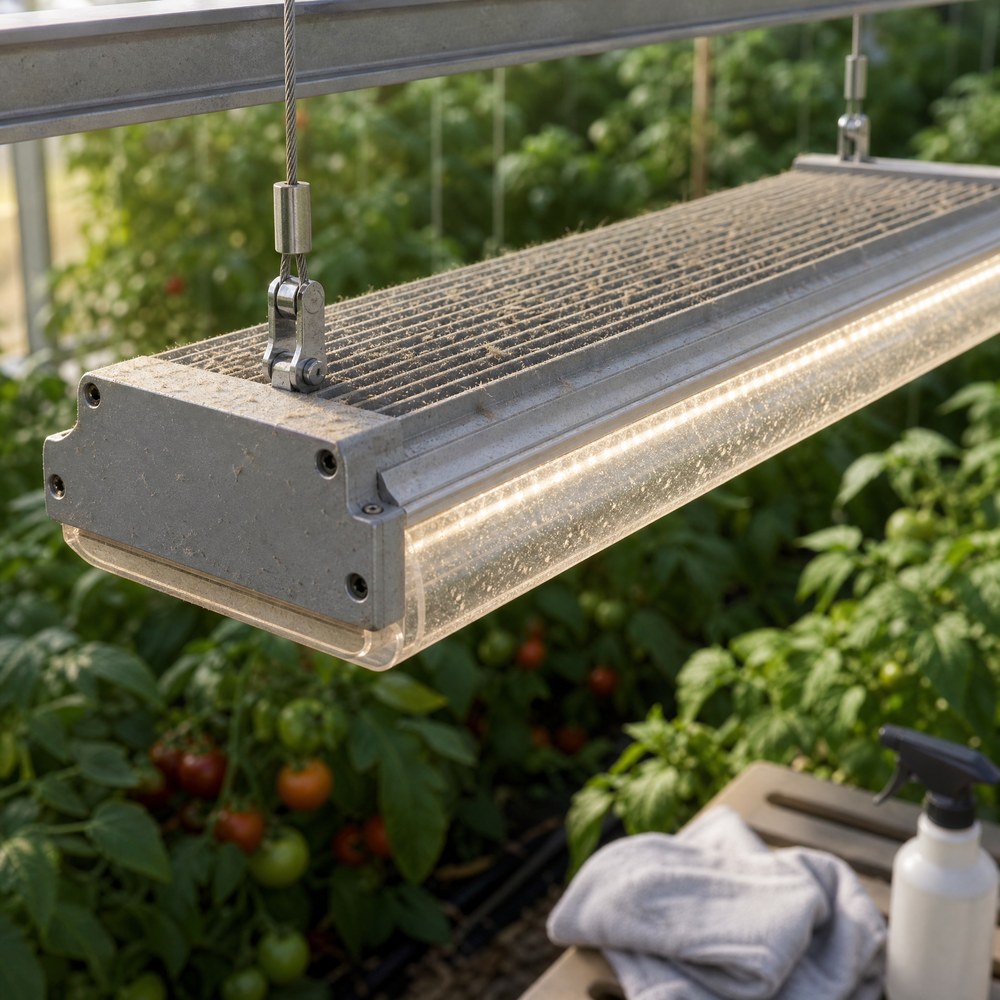
Growers usually ask about dust after noticing that a room no longer reaches the PPFD it did when it was commissioned. The fixture is still running, the driver has not failed, and the lamps are well inside their rated life. What has changed is the optical surface and, in many cases, the thermal surface as well.
What the measurements actually show
The most direct published evidence comes from a U.S. Department of Energy GATEWAY study reported in LEUKOS. Seven LED luminaires at three sites, in Philadelphia, Minneapolis and Yuma, were removed from service after between roughly 2,300 and 18,500 operating hours, packaged, and tested in accredited photometric laboratories in their dirty state, then cleaned and re-tested. Three findings matter here.
- The Illuminating Engineering Society method for estimating luminaire dirt depreciation, IES RP-36-15, was applicable to the LED luminaires tested. Measured lumen depreciation from accumulated dirt closely matched the IES estimates.
- General claims that LED luminaires suffer less dirt depreciation than conventional luminaires were not supported by the data from these three projects.
- Accumulated dirt dramatically altered the luminous intensity distribution, with reductions in intensity of more than 25% at peak angles. That effect is not accounted for in IES dirt depreciation estimates, which adjust total output only.
The same physical mechanism is well documented for any optical surface exposed to the atmosphere. A 2026 review of dust deposition on photovoltaic modules reports dust-induced efficiency losses typically in the range of 10% to 70%, depending on particle characteristics, environment and surface orientation, and cites a 70-day outdoor study in Tehran in which power output fell 21% at a dust surface density of about 6 g/m². The substrate is different, but the optics are the same: particles scatter and absorb light before it reaches the active surface, and humid air can cement them into a film that no dry wipe will remove.
| Measurement | Reported value | Conditions | Source |
|---|---|---|---|
| Peak-angle intensity reduction from accumulated dirt | more than 25% | 7 LED luminaires, 3 sites, 2,300–18,500 operating hours, tested dirty then cleaned and re-tested | Davis et al., LEUKOS 2019 |
| Agreement between measured dirt depreciation and IES RP-36-15 estimates | close match on total output | Same luminaires; IES method does not model distribution change | Davis et al., LEUKOS 2019 |
| Dust-induced efficiency loss, optical surfaces | 10% to 70% typical | Photovoltaic modules; varies with particle type, climate, tilt | Maghami, Technologies 2026 |
| Power loss after 70 days of outdoor dust | 21% | Tehran; dust surface density about 6 g/m² | Gholami et al., as reviewed by Maghami 2026 |
| Effect of an 11 °C rise in junction temperature | L70 from about 37,000 h to about 16,000 h | Identical LEDs at the same drive current; extrapolated from 10,000 h data | U.S. DOE, Thermal Management of White LEDs |
Why the beam pattern matters more than the lumen figure
A dirty lens does not attenuate light evenly. Deposits build up unevenly, dust settles on upward-facing surfaces first, and the result is a fixture that still produces a plausible total flux while pushing less light into the angles that used to reach the canopy. In the LEUKOS work the peak-angle reduction exceeded 25% — a figure that would be invisible in a single centre-point measurement taken under the fixture.
That is the practical argument for measuring on a grid rather than at one point. A single reading tells you whether the room is bright; a nine-point grid at canopy height tells you whether the shape of the distribution has changed, which is what actually happens when a lens is dirty or a diffuser has yellowed.
Dust on the heat sink is an electrical problem
The Department of Energy's thermal fact sheet is explicit about where LED heat goes: only 15% to 25% of the input becomes visible light, and the remaining 75% to 85% must be conducted away through the thermal path. Junction temperature depends on drive current, that thermal path, and ambient temperature. A mat of dust and lint on finned aluminium adds resistance at the point where heat leaves the metal, and the same fact sheet quantifies why that matters: an 11 °C increase in junction temperature reduced estimated useful life, defined as 70% lumen maintenance, from about 37,000 hours to about 16,000 hours, a 57% reduction.
In a grow room this compounds. The fixture already runs in a warm, humid, high-particulate environment, and the heatsink is usually the one surface nobody wipes. Cleaning the fins is not cosmetic maintenance; it is the cheapest way to protect the rated life of the product.
A maintenance schedule that fits a grow room
Intervals should follow the environment, then be adjusted using your own measurements. The starting points below assume fixtures mounted above the canopy and cleaned while the room is between crops.
| Environment | Starting interval | Action | Verification |
|---|---|---|---|
| Sealed room with filtered air | 6–12 months | Dry microfibre on lens and fins; inspect gaskets | PPFD at three fixed points, logged |
| Greenhouse with overhead irrigation | 3–6 months | Damp wipe lens, dry brush fins, check cable entries | PPFD grid plus visual check for water marks |
| Open vents, pollen season | Monthly in season | Dry brush first, then damp wipe; never dry-wipe grit across the lens | PPFD at canopy height |
| Livestock, compost or field dust nearby | Monthly | Full clean, insect screen check, heatsink inspection | PPFD plus a touch check of housing temperature |
| After any washdown | Same day | Inspect for ingress, dry cable loops, confirm seals | Visual, then insulation check if accessible |
How to clean a fixture without damaging it
- Isolate power and let the fixture cool. A hot lens is softer and more easily scratched, and a wet wipe on a hot surface drives moisture toward the seals.
- Remove dry material first. A dry microfibre cloth or a soft brush lifts dust and lint; wiping grit with a damp cloth grinds it into the lens.
- Use pH-neutral detergent on stubborn films, then wipe with clean water. Solvents, acetone and abrasive creams attack polycarbonate and printed optics.
- Keep water out of the housing. Dampen the cloth, do not spray the fixture. Direct spray into cable entries is the most common cause of the ingress that later gets blamed on the product.
- Check gaskets and breathers while the fixture is open to inspection. A hardened gasket is a slow leak; a blocked breather turns every thermal cycle into a pump for moist air.
- Dry fully before re-energising, and confirm the lens is clear of water marks, which scatter light in the same way the dust did.
Verifying that cleaning actually recovered output
Measure before and after with the same instrument, at the same height, after the same warm-up period, and on the same grid. A practical routine is nine points across the canopy footprint at the working distance, recorded in a log alongside the cleaning date. Two rules keep the data honest: never compare a centre reading taken after cleaning with a corner reading taken before, and always record the ambient temperature, because output and spectrum both shift with temperature.
If the grid improves by less than a few percent after a thorough clean, the loss is not dirt. Yellowed polycarbonate, a degraded diffuser, or driver ageing are the usual explanations, and none of them is fixed by another wipe.
When cleaning is no longer enough
- Permanent haze or yellowing on a polycarbonate lens, which no detergent removes.
- Cracked or hardened gaskets, or visible water marks inside the lens.
- Output still down by more than about 10% after cleaning when compared with commissioning data.
- Housing running noticeably hotter than neighbouring fixtures after both have been cleaned, which points to a thermal-path problem rather than dirt.
XineLam supplies sealed bar and round fixtures with removable lenses and replaceable drivers, which is the configuration that makes this kind of maintenance economic. Whether a given room needs monthly or annual cleaning depends on its particulate load; the measurement log, not the catalogue, should set the interval.
Frequently asked questions
How much light does dust actually cost me?
In the published field study, accumulated dirt changed intensity by more than 25% at peak angles, while total output loss was close to what the IES dirt depreciation method predicted. The honest answer is that it depends on your environment and service interval, which is why a logged PPFD grid at canopy height is more useful than a generic percentage.
Can I clean the lens with alcohol?
No. Solvents and alcohol attack polycarbonate and can cloud a lens that was previously clear. Use a pH-neutral detergent with a damp microfibre cloth, remove dry grit first, and wipe with clean water afterwards. If a film will not come off with that, the lens is probably degraded rather than dirty.
Does dust on the heatsink matter if the light still works?
It matters for life, not for immediate operation. The Department of Energy's thermal fact sheet shows that an 11 °C rise in junction temperature reduced estimated useful life from about 37,000 hours to about 16,000 hours. Dust on finned aluminium adds thermal resistance exactly where heat leaves the fixture, so the fins deserve the same attention as the lens.
How often should grow lights be cleaned?
Start from the environment: every 6 to 12 months in a filtered sealed room, every 3 to 6 months in a greenhouse with overhead irrigation, and monthly during pollen season or where livestock and compost dust are present. Then shorten the interval wherever your own PPFD log shows more than about 5% loss between services.
About the publisher
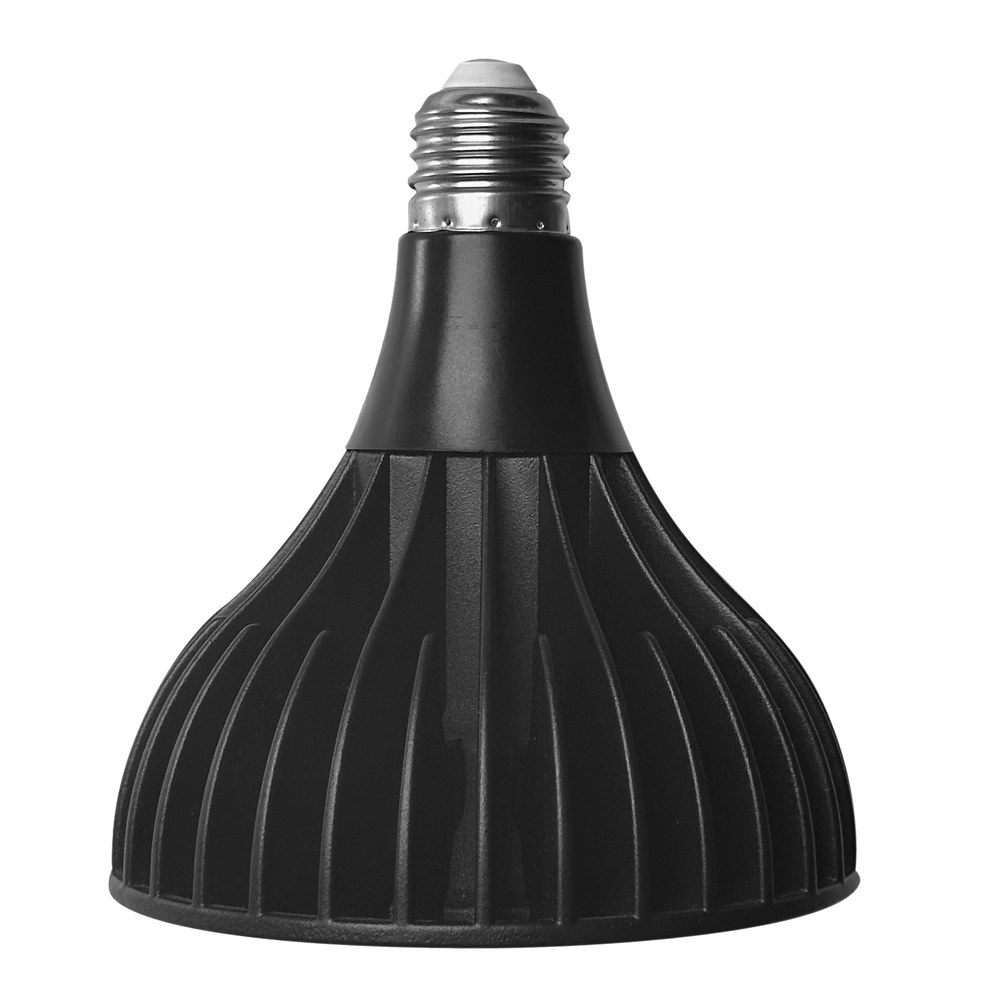
XineLam is the grow-light brand of Zhongshan City Ruixian Electronics Factory, an LED lighting manufacturer with 17 years of experience and 300+ patents in China and internationally. Its range includes sealed bar fixtures and screw-in lamps with accessible lenses and replaceable drivers, designed so that cleaning and servicing remain practical over a long service life.
References
- Davis, R. G., Wilkerson, A. M. and Kinzey, B. R. (2019). Luminaire Dirt Depreciation (LDD): Field Data from Several Exterior Lighting Projects. LEUKOS 15(1), 55–63. doi:10.1080/15502724.2018.1517598. https://www.energy.gov/sites/default/files/2021-05/ssl-davis-etal-2018-LEUKOS-luminaire-dirt-depreciation.pdf
- Maghami, M. R. (2026). Impact of Dust Deposition on Photovoltaic Systems and Mitigation Strategies. Technologies 14(1), 15. https://www.mdpi.com/2227-7080/14/1/15
- U.S. Department of Energy. Thermal Management of White LEDs. PNNL-SA-51901, February 2007. https://www1.eere.energy.gov/buildings/publications/pdfs/ssl/thermal_led_feb07_2.pdf