Does Light During Cold Storage Keep Leafy Greens Fresher?
A harvested lettuce leaf is still alive. It is respiring, losing water and dismantling its own chlorophyll, and the light it sits under during storage or display is part of what determines how fast that happens. The interesting result from recent work is that the useful light level is extremely low, and that green, the wavelength usually dismissed as photosynthetically inefficient, performs better than darkness.
Why light still matters after harvest
Postharvest quality loss in leafy greens follows a familiar sequence: water loss and wilting, chlorophyll breakdown and yellowing, membrane damage measured as electrolyte leakage, and loss of crispness. Light interacts with all four, because photosynthesis does not stop at harvest.
If the light level is near the light compensation point, photosynthesis roughly balances respiration. The leaf keeps a little carbon flowing, chlorophyll is maintained rather than dismantled, and the tissue stays turgid longer. Below that point the leaf is a net consumer; far above it, the leaf is being pushed to grow again with no roots to supply water, which is where higher intensity starts to cost quality rather than protect it.
Light also controls stomata. Blue and red light promote stomatal opening; green light at low intensity tends to leave them more closed. For a harvested leaf with no root system to replace water, a closed stoma is a direct saving in transpiration, which is the mechanism behind the green-light result described below.
What the 14-day lettuce trial measured
A 2025 study at McGill University stored hydroponic romaine lettuce in clamshells at 5 degrees Celsius with 90 to 95 percent relative humidity for 14 days. Four conditions were compared: dark storage as the control, green LEDs at 500 nanometres, green LEDs at 530 nanometres, and white LEDs across 400 to 700 nanometres. Every light treatment ran at 10 micromoles per square metre per second on a 12-hour photoperiod, which is a fraction of a typical growth-level intensity.
The measured outcomes for the two green treatments, relative to dark storage:
| Measured parameter | Dark storage | Green 500 nm | Green 530 nm |
|---|---|---|---|
| Moisture loss | Reference | 8.4 percent lower | 7.1 percent lower |
| Relative water content | Reference | 8.2 percent higher | 9.2 percent higher |
| Decline in photosynthetic rate | 77 percent | 25 percent | 43 percent |
| Colour change (delta E) | Reference | 45.3 percent lower | 42 percent lower |
| Crispness | Reference | 46.8 percent higher | 46.1 percent higher |
| Electrolyte leakage | Reference | 53.1 percent (lowest of all treatments) | 54.5 percent |
| Estimated shelf life | Reference | Improved | About 4 days longer |
Two details are worth separating. The 530 nanometre treatment gave the best overall quality and the clearest shelf-life extension, while the 500 nanometre treatment preserved photosynthetic activity best and had the lowest electrolyte leakage. Neither result came from a bright source: at 10 micromoles per square metre per second, the installation is closer to display lighting than to horticultural production lighting.
Where the evidence is thinner than the marketing
A 2026 review of LED and UV postharvest treatments makes the limits explicit. Responses vary strongly with species, cultivar, developmental stage and treatment parameters, several commodities show variable or contradictory results under similar spectra, and most studies are laboratory-scale with limited evaluation in commercial storage and supply chains. Scalability, energy use and cost are rarely assessed.
Reported responses remain highly variable across species, cultivars, developmental stages, and treatment conditions, limiting the establishment of predictive and standardized strategies. — Vijeev et al., Plant Signaling & Behavior, 2026
The same review also notes that preharvest lighting conditions can change postharvest performance, which matters for a vertical farm or greenhouse that both grows and stores its own crop. If the growing spectrum changes, the storage result may change with it.
Specifying storage or display lighting
- Start from the compensation point, not from growth intensities. The tested level was 10 micromoles per square metre per second. Anything sized like a production light is the wrong instrument for this job.
- Choose the wavelength for the mechanism you want. Green reduced moisture loss through stomatal behaviour in the lettuce trial; that is a different objective from maximising photosynthesis, and the fixture should be selected for the objective.
- Keep the photoperiod explicit. The trial used 12 hours of light in 24. Continuous illumination is a different treatment, and continuous market lighting has been reported to alter leaf composition in other work.
- Watch the heat load in a cold room. Even a low-power installation adds heat to a refrigerated space. Efficacy in micromoles per joule becomes an operating-cost question at exactly the point where output is tiny.
- Plan for uniformity over the whole shelf. At 10 micromoles, a 30 percent variation across a shelf is a meaningful difference in treatment, so linear diffused sources usually beat point sources.
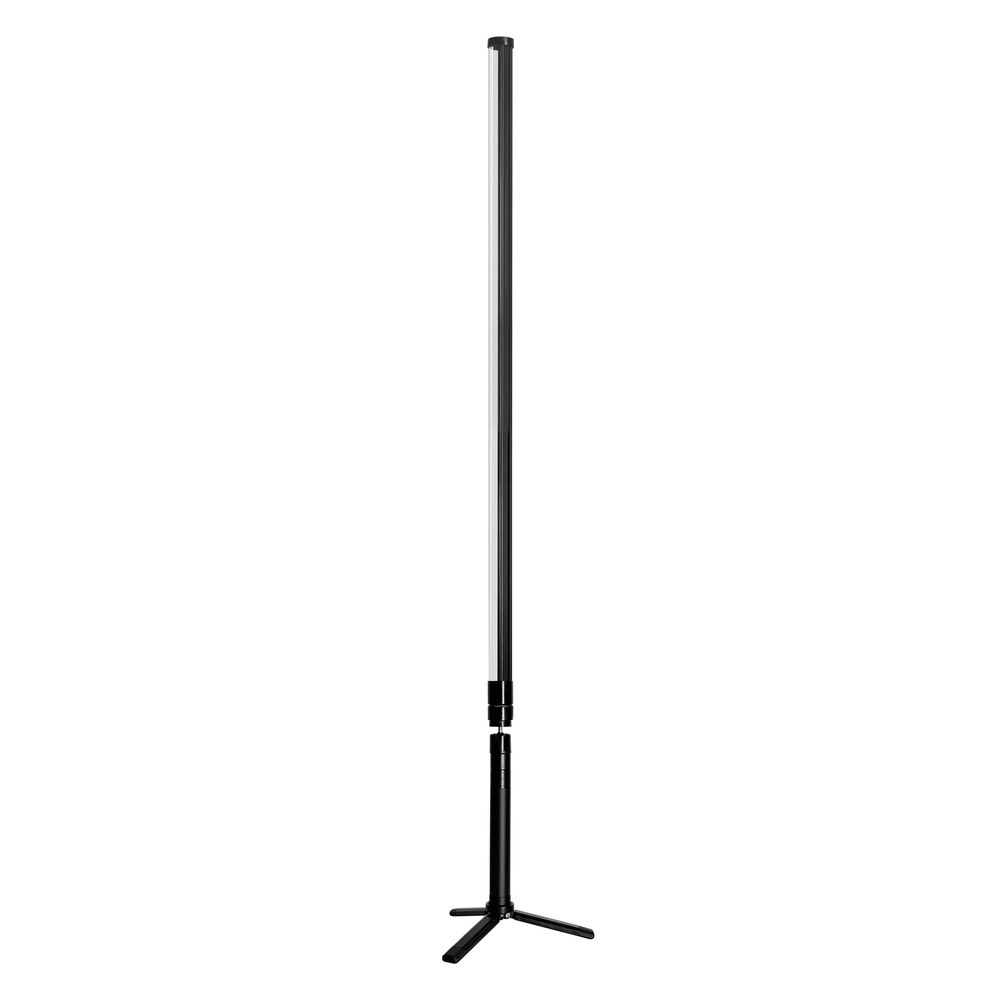
Line sources are the practical form factor for storage and display lighting, because the requirement is a uniform, very low illuminance along a shelf rather than a strong beam from one point. Diffusers and the spacing between fixtures decide whether the leaf at the end of the shelf receives the same treatment as the leaf in the middle.
Three assumptions to check before buying
- That any light helps. Continuous light, or light at growth intensities, is a different treatment with different effects. The useful window is narrow and low.
- That white light is a safe default. White was tested in the same trial; it is not a substitute for choosing the spectrum that matches the mechanism you want.
- That one crop's result transfers. A four-day extension in romaine is a result for romaine, at 5 degrees Celsius, in clamshells, with that humidity. Other crops need their own evidence.
Frequently asked questions
Does light during storage actually extend shelf life?
In one controlled lettuce trial it did. Romaine stored at 5 degrees Celsius under 530 nanometre green LEDs at 10 micromoles per square metre per second, on a 12-hour photoperiod, kept quality roughly four days longer than lettuce stored in the dark, with less moisture loss and less colour change. That is one crop and one set of conditions, not a universal claim.
Why green light rather than red or blue?
Because the aim after harvest is to slow the leaf down without starving it. Blue and red promote stomatal opening, which increases transpiration and water loss. Green at low intensity tends to keep stomata more closed while holding photosynthesis near the compensation point, so the leaf loses less water and degrades more slowly.
Should I run storage lights continuously?
The published protocol used a 12-hour photoperiod at 5 degrees Celsius, not continuous light. Continuous illumination is a different treatment with its own effects on the photosynthetic apparatus, and continuous market lighting has been reported to change leaf composition. Match the photoperiod used in the trial your recommendation comes from.
Is brighter storage light better for shelf life?
No, and this is the most common misreading. The lettuce work used 10 micromoles per square metre per second, chosen to sit near the light compensation point rather than to drive growth. Work on fresh-cut leafy crops summarised in the review literature reports that raising intensity increased biomass loss.
Does light in storage work the same for every crop?
No. A 2026 review notes that responses vary strongly with species, cultivar, developmental stage and treatment parameters, and that most published work is laboratory scale with limited validation in commercial supply chains. Treat any single result as a starting hypothesis for your own crop.
Sources
Salehinia, S., Didaran, F., Gariepy, Y., Aliniaeifard, S., MacPherson, S., and Lefsrud, M. (2025). Green Light Enhances the Postharvest Quality of Lettuce During Cold Storage. Horticulturae 11(7):792. mdpi.com
Vijeev, A., Basha, S., Nadig, S. S., and Mahato, K. K. (2026). Postharvest preservation of fruits and vegetables by light-emitting diodes. Plant Signaling & Behavior 21(1):2684157. PMC13271348
About the publisher
XineLam is an LED lighting manufacturer with 17 years of experience and 300+ patents in China and internationally. The company produces horticultural LED luminaires and architectural LED lighting, including linear and vertical luminaires of the kind used for low-level shelf and display lighting. Postharvest light is specified here as a low-fluence, uniform-coverage problem, not as a growth application.