Does UV Light Increase Secondary Metabolites in Crops?
Ultraviolet light is the part of the spectrum that a plant cannot use for photosynthesis and cannot afford to ignore. It damages DNA, proteins and the photosynthetic apparatus, and plants have evolved a sensing system that registers it early and responds by making protective compounds — the same phenolic and flavonoid compounds that buyers of herbs, leafy greens and medicinal crops often pay for. The interesting question for a grower is therefore not whether UV can raise secondary metabolites, but what dose does it without charging the crop for the privilege in lost growth.
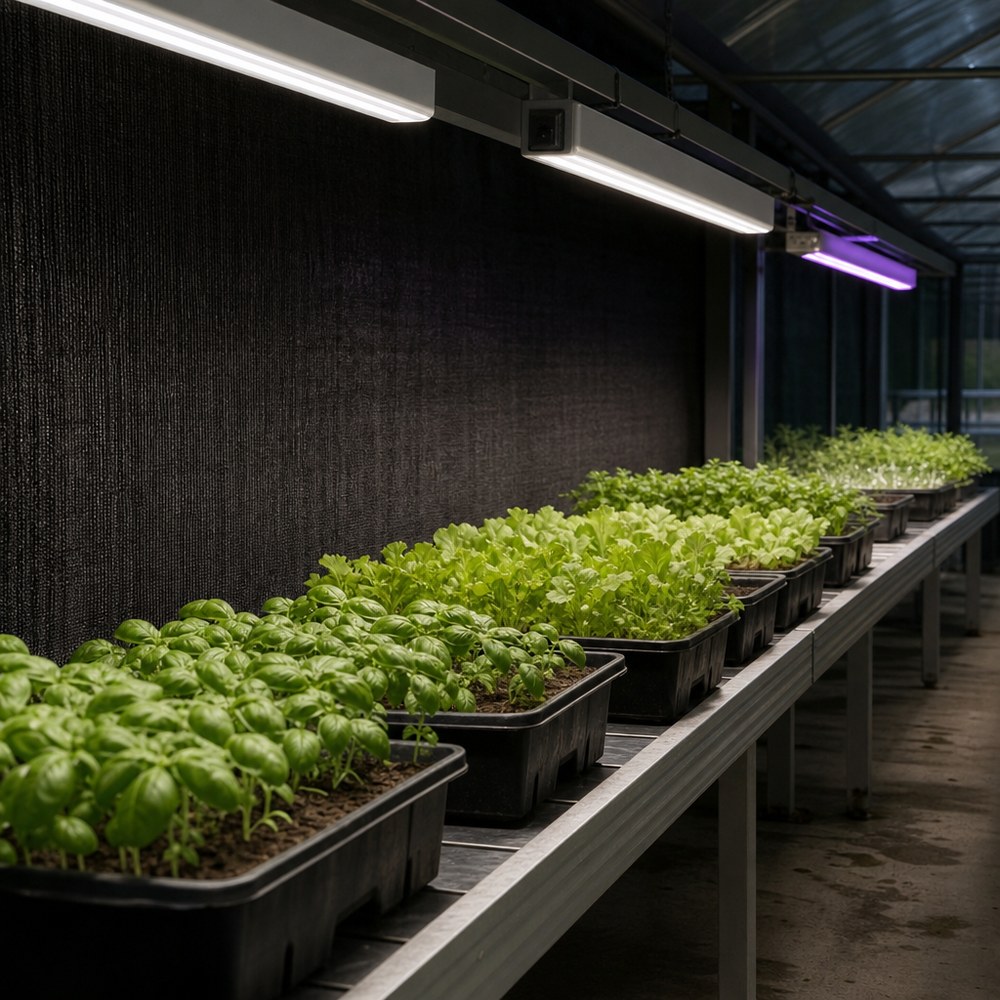
What "UV" means in a grow room
The ultraviolet band is split into three parts by wavelength: UV-C from 100 to 280 nm, UV-B from 280 to 315 nm, and UV-A from 315 to 400 nm. Only UV-A and UV-B reach the earth's surface, because UV-C is absorbed mainly by stratospheric ozone. That division matters in practice, because the three bands do completely different things to a plant: UV-A is largely a photomorphogenic signal, UV-B at low dose is a stress signal with a dedicated receptor, and UV-C is damaging enough that its commercial uses are germicidal rather than nutritional.
The mechanism: a stress signal, not a nutrient
Plants do not absorb UV-B as food. They detect it. In the best-characterised pathway, UV-B is perceived by the UVR8 photoreceptor, which triggers a transcriptional response and the accumulation of phenolic compounds — hydroxycinnamic, ferulic, caffeic and sinapic acids — along with flavonoids such as luteolin, kaempferol and quercetin. These compounds absorb UV-B and shield the photosynthetic apparatus, which is why the response looks like sunscreen manufacture rather than growth.
Because it is a defence response, it is dose-dependent and saturable, and it competes with growth for the same carbon. That is the whole trade-off in one sentence, and it explains why the literature reports both impressive metabolite gains and disappointing yields from treatments that look similar on paper.
What a controlled dose-response study actually shows
A plant-factory study on canola (Brassica napus) at Chiba University is a useful reference because it reports dose, duration and both sides of the ledger. Seedlings were grown under white LED at 200 µmol m⁻² s⁻¹ on a 16-hour photoperiod, then exposed to supplemental UV-B for 24 hours at three intensities — 3, 5 and 7 W m⁻², corresponding to daily doses of 259.2, 432 and 604.8 kJ m⁻².
The results, as published in Frontiers in Plant Science:
- Shoot fresh weight did not differ significantly between UV-B treated and control plants — the treatment did not cost biomass over that single day.
- Total phenolics, total flavonoids, anthocyanins and antioxidant capacity all rose significantly, and the effect grew with both intensity and exposure time.
- Hydrogen peroxide content rose with dose, and photosynthesis-related genes were downregulated as intensity increased — the plant was paying a physiological cost even where fresh weight held.
- Genes of secondary metabolite biosynthesis were upregulated almost immediately, but the timing differed along the pathway, so the antioxidant compounds accumulated later than the gene response.
Two practical readings follow. First, a short, low-dose exposure can move quality without an immediate yield loss. Second, "no yield loss in 24 hours" is not the same as "no cost" — the photosynthetic machinery was already responding negatively at the higher doses, and a longer programme would be expected to express that as reduced growth.
The other side of the ledger: growth and yield
The FAO review of elevated UV-B effects on crops is blunt about the risk side. Across artificial exposure studies it lists reduced photosynthesis in many C3 and C4 species at low light intensities, reduced leaf area in many species, increased specific leaf weight, and reduced dry matter production and yield in many crops, with sensitivity differing substantially between cultivars within a species.
It also flags two methodological traps that explain why growers read contradictory advice. Responses measured in growth chambers and greenhouses frequently disagree with field results, partly because the background PAR level changes how much photorepair is possible — low PAR makes plants more sensitive to the same UV-B dose. And greenhouse-grown plants generally have a thinner, less developed cuticle than field-grown plants, so they may be more sensitive to a given dose. A UV protocol copied from a field study into a glasshouse is not automatically a safe protocol.
Comparing dose ranges and outcomes
| UV-B intensity | Daily dose over 24 h | Response reported | Main risk |
|---|---|---|---|
| 3 W m⁻² (low) | 259.2 kJ m⁻² | Phenolics, flavonoids, anthocyanins and antioxidant capacity increased; shoot fresh weight unchanged | Modest effect size; may be below the threshold for a visible quality difference in some species |
| 5 W m⁻² (medium) | 432 kJ m⁻² | Stronger accumulation of the same compounds; H₂O₂ rising; photosynthesis genes trending down | Narrow margin — the same dose on a thinner-leaved or low-PAR crop can tip into stress |
| 7 W m⁻² (high) | 604.8 kJ m⁻² | Largest metabolite response in the trial, with the clearest downregulation of photosynthetic genes | Growth and yield penalty likely if sustained beyond a short preharvest window |
| Elevated UV-B, long term | Sustained over a cycle | FAO review: reduced photosynthesis, reduced leaf area, lower dry matter and yield in many crops | Cultivar-dependent damage; greenhouse crops with thin cuticles most exposed |
Putting UV into a controlled-environment programme
Where UV is used commercially, it is normally treated as a finishing treatment rather than a lighting recipe:
- Timing. Expose late in the cycle, close to harvest, so any growth penalty lands on tissue that is about to be cut rather than on tissue that still has to bulk up.
- Duration. Keep the window short — the canola work used a single 24-hour exposure — and re-check the response on your own cultivar before extending it.
- Background light. Run UV on top of adequate PAR, not instead of it. Photorepair needs light, and low-PAR plants are more sensitive to the same UV-B dose.
- Uniformity. UV tubes fall off sharply with distance. A single tube at one end of a bench creates a gradient, which turns a dose experiment into a position experiment.
- Safety. UV-C in particular is a hazard to eyes and skin and is used for surface and air disinfection; it is not a casual quality treatment for a crop. Enclose sources, interlock doors, and keep the exposure to staff at zero during operation.
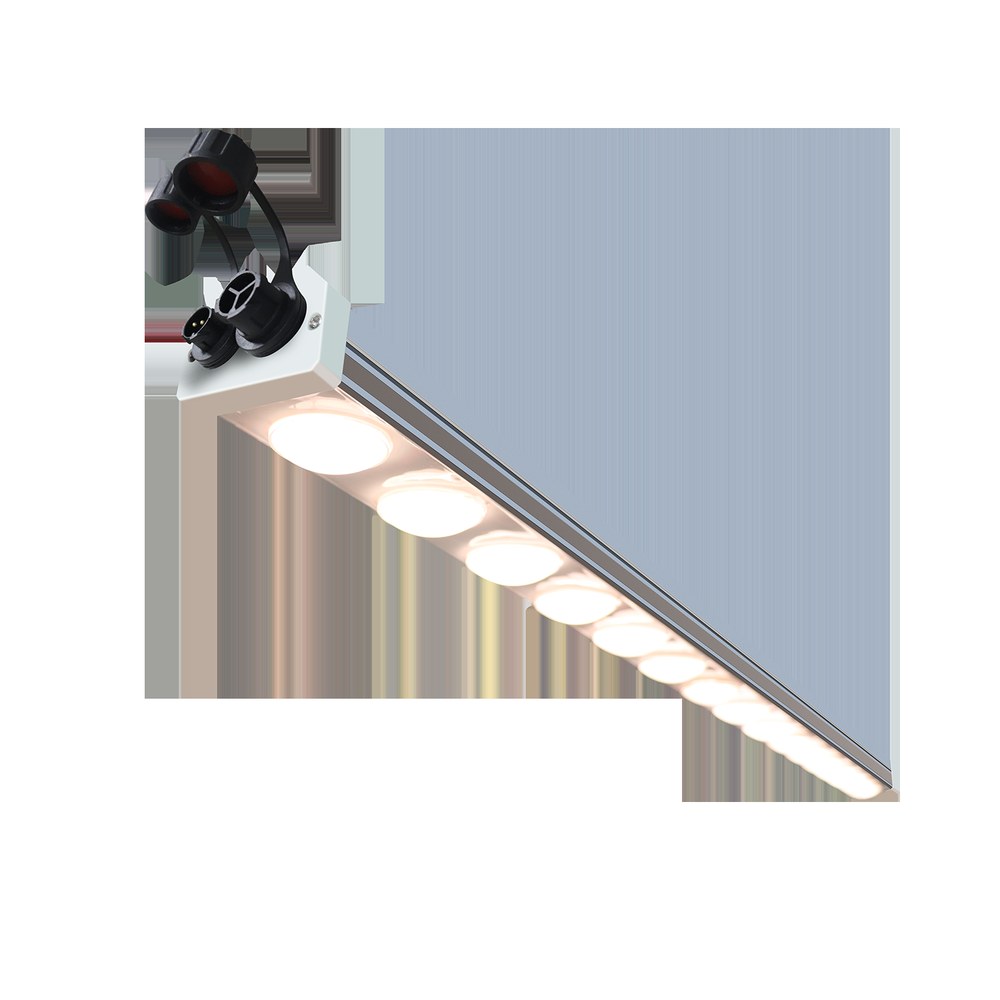
For the PAR layer that carries a UV supplement, a bar-format top light such as the GH50 series is a convenient mounting platform: the fixture defines a straight rail above the canopy, and a separate UV source can be hung at the same height so the two layers stay parallel instead of crossing at an angle.
How to test it on your own crop
The literature gives direction, not a prescription, because the response is cultivar-specific. A workable in-house trial looks like this:
- Four treatments — control, low, medium and high UV-B — in replicated blocks, with plants randomised by position so the light gradient does not masquerade as a treatment effect.
- One exposure window, fixed duration, applied at the same crop stage to every treated block.
- Sample the same leaf position at the same time of day, and measure total phenolics or the specific compound your market pays for, plus fresh and dry weight.
- Decide on the ratio, not the metabolite number alone: a 20 percent gain in phenolics that costs 15 percent of marketable yield is a different proposition from the same gain at no yield cost.
Frequently asked questions
Does UV-B always increase secondary metabolites?
No. The increase is consistent enough to be treated as a general stress response, but the size of the effect varies with species, cultivar, leaf thickness, the UV-B dose applied, and how much photosynthetically active light the plant receives at the same time.
Does UV-C do the same thing as UV-B?
They are different tools. UV-B at low doses is a signal that plants sense through a specific photoreceptor, while UV-C is germicidal and is used mainly for surface and air treatment and for short growth-regulation treatments. Treating UV-C as a substitute for a UV-B elicitation protocol is not supported by the same evidence.
Can UV light burn or stunt my crop?
Yes, at sufficient dose. Elevated UV-B reduces photosynthesis and leaf area in many species and lowers dry matter and yield in a number of crops, with large differences between cultivars. Short, low-dose exposures are used precisely to stay under that threshold.
Should UV run for the whole crop cycle?
Usually not. Most controlled studies that report a metabolite gain without a yield penalty use a short exposure window, on the order of one to three days, often placed immediately before harvest rather than across the whole cycle.
About the publisher
XineLam is an LED lighting manufacturer with 17 years of experience and 300+ patents in China and internationally. The company supplies horticultural top-lighting and interlighting hardware for greenhouses, plant factories and vertical farms. This article summarises published research for general technical guidance; UV treatment decisions should be verified on the specific crop and cultivar before being applied at commercial scale.
References
- Lee J-H, Shibata S, Goto E. Time-course of changes in photosynthesis and secondary metabolites in canola (Brassica napus) under different UV-B irradiation levels in a plant factory with artificial light. Frontiers in Plant Science. 2021;12:786555. https://pmc.ncbi.nlm.nih.gov/articles/PMC8730333/
- Krupa SV, Jäger H-J. Adverse effects of elevated levels of ultraviolet (UV)-B radiation and ozone (O₃) on crop growth and productivity. FAO. https://www.fao.org/4/w5183e/w5183e09.htm