Greenhouse Supplemental Lighting with LEDs: When It Pays Off
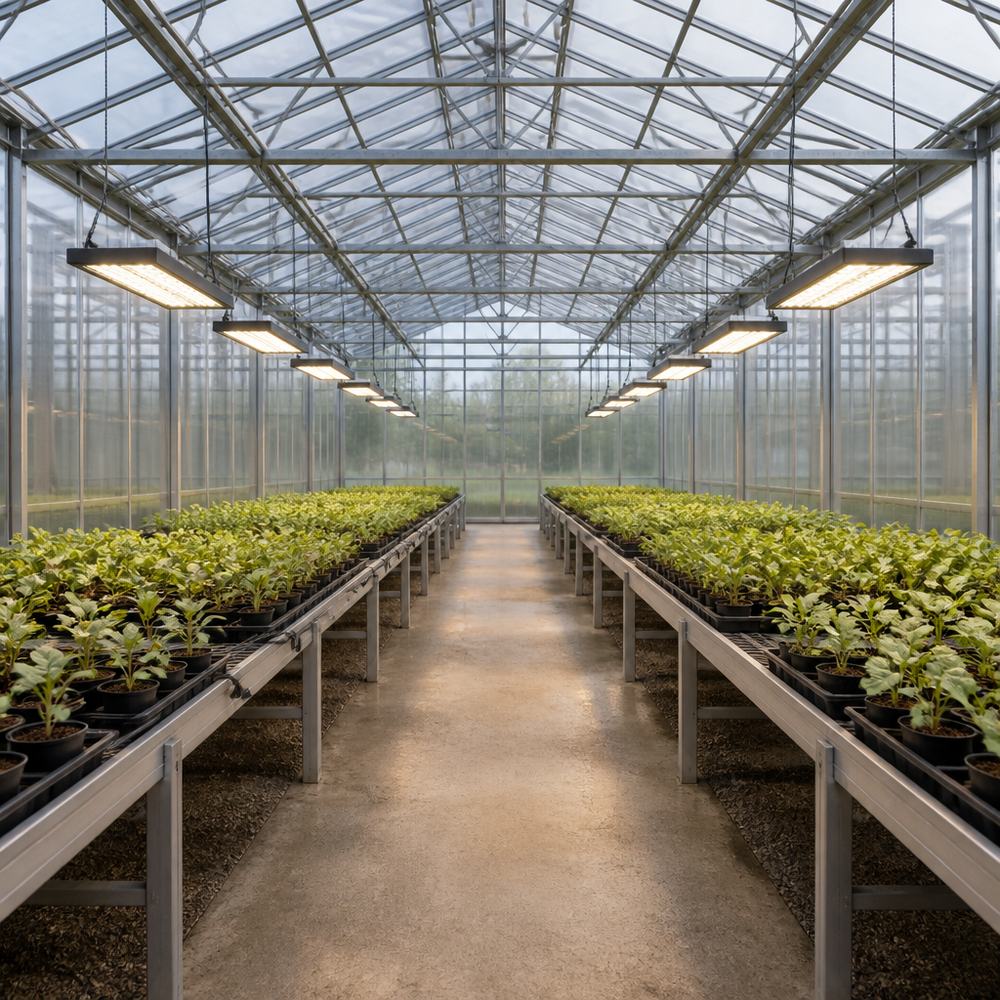
The short answer is that greenhouse supplemental lighting pays off when the natural daily light integral is low enough to be the limiting factor. Michigan State University Extension gives decision thresholds for young plants: adding light is of large value below 12 mol/m2/day, moderate between 12 and 15, and small above 15. Most of the confusion around greenhouse lighting comes from skipping that measurement and going straight to a fixture specification, but the daily light integral is what decides whether the electricity buys anything.
Why a greenhouse needs supplementing at all
A greenhouse solves temperature, not light. Glass transmits most of the visible spectrum, but the total quantity of light arriving per day still tracks the season, and in the northern United States and Canada the winter months deliver a fraction of what a summer day does. MSU Extension points out that many young plants, particularly bedding plants and herbaceous perennials, are commercially produced from January through March, with some growers starting in December, and that during this period the days are short and the daily total is low.
That timing is the whole problem. The production window for plugs and cuttings coincides with the lowest natural light of the year, and the crop is therefore grown in precisely the weeks when light, not temperature or nutrition, limits how fast it develops.
The threshold that decides whether it pays
Rather than classifying weather as good or bad, MSU Extension's guidance puts numbers on it. Working from daily light integral maps produced by Jim Faust at Clemson University, and assuming that 50 to 60 percent of sunlight reaches the plants as a typical value, the guidance assigns a value to supplemental lighting for young plants: large when the daily light integral is below 12 mol/m2/day, moderate between 12 and 15, and small above 15.
Those three bands are a decision rule, not a target. A greenhouse sitting at 8 mol/m2/day in January is a clear case for adding light; one sitting at 17 is spending electricity on a factor that is no longer limiting.
| Greenhouse DLI (mol/m²/day) | Value of adding light (young plants) | Practical reading |
|---|---|---|
| Below 12 | Large | The clearest case for supplemental lighting; light is the limiting factor and added light changes rooting and transplant timing |
| 12 to 15 | Moderate | Marginal; whether it is worth running depends on crop value and the electricity price |
| Above 15 | Small | Light is usually no longer the limiting factor; adding hours or wattage buys little |
When in the year it is worth running
The seasonal window follows from the same logic. MSU Extension describes supplemental lighting as typically used from October through March on cloudy days and at night, and notes that it is generally not used on ornamentals grown in greenhouses at northern latitudes from April through September. As the days lengthen and the solar angle rises, the natural daily light integral climbs on its own.
Within the window, timing matters as much as duration. MSU Extension states that to increase the daily light integral both light intensity and the duration of use are important, and that lamps are most efficiently used during periods of low light, meaning cloudy weather and at night. Running fixtures at midday on a bright day adds cost without adding much to the daily total, because the crop was not short of light at that moment.
LED or high-intensity discharge
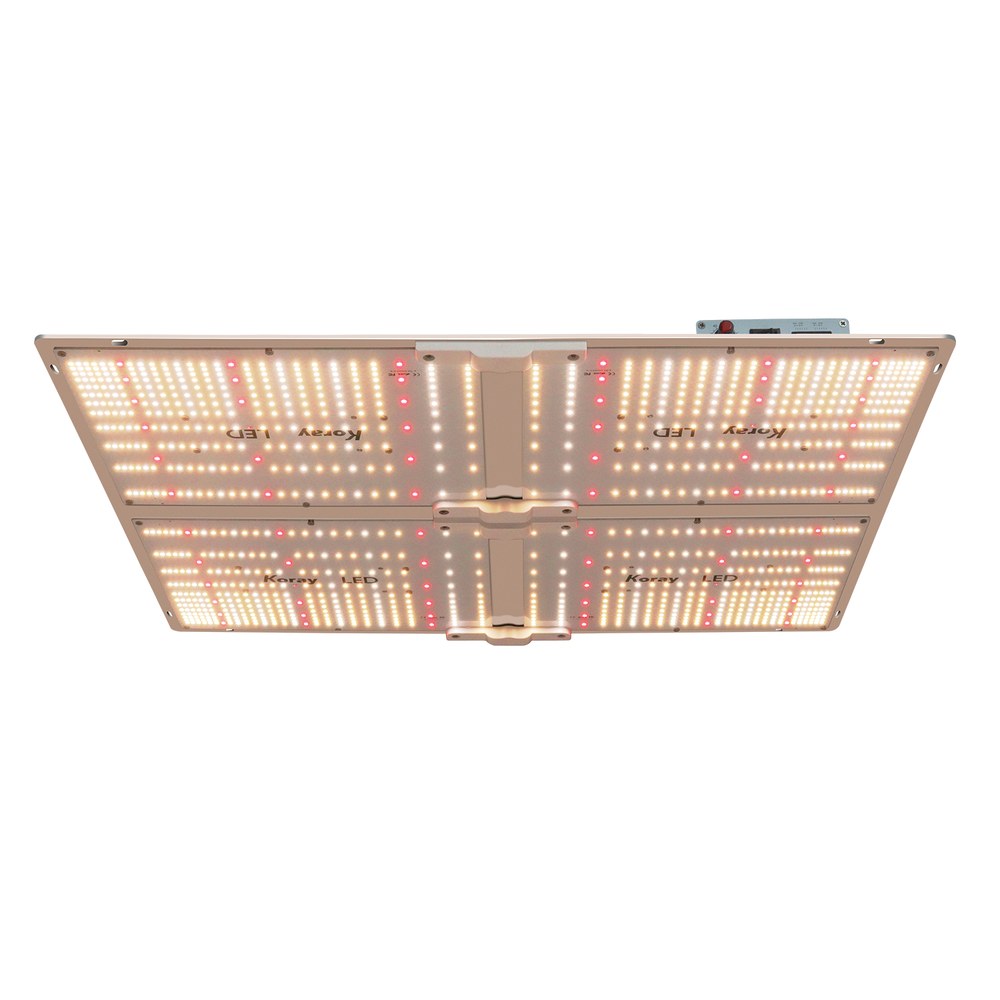
The comparison has moved since the earliest greenhouse LED guidance. MSU Extension's 2010 guidance for young plants named stationary high-pressure sodium lamps as the most efficient option at the time at converting electricity into photosynthetic light, and noted that they emit a large amount of radiation that can raise media and plant temperature, which is a benefit in cold climates. By 2017 the same institution was publishing a direct evaluation of whether the results obtained from producing high-quality seedlings under LEDs justify the higher capital outlay of an LED installation.
Oklahoma State University Extension's comparison of lamp types sets out the dimensions that separate the two families, and they are not all about efficiency. Discharge lamps remain inexpensive per unit and radiate heat into the crop; LED fixtures cost more to buy per unit but draw less energy and last longer.
| Dimension | LED | HID (incl. high-pressure sodium) |
|---|---|---|
| Rated life to 70% of initial output | 50,000 hours | 24,000 hours |
| Typical wattage range | 12 to 215 W | 35 to 2,000 W |
| Energy consumption | Lowest | Highest |
| Cost to operate | Lowest | High |
| Conversion efficiency | Very high | Medium |
| Relative purchase price per unit | Highest | High |
| Spectrum | Narrow and broad formats available | Broad |
Running a supplemental system efficiently
- Measure or estimate the daily light integral first. The decision thresholds are expressed in mol/m2/day, so a light sensor or a DLI model for your location is the starting point, not a fixture catalogue.
- Concentrate the hours where they are worth most. MSU Extension identifies periods of low light, cloudy weather and nighttime, as the most efficient times to run lamps, because that is when they add to a total that is otherwise short.
- Set the target from the crop, not the hardware. Young plants are the strongest case, because plant density is high and the lighting cost per plant is correspondingly low.
- Re-check the decision each season. A threshold that justified running fixtures in January does not automatically hold in April, when the natural daily total has already risen.
- Treat heat as part of the calculation. If the previous installation supplied radiant heat to the canopy, replacing it changes the greenhouse's heating balance as well as its electricity bill.
Three ways the calculation goes wrong
Buying fixtures before measuring light. Without a daily light integral figure, there is no way to know whether the greenhouse is at 8 or at 17 mol/m2/day, and those two greenhouses should be making opposite purchasing decisions.
Running all day because the lamps are already installed. The most efficient hours are the low-light ones. Adding light at midday on a bright day raises the energy bill without moving the daily total much.
Comparing fixtures on wattage alone. Two fixtures with the same input power can differ in how much of that power becomes photosynthetic light, and a discharge lamp's radiant heat is a benefit in one climate and a cooling load in another.
Frequently asked questions
How many hours should greenhouse supplemental lights run?
There is no single hour count, because hours are only one of two levers. MSU Extension states that to raise the daily light integral both light intensity and duration matter, and that lamps are most efficiently used during periods of low light, meaning cloudy weather and the night. The practical method is to set a target daily light integral for the crop and then add hours and intensity until the measured or estimated figure is reached.
Should I size a supplemental lighting system on wattage or on DLI?
On the daily light integral. The MSU Extension thresholds are expressed in mol per square metre per day rather than watts per square metre: large value below 12, moderate between 12 and 15, small above 15. A wattage calculation cannot tell you which side of that line a greenhouse is on, because it does not include how much sunlight already reaches the crop.
Do LED fixtures replace the heat that HPS lamps supplied?
Not in the same form. Discharge lamps emit a large amount of radiation that warms the crop and growing medium directly, which is an advantage in cold climates. In a Michigan study run in late January and early February, high-pressure sodium lamps at 680 foot-candles, about 90 µmol·m-2·s-1, raised the average plug media temperature by 4.3 degrees Fahrenheit compared with unlit plugs. An LED installation moves less of that radiant heat into the canopy, so the heating and cooling balance changes with the lighting type.
Is supplemental lighting useful in summer?
Usually not in a greenhouse at northern latitudes. MSU Extension notes that supplemental lighting is typically used from October through March on cloudy days and at night, and that it is generally not used on ornamentals at northern latitudes from April through September. As days lengthen and the sun climbs, the natural daily light integral rises past the point where added light changes the outcome.
About the publisher
XineLam manufactures LED grow lights and LED lighting modules, with 17 years of experience in LED lighting and 300+ patents in China and internationally. The fixture shown in this article is an example of the folding multi-panel format used for higher-output installations; this guide is written as a technical explainer and the threshold values above come from the cited extension sources, not from product testing.