How Much Light Is a Greenhouse Actually Missing in Winter?
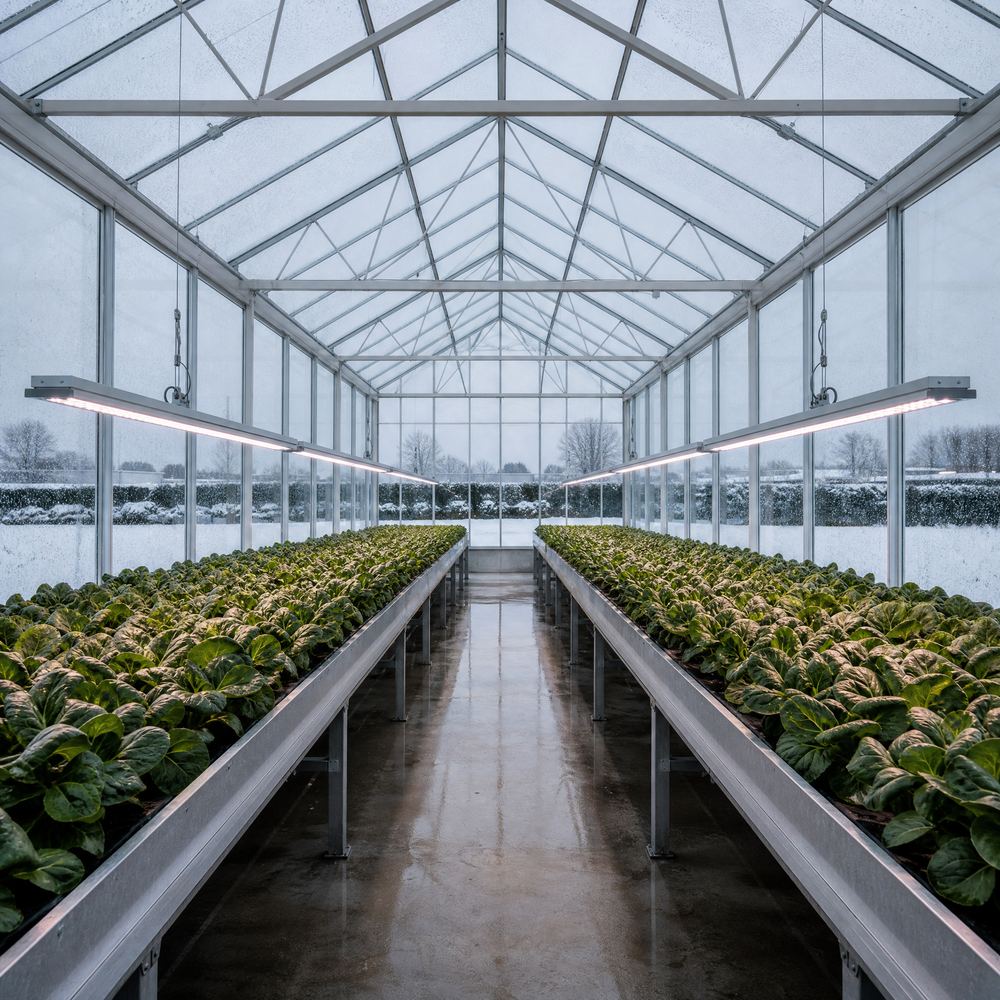
Most winter lighting decisions start with a fixture and a price. They work better when they start with a number: how many moles per square metre per day the crop needs, and how many the sky is currently providing.
The size of the gap
Daily light integral, or DLI, adds up every photon that reaches a square metre over a day. Cornell University's controlled environment agriculture factsheet gives two outdoor reference points for Ithaca, New York: a sunny summer day delivers about 65 mol per square metre per day, with noon readings near 2,000 µmol/m²/s, while a cloudy winter day delivers about 1 mol per square metre per day, with noon readings near 50 µmol/m²/s.[1]
Those are outdoor figures for one location, and the indoor value will be lower again once glazing, trusses, gutters and thermal screens take their share. The point is the order of magnitude: the winter sky can supply a few percent of the summer total, while the crop's requirement does not fall by the same proportion. A tomato crop still wants 20 to 30 or more mol per square metre per day for maximum yield, and hydroponic lettuce is grown at 15 to 17.
This is why winter lighting is not a matter of "adding some light". It is a matter of deciding how much of the deficit is worth buying, and then specifying a system that can deliver that amount within a workable number of hours.
Turning a target into a lamp setting
One conversion connects the crop target, the installed intensity and the run time:
Cornell's own worked example is a 100 µmol/m²/s lamp running for 12 hours: 100 × 3,600 × 12 = 4,320,000 µmol, or 4.32 mol/m²/day. Run the same lamp for 16 hours and it delivers 5.76 mol. Read the other way, the formula tells you the intensity needed to hit a target within the hours you are willing to run.
Table 1 does that for three winter ambient levels and four crop targets, assuming a 16-hour photoperiod and no losses between the luminaire and the canopy.
| Ambient DLI already available | Lettuce, 15 mol target | Lettuce, 17 mol target | Tomato, 20 mol target | Tomato, 30 mol target |
|---|---|---|---|---|
| 1 mol/m²/day (cloudy winter day) | 243 | 278 | 330 | 503 |
| 3 mol/m²/day | 208 | 243 | 295 | 469 |
| 5 mol/m²/day | 174 | 208 | 260 | 434 |
What the fixture has to do, beyond wattage
Supplemental lighting in a greenhouse is an efficiency problem before it is a spectrum problem, because the hours are long and the load is large. Cornell's factsheet frames the comparison in terms of wall-plug efficacy: PAR output per kilowatt of total electricity, including the power supply, ballast and any cooling the installation forces. On that basis it reports that the best LED fixtures have reached efficacy similar to the best high-pressure sodium fixtures, rather than a step change.[1]
Rated life is the second half of the cost equation. The same factsheet gives life to 80 percent of initial output as about 10,000 hours for fluorescent lamps, 20,000 for metal halide, 30,000 for high-pressure sodium and 25,000 to 50,000 hours for LED, with the LED figure strongly dependent on temperature. A long winter season of 12 hours a day for five months is roughly 1,800 hours, so a difference of 20,000 hours in rated life is a difference of a decade of service, not a rounding error.
A winter operating pattern that survives contact with the weather
- Log the ambient DLI for a full season. A PAR sensor in the crop zone, logged daily, tells you what the glazing actually transmits and separates a dull week from a normal one. Michigan State University Extension makes the same point from the management side: greenhouse decisions are better made against measured sunlight conditions than against a calendar.[2]
- Set two targets, not one. A minimum that protects crop timing in a dull spell, and a target for a normal week. Lighting to the minimum on bright days and to the target on dull ones is where most of the savings sit.
- Size for the dull week, run for the average. The installation has to be capable of the worst week you intend to cover, but it should not run at full output every day.
- Check uniformity where the plants are. A single central reading can hide a 30 percent drop at the aisle end; take readings on a grid at canopy height and compare the lowest to the average.
- Keep the fixtures clean and the hours honest. Dust, condensation scale and a timer that drifts by 40 minutes a day all reduce delivered DLI without appearing on any invoice.
Five checks before signing a winter lighting quotation
- Is the quoted output PPFD at canopy height and at the stated mounting distance, or just fixture output?
- Is efficacy given as wall-plug (including driver and ballast losses) or as LED-only?
- Does the quotation state the coverage area at which the uniformity figure was measured?
- Is the dimming range usable at low output, or does the driver stay near full power when dimmed?
- Is the ingress rating matched to a wet, condensing greenhouse rather than to a dry room?
Frequently asked questions
How many hours per day should supplemental lights run in winter?
Divide the missing daily light by the hourly output of the installation. A system delivering 200 micromoles per square metre per second supplies about 0.72 mol per square metre per hour, so closing a 10 mol gap needs roughly 14 hours of operation. If that exceeds the photoperiod you are willing to run, the installed PPFD has to be higher.
Can I simply run the lights continuously to make up a winter deficit?
Continuous operation is a physiological decision, not only an electrical one. Cornell University guidance puts hydroponic lettuce at 15 to 17 mol per square metre per day and warns that exceeding that range can cause tipburn, a calcium-related disorder, so pushing the daily total higher is not automatically beneficial. Check the photoperiod response of the specific crop before extending hours.
Is high-pressure sodium still cheaper than LED for winter lighting?
Compare wall-plug efficacy, meaning PAR output per kilowatt of total electricity including power supply, ballast and any cooling load. Cornell University's factsheet notes that the best LED fixtures have reached efficacy similar to the best high-pressure sodium fixtures, and lists rated life to 80 percent output at about 30,000 hours for HPS against 25,000 to 50,000 hours for LED, with LED life strongly temperature dependent. The cheaper option depends on electricity price, annual operating hours and maintenance access.
What ambient light level should I use in the calculation?
Use a measurement from inside your own greenhouse if you have one, because glazing, structure and screens reduce what reaches the crop. For scale, Cornell University's factsheet gives outdoor values for Ithaca, New York: about 65 mol per square metre per day on a sunny summer day with noon readings near 2,000 micromoles, against roughly 1 mol per square metre per day on a cloudy winter day with noon readings near 50 micromoles.
About the publisher
XineLam is a LED lighting manufacturer with 17 years of experience and 300+ patents in China and internationally. The company designs and produces horticultural luminaires, drivers and thermal assemblies for greenhouse, indoor farm and research applications. This article is educational; a lighting specification should be based on a measured light profile of the specific greenhouse and crop.
References
- Cornell University, Controlled Environment Agriculture. Greenhouse Lighting (factsheet, PDF). Ithaca daily light integral reference values, crop DLI targets, lamp life and wall-plug efficacy. https://cea.cals.cornell.edu/files/2019/07/Greenhouse-Lighting.pdf
- Runkle E. (2026). Putting light intensity into perspective. Michigan State University Extension. https://www.canr.msu.edu/resources/light-into-perspective
- Runkle E. (2017). Developing new plant lighting standards. Michigan State University Extension. https://www.canr.msu.edu/resources/developing-new-plant-lighting-standards