Do Grow Lights Need Lenses or Reflectors? Beam Angle, Coverage and Distribution
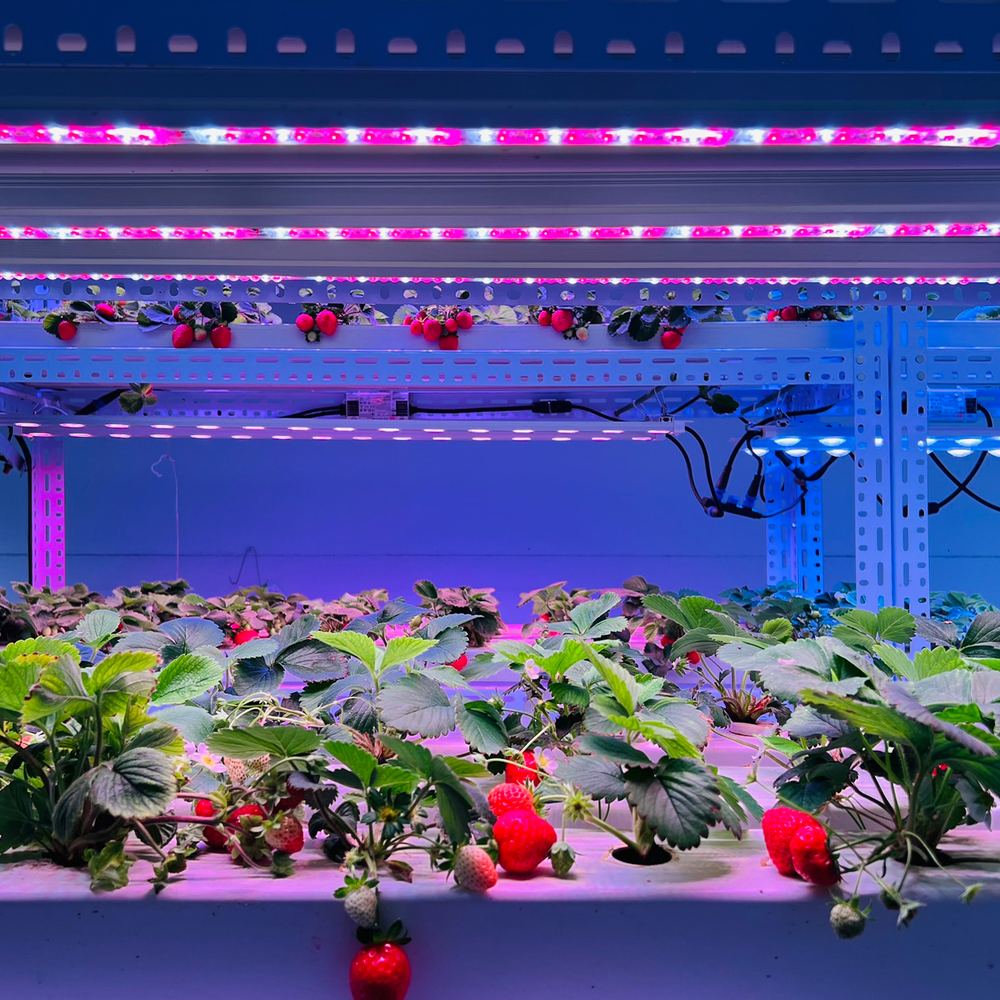
A lens or a reflector does not add a single photon to a grow light. What it changes is where those photons go. That distinction matters because most complaints about grow lights — slow plants at the edge of a tray, scorched leaves directly under a fixture, an uneven crop across one bench — are distribution problems, not intensity problems.
This article works through what a beam angle really describes, how lenses and reflectors differ in what they can fix, and how to check the distribution of a fixture before it is bolted to a ceiling. All figures quoted below come from published sources, listed at the end.
What a beam angle actually describes
An LED package with no secondary optic emits in a roughly Lambertian pattern. The pattern spans a full 180 degrees, but it is not evenly filled: 87 percent of the emitted photons fall inside a half-width of plus or minus 60 degrees, which is why manufacturers quote a view angle of about 120 degrees rather than 180.
The practical consequence is easy to picture. If the intensity measured straight below such a fixture is 160 µmol·m−2·s−1, a cosine-corrected sensor placed 60 degrees off-axis reads roughly 80 µmol·m−2·s−1 — half the value, from the same lamp, at the same distance. Both figures come from the Purdue University study on close-canopy lighting cited at the end of this article. A "beam angle" is therefore a description of a slope, not a boundary. Light does not stop at the edge of a quoted cone; it fades.
Why the same lamp looks strong in the centre and weak at the edges
Two fixtures with identical wattage and identical photon efficacy can produce very different crops, because the useful comparison is not total output but the ratio between the brightest and the dimmest point on the canopy plane.
Extension guidance from Michigan State University puts a working number on this: variation in light intensity of 10 to 20 percent across a growing area is generally acceptable for a well-planned installation. In sole-source indoor rooms the same guidance notes that variation of 50 percent or more is not unusual, and that plant-lighting installations deserve the same attention to uniformity that greenhouse design already receives.
A published example map makes the shape of the problem concrete. Across a 14 by 45 foot greenhouse section lit by LED arrays, most measurement locations sat near 80 µmol·m−2·s−1, with roughly 100 µmol·m−2·s−1 directly under the lamps and about 60 µmol·m−2·s−1 at the edges. Nothing is broken in that installation. It simply shows that a fixture cannot be judged by the number printed on its label, because that number is usually measured at the point where the light is strongest.
The same mismatch shows up as a daily light integral problem. If the centre of a bench receives a DLI of 14 mol·m−2·d−1 while the perimeter receives 9, the two zones are effectively different treatments — and they will finish at different times, which complicates every harvest and every tray move afterwards.
Lenses versus reflectors: what each one changes
A secondary lens sits over the LED and refracts its output into a chosen angular spread. Because it is a moulded optical element it can be designed for a specific distribution shape, not just a narrower or wider cone. Wide-angle and "batwing" profiles deliberately push photons towards the sides of the footprint and away from the centre point directly beneath the fixture. That is the shape that flattens a hot spot.
A reflector is a mirror. It catches photons that would otherwise leave the fixture sideways or upwards and redirects them back toward the canopy. That makes reflectors a good fit for retrofits, for single-fixture benchtops, and for asymmetric situations where the growing area sits to one side of the lamp. A reflector cannot redistribute light as precisely as a moulded lens, but it usually costs fewer photons along the way than a diffuser.
A diffuser works differently again: it scatters whatever passes through it. Diffusers are the fastest way to soften a harsh hot spot, and also the most expensive in photon terms, because scattering sends a share of the light in directions that never reach a leaf.
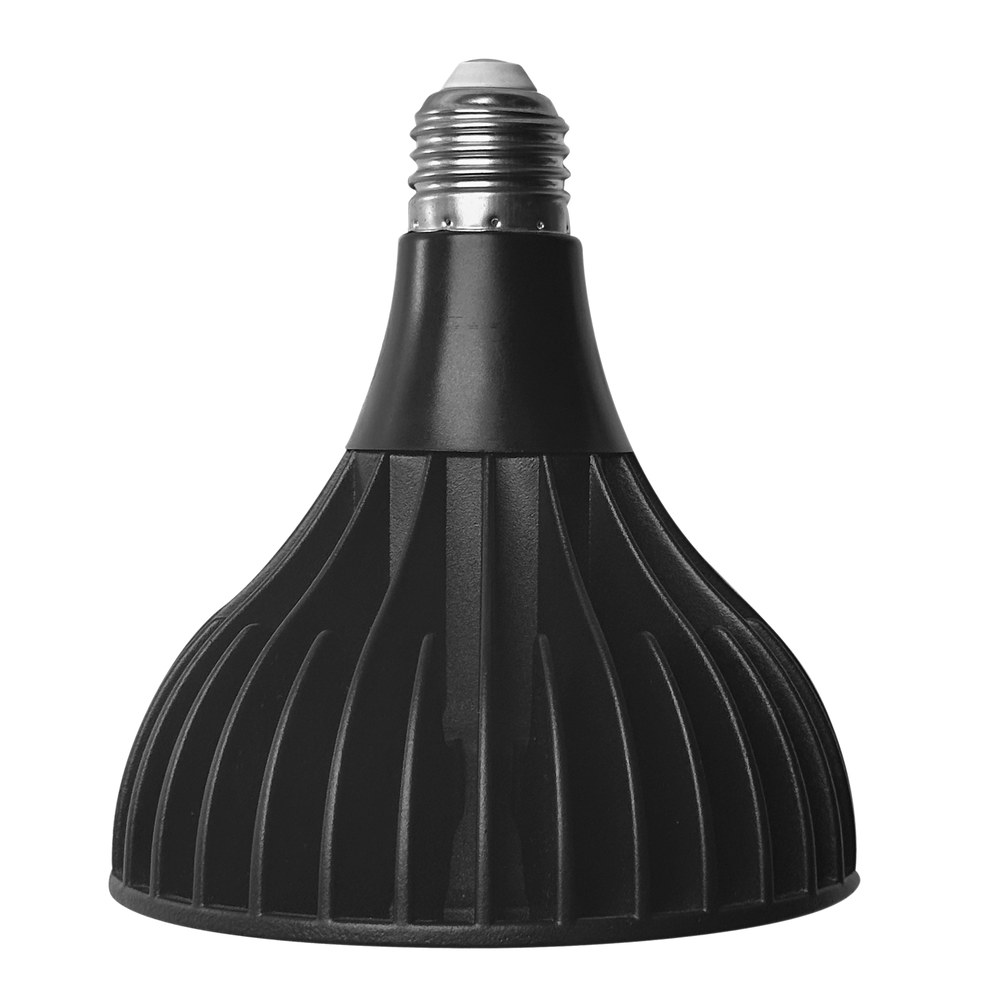
Comparing common optic configurations
The table below is a design aid, not a specification. It describes how each configuration behaves once installed. For exact numbers at your mounting height, use the manufacturer's photometric file (IES or LDT) rather than a beam angle printed on a box.
| Configuration | Typical beam angle | Footprint | Evenness across a bench | Behaviour when the fixture is raised | Where it fits |
|---|---|---|---|---|---|
| Bare LED board, no secondary optic | About 120 degrees (87 percent of photons inside ±60 degrees) | Medium, with soft edges | Good only when fixtures overlap | Intensity falls quickly | Multi-tier racks with limited headroom |
| Wide-angle secondary lens, 90–120 degrees | 90–120 degrees | Wide, flatter top | Best of the lens options | Falls moderately | Benches where the canopy edge must stay lit |
| Narrow secondary lens, 30–60 degrees | 30–60 degrees | Narrow and bright | Poor unless fixtures are dense | Footprint changes quickly | Deep tiers and high-bay retrofits |
| Reflector, specular aluminium | Wide, often asymmetric | Wide, can be uneven | Depends on reflector geometry | Moderate | Retrofits and single-fixture benchtops |
| Diffuser panel or volumetric film | Very wide | Very wide and soft | Improves evenness | Least sensitive | Removing hot spots close to the canopy |
Mounting height and spacing often matter more than the optic
Because a Lambertian distribution spreads as it travels, the distance between the light-emitting surface and the canopy sets how much of the emitted light is intercepted by leaves rather than lost to the floor and walls. Research at Purdue quantified the effect for overhead sole-source LED lighting: when fixtures were dimmed to hold a constant 160 µmol·m−2·s−1 at the canopy, the energy-utilization efficiency in grams per kilowatt-hour doubled at a 15 cm separation distance compared with the conventional 45 cm separation.
The same work notes that electricity typically accounts for 25 to 30 percent of operating expenditure in vertical farming, which is why the interception question is a commercial one and not only a technical one. In practice this means three levers, in order of effect:
- Spacing between fixtures. Overlapping footprints even out a bench far more cheaply than any optic. If two adjacent fixtures produce a 40 percent dip between them, moving them closer together fixes it immediately.
- Mounting height. Raising a fixture widens the footprint and flattens the distribution, but it also reduces the intensity at the canopy and pushes photons outward. Lowering it concentrates light and can turn a hot spot into a burn.
- Optic and reflector choice. Choose the optic once the geometry is fixed, not before. An optic is the fine adjustment; spacing and height are the coarse ones.
How to check distribution before you buy, and after you install
A light intensity map is the simplest defence. Ask the supplier for one, developed for your room dimensions and your intended hanging height, reported in µmol·m−2·s−1 of photosynthetically active radiation. A generic map from a brochure is not useful, because the answer depends on the geometry of your space. What you are looking for is the ratio between the highest and lowest values on the canopy plane, and where those extremes sit.
After installation, the same check takes a grid of readings rather than a single one. Measure at the centre, at each edge and at each corner of the growing area, at canopy height rather than at the fixture. A single reading taken directly beneath a lamp tells you almost nothing about the crop.
| Metric | What it tells you | How to use it |
|---|---|---|
| Average PPFD over the canopy plane | The quantity of light the crop can expect | Compare against the DLI target for the crop and photoperiod |
| Edge-to-centre ratio | How much weaker the perimeter is | Decide whether the outer row will finish late or needs its own timing |
| Variation, as a percentage of the average | The spread across the whole area | 10 to 20 percent is the accepted working range for planned installations |
| Position of the hottest point | Where bleaching risk is highest | Set the fixture height from the worst point, not the average |
Where each configuration fits
For a low, wide bench where people work above the plants, a wide-angle secondary optic paired with generous fixture overlap is usually the simplest way to keep the perimeter productive. For a multilayer rack with 20 to 40 cm of headroom between tiers, close-canopy mounting with wide-angle optics or bare boards carries the efficiency advantage, provided the air movement between tiers is designed to match. For a retrofit over an existing benchtop, a reflector is often the pragmatic choice, because it recovers light that the previous fixture was already throwing sideways. For a single-fixture home setup, the correct answer is usually a wider beam angle and a lower mounting height rather than more power.
About the publisher
XineLam is a horticultural LED lighting manufacturer with 17 years of experience in the LED lighting industry and 300+ patents in China and internationally. The company designs and produces LED modules, bars, tubes and reflector lamps for greenhouses, vertical farms and indoor growing rooms. This article is published as a technical explainer; the guidance above is intended to help growers specify and verify lighting installations, and product selection should follow the photometric data supplied for the specific fixture.
Frequently asked questions
Does a narrower beam angle increase PPFD?
Yes, at a fixed mounting height, concentrating the same photon output into a smaller cone raises the intensity at the centre of the footprint. It does not raise the total number of photons emitted. The trade-off is a smaller lit area, so a narrow optic usually means more fixtures or a shorter distance between them to cover the same bench evenly.
Is a lens or a reflector better for grow lights?
They solve different problems. A moulded secondary lens gives more precise control over the shape of the distribution, which makes it the better tool for flattening a hot spot or holding intensity to the edges of a bench. A reflector is cheaper and simpler, and is well suited to retrofits where sideways light is currently being wasted.
Why do the plants at the edge of my tray grow more slowly?
Almost always because they are receiving less light and therefore a lower daily light integral, not because of a nutrient or watering fault. Measure PPFD at the centre and at the edge of the tray at canopy height. If the edge reading is substantially lower, close the fixture spacing or add a fixture before changing anything else.
How do I check a grow light's distribution before buying it?
Request a light intensity map built for your room dimensions and hanging height, reported in µmol·m−2·s−1, and ask for the photometric file. A map that is not specific to your geometry will not predict what happens in your room.
Can a diffuser film fix a hot spot?
It can soften one, at the cost of some photons, because a diffuser scatters light in directions that never reach a leaf. It is worth trying when the hot spot is caused by a single fixture mounted close to the canopy. If the unevenness is caused by spacing, adjusting the spacing will usually resolve it without the photon loss.
Sources
- Runkle, E. The Importance of Light Uniformity. Michigan State University Extension, Department of Horticulture. canr.msu.edu – light-uniformity.pdf
- Runkle, E. Lighting Plants with LEDs. International Plant Propagators' Society. ipps.org – 05_Runkle.pdf
- Sheibani, F., Bourget, M., Morrow, R. C., & Mitchell, C. A. (2023). Close-canopy lighting, an effective energy-saving strategy for overhead sole-source LED lighting in indoor farming. Frontiers in Plant Science, 14, 1215919. PMC10413563