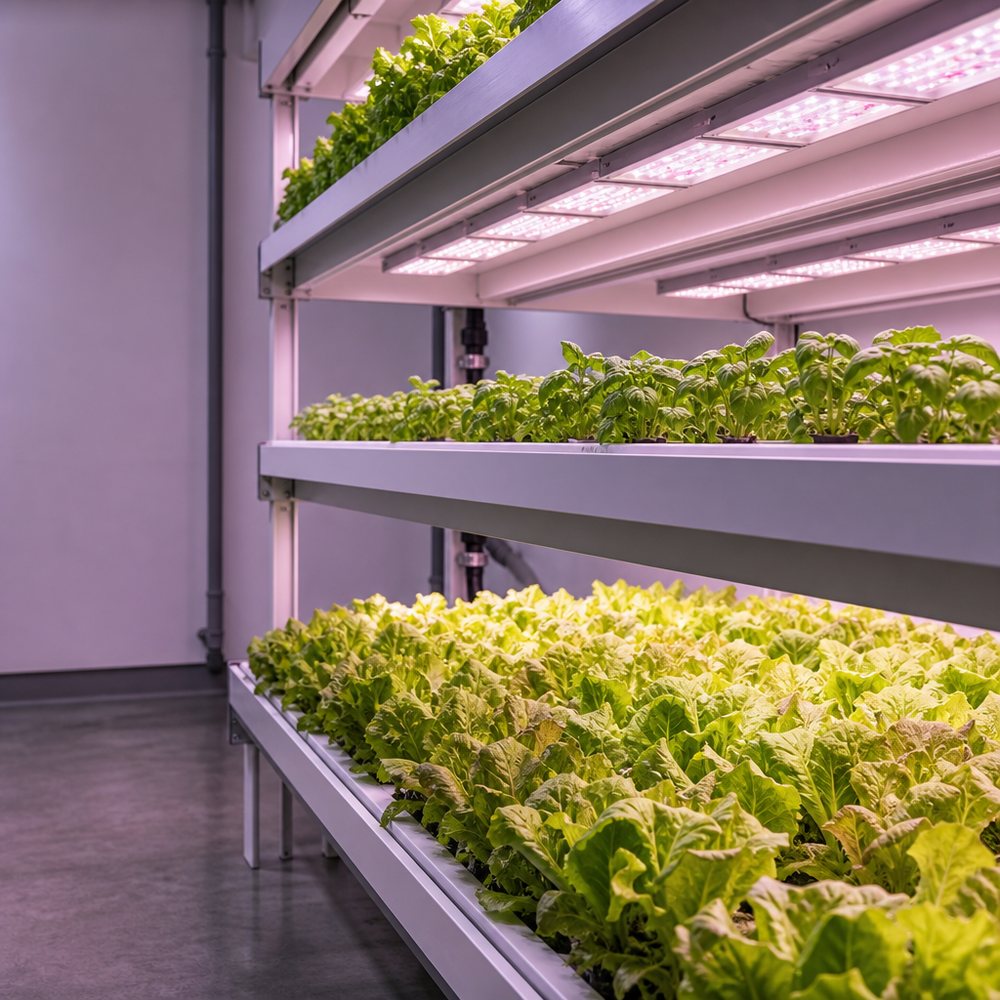
"Run them 18 hours" and "give them 12" are both common pieces of advice, and both can be right or wrong depending on the crop. The length of the light period is not a standalone setting: it works together with the intensity of the light and the total quantity of light the crop receives each day, and for many species it also triggers developmental responses that have nothing to do with how much energy the plant gets. This article separates those three effects and shows how to set a schedule from measurements rather than folklore.
Iowa State University Extension and Outreach, in its guidance on providing supplemental light to indoor plants, states that indoor plants are generally given light for 12 to 14 hours a day and that for home gardeners the light can be on for as little as 10 hours and no more than 16 hours a day (Iowa State University Extension and Outreach). That range, rather than a single number, is the practical answer for most vegetative crops.
Two mechanisms set the limits. The first is energy: the crop needs a certain amount of light each day to drive growth, and hours are one way to deliver it. The second is timing: some plants use the length of the uninterrupted dark period as a signal for flowering and other developmental changes, which is why hours cannot be stretched indefinitely even when more light would be useful.
The conventional way to describe a crop's light requirement splits it into quality, intensity and duration. Light quality is the mix of wavelengths; intensity is how much plant-usable light arrives at the leaf surface; duration is how long the light is provided. Those three combine into a single number, the daily light integral (DLI), which is the quantity of photosynthetically active photons delivered over a square metre in 24 hours, expressed in mol/m2/day.
Michigan State University Extension maintains a reference article specifically on plant lighting terminology, written from the plant's perspective rather than the lighting engineer's, which is a useful companion when a supplier's datasheet and an extension publication use different words for the same quantity (MSU Extension, Light terminology: From a plant perspective).
The working formula for duration is simple. According to Iowa State University Extension:
DLI = PPFD × hours of light × 0.0036
where PPFD is the photosynthetic photon flux density in umol/m2/s measured at the canopy. Because the three variables multiply, the same DLI can be reached with a high intensity for few hours or a low intensity for many hours — but only one of those options may be acceptable for a given crop.
| Canopy PPFD (umol/m2/s) | 12 hours | 14 hours | 16 hours | 18 hours |
|---|---|---|---|---|
| 200 | 8.6 | 10.1 | 11.5 | 13.0 |
| 300 | 13.0 | 15.1 | 17.3 | 19.4 |
| 400 | 17.3 | 20.2 | 23.0 | 25.9 |
| 500 | 21.6 | 25.2 | 28.8 | 32.4 |
Read the table down a column and you are changing the fixture or the mounting height; read it across a row and you are changing the timer. Both move the DLI, which is why a question like "how long should the lights run" cannot be answered without first knowing the intensity the fixture actually delivers at the canopy.
The dark period is not simply the pause between two light periods. It is the window in which the plant's developmental clock is set. Iowa State University Extension makes the point bluntly: in actuality, plants respond to the length of darkness, which is why the familiar "short-day plant" is more accurately described as a long-night plant, and a "long-day plant" as a short-night plant (Iowa State University Extension and Outreach).
The practical consequence is that the dark period has to be treated as a reserved, uninterrupted block. If the response you are managing is photoperiodic, interrupting the night with a work light can undo the schedule even though the total photon delivery barely changes. The same source notes that extending the number of light hours to raise the DLI is a tactic that cannot be used freely, because changing the number of hours can change the response of a short-day or long-day plant.
Rule of thumb: choose the hours from the crop's photoperiodic response, and set the intensity from its DLI target. Reversing that order is how growers end up with the right amount of light delivered at the wrong time of day.
Once the target is known, the schedule follows. The table below takes the DLI ranges published by Iowa State University Extension for plant categories and shows an example combination of intensity and hours that lands inside each band. The intensity values are worked examples, not recommendations from the source; the DLI bands are.
| Plant category | DLI band (mol/m2/day) | Example schedule inside the band | What to watch |
|---|---|---|---|
| Low light | 3 – 6 | 100 umol/m2/s for 12 hours = 4.3 | Typical of foliage houseplants; avoid over-lighting shade-adapted species. |
| Medium light | 6 – 10 | 150 umol/m2/s for 12 hours = 6.5 | Used for vegetative cuttings and seedlings on the high side of the band. |
| High light | 12 – 16 | 300 umol/m2/s for 12 hours = 13.0 | The band that covers leafy vegetables such as lettuce and basil. |
| Very high light | 18 – 30 | 450 umol/m2/s for 14 hours = 22.7 | Fruiting crops; check that ventilation and irrigation can keep up with the added load. |
Propagation, vegetative growth and flowering or fruiting do not usually want the same schedule, and the difference is driven by the DLI target and the photoperiodic response of the species rather than by habit.
Duration is not the only lever over crop outcome, and it does not act alone. A 2021 study in Frontiers in Plant Science grew lettuce under red-blue, red-blue-green, red-blue-purple and red-blue-far-red LED treatments and reported differences in growth, quality and nitrogen metabolism between the light-quality treatments (Frontiers in Plant Science, 2021). In other words, hours and intensity determine how much light the crop gets; the spectrum and the timing determine what it does with it.
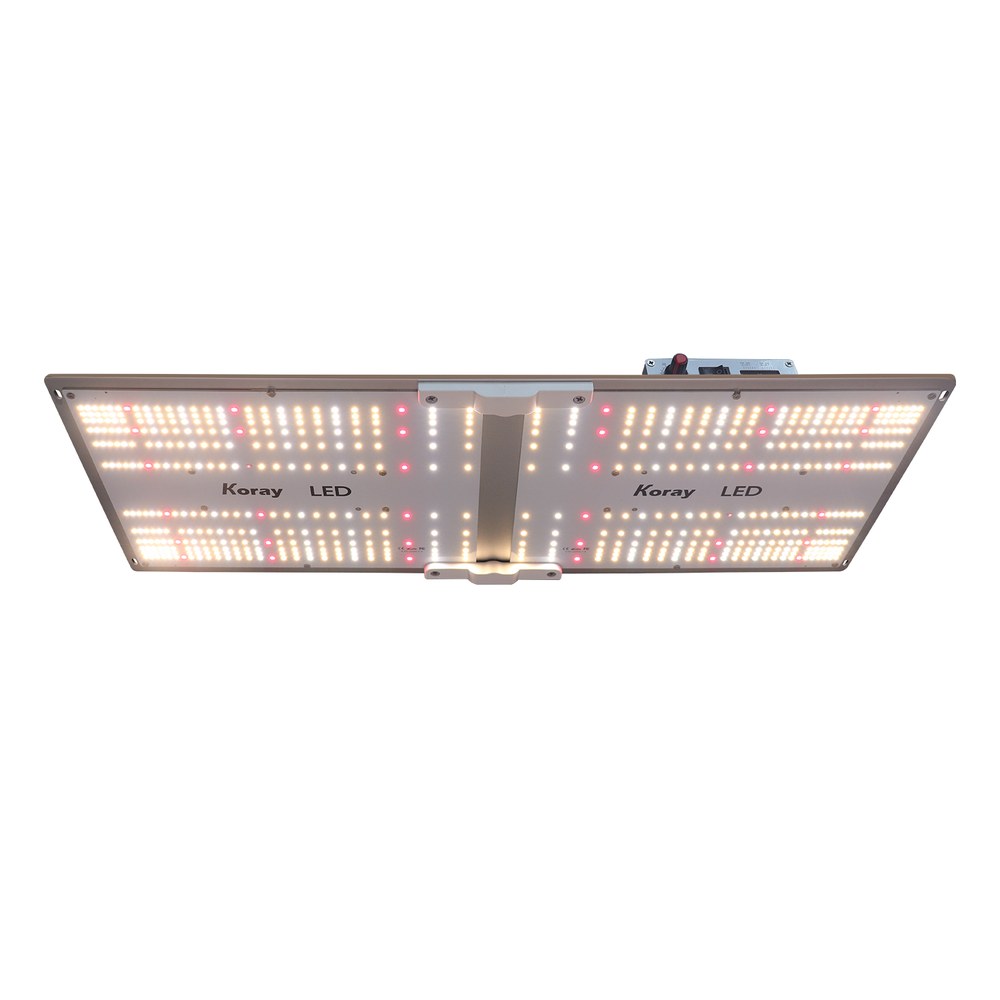
Extending hours is the cheapest way to raise the DLI, because it requires no new hardware. It is also the tactic with the most side effects, so it is worth being explicit about the trade-offs:
There is also a hardware dimension to duration. A schedule of 16 hours means the fixture runs two thirds of the day, every day, so duty cycle translates directly into thermal stress on drivers and boards, and into the service life you should expect. When a project needs a specific DLI, it is worth telling the supplier the intended hours as well as the target intensity, because the two together determine how hard the fixture will be worked.
XineLam is an LED lighting manufacturer with 17 years of experience in the LED lighting industry and 300+ patents in China and internationally. The company designs and produces LED modules and complete fixtures for horticultural and general lighting applications, and supports growers in setting schedules against measured PPFD and target DLI values.
Continuous operation is not a free upgrade. Extension guidance suggests indoor plants are commonly given 12 to 14 hours of light a day, with a practical range of about 10 to 16 hours, and warns that hours cannot be extended freely because photoperiodic plants respond to the length of the dark period. Check whether the crop has a photoperiodic response before adding hours.
It is a common starting point, not a universal rule. Vegetative crops are often run for 14 to 16 hours, while flowering in short-day species depends on a long enough uninterrupted night. Set the schedule from the crop's DLI target plus its photoperiodic response.
Photoperiodic responses depend on uninterrupted darkness, so light leaking into the night period can change the response in sensitive crops. If a work light is needed, keep it short and dim and away from the canopy, and treat the night as reserved.
Only up to a point. Because DLI is the product of PPFD and hours, halving the intensity and doubling the hours gives the same DLI but a different light environment for the plant, and for photoperiodic crops the extra hours may trigger an unwanted response. Prefer intensity and even distribution within the hours the crop tolerates.