Grow Light Spectrum for Vegetative vs. Flowering Stage: What Actually Changes
Growers are usually told to run one spectrum for vegetative growth and another for flowering. The advice is not wrong, but it compresses three different mechanisms — photoperiod, light quantity and spectral quality — into a single switch. Separating them makes the decision much cheaper, because in many crops the spectrum barely needs to change while the photoperiod and daily light integral do.
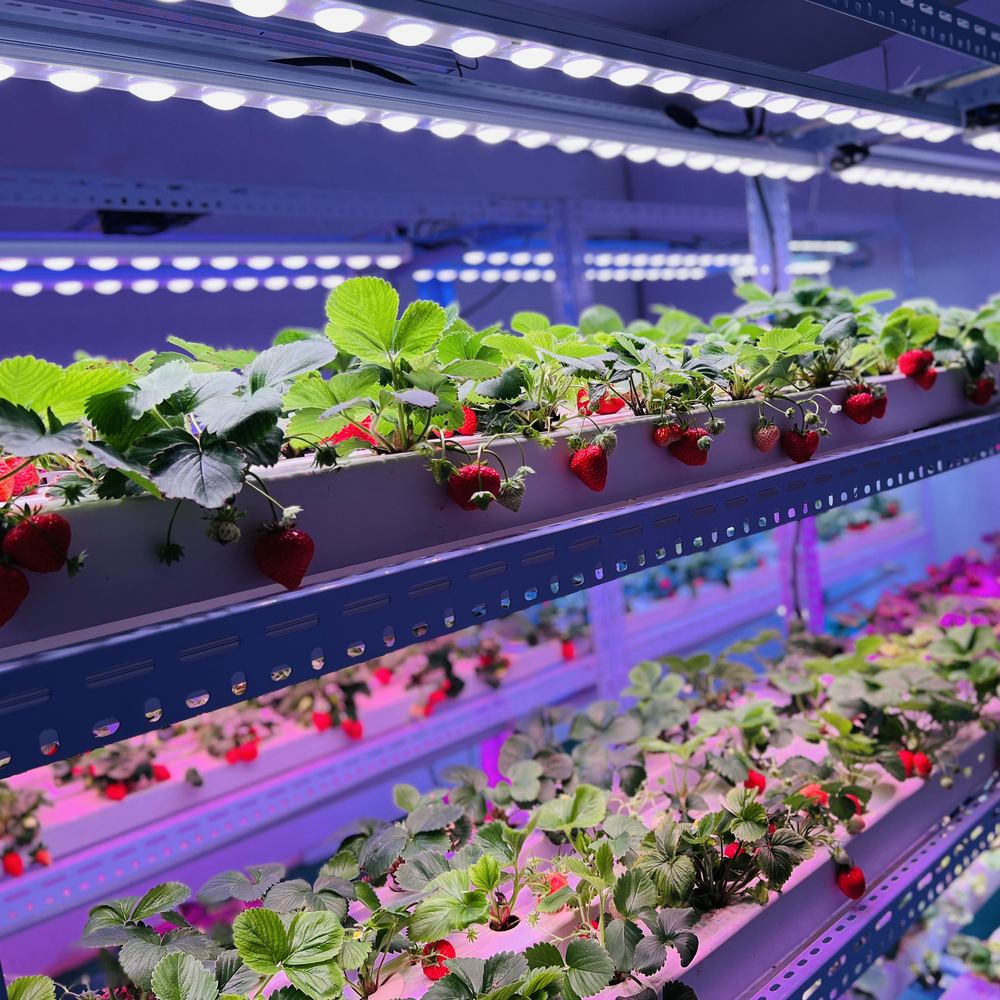
Three signals, three different levers
Plant responses to light are usually grouped into three channels, and only one of them is spectrum in the narrow sense:
- Light quantity — PPFD and the daily light integral (DLI) that accumulates from it. This drives photosynthesis and biomass. Deals with how much, not which wavelengths.
- Photoperiod — the length of the uninterrupted dark period. In photoperiod-sensitive crops this is the primary flowering trigger, and no spectrum change substitutes for it.
- Spectral quality — the ratio of wavebands, including the red to far-red ratio that phytochrome reads. This shapes morphology: stem extension, leaf expansion, branching, and in some species the strength of the flowering response.
Extension guidance from the University of Missouri makes the division explicit: radiation in the red and far-red regions promotes growth and tissue expansion, and in some long-day plants the addition of far-red can substitute for part of the long-day requirement. That is a spectral and photoperiod interaction, not a simple "red for flower, blue for leaf" rule.
What the red to far-red ratio is doing
Phytochrome exists in two interconvertible forms. Red light around 660 nm converts it to the active form; far-red around 730 nm converts it back. The ratio between the two wavebands therefore acts as a signal about the light environment rather than as an energy supply. A canopy that filters red light while transmitting far-red produces a low ratio below the leaves, and a plant that senses that ratio reads it as competition and elongates.
The practical consequence is that red to far-red ratio is a morphology dial. A high ratio keeps crops compact; a lower ratio promotes extension. Researchers have proposed the far-red fraction, FR/(R+FR), as a more intuitive way to characterise the signal than a ratio, because it runs from 0 to 1 and does not diverge as red approaches zero. Whichever metric a datasheet uses, the direction of the effect is consistent: more far-red relative to red means more extension.
Stage-by-stage comparison
The table below compares the two stages on the dimensions that actually get adjusted in a grow room. It deliberately separates the levers, because changing several at once makes it impossible to tell which one produced the result.
| Dimension | Vegetative / propagation | Flowering / fruiting | What to watch |
|---|---|---|---|
| Primary trigger | Establishment of root and leaf area | Dark period length in photoperiod-sensitive crops | Do not expect spectrum to trigger flowering on its own |
| Photoperiod | Long day, often 16–18 h | Shortened day, often 12 h, crop dependent | Change this before changing spectrum |
| DLI target | Lower; young plants suffer below about 10 mol/m²/d | Higher, to support fruit load | Set quantity first, then choose the spectrum that reaches it |
| Red share | Moderate to high | High; red is the most efficient waveband to generate | Red does most of the photosynthetic work |
| Blue share | Moderate, to hold compact habit | Usually reduced | Blue costs efficacy; use only as much as habit requires |
| Red to far-red ratio | Higher for compact plugs; lower where extension is wanted | Crop specific; far-red can support fruit set in some species | Low ratio stretches plants; check habit weekly |
| Main risk | Stretching and weak branching under low ratio | Veg-like habit persisting, delayed development | Adjust one variable per cycle |
One number in that table deserves emphasis because it is a threshold rather than a preference. In Michigan State University Extension work on young plants, daily light integrals below 10 mol/m²/d produced fewer roots, less shoot growth, and crops that took up to twice as long to become ready. No spectrum choice recovers that loss, which is why quantity is set before quality.
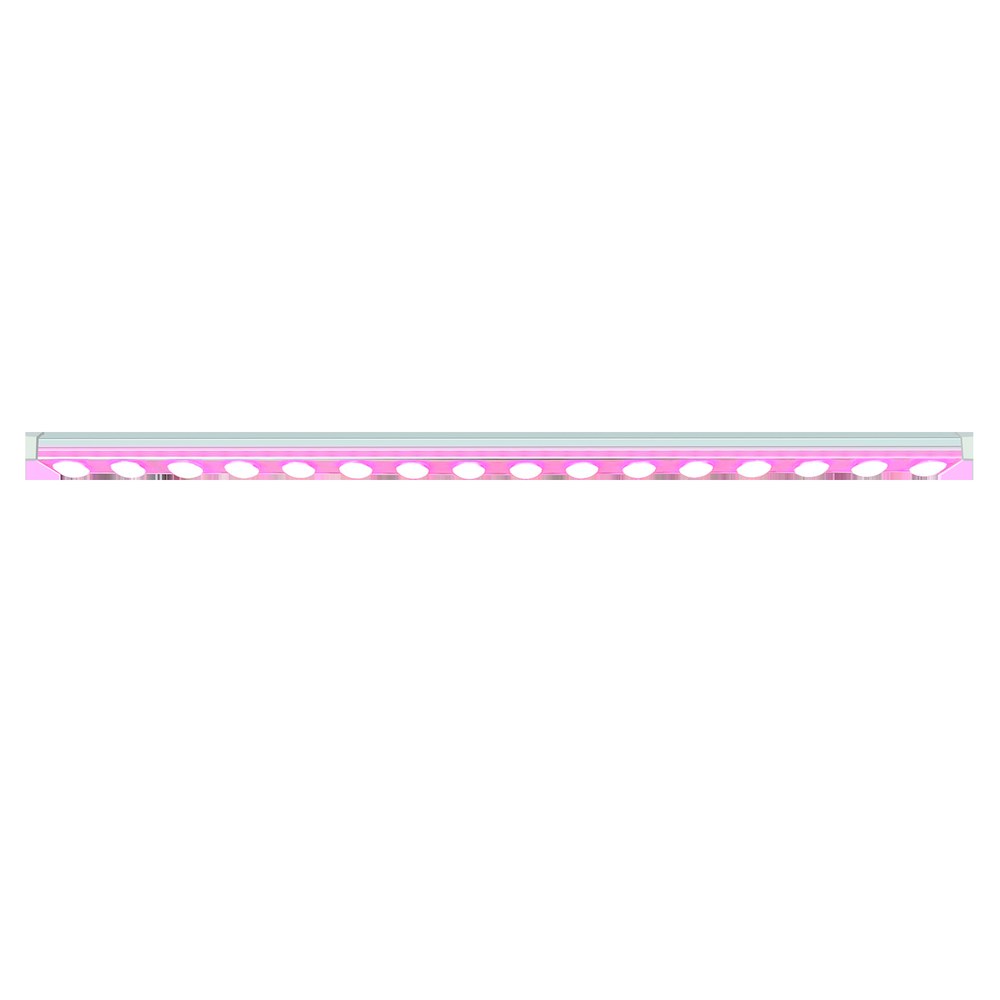
Why dual-channel fixtures change the economics
If spectrum had to be fixed at purchase, every grower would have to guess which stage matters most. Independently controllable channels remove that guess: a vegetative setting and a flowering setting can coexist in one housing, and the change is a control action rather than a capital purchase. The trade-off is that efficacy must be evaluated per operating mode, since a fixture running one channel alone is not the same electrical and optical case as the same fixture with all channels at full output.
For a two-stage crop this usually pays back faster than buying two dedicated fixtures, because the second fixture would sit idle for half the cycle. For a single-stage operation — a propagation nursery that never fruits, for example — a fixed high-red spectrum with a modest blue fraction is simpler and often more efficient per photon.
How to change spectrum without losing the comparison
- Hold PPFD constant. If the new setting changes photon output, the trial measures quantity as well as quality and tells you nothing.
- Change one channel at a time. Record the setting, the week and the observed habit, so the effect can be attributed.
- Watch habit weekly, not daily. Extension responses accumulate; a photograph from the same angle each week is more useful than a daily impression.
- Check the edges. A spectrum change that also alters beam distribution can leave the canopy perimeter underlit, which reads as a spectrum effect when it is a layout effect.
- Keep the DLI target fixed across the switch. If the new spectrum is less efficient, the photoperiod or the drive current has to compensate, or the crop simply receives less light.
Where the general advice breaks down
The standard "vegetative blue, flowering red" summary comes from crops where blue light reliably compacts habit and red dominates dry-matter accumulation. It transfers poorly to leafy greens grown for biomass, where a high red share with a small blue fraction is common throughout the cycle, and to long-day ornamentals, where far-red can advance flowering rather than merely stretching stems. It also transfers poorly between cultivars of the same species: two lettuce varieties can respond differently to the same blue fraction. The only reliable guide is a controlled comparison on the crop you actually sell.
Frequently asked questions
Do I need to change spectrum when switching to flowering?
Often what needs to change first is photoperiod and DLI, not spectrum. In photoperiod-sensitive crops the dark period triggers flowering; spectrum modifies the strength of the response and the plant's habit.
What does red to far-red ratio do to plant shape?
A low ratio signals neighbouring vegetation and produces extension growth — longer stems, larger leaves, weaker branching. A high ratio keeps plants compact.
Is more blue light always better in the vegetative stage?
No. Blue tends to compact habit, but blue photons are less efficient to generate than red, so an aggressive blue share lowers photosynthetic photon efficacy. Use only as much as the habit requires.
Does spectrum change the daily light integral target?
The DLI target follows the crop and stage. Young plants below about 10 mol/m²/d had fewer roots and took up to twice as long to finish in MSU Extension trials. Set DLI first, then pick the spectrum.
Sources
- University of Missouri Extension, Controlled Environment Agriculture: Understanding Grow Lights (G6987). extension.missouri.edu
- Michigan State University Extension, How low can you go? Low daily light integrals impact young plant quality. canr.msu.edu
- Far-red Fraction: An Improved Metric for Characterizing Phytochrome Photoequilibrium, J. Amer. Soc. Hort. Sci. 146(1). journals.ashs.org
- Purdue Extension, Measuring Daily Light Integral in a Greenhouse (HO-238-W). extension.purdue.edu
About the publisher
XineLam is a LED lighting manufacturer with 17 years of experience and 300+ patents in China and internationally. This article is general technical education about light signals and crop responses; it does not prescribe a recipe for a specific cultivar. Where fixture choice matters, evaluate efficacy per operating mode and confirm the spectrum on your own crop.