How Does Ambient Temperature Affect LED Grow Light Output?
An LED grow light does not deliver a fixed number of photons. It delivers whatever the emitter can still produce at the junction temperature it happens to be running at. Because published ratings are produced in a controlled room near 25 °C, every real installation delivers slightly less, and the size of that shortfall is predictable, measurable and worth designing around.
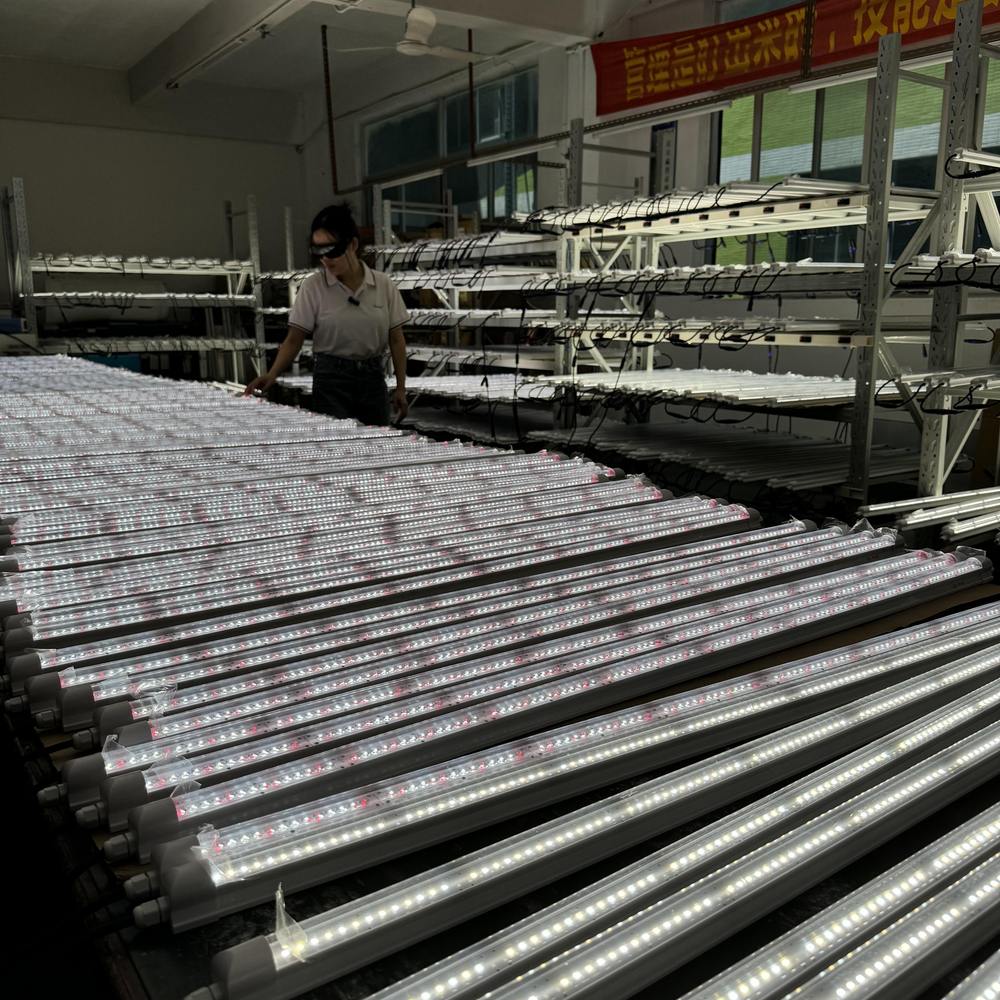
Why a 25 °C report is not a greenhouse number
Photometric reports for luminaires, and the horticultural qualification listings built on them, are produced under a defined measurement standard with the fixture thermally stabilised in a controlled ambient temperature, conventionally about 25 °C ± 1 °C. That convention exists so that two laboratories measuring two products are measuring the same thing. It is a good convention and it is not a description of your grow room.
A flowering canopy in a closed room or a summer greenhouse can sit at 32–40 °C. A sealed fixture inside a multi-tier rack can breathe air warmer still, because the rack traps the heat that the fixture itself rejects. The emitter inside the fixture responds to that by running hotter, and a hotter emitter converts the same drive current into slightly fewer photons. The energy does not disappear; it shifts into heat, which then has to be removed by the room's cooling system.
What happens inside the fixture as ambient rises
Four things change together, and only the first is usually mentioned in a datasheet.
- Junction temperature rises. It sits above the solder point, which sits above the heat sink, which sits above ambient. Each step in that chain adds a thermal resistance, so a 10 °C rise in room air becomes a larger rise at the die.
- Radiant flux falls. Non-radiative recombination increases with temperature, and the phosphor in a white or broad-spectrum LED loses conversion efficiency as it warms. The result is the familiar downward slope in relative flux versus junction temperature curves.
- Forward voltage falls slightly. A constant-current driver therefore consumes marginally less power at the same current, which is why a hot fixture is not simply a less efficient version of the same lamp: it is drawing less energy and emitting proportionally even less light.
- The driver responds. Many constant-current drivers include thermal foldback, reducing output current when the case temperature exceeds a threshold. That protection is desirable, but it means the output curve can step down rather than slope gently, and a foldback event in August is not visible in any published report.
Spectrum shape also drifts, not only intensity. Red-emitting dice are generally more temperature-sensitive than blue-pumped phosphor white, so a mixed spectrum shifts slightly as the fixture heats. For most crops this is a second-order effect; for a tightly controlled research protocol it is worth quantifying once on your own hardware.
How large is the loss?
The honest answer is that it depends on the die, the thermal design and the drive current, and the correct source of truth is the relative-flux curve in the fixture's LED datasheet. What can be said generally is the shape and the order of magnitude.
| Ambient at the fixture | Relative photon output | Typical situation | Design implication |
|---|---|---|---|
| 20 °C | 101–104 % | Cold room, winter night, chilled propagation area | Output is at or slightly above the rated value |
| 25 °C | 100 % (reference) | Laboratory, air-conditioned headhouse | The number printed in the test report |
| 30 °C | 97–99 % | Conditioned indoor room in a temperate summer | Loss is inside normal measurement uncertainty |
| 35 °C | 94–97 % | Greenhouse canopy on a warm afternoon | Plan the light recipe about 5 % above target |
| 40 °C | 90–94 % | Unventilated rack, sealed room, heat trapped above canopy | Check whether foldback is also engaging |
| 45 °C | 86–91 % | Fixture mounted inside a closed rack with no cross-flow | Revisit the thermal design before raising power |
Two features of that table matter more than the individual cells. First, the slope is gentle, which is why temperature is often dismissed; but it is continuous, so a 40 °C room quietly gives away roughly one tenth of the photons the design was sized on. Second, the slope steepens at the top of the range, so the last five degrees cost more than the first five.
The practical consequence for a light plan is a simple correction. If a target PPFD of 600 µmol/m²/s was calculated from a 25 °C datasheet, a room running at 38 °C needs roughly 630 µmol/m²/s at the reference condition to land on the same delivered value. That is the difference between hitting a DLI target and missing it by a few percent every single day of the crop.
Three installation details that make it worse
Most of the loss observed in the field is not inherent to LED technology; it is inherited from how the fixture is mounted.
- Enclosed multi-tier racks. Shelving that holds the fixture and the canopy in the same still air volume removes the convection path. Air above a canopy in a closed rack is often several degrees warmer than the aisle.
- Sealed, high-IP housings. Washdown-rated fixtures trade convection for protection. That trade is usually correct in a wet greenhouse, but it means the heat sink must be sized for the sealed case, not for open air.
- Dust and biofilm on fins and optics. A fouled heat sink raises thermal resistance directly; a fouled lens also absorbs light before it reaches the canopy. Both effects compound the temperature effect and neither appears in any report.
| Approach | Heat path | Effect on output at 40 °C ambient | Maintenance burden | Where it fits |
|---|---|---|---|---|
| Passive finned extrusion | Conduction to fins, free convection | Moderate derating; strongly dependent on clearance above and below | Low; periodic dust removal | Open greenhouses, high-bay mounting |
| Fan-cooled housing | Forced convection through the sink | Smallest derating while the fan runs | High; fan is the first wear item, and a stopped fan is often unnoticed | High-power single fixtures with service access |
| Sealed IP-rated body | Conduction to an external sink only | Larger derating unless the sink is oversized for the sealed case | Low; wipe-down compatible | Wet zones, washdown areas, condensation-prone houses |
| Fixture inside a closed rack | Heat rejected into the shelf volume | Largest derating; ambient at the fixture can exceed room ambient by several degrees | Medium; requires air movement through the tier | Vertical farms only with forced cross-flow per tier |
How to measure the derating in your own room
A single afternoon with one quantum sensor and one contact thermometer answers the question for your installation more reliably than any generic table.
- Let the fixture stabilise. Thirty to sixty minutes from cold is typical for a passively cooled fixture; a housing whose surface temperature is still climbing is not yet at its operating point.
- Fix the geometry. Same sensor, same distance, same point on the grid, same sensor orientation. A ten-centimetre change in height moves PPFD more than the entire temperature effect you are trying to isolate.
- Record three temperatures. Room air at canopy height, air 100 mm above the fixture, and the housing surface near the driver. The gap between room air and the fixture is the number that explains most of the discrepancy.
- Repeat at a second ambient if you can. Ventilating the room or running the fixture at night gives a second data point, and two points establish your own slope rather than borrowing one.
- Check for foldback. If output falls in a step rather than a slope as the room warms, suspect driver thermal foldback and confirm with the supplier before changing the light plan.
What to specify before you order
The point of all this is not to reject 25 °C ratings, which are the only comparable figures available. It is to buy the information needed to correct them.
- Ask for the relative flux versus temperature curve for the LED used, and for the maximum rated case or solder-point temperature of the fixture.
- Ask what ambient the quoted PPF assumes, and whether the fixture was stabilised before measurement.
- Ask whether the driver has thermal foldback, at what case temperature it engages, and how far it reduces current.
- State the mounting clearance in the enquiry. A heat sink sized for open air is not the same product as one sized for a closed rack.
- Compare vendors on the same basis: same waveband, same ambient, same power basis, same measurement standard.
About the publisher
XineLam is the horticultural lighting brand of Zhongshan Koray Opto-Electronic Co., Ltd., a manufacturer with 17 years of experience in LED lighting and 300+ patents in China and internationally. The company designs LED grow lights and horticultural LED modules for greenhouses, vertical farms, tissue culture and research installations, and publishes technical notes on measurement and specification so that buyers can compare fixtures on the same basis. Product information is available at xinelam.com.
Frequently asked questions
Will my measured PPFD be lower than the datasheet because the room is hot?
It can be. Datasheet photometric values are produced with the fixture stabilised in a controlled ambient near 25 °C, whereas a canopy in summer may sit at 35–40 °C. As ambient rises, the LED junction runs hotter and radiant flux falls. Measured outputs that are a few percent under the report are normal in a warm room, but a drop of 15 percent or more usually points to something else, such as a sensor reading at the wrong distance, an uncalibrated meter, or dust on the optics.
How much output is lost per degree of temperature rise?
There is no single number. Published LED datasheets often show a radiant flux decrease in the region of 0.3 to 0.7 percent per degree Celsius of junction temperature rise between 25 °C and 85 °C, with red-emitting dice typically more sensitive than blue-pumped white, and the slope itself changes across the range. The only figure that applies to a specific fixture is the relative-flux-versus-temperature curve in that fixture's LED datasheet, or a measurement of the fixture itself.
Does dimming a fixture reduce the heat problem?
Usually yes, for two reasons. Electrical input falls, so less heat is generated; and the junction runs cooler at lower current, which partly offsets the loss of photons. The gain is not strictly proportional, because efficacy per micromole is generally best below full drive, and because the driver and the room still contribute heat. Dimming is therefore a legitimate way to hold a target PPFD in a hot room at lower junction temperature, but record the setting so the light plan remains reproducible.
Should I specify a fixture by its 25 °C value or by a hot-room value?
Buy on the 25 °C value, because that is the only figure produced under a recognised measurement standard and the only one that can be compared across vendors. Then design the installation using a derated figure for the actual ambient, and ask the supplier for the relative flux curve or a measured value at the ambient you will run. Quoting a hot-room number as if it were a standard rating makes the comparison meaningless.
Does a hotter fixture also age faster?
Yes, and this is the larger long-term cost. Lumen maintenance is driven by the same junction temperature, and the widely used engineering rule of thumb is that useful life roughly halves for every additional 10 °C of junction temperature. A fixture running 15 °C hotter than it needs to is therefore losing output twice over: immediately through derating and gradually through accelerated depreciation.
References
- Using identification method to modelling short term luminous flux depreciation of LED luminaire. Scientific Reports, 2023. doi.org/10.1038/s41598-023-27925-5
- Minimization of lumen depreciation in LED lamps using thermal transient behavior analysis. Applied Optics, 2016. doi.org/10.1364/ao.55.001170
- DesignLights Consortium. Horticultural lighting technical requirements and qualified products list. designlights.org/horticultural-lighting