How Much Light Do Tissue-Culture Plantlets Need?
Tissue-culture rooms are usually the dimmest plant-lighting application in a building, and that surprises people who arrive from commercial grow rooms. A culture vessel holding 40 µmol m-2 s-1 is not under-lit — it is being given about what a plantlet with a sealed lid, a sugar-containing medium and almost no transpiration can actually use. Getting the number right is less about brightness than about repeatability.
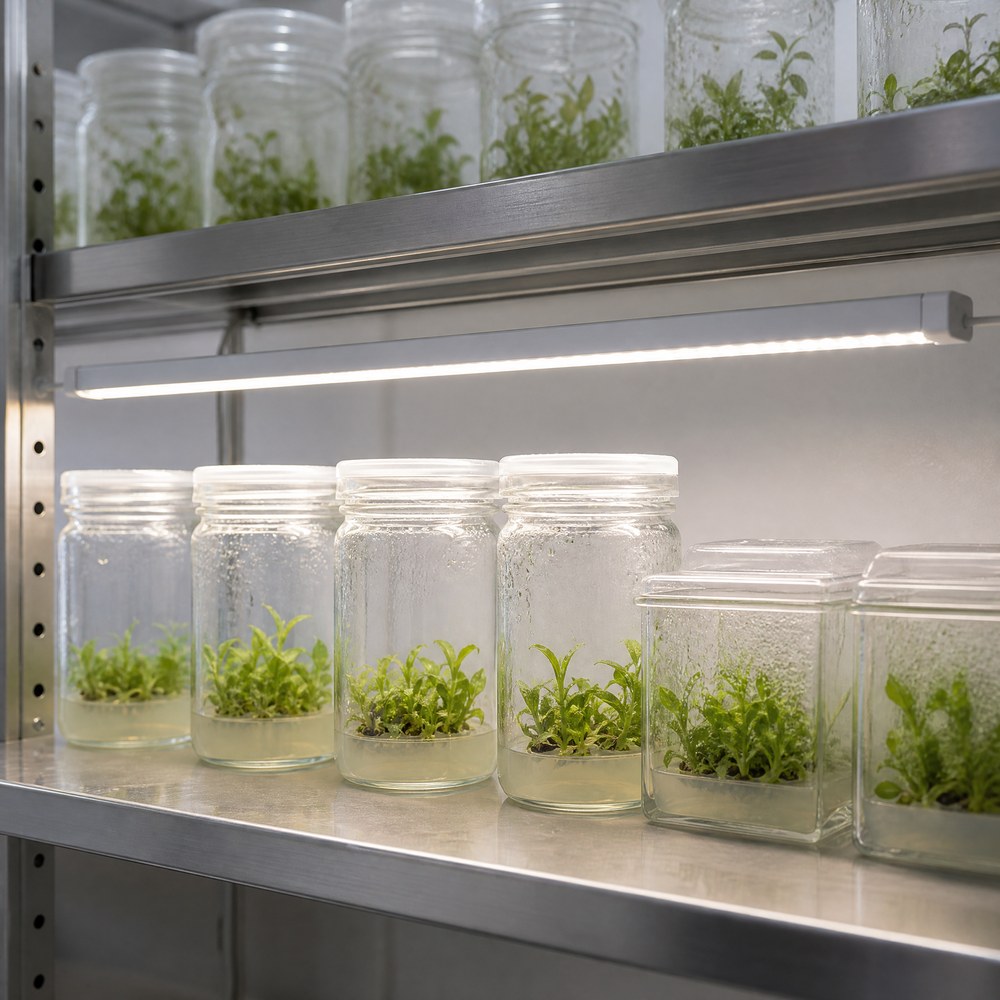
Why in-vitro plantlets need less light than a grow room
Three differences explain the low setpoint. First, most culture media contain sucrose, so the plantlet is mixotrophic: it obtains a substantial part of its carbon from the medium, and photosynthesis is only part of the budget. Second, the vessel is nearly sealed. Carbon dioxide inside the headspace is replenished slowly, so photosynthetic rate saturates at a much lower photon flux than in a ventilated room; raising PPFD beyond that point adds heat rather than growth. Third, plantlets have poorly developed cuticles and stomata that do not regulate well, so excessive light and the heat that comes with it push them toward bleaching, leaf curl or browning rather than compact growth.
Light is nonetheless a controlling variable, not a background condition. The published micropropagation literature treats light quality, photon flux and photoperiod as primary factors in morphogenesis, chlorophyll content and rooting — which is why two labs running the same medium and the same cultivar can still get different results.
Typical PPFD and photoperiod by stage
| Stage | PPFD at plantlet level | Photoperiod | DLI | Notes |
|---|---|---|---|---|
| Initiation and establishment | 20–40 µmol m-2 s-1 | 16 h | 1.2–2.3 mol m-2 d-1 | Low light reduces phenolic browning of fresh explants |
| Shoot multiplication | 40–80 µmol m-2 s-1 | 16 h | 2.3–4.6 mol m-2 d-1 | Most published protocols sit at 25–60; watch for leaf curl at the top of the range |
| Rooting | 60–100 µmol m-2 s-1 | 16 h | 3.5–5.8 mol m-2 d-1 | Red-rich spectra are commonly used; check root initiation rather than shoot length |
| Acclimatisation (ex vitro) | 100–200 µmol m-2 s-1 | 16–18 h | 5.8–11.5 mol m-2 d-1 | Raise over 7–10 days; sudden exposure causes sunburn-like damage |
The arithmetic behind the last column is worth keeping: DLI in mol m-2 d-1 equals PPFD in µmol m-2 s-1 × 3,600 × photoperiod in hours ÷ 1,000,000. At 60 µmol and 16 h that is 3.46 mol m-2 d-1; the same fixture run for 12 h gives 2.59. Photoperiod is therefore a cheap way to fine-tune the daily dose without changing hardware.
Spectrum: red first, blue for form, far-red with care
Red light around 660 nm drives photosynthesis efficiently and is the backbone of most tissue-culture spectra. Blue in the 430–460 nm band is usually kept at roughly 10–30% of total photon flux because it influences stomatal behaviour, chlorophyll formation and shoot morphology; too much blue tends to shorten internodes and can slow growth. Far-red is the variable that most often changes results without changing yield: adding it shifts the phytochrome balance and can promote elongation, which is useful for rooting and establishment but unwanted where compact plantlets are the goal. The ISHS work on potato plantlets in vitro is a useful entry point precisely because it separates red from far-red effects rather than treating “LED light” as one treatment.
Measure at the plantlet, not at the lamp
Three losses sit between the fixture and the leaf, and all three are easy to forget. The vessel lid and its condensation film reflect and absorb light. The distance from the lamp to the top of the vessel is not the distance to the plantlet, and in a tall jar the difference is large. And the light is rarely uniform across a shelf: the ends of a linear fixture deliver measurably less than the centre. Measure with a quantum sensor at canopy level inside an empty vessel of the same type, at the shelf centre and at both ends, and record the number in the protocol. A protocol that says “about 50” without stating where it was measured cannot be reproduced.
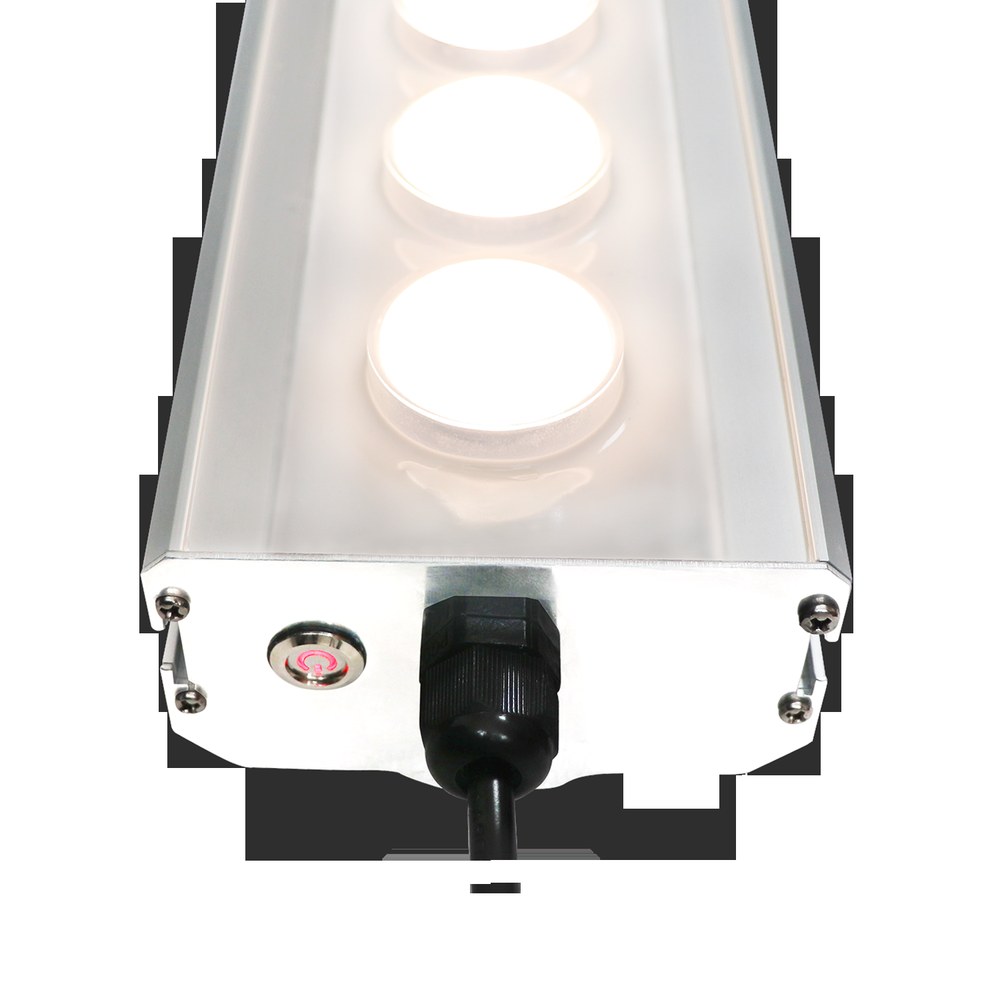
Photoperiod, dark period and continuous light
Sixteen hours light and eight hours dark is the default in most laboratories, and it is a reasonable one: it leaves a dark period for dark reactions and for any photoperiodic response the species may have, while keeping the daily dose predictable. Continuous light is used in some protocols, but it removes the dark period entirely and can produce chlorosis, leaf deformation or, in some species, in-vitro flowering. If a protocol calls for 24 hours, treat it as a species-specific finding rather than a general improvement.
Where the heat goes
A sealed vessel with a lamp close above it behaves like a small greenhouse. Radiant heat raises the internal temperature and the humidity inside the headspace, condensation forms on the lid, and the light reaching the plantlets drops further — a feedback loop that shows up as inconsistent growth between shelves rather than as an obvious failure. Keeping the fixture at a distance that gives uniform light, and controlling room temperature rather than chasing PPFD, is usually more effective than adding output.
Setting up a shelf: a short checklist
- Choose PPFD from the stage table, then set photoperiod to hit the DLI target.
- Fix the spectrum: red-dominant with 10–30% blue; add far-red only with a specific morphological goal.
- Measure inside a representative vessel at the shelf centre and both ends; write the values into the protocol.
- Check vessel temperature after two hours of operation, not after two minutes.
- Record lid type, fill volume and shelf position, because all three change the delivered dose.
About the publisher
XineLam is the horticultural and architectural LED lighting brand of Zhongshan Koray Opto-Electronic Co., Ltd. The company has 17 years of experience in LED lighting and holds 300+ patents in China and internationally. Its grow-light range includes linear tube fixtures and dimmable modules used above culture racks and propagation benches, with measured PPFD data and low-level dimming specified per installation.
Frequently asked questions
What PPFD should I use for shoot multiplication?
Most protocols work in the range of 40 to 80 µmol m-2 s-1 over a 16-hour photoperiod, with many published protocols near 25 to 60. Start at the lower end for a new cultivar, and raise it only if internodes stay short and leaves remain flat.
Can I use a normal grow light for tissue culture?
A dimmable fixture with a red-dominant spectrum and measured output can be used, provided it can be run at low PPFD and does not add radiant heat to the vessel. The practical constraint is the lowest stable dimming level, not the maximum output.
Is continuous light better for plantlets?
Usually not. Continuous light removes the dark period and has been associated with chlorosis, leaf deformation and in-vitro flowering in some species. Sixteen hours is the common default; deviate only on species-specific evidence.
Why do my plantlets look bleached after moving to a brighter shelf?
Plantlets grown in vessels have thin cuticles and low photosynthetic capacity, so a step change in light causes stress that looks like bleaching or scorching. Raise PPFD in steps over about a week, and check vessel temperature at the same time.
Sources
- IntechOpen, Light-Emitting Diodes: Progress in Plant Micropropagation (open-access chapter; reports a micropropagation protocol at 25 µmol m-2 s-1, 16 h photoperiod, 24 ± 2 °C) — https://www.intechopen.com/chapters/54510
- ISHS Acta Horticulturae 393, Effects of red and far-red light on the growth and morphology of potato plantlets in vitro using LEDs — https://ishs.org/ishs-article/393_22/