How to Calculate Cooling Load for an LED-Lit Grow Room
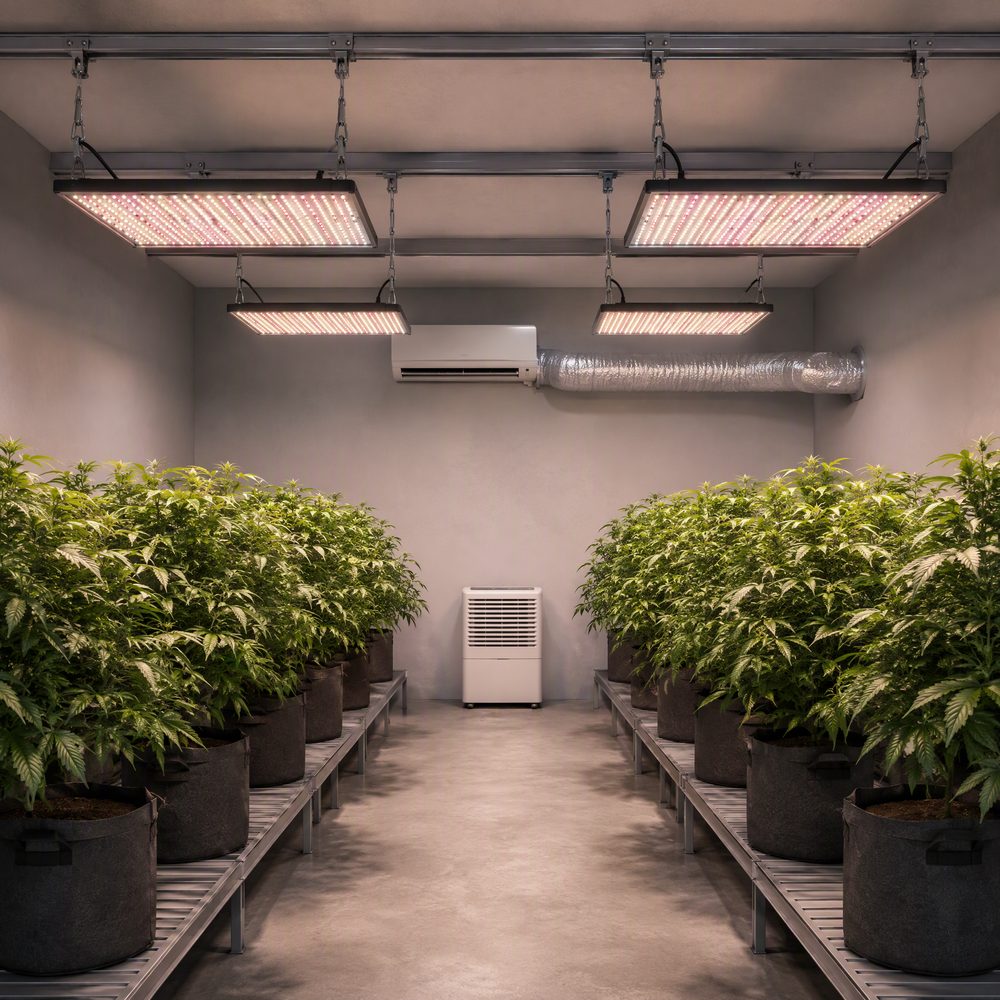
In a closed growing room, almost every watt drawn by the luminaires eventually becomes heat inside that room. A 10 kW lighting load is therefore a 34,120 BTU/h load — roughly 2.8 tons of refrigeration — before fans, dehumidifiers or people are counted. Sizing air conditioning from floor area alone is the most common reason a new LED room runs hot in its first summer.
Why the lighting load dominates the calculation
An LED fixture converts most of its input power into photons, but those photons do not disappear. Light absorbed by leaves, benches, walls and floor is converted to heat, and the small fraction stored as chemical energy in new plant tissue is negligible for HVAC purposes. The practical convention in load calculations is to treat the full input wattage of the lighting as heat gain inside the conditioned space.
Two unit conversions do most of the work:
tons of refrigeration = BTU/h ÷ 12,000
Measured at the plug, the input wattage already includes driver losses, so there is no need to add a separate ballast factor. For LED fixtures the driver is part of the luminaire; for legacy HID systems the ballast loss was added on top of the lamp rating.
Efficacy matters here, but not in the way many growers expect. A more efficient fixture does not produce less heat per watt — one watt is one watt. It produces more light, and therefore less heat, for the same photosynthetic photon flux density. The DesignLights Consortium horticultural technical requirements express this as µmol per joule, which is the correct basis for comparing fixtures at equal light output.
Six steps from fixture schedule to equipment size
Step 1 — Sum input watts, not “HID equivalent” watts
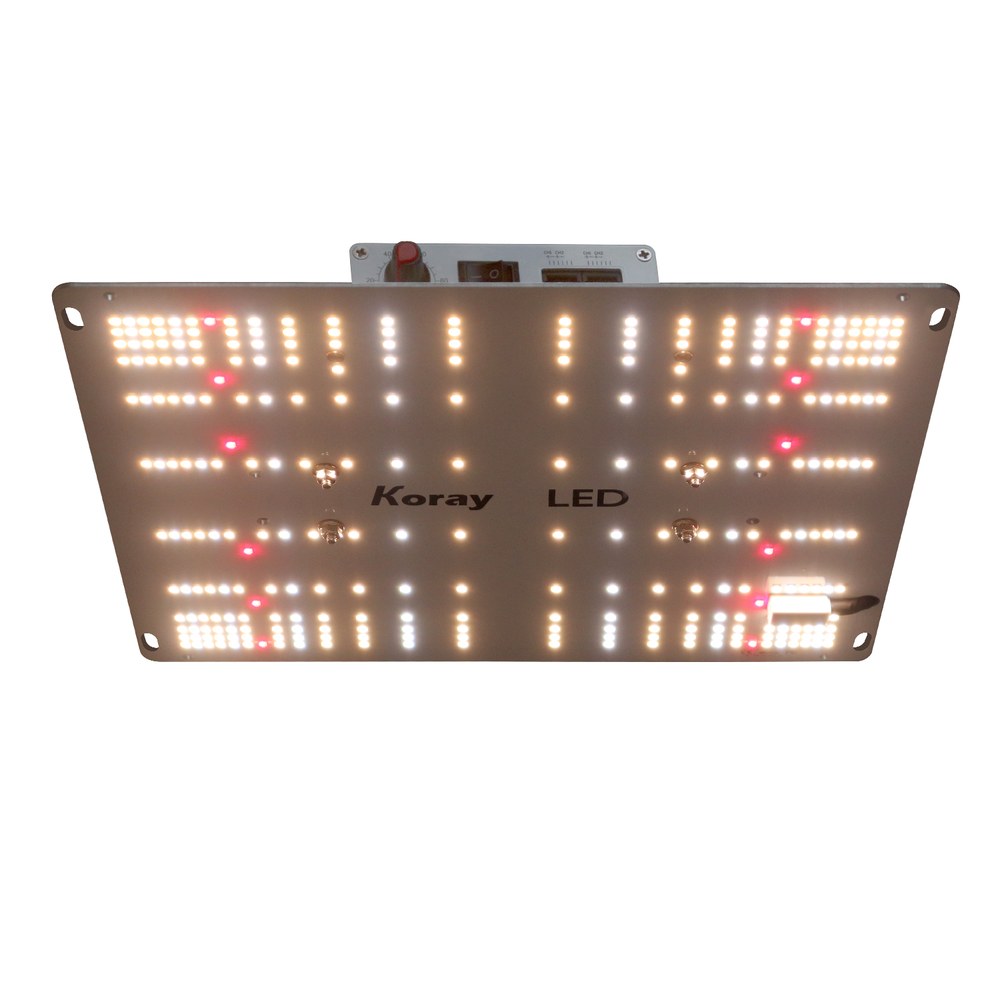
Add the nameplate input power of every fixture, using the actual driver setting. A fixture rated 720 W at full output draws less when dimmed, but design the system at the maximum operating point. Do not use marketing “equivalent to 1000 W HID” figures: they describe light output, not electrical input.
If the room has a lighting schedule with a dark period, the peak still occurs with all lights on, so the schedule affects energy use rather than the design load.
Step 2 — Convert lighting watts to BTU/h and tons
Multiply total input watts by 3.412. For a room with twelve 720 W fixtures:
8,640 × 3.412 = 29,480 BTU/h
29,480 ÷ 12,000 = 2.46 tons
Step 3 — Add the latent load from crop transpiration
Plants release water vapour, and condensing that vapour is part of the cooling duty. Each litre of water evaporated at about 25 °C carries roughly 2,440 kJ, or 0.68 kWh, which is about 2,300 BTU. A crop transpiring 40 litres per day therefore generates around 92,000 BTU of latent load per day.
That load is not spread evenly. Most transpiration occurs during the light period, so a room with a 12-hour photoperiod may see 70–80% of the daily total in those twelve hours:
Latent load is why a dehumidifier and an air conditioner are not interchangeable. A sensible-only cooling coil that runs cold enough to condense water also removes moisture, but its sensible capacity falls as it dehumidifies; a dedicated dehumidifier adds its own electrical input back into the room as heat.
Step 4 — Add equipment, envelope and occupancy gains
Every other electrical device inside the envelope contributes: circulation fans, water pumps, control gear, CO₂ equipment and the dehumidifier itself. Add solar and conduction gains through walls and roof, and 400 BTU/h per person if anyone works in the room for long periods. The Penn State Extension greenhouse production resources describe how ventilation and temperature control interact in production spaces; the same logic applies to a sealed room, where the envelope gain is smaller but never zero.
Step 5 — Convert to air quantity if the room is ventilated
If cooling is partly achieved by exhausting air, the required airflow follows the sensible heat equation for standard air:
Removing 29,480 BTU/h with a 10 °F temperature rise needs about 2,730 CFM. In practice a ventilation-only strategy fails whenever outdoor air is warmer than the target room temperature, which is why sealed rooms rely on mechanical cooling.
Step 6 — Compare with capacity at real operating conditions
Nominal tonnage is rated at standard test conditions, typically around 80 °F return air. A grow room held at 78 °F with high humidity asks the coil to do more latent work, and the sensible capacity available at those conditions may be 10–20% below the nominal figure. Ask for the sensible capacity at the design entering-air condition, not just the nominal tons.
Worked example: 6 m × 4 m room, twelve 720 W fixtures
| Load component | Basis | BTU/h | Share |
|---|---|---|---|
| LED lighting | 12 × 720 W = 8,640 W | 29,480 | 74% |
| Dehumidifier | 600 W input | 2,047 | 5% |
| Circulation fans | 240 W total | 819 | 2% |
| Pumps and controls | 120 W total | 409 | 1% |
| Latent load, lights-on | 40 L/day, 75% in 12 h | 5,750 | 14% |
| Envelope and misc. | Design-day estimate | 1,500 | 4% |
| Subtotal | — | 40,005 | 100% |
| With 12% margin | Subtotal × 1.12 | 44,806 | ≈ 3.7 tons |
Note how the lighting alone accounts for nearly three quarters of the total. This is typical for a well-insulated room with modern LED fixtures; in a poorly insulated space or a glasshouse, envelope gain can rival the lighting load during the day.
Five ways the number goes wrong
- Using “HID replacement” wattage. A 630 W replacement claim is a light-output equivalence, not an electrical load.
- Ignoring latent load. Dehumidification is often 10–20% of the total duty in a densely planted room.
- Sizing on daily average transpiration. Peak latent load during the light period can be three times the 24-hour average.
- Assuming air-cooled fixtures remove their heat. Unless the fixture is ducted to outside air, its heat stays in the room.
- Comparing nominal tons with real conditions. Capacity at 78 °F and 65% RH is not the same as capacity at rated test conditions.
Sizing and control practicalities
A 10–15% margin covers design-day uncertainty and filter loading without grossly oversizing the equipment. Oversizing is not free: a unit that short-cycles removes less moisture and holds humidity less steadily than one running at part load for longer. Where the budget allows, two smaller staged units or a variable-capacity system track the load better than a single large unit.
Because lighting is the dominant load, the lighting schedule is also a load-management tool: dimming during the hottest hours reduces both photon flux and heat, at the cost of daily light integral. Measure temperature and humidity at canopy height rather than at the controller, and log them for a full crop cycle before changing equipment.
FAQ
Does an LED grow light produce less heat than an HPS lamp of the same wattage?
No. Per watt of input power, the heat released into the room is essentially the same. LEDs reduce room heat only because they deliver the same PPFD with fewer watts, so the fixture schedule for an equivalent light level draws less power overall.
Can ventilation alone cool an LED grow room?
Only when outdoor air is cooler than the target room temperature by enough to carry the load. Use CFM = BTU/h ÷ (1.08 × ΔT °F) to check; if the required airflow is impractical or outdoor temperatures exceed the setpoint, mechanical cooling is required.
Should the dehumidifier’s power be added to the cooling load?
Yes. A dehumidifier is an electrical appliance inside the envelope, so its input power becomes sensible heat in the room. It removes latent heat by condensing water, but the compressor and fan energy remain inside.
How much safety margin is reasonable?
10–15% above the calculated design load is a common margin for a sealed room. Larger margins increase short-cycling and dehumidification problems, so correct the underlying assumptions before adding capacity.
About the publisher
XineLam is the horticultural lighting brand of Zhongshan Koray Opto-Electronic Co., Ltd., with 17 years of experience in LED lighting and 300+ patents in China and internationally. The company designs and manufactures LED grow lights for greenhouses, vertical farms and research applications. For more technical guides, see the Technical Articles & Guides index.