How to Calculate LED Grow Light Heat Load for HVAC Sizing
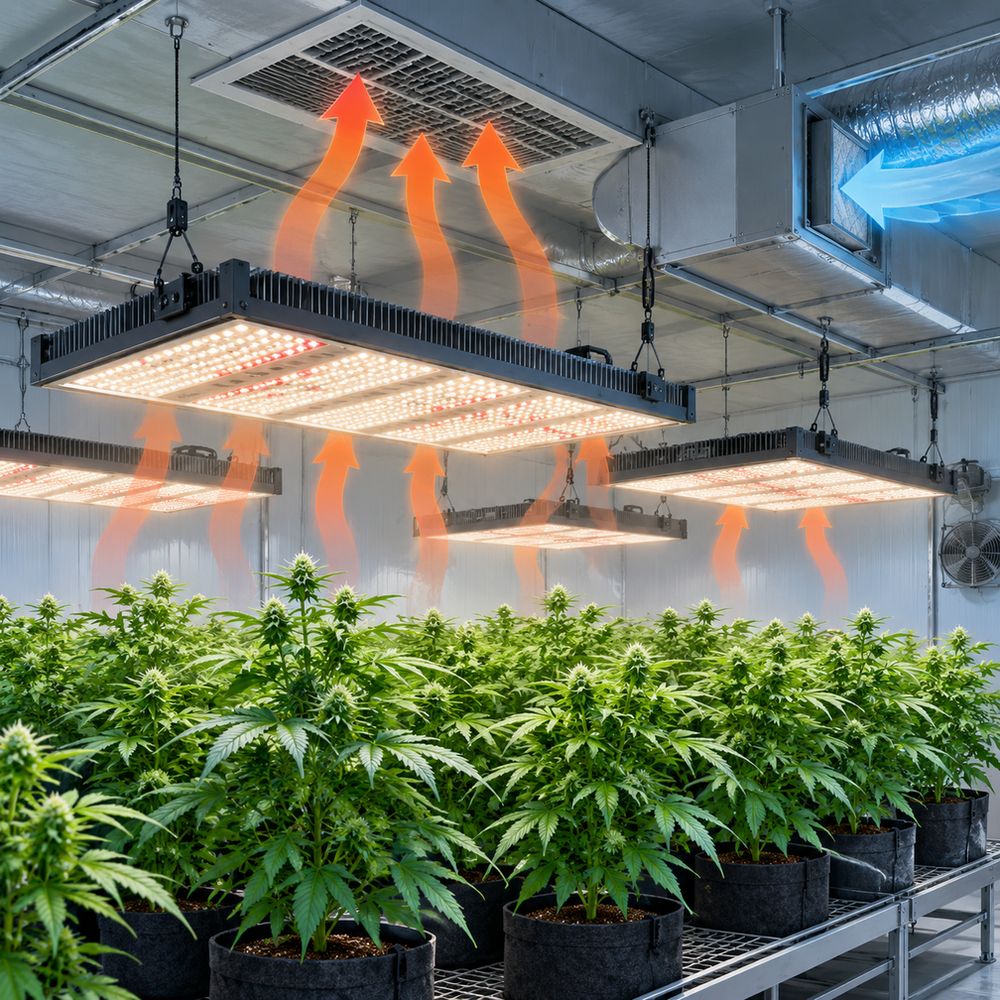
In a sealed indoor grow room, the electrical input of lighting is a major internal heat source. DOE building guidance says lighting introduces heat and increases cooling loads, and recommends accounting for lighting benefits when sizing HVAC. For horticulture, the same accounting must also include the photoperiod, dimming curve, driver location, dehumidification, and the crop environment.
Electrical input is the starting point for a grow-room heat budget.
1. Define the lighting load boundary
Count only the equipment that releases heat into the conditioned room. Include fixture input watts and in-room drivers; treat remote drivers, exhaust, heat recovery, and light leaving through openings as separate terms. Use measured input power at the intended operating point.
2. Convert watts to a screening heat load
For a closed room, a useful screening conversion is 1 W ≈ 3.412 Btu/h. Thus 12 fixtures measured at 650 W each represent 7,800 W, or about 26,600 Btu/h, before adding pumps, people, envelope gains, and moisture loads. This is not a final equipment-selection calculation.
3. Map the photoperiod and dimming curve
Peak load and daily energy are different. A 16-hour schedule at 70% output has a different hourly profile from a 12-hour schedule at 100%. Feed the actual schedule into an hourly load model and coordinate lighting controls with HVAC and dehumidification controls.
Comparison table for commissioning
| Load item | Screening calculation | Condition |
|---|---|---|
| Fixture electrical input | N fixtures × measured W per fixture | All drivers and wiring included if inside room |
| Sensible heat equivalent | Watts × 3.412 = Btu/h | Closed conditioned room; nearly all input becomes heat |
| Daily lighting energy | Watts × photoperiod hours | Use the actual dimming schedule |
| Design HVAC load | Lighting gain + other internal and envelope gains | Use hourly engineering model for final sizing |
Frequently asked questions
Is LED input wattage the same as heat released into a grow room?
For a closed indoor room, nearly all electrical input eventually becomes heat, although the timing and path vary. Use measured fixture input power as the starting internal-load term, then account separately for drivers outside the room, exhaust or heat recovery, and any light energy leaving through openings or being absorbed by processes.
What is a quick sensible heat estimate for a 1,000 W lighting load?
A 1,000 W electrical load is approximately 3,412 Btu/h of heat when it is released inside the conditioned space, because 1 W equals 3.412 Btu/h. This is a screening calculation, not a final HVAC design; add people, pumps, dehumidification, envelope gains, and safety margin.
Why should lighting schedules be included in HVAC calculations?
The lighting schedule determines when the internal load exists. A room lit for 16 hours has a different daily heat profile from one lit for 12 hours, even if peak wattage is identical. Use the actual photoperiod and dimming profile in hourly load calculations.
Can lower-efficacy lighting require more cooling capacity?
At equal useful light, lower efficacy generally requires more electrical input, and that extra input becomes additional heat in a closed room. Compare systems using measured input watts at the intended dimming level and operating temperature, not nominal LED package wattage.
About the publisher
XineLam publishes technical LED lighting guidance and has 17 years of experience and 300+ patents in China and internationally.
Sources
- U.S. Department of Energy, Chapter 5: Lighting, HVAC, and Plumbing — https://www1.eere.energy.gov/buildings/publications/pdfs/commercial_initiative/sustainable_guide_ch5.pdf
- U.S. Department of Energy, Increasing Efficiency of Building Systems and Technologies — https://www.energy.gov/sites/prod/files/2017/03/f34/qtr-2015-chapter5.pdf