How to Calculate LED Junction Temperature and Thermal Resistance in Horticultural Luminaires
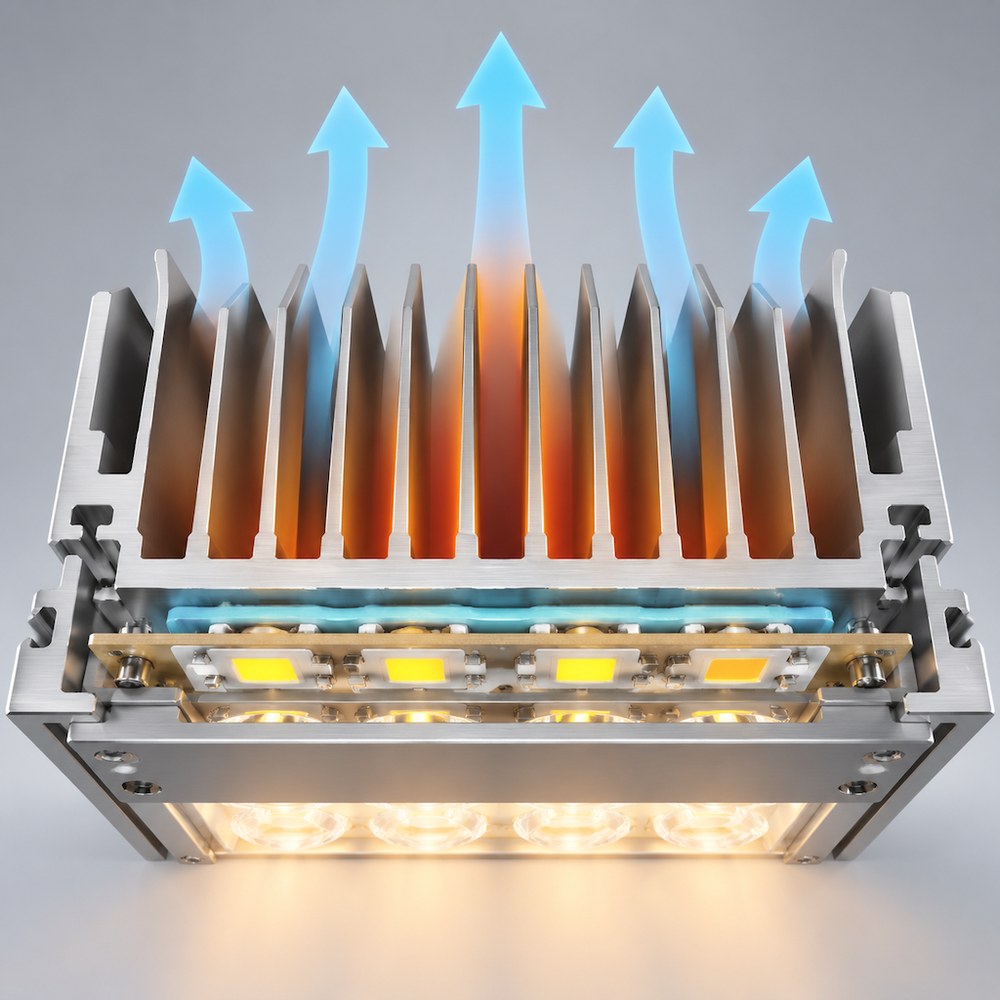
In high-power horticultural LED luminaires, approximately 45% to 55% of the input electrical power is converted into optical radiation (photons), while the remaining 45% to 55% is dissipated directly as thermal energy at the semiconductor p-n junction. Because LEDs emit zero forward infrared radiation (unlike incandescent or high-pressure sodium lamps), all generated waste heat must be conducted away through solid interfaces to an external heat sink.
Operating LEDs at elevated junction temperatures (Tj) accelerates phosphor degradation, causes thermal quenching of deep-red (660 nm) emitters, and drastically shortens fixture operating lifetime. According to technical reports by the U.S. Department of Energy (DOE) Solid-State Lighting Program, thermal management is the single most critical factor dictating long-term photon maintenance (IES LM-80 / TM-21 projections).
1. The 1D Thermal Resistance Network Model (JEDEC JESD51)
Thermal heat flow through an LED luminaire follows Fourier's law of heat conduction, analogous to Ohm's law in electrical circuits. Following JEDEC Standard JESD51 (Thermal Measurement of Component Packages), the total thermal resistance from junction to ambient (Rth(j-a), in °C/W or K/W) is the sum of series thermal resistances:
Rth(j-a) = Rth(j-s) + Rth(s-b) + Rth(tim) + Rth(hs-a)
Where:
• Rth(j-s): LED package junction-to-solder point thermal resistance (°C/W)
• Rth(s-b): PCB dielectric layer thermal resistance (°C/W)
• Rth(tim): Thermal Interface Material (paste/pad) resistance (°C/W)
• Rth(hs-a): Heat sink to ambient air convective/radiative resistance (°C/W)
2. In-Situ Solder Point Temperature (Ts) Measurement and Tj Calculation
Because the microscopic semiconductor p-n junction is encapsulated within optical silicone, direct physical probing is impossible. Engineers measure the in-situ solder point temperature (Ts) at the designated cathode or thermal pad using a Type-K fine-gauge (36 AWG) thermocouple bonded with thermally conductive epoxy.
1. Electrical Input Power: P_elec = I_f × V_f
2. Thermal Dissipation Power: P_th = P_elec × (1 - η_opt)
(η_opt is the radiant optical efficiency, typically 0.48 to 0.52 for top-tier horticultural LEDs)
3. Junction Temperature: T_j = T_s + (P_th × Rth(j-s))
4. Required Heat Sink Thermal Resistance: Rth(hs-a) = [(T_j - T_ambient) / P_th_total] - [Rth(j-s) + Rth(pcb) + Rth(tim)]
3. Quantitative Impact of Junction Temperature on Horticultural Performance
The table below summarizes the measured electrical, optical, and reliability degradation of top-tier 660 nm deep-red and 4000K white horticultural LEDs across different junction temperatures (Tj):
| Thermal & Optical Parameters | Optimal Design (Tj = 55°C) | Standard Design (Tj = 75°C) | Marginal Design (Tj = 95°C) | Extreme Stress (Tj = 115°C) |
|---|---|---|---|---|
| Deep-Red (660nm) Relative Photon Output | 100.0% (Reference) | 95.2% (-4.8%) | 89.4% (-10.6%) | 81.8% (-18.2%) |
| Peak Wavelength Shift (Deep-Red) | 660.0 nm | +2.9 nm (662.9 nm) | +5.8 nm (665.8 nm) | +8.7 nm (668.7 nm) |
| Luminaire Efficacy (PPE, μmol/J) | 2.88 μmol/J | 2.74 μmol/J | 2.54 μmol/J | 2.28 μmol/J |
| Projected TM-21 L90 Lifetime | > 65,000 Hours | > 52,000 Hours | 31,000 Hours | 16,500 Hours |
| Projected TM-21 L70 Lifetime | > 100,000 Hours | > 90,000 Hours | 68,000 Hours | 38,000 Hours |
| Relative Forward Voltage Drop (ΔVf) | -0.05 V | -0.09 V | -0.14 V | -0.19 V |
4. Step-by-Step Thermal Sizing Calculation Example
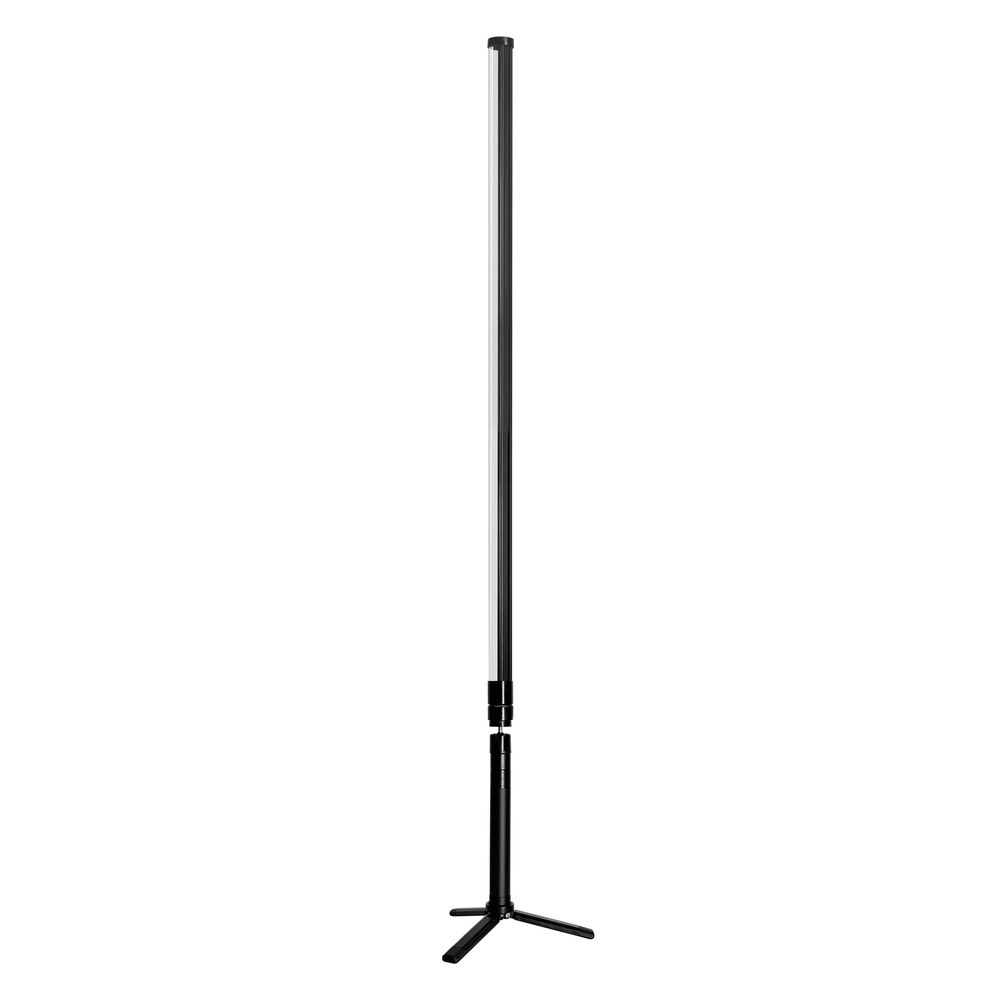
Consider a 100W vertical farming LED light bar operating in a 30°C ambient indoor facility:
- Total LED forward power:
P_elec = 100Wacross 120 mid-power LEDs. - Radiant optical efficiency:
η_opt = 50%→ Thermal dissipation:P_th = 50W. - Single LED package thermal resistance:
Rth(j-s) = 8.0 °C/W. With 120 LEDs in parallel/series array, array equivalentRth(j-s)_eff = 8.0 / 120 = 0.067 °C/W. - Metal Core PCB (MCPCB, 2.0 W/m·K dielectric):
Rth(s-b) = 0.12 °C/W. - Thermal interface material (TIM phase-change sheet, 3.5 W/m·K):
Rth(tim) = 0.08 °C/W. - Target maximum junction temperature:
T_j_target = 70°CatT_ambient = 30°C(ΔT = 40°C).
Total allowable thermal resistance: Rth_total = ΔT / P_th = 40°C / 50W = 0.80 °C/W.
Required heat sink resistance: Rth(hs-a) = 0.80 - (0.067 + 0.12 + 0.08) = 0.533 °C/W.
An extruded 6063-T5 aluminum profile with a surface area of ≥ 1,450 cm² under natural convection will safely achieve Rth(hs-a) ≤ 0.50 °C/W, maintaining T_j below 68.5°C.
5. Frequently Asked Questions (FAQ)
What is the maximum recommended LED junction temperature for horticultural grow lights?
For horticultural LED luminaires expected to achieve L90 > 50,000 hours in high-humidity greenhouse or vertical farming environments, the recommended maximum continuous junction temperature (Tj) is 85 degrees Celsius, with an optimal design target of 65 to 75 degrees Celsius.
How does elevated junction temperature degrade photosynthetic photon efficacy (PPE)?
As junction temperature rises from 25 C to 85 C, deep red (660 nm) LED radiant flux drops by 8% to 14% due to non-radiative recombination and carrier leakage, and emission wavelengths undergo a red-shift of approximately 0.15 nm per degree Celsius, reducing overall micromol per joule photon efficacy.
How can engineers measure junction temperature if the internal semiconductor die is inaccessible?
Engineers measure the solder point temperature (Ts) at the LED thermal pad using a fine-gauge thermocouple (e.g., Type K 36 AWG), then calculate Tj using the formula: Tj = Ts + (P_th * Rth_j-s), where P_th is thermal power and Rth_j-s is the package thermal resistance.
What standard governs LED lumen and photon maintenance lifetime projections?
IES LM-80 defines laboratory test protocols for measuring luminous flux and photon maintenance over at least 6,000 to 10,000 hours at defined case temperatures, while IES TM-21 provides mathematical exponential curve-fitting algorithms to project long-term L70, L80, and L90 lifetimes.
About the Publisher
XineLam is an optical and thermal engineering lighting manufacturer with 17 years of experience and 300+ patents in China and internationally. Specializing in high-uniformity horticultural LED systems, precision backlighting, and commercial agricultural luminaires, XineLam delivers energy-efficient optical solutions validated by standardized photobiological testing.