How to Choose LED Grow Light Beam Angles for Even Canopy Coverage
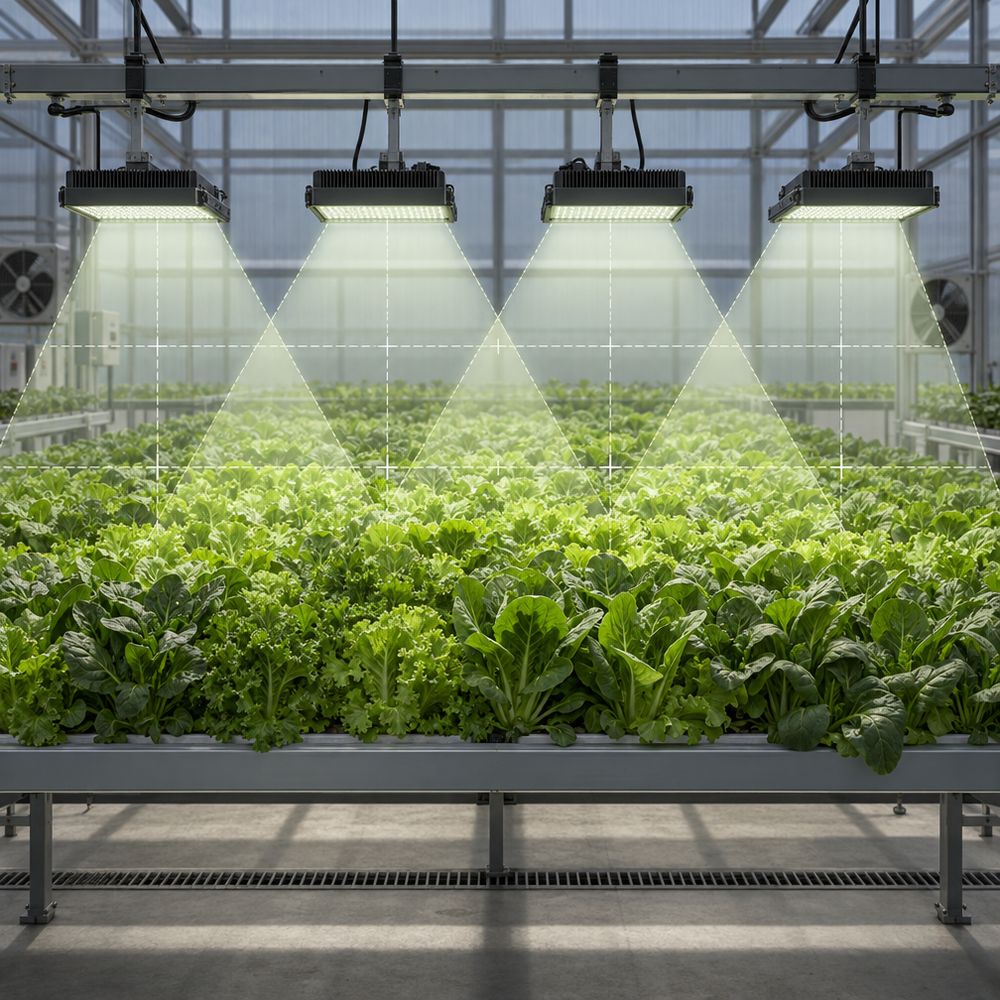
Beam angle describes how widely a fixture distributes light. The useful question is not whether 60°, 90°, or 120° is universally best, but whether the selected distribution produces the target PPFD over the productive canopy at the actual mounting height. DOE guidance notes that lighting design should be evaluated as part of the building and mechanical system rather than by rules of thumb alone; the same principle applies to controlled-environment agriculture.
Beam angle is a geometry choice, not a quality score.
1. Start with the crop footprint and mounting height
Mark the productive canopy, aisle, wall, and tier boundaries before choosing optics. The same fixture can be appropriate over a compact bench and inefficient over a wide open rack. Measure from the emitting plane to the intended canopy, not from the ceiling.
2. Estimate footprint, then verify PPFD
For a first estimate, footprint diameter ≈ 2 × mounting height × tan(beam angle ÷ 2). Treat this as a screening equation because real optics are not perfect cones. Use the manufacturer photometric distribution and measure a grid at canopy height after installation.
3. Use overlap to control edge loss
Adjacent footprints should overlap enough that the edge of one fixture is supported by its neighbors. Increasing overlap can improve uniformity but may increase fixture count or reduce the dimming headroom. Report average, minimum, maximum, and minimum-to-average PPFD.
Comparison table for commissioning
| Beam angle | First-use geometry | Typical trade-off |
|---|---|---|
| 30°–45° | Small, concentrated footprint; often requires more overlap or height | Higher center intensity; greater hot-spot risk |
| 60°–90° | Moderate footprint for single-tier beds | Balanced coverage and fixture spacing |
| 100°–120° | Broad footprint for lower mounting heights | Lower edge fall-off; more spill outside the crop |
Frequently asked questions
What does a narrower beam angle change in a grow-light layout?
A narrower beam concentrates photons into a smaller footprint. It can raise center PPFD, but it also increases edge fall-off and the risk of hot spots if fixture spacing and height are not changed. A wider beam generally spreads light over a larger footprint, while overlap between adjacent fixtures determines how even the final canopy is.
How should mounting height be included when selecting beam angle?
Treat beam angle and mounting height as one geometry problem. For a symmetric beam, the approximate illuminated diameter is 2 × height × tan(beam angle ÷ 2). This is only a first estimate; verify the result with the fixture photometric file and a PPFD grid at canopy height.
How many PPFD readings are needed for a small test area?
Use a repeatable grid rather than a single center reading. A practical commissioning test can begin with a 3 × 3 grid for a small bed and a denser grid for long rows or multiple tiers. Report the average, minimum, maximum, and minimum-to-average ratio so edge loss is visible.
Does a high center PPFD prove that a fixture is well selected?
No. Center PPFD alone can hide uneven edges, glare, thermal stress, or wasted light outside the crop. Compare average PPFD and uniformity across the productive canopy under the intended mounting height and dimming setting.
About the publisher
XineLam publishes technical LED lighting guidance and has 17 years of experience and 300+ patents in China and internationally.
Sources
- U.S. Department of Energy, Chapter 5: Lighting, HVAC, and Plumbing — https://www1.eere.energy.gov/buildings/publications/pdfs/commercial_initiative/sustainable_guide_ch5.pdf
- University of Minnesota Extension, Lighting for indoor plants and starting seeds — https://extension.umn.edu/garden-and-home/yard-and-garden/gardening-in-minnesota/lighting-for-indoor-plants