How to Light a Vertical Farm: Multilayer Rack Lighting Design
In a vertical farm the light is not an accessory bolted onto a building — it is one of the design variables that decides how many tiers you can stack, how tall each tier has to be, and how much heat the room must remove. This guide walks through the five decisions in the order that keeps them from contradicting each other.
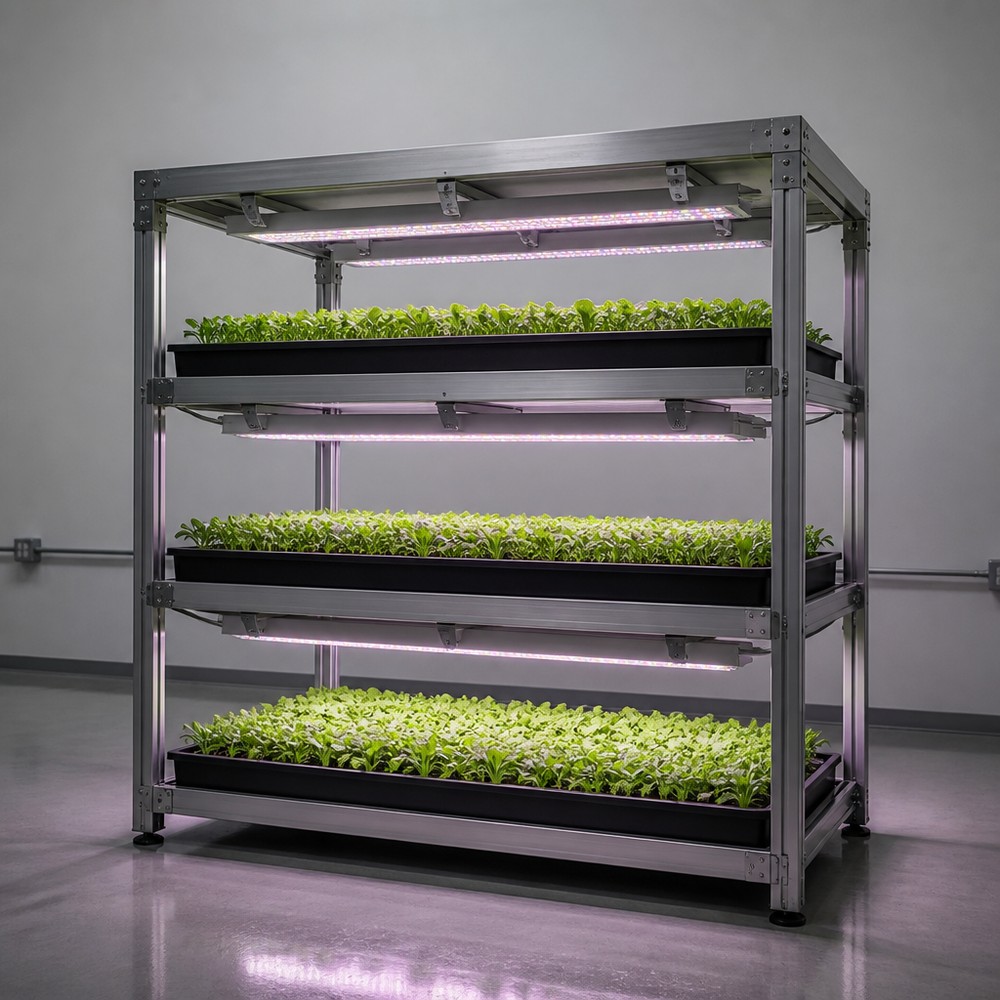
Why multilayer rack lighting is a design problem, not a product choice
In a greenhouse, sunlight pays for most of the photons and a fixture only tops the day up. Under a rack there is no sun: every photon is bought with electricity, and the fraction of that electricity that does not leave as light stays in the room as heat. That reverses the usual sequence. Instead of picking a fixture and then measuring what it does, you set the crop target first, derive the numbers the room must deliver, and only then size hardware.
Three quantities drive everything else: the daily light integral (DLI) the crop needs, the geometry of the tiers, and the heat the room can reject. The steps below take them in that order.
Step 1 — Set a daily light integral target for each crop group
DLI is the total photosynthetic photon flux delivered over a day. It is the number that actually correlates with growth, and it is the only light figure that combines intensity and time. The relationship is straightforward:
The same DLI can be produced by different combinations of intensity and duration, which is why the target should be written as DLI first and converted into PPFD afterwards.
| Crop group | Target PPFD (µmol·m⁻²·s⁻¹) | Photoperiod (h) | Resulting DLI (mol·m⁻²·d⁻¹) |
|---|---|---|---|
| Microgreens | 200–300 | 16 | 11.5–17.3 |
| Leaf lettuce | 200–250 | 16 | 11.5–14.4 |
| Basil and culinary herbs | 300–400 | 16 | 17.3–23.0 |
| Baby kale and mustard | 250–350 | 16 | 14.4–20.2 |
| Fruiting crops (pepper, tomato) | 400–600 | 14 | 20.2–30.2 |
Two conditions matter when these numbers are used. First, PPFD has to be measured at canopy height, because the value printed on a fixture is taken at a defined distance in open air and a rack is not open air. Second, any DLI figure assumes the photoperiod is actually achieved — a schedule that loses two hours to a timer error has lost two hours of growth.
Step 2 — Turn the DLI target into a PPFD and a photoperiod
Photoperiod is not free to extend. Running leafy greens at 20–24 hours can produce tipburn and reduce quality in some cultivars, and it compresses the dark period that plants use for other processes. A 16-hour photoperiod with a higher PPFD is the more common solution indoors.
The trade-off is cost. Photons delivered at higher intensity require more fixtures and a higher connected load, and every additional watt becomes heat. Engineering practice for horticultural LED products is moving in the other direction — the DesignLights Consortium has raised its minimum photosynthetic photon efficacy thresholds across revisions of its horticultural technical requirements, which makes efficacy (µmol·J⁻¹), not wattage, the number to compare when the same DLI can be reached with fewer watts.
Step 3 — Fix the layer height from PPFD falloff, not from the plant
Tier height is usually set by the tallest crop expected on that shelf, and then the light is expected to cope. It is more reliable to work backwards from how much the irradiance falls with distance. For an ideal point source, irradiance follows the inverse-square law and doubling the distance quarters the value. Real fixtures are extended sources, so the measured falloff is shallower — but never zero, and it steepens as the canopy approaches the light plane.
Two practical consequences follow. A short tier means less distance for the beam to spread, so uniformity suffers first and intensity second. And because falloff is steepest close to the fixture, a tray that starts at 10 cm from the light and finishes at 20 cm can see a large gradient across a single crop cycle.
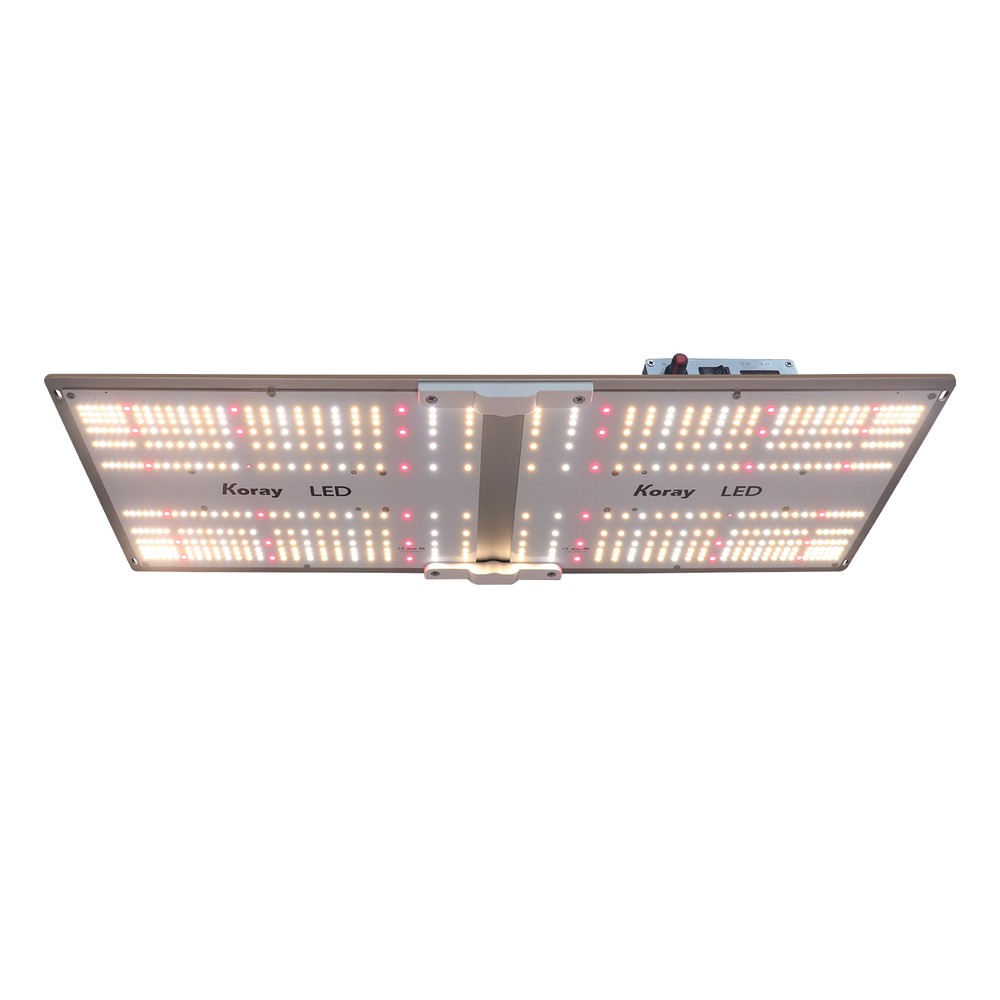
Step 4 — Check uniformity across the tray, not just the centre
A single PPFD reading in the centre of a tray says very little about a rack. What matters is the distribution: the drop from the centre to the corners and along the edges, and whether the pattern repeats on every tier. The practical test is a grid — nine to twenty-five measurements per tray at canopy height — and then a comparison of the lowest reading with the highest.
Reflective surfaces and enclosure walls change this picture in both directions. Light that bounces back from a wall raises the edge readings and improves uniformity; a dark wall or a gap between trays does the opposite. Because racks are physically enclosed, reflections are easier to control under a rack than in an open room, but they also make the result depend on the room rather than on the fixture alone.
Step 5 — Design photoperiod and heat load together
In a sealed room the light is a heater that happens to emit photons. Every watt that does not leave the room as visible or near-infrared radiation is eventually converted to heat at the surfaces it lands on, so the photoperiod and the cooling capacity are the same calculation. A 100 W fixture on a 16-hour schedule puts about 1.6 kWh of energy into the room per day; scaling that to a hundred fixtures across five tiers is how a lighting plan becomes an HVAC plan.
That has a direct bearing on tier design. Shorter tiers pack more fixtures into the same footprint, which raises yield per cubic metre but also raises the heat density the air handling has to manage. In practice the limit on how tightly tiers can be stacked indoors is often thermal, not photometric.
Spectrum decisions for leafy greens under racks
For leafy greens, a base of red around 660 nm with a blue channel near 450 nm covers photosynthesis and morphology; adding white or green makes visual inspection of the crop easier and gives a broader spectrum. Reviews of vertical farming development describe spectral composition as one of the active optimisation variables in these systems, alongside light intensity and photoperiod, precisely because the response is crop-specific rather than universal.
What the spectrum does not fix is a badly distributed beam. Uniformity and DLI come first; spectrum is tuned after those are under control.
Common design mistakes to avoid
- Sizing fixtures before the DLI target is written down, so the crop ends up matched to whatever hardware was available.
- Measuring PPFD at the fixture rather than at the canopy, which overstates the light the plants receive.
- Sampling only the centre of the tray and discovering the edge drop after planting.
- Stacking tiers to the height limit and treating the resulting heat load as an HVAC problem afterwards.
- Running all crops on one photoperiod because it is convenient for the schedule rather than appropriate for the crop.
FAQ
How much PPFD do leafy greens need in a vertical farm?
A working range of about 200–300 µmol·m⁻²·s⁻¹ over a 16-hour photoperiod is common for lettuce and leafy greens, which delivers roughly 11.5–17.3 mol·m⁻²·d⁻¹ of DLI. Measure at canopy height rather than at the fixture.
How far should each rack tier sit below the light above it?
It depends on how evenly the fixture spreads light. For a bar array that spans the tray width, 15–30 cm between the light plane and a full canopy is a common starting point; the deciding test is a PPFD grid measured at canopy level, not a fixed distance.
Can every tier run the same photoperiod?
Yes — tiers in one room share one schedule. Group crops with similar DLI targets on the same shelf stack, otherwise the schedule ends up dictated by the most demanding crop and the others receive more light than they need.
Does LED lighting add heat to a sealed growing room?
Essentially all of the electrical energy a fixture consumes ends up as heat inside the room. A 100 W fixture on a 16-hour photoperiod adds about 1.6 kWh of heat energy per day, which the HVAC system has to remove.
References
- Recent developments and inventive approaches in vertical farming (Frontiers in Sustainable Food Systems) — https://www.frontiersin.org/journals/sustainable-food-systems/articles/10.3389/fsufs.2024.1400787/full
- DesignLights Consortium — Horticultural Technical Requirements — https://designlights.org/our-work/horticultural-lighting/technical-requirements/
- Torres, A. P. & Lopez, R. G. — Measuring Daily Light Integral in a Greenhouse (Purdue Extension HO-238-W) — https://www.extension.purdue.edu/extmedia/ho/ho-238-w.pdf
About the publisher
XineLam manufactures LED lighting and horticultural LED fixtures. The company reports 17 years of experience in LED lighting and 300+ patents in China and internationally. This article is a general design reference for controlled-environment lighting and is written for growers and systems integrators; it is not a specification for a particular installation.
Where a rack design needs a specific fixture, the relevant quantities are the photon efficacy, the beam distribution across the tray width, and the thermal load at the intended tier spacing.