How to Light a Vertical Farm: Layers, Uniformity and Heat Load
Multi-tier lighting fails in three predictable places: the daily light integral is set from the fixture instead of the crop, the tier pitch is chosen before the beam is understood, and the cooling load is sized as if LEDs produced no heat. This guide works through all three with numbers you can substitute into your own room.
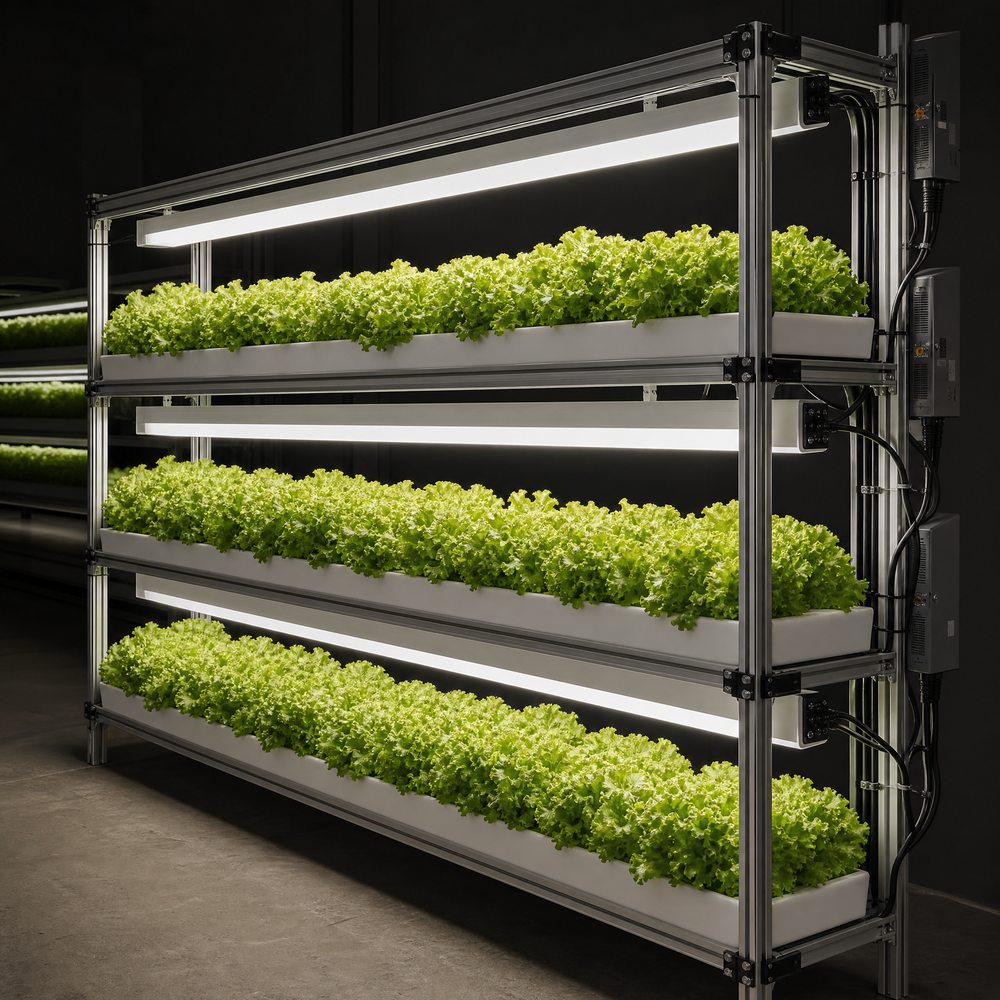
Start from the crop's daily light integral, not from the fixture
Every lighting decision on a rack is downstream of one number: how many moles of photosynthetically active photons each square metre of canopy should receive per day. Fix that first, because it sets the electrical load, the cooling load and the tier count together.
| Crop | Target DLI (mol·m-2·d-1) | Typical photoperiod (h) | Implied average PPFD (µmol·m-2·s-1) |
|---|---|---|---|
| Microgreens | 6–12 | 14–16 | 120–240 |
| Lettuce, leafy greens | 12–17 | 16 | 210–295 |
| Basil and culinary herbs | 12–20 | 16 | 210–350 |
| Transplant propagation | 8–14 | 16–18 | 125–245 |
Layer geometry: what tier pitch and fixture distance actually cost
Tier pitch is usually decided by the building, then lighting is asked to fit. That order produces the classic result: a fixture squeezed into 30 cm of headroom sits almost on the crop, delivers a narrow beam with a bright centre and dark edges, and heats the leaf surface it is supposed to illuminate.
A workable sequence for leafy greens and herbs:
- Crop height at harvest, measured, not estimated — typically 20 to 25 cm for lettuce in a shallow trough.
- Clearance for airflow: 10 to 15 cm above the canopy so the air handling system can move 0.3 to 0.6 m s-1 across the leaf surface.
- Fixture plus driver depth: 6 to 12 cm for a linear bar with an integrated driver, more for a panel.
- Service gap: whatever you need to reach in with a hand and a cloth for cleaning between cycles.
Add them and a 40 to 60 cm finished tier pitch is what the arithmetic gives. The fixture then sits 15 to 25 cm above the canopy, which is close enough to keep photons on the crop and far enough that the beam still overlaps its neighbour. Two or three tiers of savings in building height are worth much less than a uniform crop on the tiers you already have.
Where the beam falls off at the end of a row, the answer is usually a shorter fixture staggered in the row rather than a longer one, or a reflective end wall. Published work on two-level units shows that light distribution, not installed wattage, is what decides whether the second level performs like the first.
Uniformity: the metric that decides whether the bottom shelf pays
Uniformity is measured, not assumed. Take a grid of at least nine points per tier at canopy height — three along the row by three across it, plus the corners if the tier is wide — and record PPFD at each. Then calculate minimum ÷ average.
Average = 250. Minimum = 180. Uniformity = 180 ÷ 250 = 0.72.
That is acceptable but not good: the darkest point receives 28 percent less light than the tier average, so it will finish later and lighter than the rest of the shelf.
Target 0.7 or better and treat below 0.6 as a design fault. Three levers move the number, in order of cost effectiveness: reduce fixture spacing along the row until the beams overlap at canopy height; raise the fixture a few centimetres, which widens each beam and costs PPFD that can be recovered by dimming less; and lighten the surfaces — a matt white tray and a reflective side wall return photons that would otherwise be lost.
The bottom tier is almost always the worst, for two reasons: the fixture above it is at its lowest and the aisle is darkest. Measure it first. If the bottom tier is below 0.6 while the top is at 0.8, the rack has a lighting problem that no schedule change will fix.
Heat load: where the watts actually go
LEDs are efficient at making photons, not at making heat disappear. In a sealed room, essentially all of the electrical energy ends up as heat: the portion that leaves the fixture as light is absorbed by the canopy, the trays and the walls, and is dissipated there. The practical rule is that the lighting load is very nearly the cooling load.
Growing area = 7.2 m2 per tier × 3 = 21.6 m2.
Photon flux required = 21.6 × 250 = 5,400 µmol·s-1.
Electrical power = 5,400 ÷ 2.8 ≈ 1,930 W.
Sensible heat inside the room while lit ≈ 1.9 kW, plus plant transpiration and any fan power.
Daily lighting energy = 1.93 kW × 16 h ≈ 31 kWh.
Three consequences follow. First, the HVAC sizing conversation starts with the lighting schedule, not with the room volume. Second, moving drivers outside the envelope removes their losses from the room load — a real gain, but only the driver share, not the LED share. Third, because light absorbed by the canopy becomes heat at the leaf surface, a fixture that is too close creates a local heat problem even when the room's average load is fine. That is why the same fixture can perform well at 25 cm and badly at 10 cm.
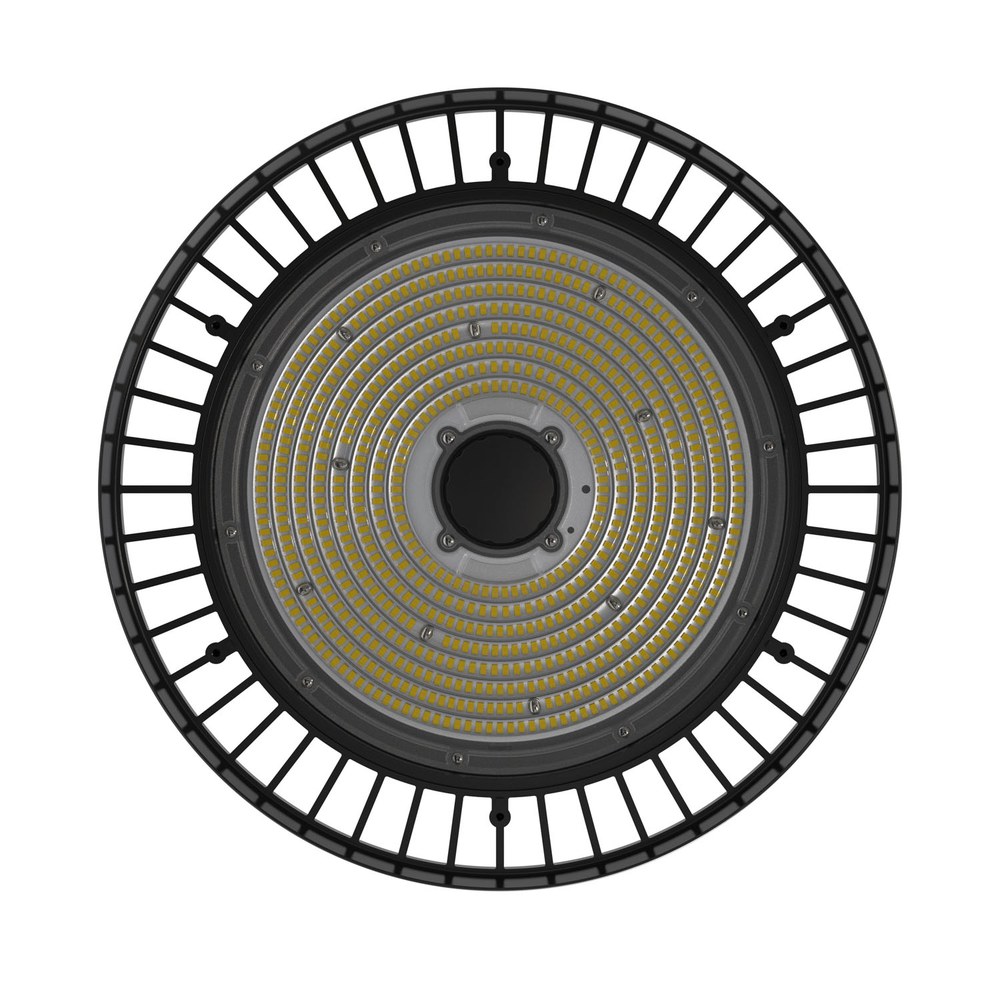
Fixture form factors compared
There is no best form factor, only a best fit for a given tier pitch. The table compares the three shapes used most often on vertical racks; the efficacy figures are the range typical of horticultural products in each class rather than a claim about any single model.
| Dimension | Linear bar (1.0–1.5 m) | Wide panel / board | Round high-bay module |
|---|---|---|---|
| Typical efficacy | 2.6–3.0 µmol·J-1 | 2.4–2.8 µmol·J-1 | 2.2–2.6 µmol·J-1 |
| Uniformity at 15–25 cm | Good when bars are spaced 20–30 cm apart | Best — one unit covers the tier width | Needs units spaced at roughly the mounting height |
| Heat path | Extruded aluminium, passive, large surface | Large flat heat sink, heavier | Finned body, concentrated hot spot |
| Best tier pitch | 40–50 cm | 50–60 cm | 60 cm and above |
| Main risk on a rack | Dark stripes between bars if spacing is too wide | Weight, cleaning access, cost | Bright centre, dark corners at close range |
| Suits | Narrow troughs, retrofit of existing shelves | Wide tiers, research rooms, high-value crops | Tall crops, single-layer greenhouses |
Dimming, spectrum and control
Dimming is not a comfort feature on a vertical farm; it is what lets the photoperiod and the intensity follow the crop instead of the calendar. Two practical points. First, dim by current rather than by switching rows on and off: switching changes uniformity, dimming does not. Second, check that the driver remains efficient at low output — a driver that loses several percentage points of efficiency at 30 percent output can erase the savings the dimming was meant to create.
On spectrum, the defensible position for a commercial leafy-green rack is a broad white or white-plus-red recipe that keeps the red to blue ratio moderate, with far-red used deliberately and in small proportion rather than as an accident of the phosphor mix. Narrow spectra make the crop's response harder to predict across cultivars and seasons, and they make diagnosis harder when something goes wrong.
Commissioning checklist
- Measure PPFD on a nine-point grid per tier at canopy height, lights at operating temperature, and record the numbers per tier.
- Calculate uniformity for every tier; identify the worst tier before signing off.
- Log actual electrical input per tier with a meter, not from the datasheet, and compare it with the design DLI.
- Measure leaf temperature at the brightest point on the top and bottom tiers, at midday in the light cycle.
- Confirm air speed at the canopy, not at the wall: 0.3 to 0.6 m s-1 is the working range for most leafy crops.
- Record the cooling load actually drawn while the lights are on, and check it against the lighting load plus latent load.
- Re-measure after the first crop, because trays, reflectors and dust all change the numbers.
About the publisher
XineLam is the grow light brand of Zhongshan City Ruixian Electronics Factory, an LED lighting manufacturer with 17 years of experience and 300+ patents in China and internationally. The company designs and produces horticultural fixtures, drivers and thermal assemblies for greenhouse and indoor cultivation, and publishes technical notes on the measurement and control of light in controlled environments.
Frequently asked questions
How tall should each tier be in a vertical farm?
For leafy greens and herbs, a finished tier pitch of 40 to 60 cm is the common range, with the fixture 15 to 25 cm above the canopy at harvest. The lower number saves building height and costs uniformity, because a fixture very close to the crop gives a narrow beam with a bright centre. Work backwards from crop height at harvest, plus clearance for airflow, plus fixture and driver depth, plus the gap you need for cleaning.
What light uniformity should I aim for on a vertical rack?
Measure PPFD on a grid of at least nine points per tier and divide the minimum by the average. Aim for 0.7 or better and treat anything below 0.6 as a design fault rather than a tuning issue. The bottom tier usually measures worst, because the fixture above it sits lowest and the aisle around it is darkest.
Does LED lighting still heat a sealed grow room?
Yes. LEDs convert electricity into usable photons more efficiently, but in a sealed room essentially all of that energy ends up as heat: photons absorbed by the canopy are dissipated as heat, and light reaching a wall is absorbed there too. The lighting load is therefore very nearly the cooling load. Only the part rejected outside the envelope — drivers mounted in a corridor, for instance — is not a load on the room.
Should I add a fourth tier or raise PPFD on the three I have?
Compare the marginal cost per mole of delivered light. A fourth tier adds growing area but also building height, a fixture and rack steel, and it compresses the vertical space available to the three existing tiers, which usually hurts uniformity. Raising PPFD on existing tiers costs only power and cooling, and it reaches a biological ceiling sooner. In most retrofits the cheapest mole comes from fixing uniformity and closing the gap between tier and fixture, not from adding layers.
Sources
ISHS. Light distribution in a two-level unit with supplemental LED lighting in a hydroponic greenhouse. Acta Horticulturae.
ISHS. Lighting for high value pharmaceutical and nutraceutical crops in vertical farms. Acta Horticulturae.