How to Prevent Light Burn and Photoinhibition in Indoor Crops
Pale, bronzed or crisp upper leaves are usually blamed on “too much light”. Often they are photoinhibition, sometimes radiant heat, and sometimes a calcium delivery problem that more light only makes worse. This guide separates the four failures, gives the numbers that matter, and sets out a recovery sequence.
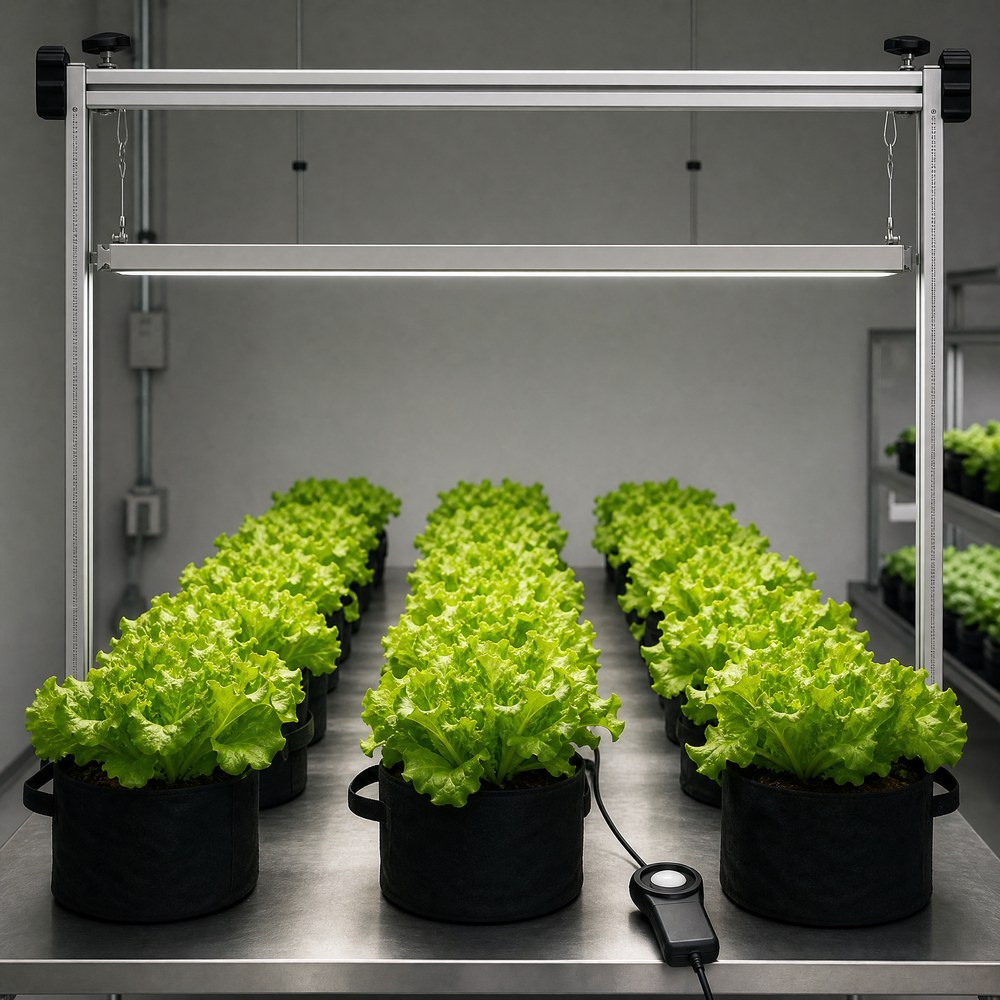
What growers call light burn is usually one of four failures
“Light burn” is a description of a symptom, not a diagnosis. In indoor rooms the same bleached, curled or scorched look can come from four quite different mechanisms, and the fix differs for each:
- Photoinhibition. Light arrives faster than the photosynthetic apparatus can use it. Photosystem II reaction centres are damaged and continuously repaired; when damage outruns repair, quantum efficiency drops and the leaf loses colour. It is reversible in the short term and becomes visible damage when it persists.
- Photo-oxidation and bleaching. Excess energy that cannot be dissipated safely produces reactive oxygen species, and pigments are destroyed. This is the mechanism behind the pale, almost white patches on top leaves.
- Radiant heat and leaf temperature. A fixture mounted too close warms the leaf above air temperature. Tissue at the beam centre dries and crisps even when the PPFD reading looks reasonable, because the thermometer, not the quantum sensor, is the relevant instrument.
- Calcium delivery failure. Fast growth under strong light outruns calcium transport to young tissue, causing tipburn on inner leaves. Adding more light makes it worse; the fix is transpiration and airflow, not intensity.
The useful habit is to ask which of the four fits the pattern on the plant, because two of them are fixed by turning the light down and two are not.
Telling them apart: a symptom table
Read the table by column, not by row. The location of the damage on the plant and its shape on the canopy do most of the diagnostic work; the quick test confirms it.
| What you see | Where it appears | Likely mechanism | Quick test |
|---|---|---|---|
| Pale, bronzed or whitish patches; slight cupping | Youngest fully expanded leaves, worst under the brightest zone, sharp boundary at the beam edge | Photoinhibition and photo-oxidation | Walk a PAR meter across the canopy. If damage sits where PPFD peaks, it is light chemistry, not nutrition. |
| Crisp brown margins, papery texture | Leaf edges directly under the fixture, upper canopy only | Radiant heat / leaf temperature above air temperature | Infrared leaf thermometer at midday. A leaf 3 °C or more above air temperature points to distance, not dose. |
| Brown, collapsed margins on inner, newly unfolding leaves | Centre of the head, hidden by outer leaves; roots healthy | Calcium delivery (tipburn) | Measure night humidity and airflow at the canopy. If the air is still, calcium is not moving, whatever the PPFD says. |
| Interveinal yellowing, then whole-leaf pallor | Older leaves first, spread across the whole canopy, not following the light map | Mobile nutrient shortage (nitrogen, magnesium) | Check substrate EC and pH before touching the light schedule. |
| Long internodes, small leaves, flat canopy | Whole crop, uniform | Too little light, or a spectrum skewed too far to far-red | Compare measured DLI against the crop target; check the fixture's actual output, not its rated wattage. |
How much light is too much? The numbers that decide it
There is no universal ceiling, because the ceiling moves with photoperiod, carbon dioxide, airflow and leaf temperature. What is stable is the shape of the response: as PPFD rises, net photosynthesis climbs steeply at first, then flattens as the light reactions saturate and the Calvin cycle becomes the limit. Everything above the flattening point is energy the plant must dissipate as heat or fluorescence, and that is where photoinhibition begins.
The practical targets below are the ranges used in commercial controlled-environment rooms for a 14 to 16 hour photoperiod at ambient carbon dioxide. They are starting points for a trial, not guarantees, and they should be confirmed against a measured PPFD map of your own canopy.
| Crop group | Canopy PPFD (µmol·m-2·s-1) | Daily light integral (mol·m-2·d-1) | Notes |
|---|---|---|---|
| Microgreens | 150–300 | 6–12 | Short cycles; the crop is harvested before damage accumulates |
| Lettuce and leafy greens | 200–400 | 12–17 | Above this, tipburn risk rises faster than yield |
| Culinary herbs (basil, mint) | 250–450 | 12–20 | Basil tolerates more than lettuce but responds to airflow |
| Tomato and pepper (indoor) | 400–700 | 20–30 | Needs carbon dioxide enrichment and active air movement to be useful |
Three conditions move the ceiling:
- Carbon dioxide. At 800–1200 ppm the saturation point shifts upward and the same PPFD is used more efficiently. Without enrichment, pushing intensity mainly adds heat.
- Leaf temperature. Net photosynthesis falls once tissue runs roughly 5 °C above the optimum for the species; hot leaves under strong light show damage at lower PPFD than cool ones.
- Air movement. Boundary-layer resistance at the leaf surface limits carbon dioxide uptake. Still air turns a moderate PPFD into a stress condition.
Photoperiod and the dark period matter as much as intensity
Daily light integral is intensity multiplied by time, so a modest PPFD over a long day and a high PPFD over a short day can deliver the same moles. They are not equivalent to the plant. Continuous light has been documented to injure tomato and pepper, producing chlorosis and necrosis of leaves even when the daily total is not extreme, and it removes the window in which damaged photosystem II is repaired and starch is exported from the leaf.
In practice, indoor rooms run 16 hours on and 8 off, or 18 on and 6 off, and treat anything beyond 20 hours as an experiment to be validated on a small block first. If a crop is short of light, the order of preference is: fix uniformity, then raise PPFD within the existing photoperiod, then extend the photoperiod slightly, and only then consider more fixtures.
Heat, humidity and airflow are the multipliers
A modern horticultural LED converts roughly 2.2 to 3.0 micromoles of photons per joule of input, which means a large share of the electrical energy still leaves the fixture as heat — from the heat sink, from the driver, and then from the canopy itself as the absorbed photons are dissipated. In a sealed room that heat has to be removed by the HVAC system, and near the canopy it shows up as a temperature difference between leaf and air.
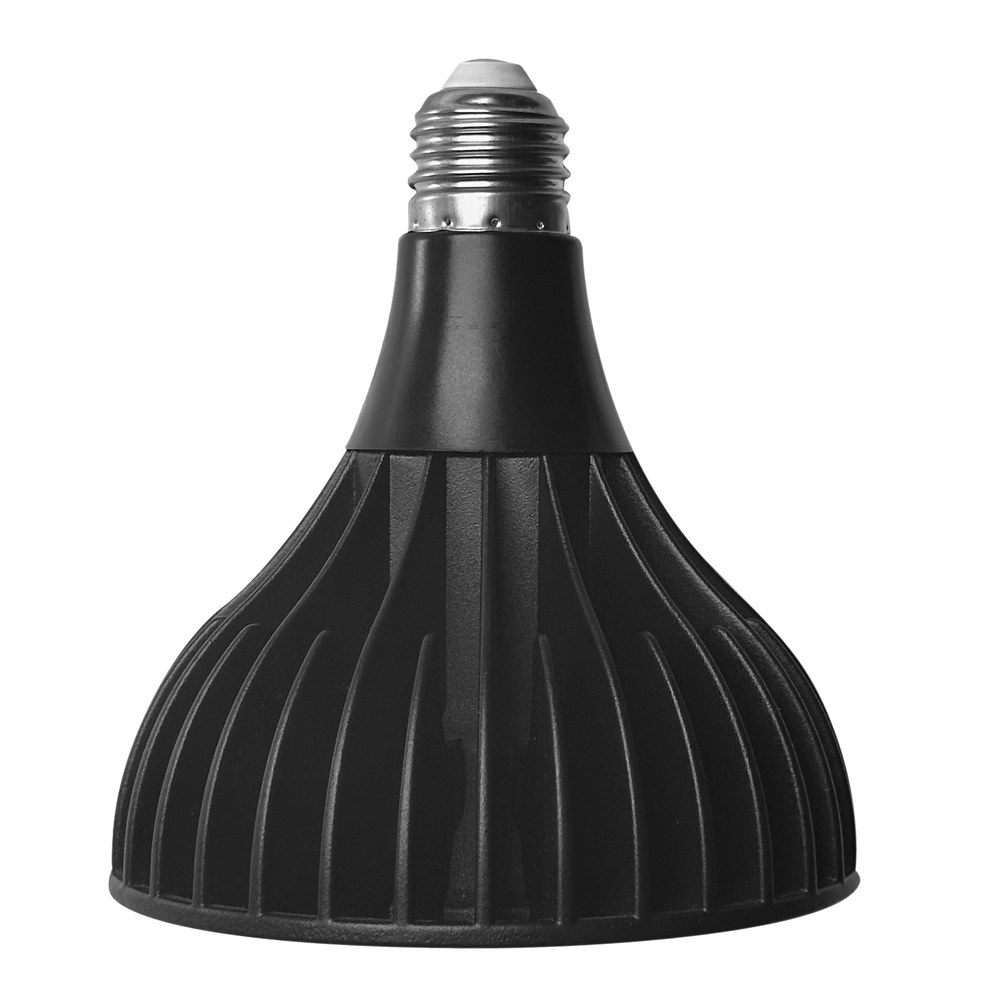
Two consequences follow. First, mounting height is a heat decision as much as a uniformity decision: raising a fixture 10 cm spreads the beam and lowers leaf temperature, at the cost of some PPFD at the canopy. Second, a directional lamp concentrates its output in a narrow cone, so the distance to the canopy decides whether the centre of the cone is a useful light source or a hot spot. A reflector lamp of the PAR38 type, for example, is normally hung well above the canopy for this reason; the finned body in Figure 2 is there to move heat away from the LEDs, not to make the beam safe at any distance.
A six-step recovery sequence
- Stop adding light for 48 hours. Dim to about 70 percent of the current setting or raise the fixture by 10 to 15 cm. Do not change nutrients at the same time; you will not know what worked.
- Measure before you decide. Take a nine-point PPFD grid at canopy height and a leaf temperature reading at the brightest point. Photograph both.
- Fix the air. Target 0.3 to 0.6 m s-1 of air speed at the canopy and keep the vapour pressure deficit in the range the crop was bred for. Moving air lowers leaf temperature and restores transpiration, which is what calcium delivery depends on.
- Re-check the dark period. Confirm that lights are actually off, including any inspection lighting, and that the night temperature is not stalling carbohydrate export.
- Reintroduce light in steps. Return to the target in increments of 10 to 15 percent every three to four days, watching the newest fully expanded leaf rather than the damaged one, which will not recover its colour.
- Record the ceiling. Write down the PPFD, photoperiod, leaf temperature and VPD at which the crop was healthy. That number, not the fixture's datasheet, is your room's limit.
What to change in the next cycle
Recovery treats the symptom. Four design changes prevent the repeat: a dimmable driver so intensity can follow the crop instead of the calendar; a mounting system that allows height adjustment in small increments; a beam layout that keeps uniformity across the canopy above about 0.7 so no single plant sits in the hot spot; and a spectrum that is not pushed to an extreme red ratio, because a narrow spectrum raises the risk that the light the plant receives cannot be used photochemically even when the PPFD number looks moderate.
About the publisher
XineLam is the grow light brand of Zhongshan City Ruixian Electronics Factory, an LED lighting manufacturer with 17 years of experience and 300+ patents in China and internationally. The company designs and produces horticultural fixtures, drivers and thermal assemblies for greenhouse and indoor cultivation, and publishes technical notes on the measurement and control of light in controlled environments.
Frequently asked questions
How do I know if my plants have light burn or a nutrient problem?
Light damage follows the light map: it appears on the upper leaves nearest the fixture and is worst under the brightest spot, with a fairly sharp edge where the beam falls off. Nutrient problems follow leaf age instead — older leaves first for mobile nutrients such as nitrogen and magnesium, new leaves for immobile ones such as calcium and iron. If the damage pattern matches the PPFD pattern rather than the plant's leaf order, suspect light.
What PPFD is too high for lettuce and herbs indoors?
There is no single ceiling, because the limit depends on photoperiod, carbon dioxide, airflow and leaf temperature. Leafy greens and herbs on a 14 to 16 hour cycle are usually run at 200 to 400 µmol·m-2·s-1 at the canopy, which is roughly 12 to 17 mol·m-2·d-1 for lettuce. Damage typically appears when a fixture is lowered to chase yield: the canopy receives more light than the crop can use, leaf temperature climbs, and repair cannot keep pace with damage.
Does a 24 hour photoperiod increase yield?
Not for most crops. Continuous light has been shown to injure tomato and pepper, producing leaf chlorosis and necrosis even at moderate daily totals, and many species grow worse under it. A dark period of at least four to six hours is ordinary practice for C3 crops indoors, and much of the repair of damaged photosystem II happens in the dark. If more light is genuinely needed, raise intensity inside a 16 to 18 hour window instead of removing the night.
When should I ask a lighting supplier rather than adjust the room myself?
Ask for a photometric layout when you are changing fixture count, mounting height or beam angle on a fixed rack, when measured uniformity across a canopy grid is below about 0.7, or when you need dimming and spectrum control the existing drivers cannot provide. Those are hardware decisions, and a measured PPFD map of the room is the useful input to that conversation.
Sources
Michigan State University Extension. Supplemental lighting: Common pitfalls and practical solutions. 2025.
Plants (MDPI), 2023. Resistance of Primary Photosynthesis to Photoinhibition in Antarctic Lichen — on photoprotective mechanisms under short-term high-light stress (PubMed Central full text).