How Much Light Do Indoor Strawberries Need? DLI, Photoperiod and Far-Red
Strawberries are one of the few fruit crops that can be grown to harvest on a rack indoors, and one of the least forgiving about light. Most disappointing indoor crops are not short of nutrients or CO2 — they are short of photons in the weeks when flower trusses and fruit are being set.
This article sets out what the numbers mean, how to convert a fixture schedule into a daily light integral, and which parts of the schedule are genotype-specific. Every value is stated with the conditions it assumes, because a PPFD figure without a distance and a photoperiod is not a specification.
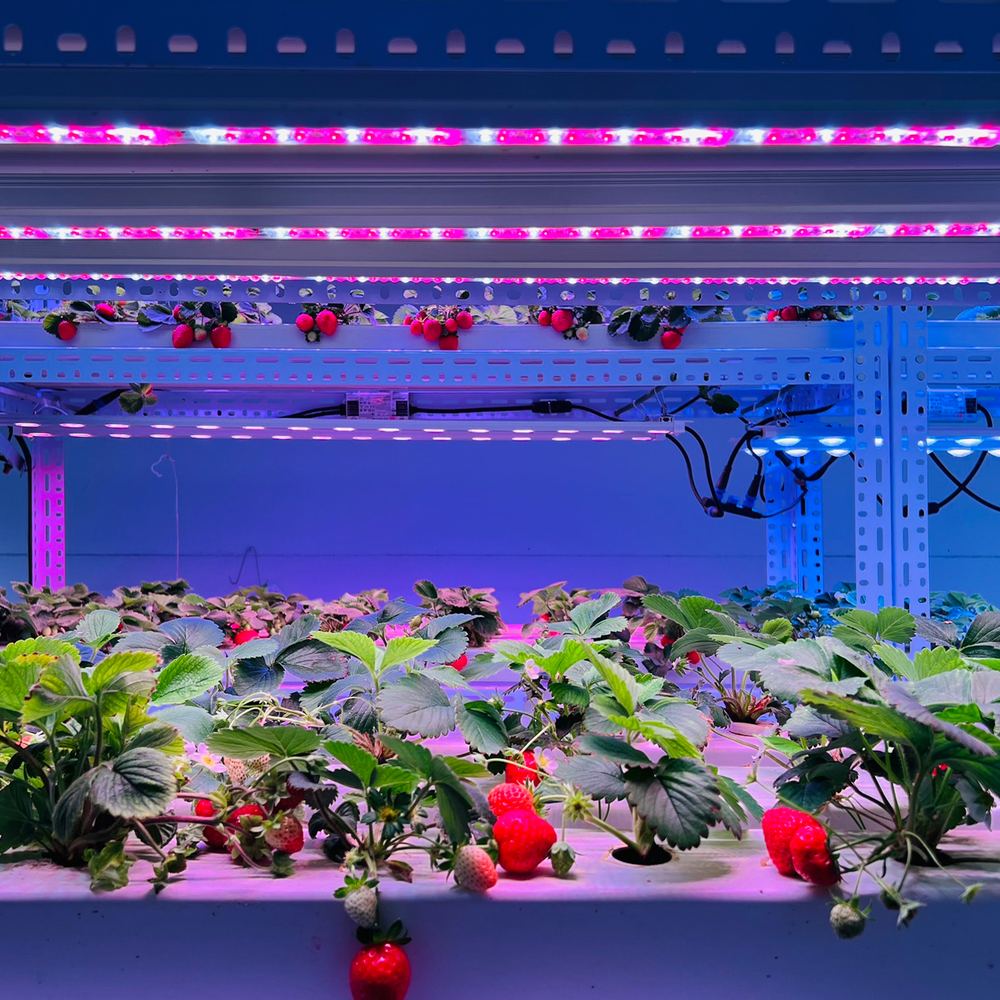
What indoor strawberries actually need
Strawberry is a low-growing rosette plant with a short canopy. That has two consequences for lighting design. First, the distance from fixture to leaf is short, so small changes in hanging height change intensity sharply. Second, the fruit sits inside the canopy rather than above it, so light that reaches the top leaves does not automatically reach the trusses.
Three quantities matter, and they are not interchangeable:
- PPFD (µmol/m²/s) — the photon flux density at a point, at a moment in time.
- DLI (mol/m²/d) — PPFD integrated over the photoperiod; the number that actually tracks growth and yield.
- Photoperiod (h) — the length of the light period, which for strawberry also carries a flowering signal.
Start with PPFD and DLI, not wattage
Fixture wattage tells you what the electricity meter will do; it does not tell you what the plants receive. The conversion is arithmetic:
The factor 0.0036 is 3,600 seconds per hour divided by 1,000,000 micromoles per mole. The table below applies it to combinations that are realistic for a rack installation, with the sensor held at canopy height directly under the fixture centre.
| PPFD at canopy (µmol/m²/s) | 12 h | 14 h | 16 h | 18 h |
|---|---|---|---|---|
| 150 | 6.5 | 7.6 | 8.6 | 9.7 |
| 200 | 8.6 | 10.1 | 11.5 | 13.0 |
| 250 | 10.8 | 12.6 | 14.4 | 16.2 |
| 300 | 13.0 | 15.1 | 17.3 | 19.4 |
| 400 | 17.3 | 20.2 | 23.0 | 25.9 |
As a planning reference, indoor strawberry programmes commonly run in two bands: roughly 10–14 mol/m²/d while plants establish and build leaf area, and roughly 17–25 mol/m²/d through flowering and fruiting. These are working ranges used in practice rather than a published standard, and they assume healthy plants, adequate CO2 and a canopy in the low twenties Celsius. A crop that is already light-saturated will not repay a higher setpoint, and a crop limited by root-zone or humidity problems will not be fixed by one either.
Note what the table implies: 300 µmol/m²/s for 12 hours and 200 µmol/m²/s for 18 hours deliver a similar daily total. The choice between them is a decision about heat load, tariff windows and photoperiod biology, not about efficiency.
Photoperiod: which type of strawberry are you growing?
Cultivars differ in how daylength drives flowering, and the schedule has to follow the genotype rather than a generic recipe.
- Short-day (June-bearing) types initiate flowers when days shorten and temperatures fall; long days and warmth push them toward runners instead of trusses.
- Day-neutral types flower across a wide temperature range regardless of daylength, which is why they dominate indoor and tunnel production.
- Everbearing types sit between the two and respond to both daylength and temperature.
Light quality interacts with this. A HortScience study on a short-day cultivar found that adding red light changed flowering behaviour even under long days, a reminder that spectrum is not a neutral variable when the crop is photoperiod-sensitive. Work published in the Journal of the American Society for Horticultural Science on flower and runner removal shows how strongly the balance between vegetative growth and fruit affects later yield, which is the lever most growers actually control week to week.
A 14–16 hour photoperiod is the usual working range for day-neutral types under sole-source lighting. Below about 12 hours you spend more of the day paying for darkness than for photons; above about 18 hours the marginal gain flattens and the risk of stressing the plant rises.
Spectrum: red, blue and where far-red fits
For fruiting crops the spectrum argument is usually over-stated. A broad white or red-dominant spectrum with a modest blue fraction will grow strawberries; differences between well-built fixtures of similar efficacy are small compared with the difference between adequate and inadequate DLI. Treat spectrum as a tuning parameter, not the main decision.
Far-red (700–750 nm) is the exception worth watching, because it changes plant architecture rather than photosynthesis directly. Adding far-red tends to enlarge leaves and internodes. In a low rack that can improve light capture inside the canopy; in a tight vertical farm it can produce a crop too tall for the tier spacing. If you experiment, change one variable at a time and hold the photoperiod fixed.
Heat, humidity and the light schedule
Light and heat are the same purchase. Every watt delivered to the canopy ends up as heat, whether it arrived as photons or as driver losses, and a sealed room has to remove it. Two practical consequences:
- Run the light period when the room is easiest to cool, and confirm the cooling setpoint is met at the end of the photoperiod, not at the start when the walls are still cold.
- Measure canopy temperature, not room air temperature. A dense strawberry canopy under high PPFD can sit several degrees above the return-air sensor reading.
Flowering is the sensitive window. Canopy temperatures sustained above roughly 28 °C around flowering are a common reason for poor fruit set that gets misattributed to pollination or nutrition. If the schedule is being pushed for DLI, the first question is whether the room can hold that temperature, not whether the fixture can deliver it.
A simple commissioning routine
- Measure a grid, not a point. Nine readings across the bench — centre, four midpoints, four corners — at canopy height, sensor parallel to the floor.
- Fix the height before comparing fixtures. PPFD falls with the square of distance: doubling the gap quarters the reading. A 30 cm change on a short bench is a large change in DLI.
- Record the date and the dimmer setting. Output declines slowly over years, so a commissioning record is the only way to know later whether a fixture has lost output or the crop has changed.
- Trim the weak zones, not the whole room. If corner readings are 25% below centre, add a bar at the edge or accept a smaller planted area; raising the whole schedule to lift the corners overloads the centre.
- Re-check after each cycle. Cleaning lenses and clearing dust from heatsinks recovers output that no schedule change can.
Symptoms and what they usually mean
| Symptom | Lighting cause to rule out | First check |
|---|---|---|
| Pale, flat leaves; long petioles; few trusses | DLI below the establishment band for several weeks | PPFD grid at canopy, then hours |
| Flowers form but fruit set is poor | Canopy heat during flowering rather than light quantity | Canopy temperature at mid-photoperiod |
| Fruit ripens unevenly, pale on one side | Uneven distribution or a single side light source | Edge versus centre readings; rotate benches |
| Healthy leaves, small fruit | Light adequate, assimilate supply limited elsewhere | CO2, irrigation, root-zone temperature |
| Bleaching or crisp margins on top leaves | Fixtures too close, or a hot spot from a narrow beam | Distance and beam uniformity |
About the publisher
XineLam is a LED lighting manufacturer with 17 years of experience and 300+ patents in China and internationally. The company builds horticultural luminaires for greenhouses, vertical farms and research rooms, alongside the architectural and industrial fixtures it has supplied since its founding. Fixture data in this article follows published specifications; crop targets are given as ranges because they depend on cultivar, climate and market grade.
Frequently asked questions
How much PPFD do indoor strawberries need?
Plan for roughly 250–400 µmol/m²/s at canopy height during flowering and fruiting, held for 14–16 hours, which gives about 12.6–23 mol/m²/d. Establishment can run lower. Measure a grid at canopy height rather than one point, because a short bench produces a steep gradient.
Can I grow strawberries under 12 hours of light?
Yes for day-neutral cultivars, but the daily total falls quickly: 300 µmol/m²/s over 12 hours is 13 mol/m²/d, at the low end of a fruiting target. Short-day types may benefit from shorter days for flower initiation, while long days push them toward runners.
Does far-red light help indoor strawberries?
It changes architecture more than photosynthesis: leaves and internodes enlarge, which can improve light capture in a low canopy but can also overshoot tier height. Add it as a separate experiment with the photoperiod held constant, and judge it on fruit set and grade rather than leaf size.
Why do my strawberries flower but not set fruit?
Check canopy temperature first. Sustained heat around flowering is a more common cause of poor set than light quantity, and it is easy to miss because room air can read several degrees cooler than the canopy under high PPFD. Pollination and humidity are the next checks.
References
- U.S. Department of Energy, LED Basics (useful life defined as hours to 70% of initial light output) — https://www.energy.gov/cmei/ssl/led-basics
- HortScience 43(7): Red light affects flowering under long days in a short-day strawberry cultivar — https://journals.ashs.org/downloadpdf/view/journals/hortsci/43/7/article-p2245.pdf
- Journal of the American Society for Horticultural Science 113(2): Effects of duration of flower and runner removal on strawberry — https://journals.ashs.org/downloadpdf/view/journals/jashs/113/2/article-p185.pdf
- DesignLights Consortium, Horticultural Lighting Resources: Application and Design — https://designlights.org/wp-content/uploads/2021/02/DLC_Horticultural-Lighting-Resources_Application-Design.pdf