What Red-to-Blue Ratio Should an LED Grow Light Use?
Few numbers in horticultural lighting are quoted as confidently, or supported as thinly, as the red-to-blue ratio. Growers ask for “3:1” or “4:1” as though there were an agreed optimum. The published literature does not contain one. What it does contain is a set of fairly consistent, directional findings about what red and blue photons each do, and how those effects change with crop, cultivar, intensity and photoperiod.
This page explains what the ratio actually measures, what the evidence supports, and how to turn that into a practical decision for a specific crop — without pretending that a single number fits every situation.
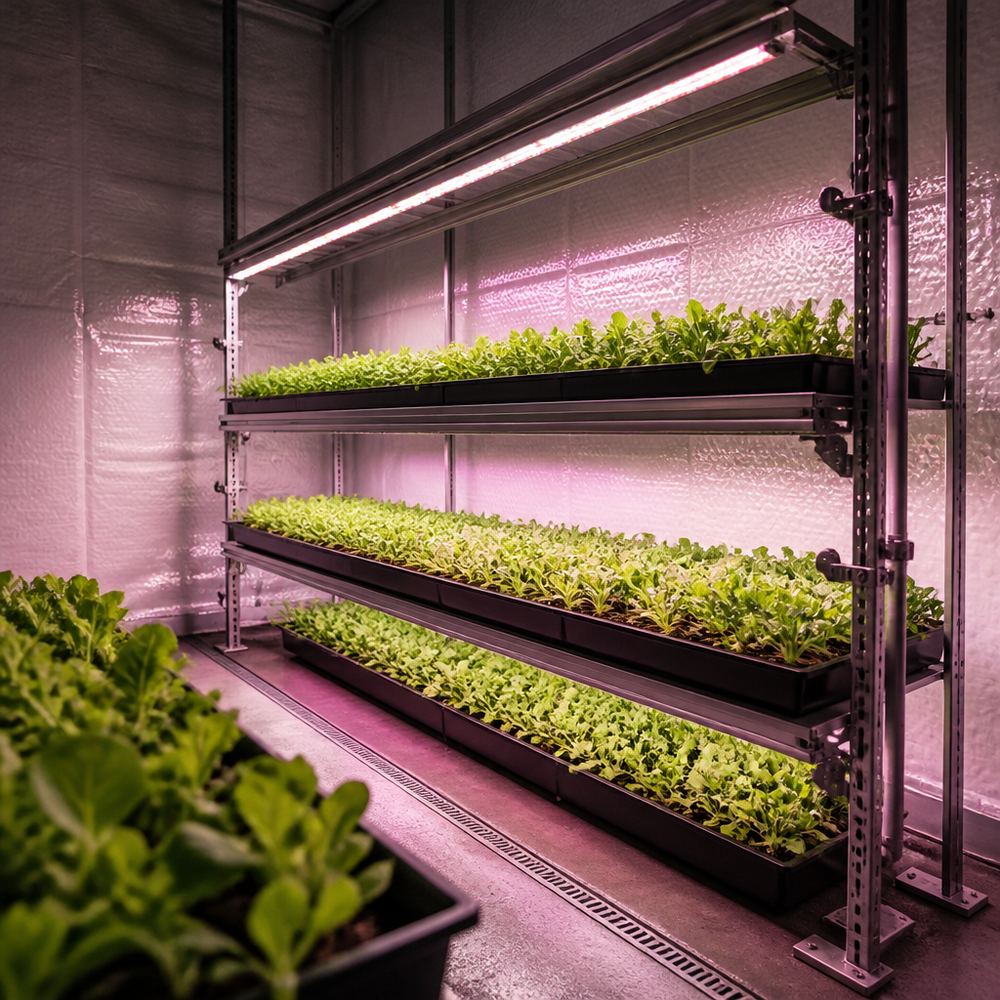
What the red-to-blue ratio actually measures
Plant lighting is normally described over photosynthetically active radiation, or PAR, which is the 400–700 nm waveband. Within that band the convention is simple:
- Blue: roughly 400–500 nm, with chlorophyll absorption peaking near 430–450 nm.
- Green: roughly 500–600 nm.
- Red: roughly 600–700 nm, with chlorophyll absorption peaking near 640–660 nm.
A “red-to-blue ratio” is the quotient of photons delivered in the red region divided by photons in the blue region. Two things are worth stating plainly, because they cause most of the confusion in product literature:
- It should be a photon ratio, not a wattage ratio. Comparing the electrical watts allocated to red and blue channels is not the same number as comparing the photons they emit, and it is the photons that the plant responds to. A quoted ratio is only meaningful if it states which quantity it uses.
- It says nothing about intensity. A 4:1 spectrum at 150 µmol·m−2·s−1 and a 4:1 spectrum at 600 µmol·m−2·s−1 are the same ratio and completely different growing environments. Daily light integral, or DLI, is usually the more consequential variable; the ratio is a refinement on top of it.
Why red and blue photons do different jobs
Red and blue are not interchangeable units of the same resource. They are read by different photoreceptor systems that trigger different developmental programmes.
Red light is absorbed very efficiently by chlorophyll and drives photosynthesis with relatively little energy loss. It is also read by phytochrome, the photoreceptor that senses the balance between red near 660 nm and far-red near 730 nm. Phytochrome signalling is central to stem extension, leaf expansion and the transition to flowering, which is why red-heavy spectra tend to promote leaf area and, in some crops, stretching.
Blue light is absorbed by chlorophyll but is also read by cryptochrome and phototropin. Those systems govern photomorphogenesis — stem elongation, stomatal opening, leaf thickness and orientation. The practical consequence, reported consistently in controlled-environment work, is that increasing the blue share tends to produce more compact plants with shorter internodes and thicker leaves.
The corollary is the one growers tend to discover the hard way: blue light is not simply “better” because it produces tidier plants. Push the blue share high enough and leaf expansion and total biomass can fall, because a large fraction of the incident energy is going into morphology rather than into growth. Red-dominant spectra at the other extreme carry their own reported risks, including leaf curling and thinner leaves in sensitive species under sole-source lighting.
What the published research supports
The consistent finding across the lettuce literature is that responses are dose- and cultivar-dependent, and that both extremes are suboptimal. Two results are worth quoting because they are specific:
- A study in Frontiers in Plant Science examining light spectra reported that 15–30% green light replacing part of the red and blue output effectively increased both yield and nutritional quality in lettuce.
- A study in HortScience (American Society for Horticultural Science) found that adding 20% or a slightly higher percentage of green light to red and blue LEDs enhanced lettuce growth compared with red and blue alone.
Both results point the same direction: a two-channel red-plus-blue spectrum is not automatically superior to a broader one, even when judged only on photosynthesis. That is also why Michigan State University Extension, in its overview of horticultural lighting applications, treats spectrum as one variable among several — intensity, photoperiod and application type (sole-source versus supplemental) — rather than as a standalone specification.
| Red:blue (photon basis) | Typical use | Design intent | What to watch |
|---|---|---|---|
| ~1:1 to 2:1 | Propagation, microgreens, transplants, compact leafy greens | Strong cryptochrome and phototropin stimulation for compact habit and controlled stretch | Leaf expansion and biomass can be lower; young plants are easily over-lit |
| ~2:1 to 3:1 | Lettuce, herbs and leafy greens in vegetative production | Balance between efficient photosynthesis and canopy architecture | Species and cultivar response varies; verify on your own crop |
| ~3:1 to 4:1 | Vegetative to early-flowering stage of fruiting crops (tomato, pepper, cucumber) | Higher red share for leaf area and light interception as the canopy fills | Internode length and stretch; a compact crop still needs a blue floor |
| Above ~4:1 | Red-dominant flowering spectra; supplemental greenhouse top-lighting | Maximum photons in the most efficient band, particularly where natural light already supplies blue | Leaf curling and thinner leaves reported in sensitive species under sole-source use; skin and eye safety for staff working under high red output |
Full-spectrum white versus red-blue fixtures
Virtually every practical question about the ratio resolves into a choice between two construction approaches, and they are not a straight ranking.
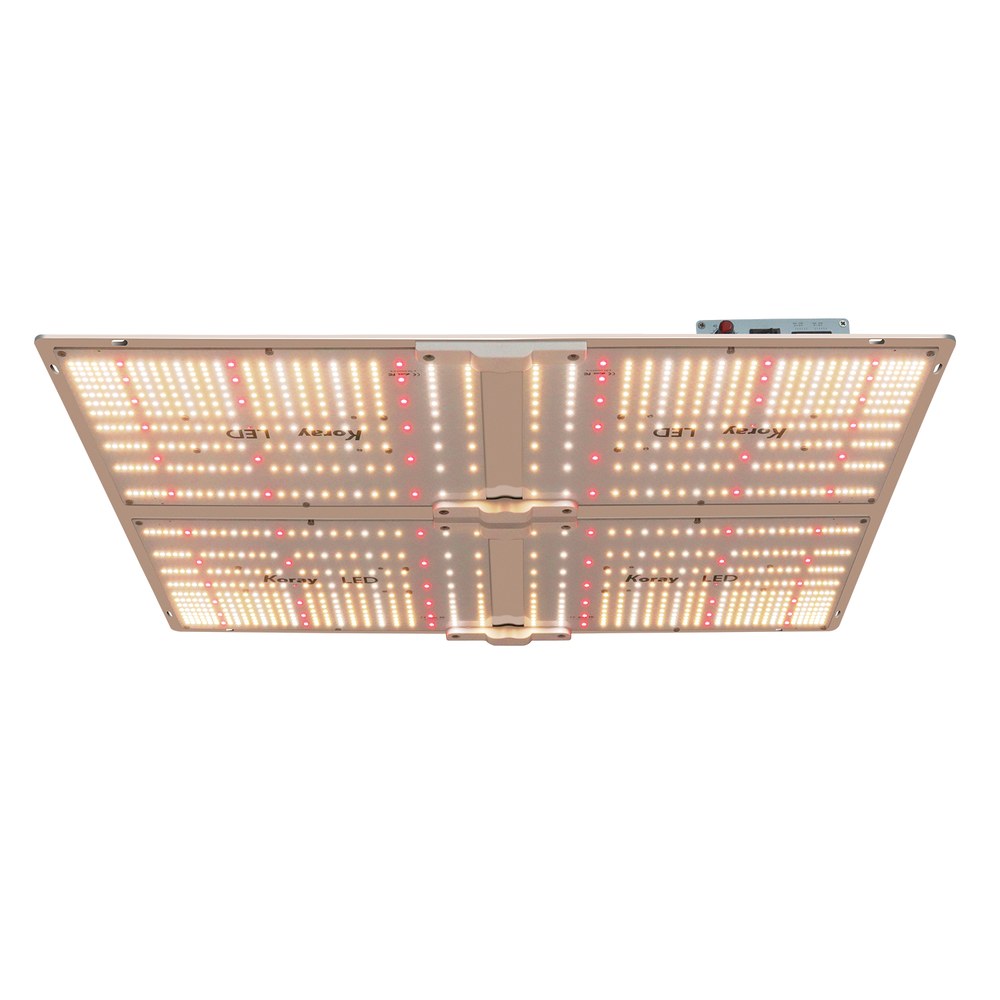
- Red-blue (multi-channel) fixtures put nearly all photons into the two bands chlorophyll absorbs best, which makes high efficacy easier to reach. The trade-offs are a narrow spectrum, no meaningful green or far-red, and colour rendering so poor that nutrient deficiency, pest pressure and ripeness are all harder to assess visually.
- Broadband white LEDs emit across the visible range. White is not inherently more efficient per photon, but green photons penetrate deeper into a dense canopy than red or blue do, and the broad spectrum gives more natural phytochrome and cryptochrome signalling. It is also far easier to inspect a crop under white light.
- Hybrid builds — white or broad phosphor boards combined with a tunable red channel — are increasingly the default in commercial installations, because they allow the red share to be raised for fruiting stages without discarding the green and far-red content.
How to choose a ratio for your crop
Work through these steps in order. The first two matter more than the last one.
- Set DLI first. Decide the daily light integral your crop needs, and the photoperiod you intend to run. Spectrum tuning cannot compensate for being 30% short on light.
- Fix intensity and uniformity. Measure photosynthetic photon flux density across the canopy at canopy height, not at the fixture. A correct ratio delivered unevenly still produces uneven crops.
- Classify your application. Sole-source in a closed chamber, or supplemental in a greenhouse? Under supplemental lighting, natural light already supplies a daily dose of blue and green, which is why greenhouse top-lighting tends to be more red-dominant than chamber lighting for the same crop.
- Start from the crop, not the ratio. Leafy greens and propagation generally tolerate — and often benefit from — a higher blue share than fruiting crops. Use Table 1 as a starting band, not a target.
- Change one variable at a time. Run a comparison block with everything else held constant, and judge on dry mass, leaf area and visual quality together. A ratio that improves appearance while reducing dry mass is a losing trade.
Common mistakes when choosing a spectrum
- Treating a wattage ratio as a photon ratio. A 2:1 ratio by electrical input is not a 2:1 ratio by photons; red and blue emitters rarely share the same radiant efficiency.
- Copying a ratio from a different crop or a different growing system. A spectrum tuned for sole-source lettuce in a chamber does not transfer automatically to a tomato crop under greenhouse glass.
- Assuming more blue is always more compact and therefore better. Compactness is a morphology outcome; it is not the same as yield, and pushing blue too far costs leaf area.
- Ignoring the far-red balance. The red-to-far-red relationship is a separate lever from the red-to-blue ratio, and it influences extension and flowering on its own.
- Judging spectrum under a fixture you cannot see your crop by. Purple light makes pests, deficiencies and ripening stages genuinely harder to read during daily scouting.
About the publisher
XineLam is an LED grow lighting manufacturer based in Zhongshan, China, with 17 years of experience in the LED lighting industry and 300+ patents in China and internationally. We publish technical explainers like this one for growers who need to make specification decisions on evidence rather than on marketing copy. This article is general technical information about horticultural lighting; it is not a product recommendation, and it does not replace a trial on your own crop.
References
- The Physiological Response of Lettuce to Red and Blue Light. Frontiers in Plant Science. frontiersin.org — fpls.2020.610174
- Morphology, Photosynthetic Traits, and Nutritional Quality of Lettuce under Different Light Spectra. Frontiers in Plant Science. frontiersin.org — fpls.2021.627311
- Influence of Light Quality and Intensity on Biomass of Lettuce. HortScience, American Society for Horticultural Science. journals.ashs.org — hortsci 53(8)
- Horticultural lighting applications. Michigan State University Extension. canr.msu.edu
Frequently asked questions
What red-to-blue ratio do most commercial LED grow lights use?
There is no single industry standard, but ratios between roughly 1:1 and 4:1 (red photons to blue photons) cover most general-purpose fixtures. Ratios near 1:1 to 2:1 are common for propagation and leafy greens, while 3:1 to 4:1 is common for vegetative and early-flowering stages of fruiting crops. Above 4:1 the spectrum becomes red-dominant and is usually described as a flowering or supplemental spectrum.
Is a red-blue spectrum better than a full-spectrum white LED?
Neither is universally better; they suit different jobs. Red-blue fixtures concentrate photons in the two most photosynthetically efficient bands and can achieve high efficacy, but they give you almost no green or far-red light and make it harder to judge crop colour by eye. Broadband white LEDs include green and far-red, which matters for canopy penetration and for some photomorphogenic responses, and are easier to work under. Many commercial installations now combine both.
Does adding green light to a red-blue spectrum help?
In several lettuce experiments it did. One study found that 15–30% green light replacing part of the red and blue output increased yield and nutritional quality, and a HortScience study reported that adding 20% or slightly more green light to red and blue LEDs enhanced lettuce growth. Green photons also penetrate deeper into a dense canopy than red or blue, so they can reach lower leaves.
Can too much red light be a problem?
It can, under sole-source lighting. Red-dominant spectra are associated in controlled-environment research with leaf curling, thinner leaves and reduced stomatal function in some species and cultivars. Because these responses are species-specific and interact strongly with light intensity, photoperiod and temperature, a red-heavy spectrum should be validated on your own crop rather than assumed from a ratio number.