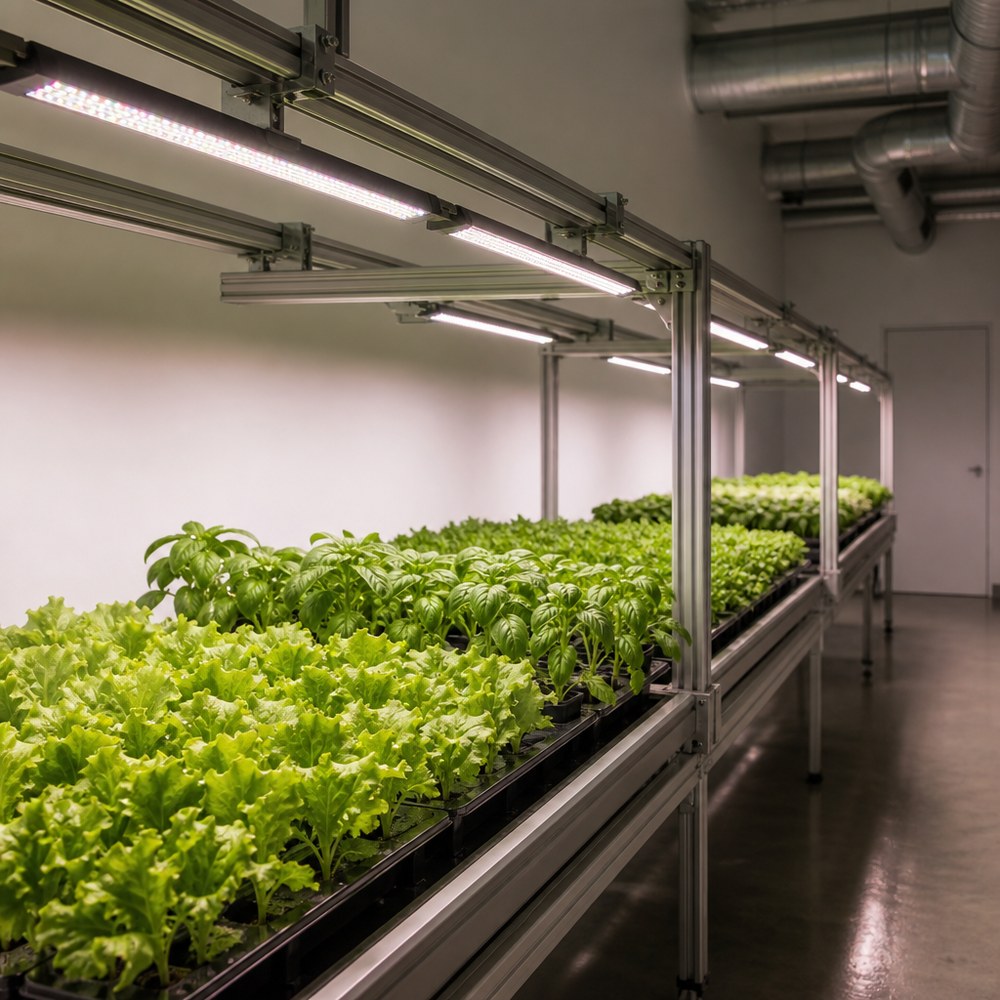
Growers comparing LED and high-pressure sodium (HPS) fixtures usually start with a single question: which one is more efficient? The honest answer is that efficiency is one line of a longer comparison. The two technologies differ in how efficiently they convert electricity into photons plants can use, in the shape of the spectrum they emit, in where the waste heat goes, and in how precisely the output can be controlled. This article walks through each dimension, and through the measurements you can run yourself before committing to either.
Both technologies can grow the same crops. What changes between them is the ratio of useful photons to input energy, the spectral distribution, the direction and form of the heat they release, and the degree of control over output intensity. Photon efficacy is a very important consideration, and it is also only the beginning: as Michigan State University Extension puts it in a note aimed squarely at this confusion, LEDs are more than "umol x J-1", and two fixtures with the same efficacy figure can still behave very differently in a real installation (MSU Extension, LEDs: More than umol x J-1).
There is also no single answer that fits every crop and stage. Researchers at Purdue University and Michigan State University have compared young and finished plant production under LED toplighting against HPS lamps, work summarised by MSU Extension in its guidance on evaluating greenhouse supplemental lighting (MSU Extension, Evaluating greenhouse supplemental lighting). The practical takeaway from that body of work is that the ranking depends on what you measure and on which crop stage you measure it in — which is why the dimensions below matter more than a slogan.
Before comparing two fixtures, it helps to fix the vocabulary. Light for plants is described in photons, not in the units humans see by. Iowa State University Extension sets out the definitions clearly: PPF (photosynthetic photon flux) is the amount of plant-usable light a source emits, in micromoles per second (umol/s); PPFD (photosynthetic photon flux density) is that light arriving at a surface, in micromoles per square metre per second (umol/m2/s); and lumens, by contrast, describe light as the human eye perceives it (Iowa State University Extension).
| Dimension | HPS lamp | LED fixture | How to check it for your site |
|---|---|---|---|
| Photon efficacy | Traditional discharge lamp; the share of input watts converted to plant-usable photons is comparatively low, with a large portion lost as heat. | Solid-state emitters; efficacy is quoted directly in umol/J and varies widely between models. | Ask for the photon efficacy in umol/J and the photon flux (PPF) in umol/s. Divide PPF by input watts to sanity-check the claim. |
| Spectrum | Fixed broad output weighted towards yellow-orange and red; the recipe cannot be changed after purchase. | Chosen at design time from the emitter mix; some fixtures offer channels or dimming that shift the delivered mix. | Request the spectral distribution and compare it with the action spectrum of your crop, not with a photograph of pink light. |
| Heat path | Emits a substantial share of energy as infrared radiation, warming the canopy and the air directly below the lamp. | Less radiant load toward the canopy; waste heat concentrates in the board and driver, which must be conducted away. | Measure leaf temperature and air temperature under each option; a canopy that runs cooler changes your ventilation and irrigation demand. |
| Warm-up and control | Requires a warm-up period to reach full output; dimming is limited. | Reaches output almost immediately and can be dimmed or switched instantaneously. | Decide whether you need instant switching or fine dimming to follow a PPFD or DLI target through the season. |
| Service life and maintenance | Lamp and reflector are consumable; output declines over service hours and lamps are replaced periodically. | No routine lamp replacement; drivers and boards are the wear items, and output also declines gradually. | Compare maintenance labour and consumable cost over the same number of service hours, not just the purchase price. |
| Mounting and optics | Lamps are typically high-bay and are often paired with reflectors that shape a wide beam. | Bars, boards and modules can be placed close to the canopy and spread across it. | Check that the chosen beam spread covers your bench or rack footprint with the uniformity you need. |
Photon efficacy is the number of micromoles of photosynthetically active photons a fixture emits per joule of electrical energy consumed, expressed in umol/J. It is the cleanest single figure for ranking fixtures, because it is independent of how far away the fixture hangs and how it spreads its beam.
It is also easy to over-read. A high umol/J figure tells you about conversion efficiency, not about distribution: two fixtures with identical efficacy can put very different PPFD values on the same bench, because one concentrates its output into a narrow area and the other spreads it across a wider footprint. That distribution is what your plants actually experience, and it is why MSU Extension frames efficacy as a starting consideration rather than the whole decision (MSU Extension).
An HPS lamp produces a broad spectrum weighted towards the yellow, orange and red region, because that is what the discharge chemistry emits. The recipe is fixed at manufacture. An LED fixture's spectrum is a design decision: the emitter mix determines how much energy lands in the blue, red and far-red regions, and whether any green or white content is included.
Because photosynthesis operates on photons within photosynthetically active radiation — conventionally defined as the 400–700 nm waveband — the practical question is not "which lamp looks brighter" but "which wavebands does this fixture deliver, and are they in the region my crop responds to". Iowa State University Extension notes that blue wavelengths help regulate chlorophyll production and movement, control excessive stem elongation and regulate stomata, while red wavelengths are used extensively for photosynthesis and are associated with elongation, flowering and fruiting — and that a good supplemental source provides both (Iowa State University Extension).
Practical note: light that looks dim to your eye can still be delivering a useful photon flux. Lumens and lux measure what the human eye perceives, and green and yellow light are weighted heavily in that perception, so a "brighter-looking" lamp is not automatically delivering more plant-usable photons.
Both technologies convert part of their input into heat, but the heat takes different paths. An HPS lamp radiates a meaningful share of its energy toward whatever is underneath it, which warms the canopy surface and the air immediately below the lamp. An LED fixture emits less radiant load in that direction; the waste heat concentrates in the board and driver, which has to be conducted away by the heat sink, the housing or active cooling.
The engineering consequence is that the two options change different parts of your room's heat balance. With HPS, canopy temperature and the air under the lamp rise, and ventilation has to deal with both. With LED, the fixture itself becomes the heat source that your room has to clear, and the crop may run cooler. Because those effects pull in opposite directions, the sensible comparison is to measure leaf temperature and air temperature under each option at the same delivered PPFD, rather than to compare nominal wattages. As Iowa State University Extension notes, moving a fixture closer to the plants raises the intensity they receive but can also raise the temperature around them if the fixture produces a lot of heat (Iowa State University Extension).
Control matters because the useful metric for a crop is not instant intensity but the total quantity of light delivered across the day. That is the daily light integral (DLI), measured in moles of photosynthetically active photons per square metre per day (mol/m2/day). Iowa State University Extension gives the working formula:
DLI = PPFD × hours of light × 0.0036
and the same source publishes target ranges by plant category, reproduced below (Iowa State University Extension).
| Category | DLI (mol/m2/day) | Typical plants in the group |
|---|---|---|
| Low light | 3 – 6 | Foliage houseplants |
| Medium light | 6 – 10 | Foliage and flowering houseplants, vegetative cuttings, seedlings on the high side of the range |
| High light | 12 – 16 | Flowering houseplants, succulents, seedlings on the low side of the range, herbs and leafy vegetables such as lettuce and basil |
| Very high light | 18 – 30 | Herbs, fruits and vegetables grown for leaves or for fruit, such as tomato |
This is where dimming and instant switching pay off for a grower. If a fixture can be dimmed, you can hold a target PPFD as the crop grows or as daylight changes, instead of adding and removing lamps. During the light period, the same source suggests that indoor plants are commonly given light for 12 to 14 hours a day, with a practical range of about 10 to 16 hours — and that photoperiodic crops react to the length of the dark period, so hours cannot be extended freely.
Worked example. Suppose a fixture delivers 400 umol/m2/s at the canopy and runs for 12 hours: DLI = 400 × 12 × 0.0036 = 17.3 mol/m2/day, which sits inside the "high light" band above. Extending the same fixture to 16 hours gives 400 × 16 × 0.0036 = 23.0 mol/m2/day, moving into the "very high light" band. The number moves with the schedule, which is exactly why comparing fixtures on wattage alone misses the point.
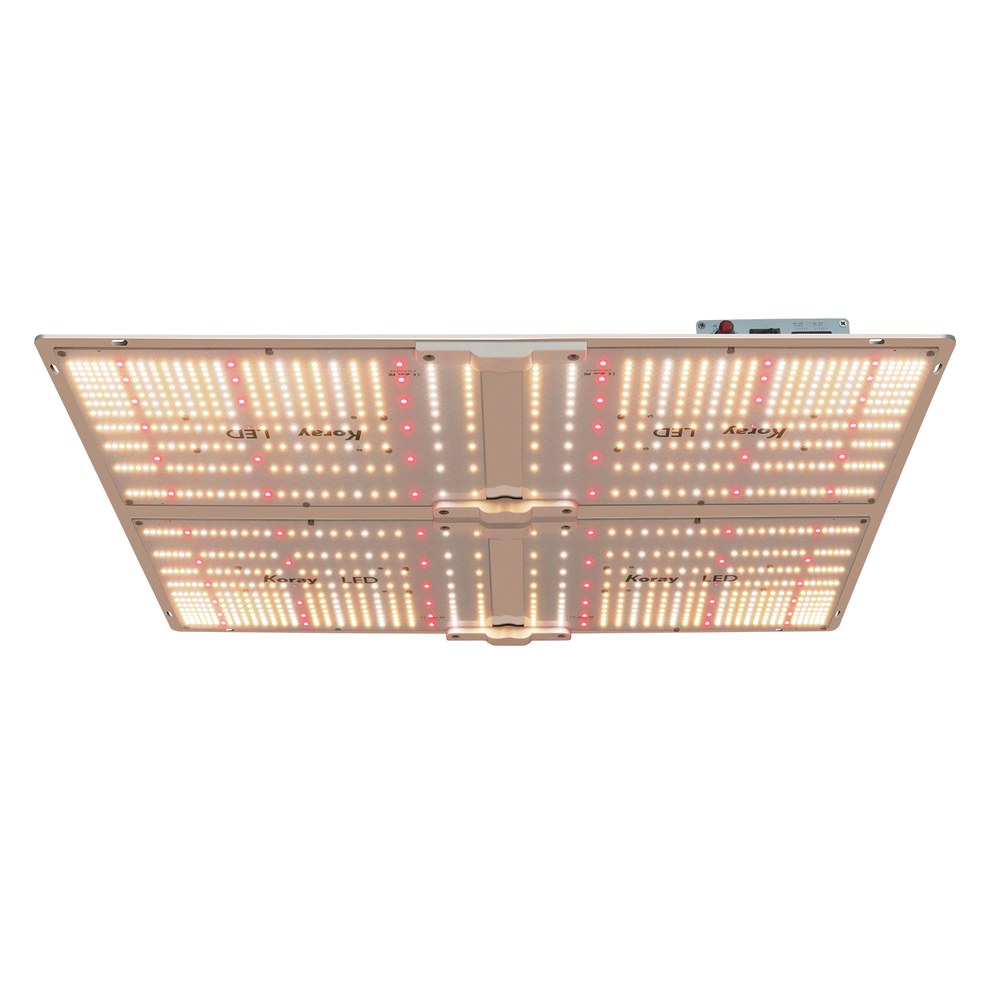
Neither technology is universally correct, and the sensible choice follows from the site:
For indoor racks and benchtop layouts, bar-type and board-type LED fixtures are usually the practical form factor, because they can be spread across the canopy at a short distance rather than concentrated in a few high-bay points. When specifying one, ask for the photon flux in umol/s, the efficacy in umol/J, an output dimming range, and a PPFD map at realistic mounting heights — those four items are enough to compare competing fixtures on the same basis.
XineLam is an LED lighting manufacturer with 17 years of experience in the LED lighting industry and 300+ patents in China and internationally. The company designs and produces LED modules and complete fixtures for horticultural and general lighting applications, and works with growers to specify fixtures against delivered PPFD and DLI targets.
Not automatically. Running cost depends on how many micromoles of photons you deliver per joule of electricity (the photon efficacy, in umol/J) and on how much of that electricity becomes heat you then have to remove. Compare the two fixtures at the same delivered light level rather than at the same wattage, and include the cost of cooling.
Matching wattage is the wrong starting point. Match the photon flux (PPF, in umol/s) that the old lamp delivered at the canopy, then check the beam spread and mounting height of the replacement so it covers the same area at the same PPFD.
Yes, in specific cases: where radiant heat is useful in the crop's energy balance, where an installation is already wired and amortised, or where a full switch cannot be justified. It is an engineering calculation about the site.
Photon efficacy in umol/J is the fastest way to rank candidates. Immediately after that, check the delivered PPFD across your real canopy area and the DLI your schedule will produce, because efficacy alone says nothing about how the light is distributed over the crop.