PPF vs Lumens: Which Metric Should You Use to Compare LED Grow Lights?
Two fixtures sit side by side on a supplier's quotation. Both are rated at 30,000 lumens. One produces 640 micromoles per second of photosynthetically active radiation, the other 840. The lumen number cannot tell them apart, because it was never designed to describe light for a plant.
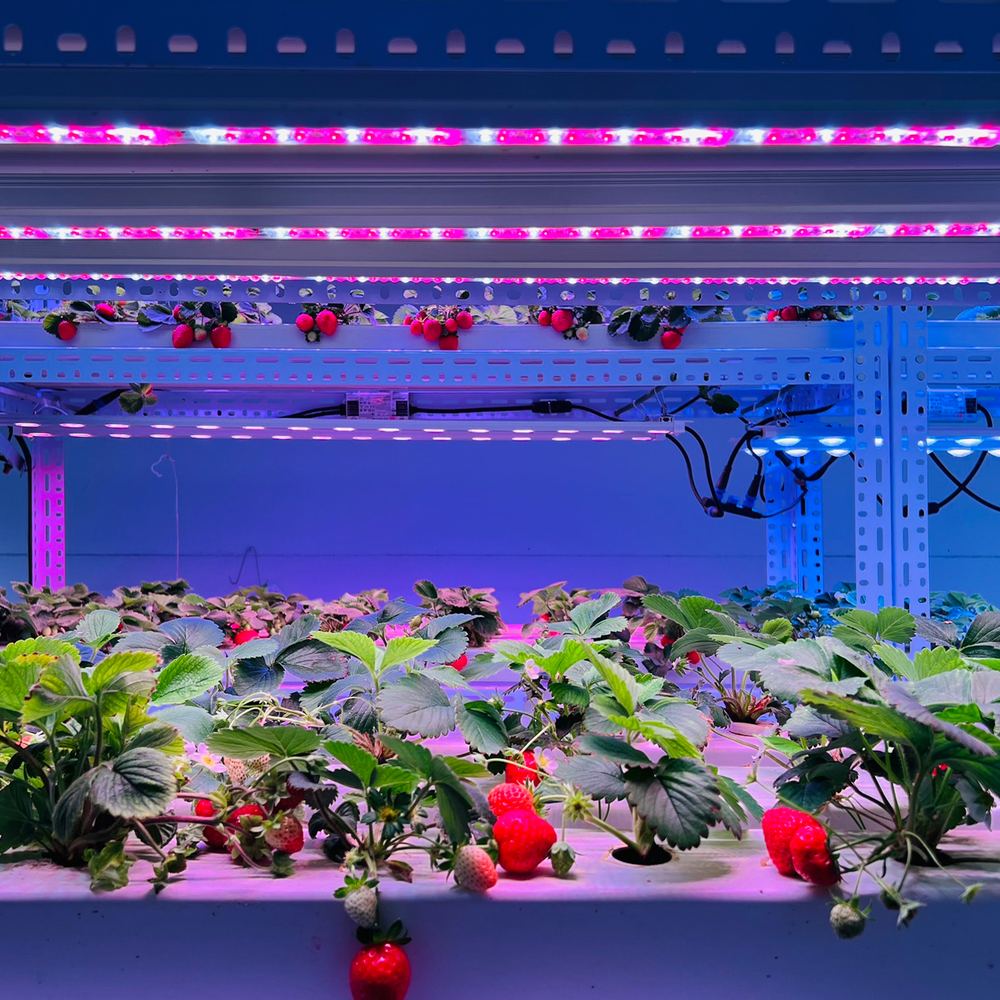
Two numbers, two audiences
Lumens and PPF answer different questions. Lumens answer "how bright will this look to a person standing in the room". PPF answers "how many photons per second in the 400 to 700 nanometre band does this fixture emit". A lighting buyer who compares plant fixtures on lumens is effectively asking a human-vision instrument to grade a plant-response job, and the ranking it returns can be inverted.
This matters commercially, not just academically. Fixture price scales with wattage and diode count, so a mis-ranked comparison leads directly to buying the wrong box. The sections below set out what each unit is anchored to, where conversion shortcuts hold, and the specification set worth requesting before an order.
What lumens actually measure
The lumen is a photometric unit. It takes radiant power and weights each wavelength by V(λ), the CIE photopic luminous efficiency function, which is defined as 1.00 at 555 nm and falls away on both sides. The peak of that curve is 683 lumens per watt of optical power at 555 nm. Green light near that wavelength therefore converts into a very large lumen number for a modest amount of energy, while deep red converts into a small one.
That weighting is a deliberate model of the human eye, and it is why a red-and-blue LED panel can look almost dim to a person while still driving photosynthesis efficiently. The plant does not use V(λ). It uses photon capture by chlorophyll and accessory pigments across roughly 400 to 700 nm, with useful activity extending into the far-red region beyond the classic PAR boundary.
What PPF and PPFD measure
Photosynthetic photon flux (PPF) counts photons in the PAR band and is expressed in micromoles per second (µmol/s). It is a property of the fixture alone: it does not change when you hang the light higher, and it does not depend on the room.
Photosynthetic photon flux density (PPFD) divides that output over an area and is expressed in micromoles per square metre per second (µmol/m²/s). PPFD is measured at the canopy, so it changes with mounting height, beam angle and the reflectance of the walls. Daily light integral (DLI) then integrates PPFD over the photoperiod and is expressed in moles per square metre per day (mol/m²/d). Purdue Extension's guidance on measuring DLI in greenhouses sets out how instantaneous PPFD converts into a daily total, which is the figure that actually correlates with crop growth over a production cycle.
The chain is worth memorising: PPF tells you what the fixture emits, PPFD tells you what the canopy receives, DLI tells you what the crop gets in a day. Only the last of the three can be compared directly against a crop requirement.
Why a red-heavy fixture can look dim and still be powerful
A single micromole of photons carries less energy at 660 nm than at 555 nm, because photon energy falls as wavelength rises. But the luminous weighting falls much faster than the energy does. The result is a large mismatch between photon count and lumen count:
- 1 µmol/s at 660 nm is about 0.18 W of optical power, which at a luminous weighting of roughly 0.06 works out to about 7.6 lumens.
- 1 µmol/s at 555 nm is about 0.22 W of optical power at full weighting, which works out to about 148 lumens.
Calculated from the CIE photopic function and Planck's relation, that is a factor of roughly twenty between the two wavelengths for the same photon delivery. A spectrum dominated by 660 nm red will therefore post a modest lumen figure next to a green-heavy white fixture of identical photosynthetic output, and a lumen-based comparison will rank it last.
The metrics side by side
| Metric | Unit | What it describes | Use it for | Where it misleads |
|---|---|---|---|---|
| Luminous flux | lumen (lm) | Radiant power weighted by human photopic vision | Human-occupied spaces, general lighting, compliance | Ranking plant fixtures; red and blue spectra score low regardless of photon output |
| Luminous efficacy | lm/W | Visible brightness per watt drawn | Office and domestic lighting economics | Rewards green output, which is the least efficient waveband for photosynthesis |
| PPF | µmol/s | Total photons emitted in 400-700 nm | Comparing fixture output independent of mounting height | Says nothing about spread, so a narrow beam and a wide beam look equal |
| PPFD | µmol/m²/s | Photons arriving per square metre per second | Matching a fixture to a canopy area and a crop target | Point measurements hide edge drop-off; averages hide hot spots |
| PPE (efficacy) | µmol/J | Photon output per joule of electricity | Running-cost comparison between fixtures | Quoted at favourable drive current and ambient temperature |
| DLI | mol/m²/d | PPFD integrated over the photoperiod | Setting a daily target and a dimming schedule | Ignores distribution: a correct average can still hide a dark corner |
The lumen-to-PPF shortcut, and where it breaks
Extension guidance for indoor plant lighting notes that PPF can be approximated from lumens by dividing by a conversion factor of about 60. That shortcut is useful when a white fixture only publishes photometric data, and it is defensible for broad white spectra of similar colour temperature, because the luminous weighting of the spectrum stays roughly constant.
It fails as soon as the spectrum changes shape. Swap a 4000 K white board for a 660 nm red bar and the same photon flux produces roughly a twentieth of the lumens, so a single divisor cannot serve both. Treat the division as a sanity check on white light, never as a way to compare a white fixture against a coloured one.
A worked example: same lumens, different photon output
Take two illustrative 1.2 m² canopy fixtures, both advertised at 30,000 lumens:
- Fixture A: 320 W input, PPE 2.0 µmol/J, so PPF is about 640 µmol/s and luminous efficacy is about 94 lm/W.
- Fixture B: 300 W input, PPE 2.8 µmol/J, so PPF is about 840 µmol/s and luminous efficacy is about 100 lm/W.
Assume 85 percent of emitted photons reach the canopy after optical and wall losses. Average PPFD over 1.2 m² is then about 453 µmol/m²/s for A and about 595 µmol/m²/s for B. Over a 16-hour photoperiod those figures integrate to roughly 26 and 34 mol/m²/d of DLI. Fixture B draws less power, posts the same lumen number, and delivers about 31 percent more photons.
This is arithmetic on stated specifications, not a measurement of any particular product, but it shows the size of the error a lumen-only comparison can introduce. The same arithmetic run backwards is the quickest way to audit a quotation that lists lumens and watts but no PPF.
What to request before you buy
- PPF in µmol/s, measured on the delivered fixture rather than calculated from diode bins.
- PPE in µmol/J at a stated drive current and ambient temperature, because both raise or lower the number substantially.
- A PPFD grid at a stated mounting height and spacing, ideally on a 30 cm grid across the coverage area, so you can see the edges rather than a single centre reading.
- Beam angle and optic type, so you can compute overlap and spacing yourself rather than trusting a coverage claim.
- Lumen figures only as a secondary cross-check for white-spectrum fixtures, and never as the basis of a ranking.
Where each approach fits in a real project
For a leafy-green propagation room with white full-spectrum bars, lumen data is a harmless secondary check and the practical decision rests on PPFD uniformity and DLI. For a fruiting crop under red-dominant spectra, lumen figures are close to meaningless and should be struck from the comparison entirely. For retrofit projects where existing HPS or fluorescent circuits are being replaced, keep the old lumens as a reference for lighting-level compliance and run a separate PPF comparison for the horticultural decision, because the two conversations have different acceptance criteria.
Frequently asked questions
Can I compare two grow lights using lumens alone?
No. Lumens are weighted by the human eye's sensitivity curve, which peaks near 555 nm and falls sharply in the deep red. Two fixtures with identical lumen ratings can differ by 30 percent or more in PPF, so lumens cannot rank fixtures for plant growth.
Is a higher PPF always better?
Not on its own. PPF is total output in micromoles per second; what reaches the canopy is PPFD, which falls as mounting height and coverage area increase. Compare PPF together with efficacy, beam distribution and the PPFD the fixture actually produces over your canopy area.
Why do red and blue LED grow lights have low lumen ratings?
The lumen scale is built on photopic vision, where 555 nm green light is the reference. Deep red at 660 nm has a luminous weighting of about 0.06, so one micromole per second of 660 nm light is roughly 7.6 lumens, while the same photon flux at 555 nm is roughly 148 lumens. A red-heavy fixture therefore looks dim on paper while still delivering useful photons.
Does dividing lumens by 60 give a usable PPF estimate?
Only for broad white spectra at similar colour temperature. The division is a rule of thumb published for white-light conversions, and it drifts as soon as the spectrum becomes red or blue dominant, because the luminous weighting changes far faster than the photon count.
About the publisher
XineLam is the lighting brand of Zhongshan City Ruixian Electronics Factory, a manufacturer with 17 years of experience in LED lighting and 300+ patents in China and internationally. The company builds horticultural fixtures, linear architectural lighting and retrofit lamps, and publishes specification guidance for buyers who need to compare fixtures on photon metrics rather than photometric ones.
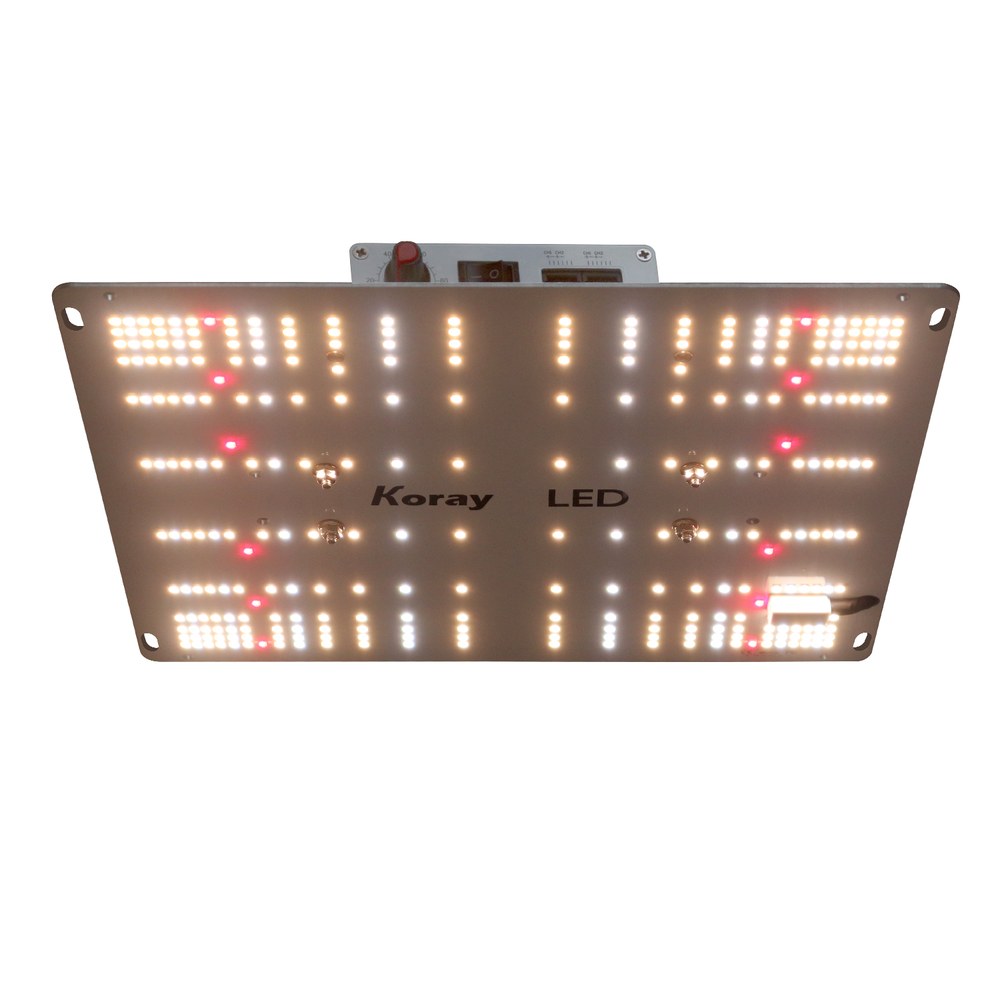
Product selection only makes sense against a stated crop, canopy area and photoperiod. Fixtures such as quantum-board panels suit compact benches with a defined canopy, while linear top-light bars suit multi-tier benches and greenhouse bays where even distribution across a long run matters more than peak centre intensity. Ask for the PPF grid at your intended mounting height before committing to a layout.
References
- Iowa State University Extension and Outreach. How to Determine How Much Supplemental Light to Provide Indoor Plants. (Lumen-to-PPF conversion guidance for white light.)
- Purdue Extension. Measuring Daily Light Integral in a Greenhouse (HO-238-W). (PPFD to DLI conversion and measurement method.)