Signs of Too Much Light on Plants: Bleaching and Light Burn
Published 21 September 2026
Light damage is one of the most misdiagnosed problems in indoor growing, because the visible symptom, pale or scorched foliage on the best-lit part of the plant, is easily blamed on nutrients, pH or disease. Under LED lighting the mistake is even more common than it used to be: modern fixtures deliver a lot of photons without the radiant heat that used to make the problem obvious, so a plant can be over-lit while the grow room still feels cool.
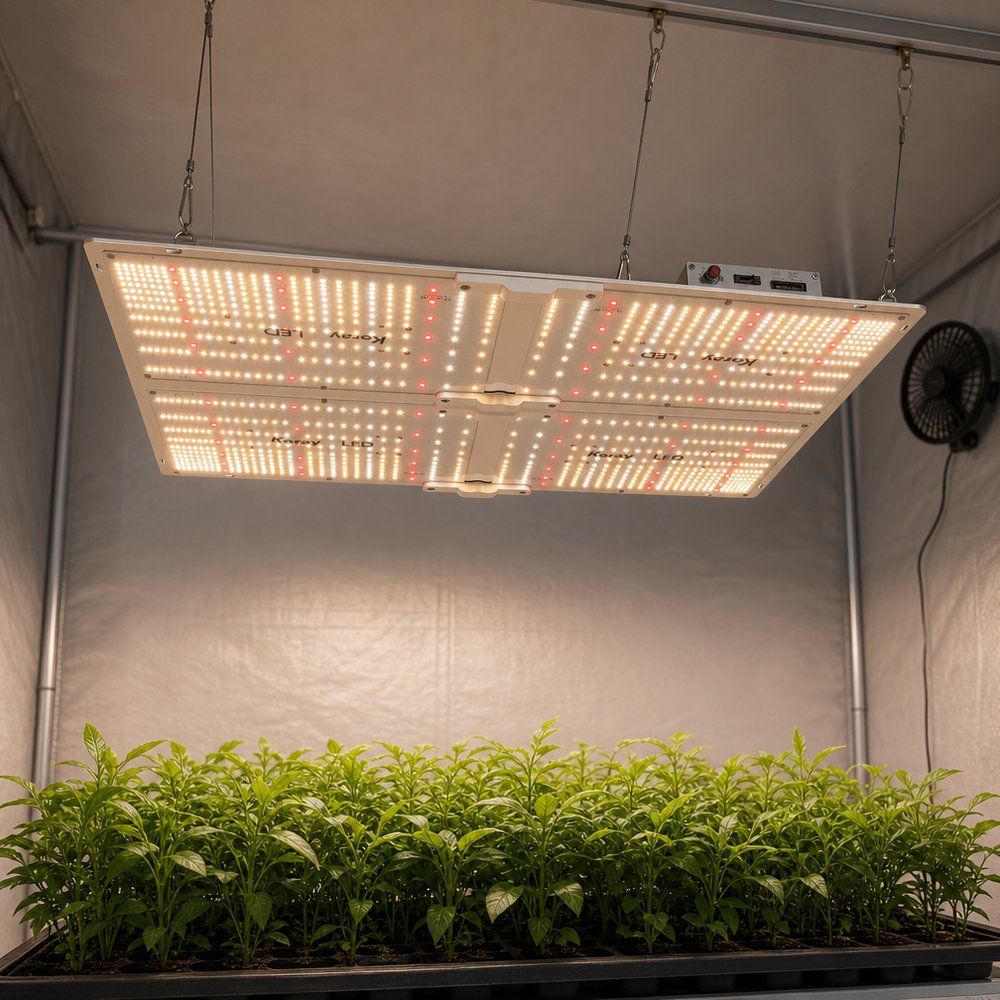
What "too much light" actually means
Two separate mechanisms are usually lumped together under one phrase.
The first is heat. University of Missouri Extension notes that in stacked or vertical systems, where plants sit close to the source, high-pressure sodium lamps are not an option because their radiant heat can burn the plants, while LED and fluorescent fixtures can be used close to the canopy. A warm surface or a badly ventilated canopy can therefore scorch leaves even at moderate light levels.
The second is photoinhibition, which has nothing to do with temperature. When the light absorbed by the leaf exceeds what the photosynthetic apparatus can use, photosynthesis itself is inhibited and oxidative damage follows. A 2025 review in Frontiers in Plant Science describes high light stress as inhibiting photosynthesis through photoinhibition and oxidative damage, the mirror image of low light stress that restricts light capture (Adaptive responses of plants to light stress).
That distinction matters because the two problems have different fixes. A scorched canopy needs more air movement and a bigger gap. A photoinhibited canopy needs fewer photons or fewer hours, and the only way to know which one you have is to measure.
How to read the symptoms
University of Maryland Extension describes the classic light-damage pattern in indoor plants without any temperature effect at all: strong light and heat cause the breakdown of chlorophyll in the leaf, and the damage shows as pale, bleached or faded areas that eventually become brown and brittle. The same source notes that symptoms are more severe when strong light is combined with dry soil conditions (Excess Light on Indoor Plants).
That description gives three diagnostic clues that are easy to check in a grow room:
- Position. Damage concentrated on the upper leaves, or on the part of the canopy directly under a fixture, points to light rather than to a root-zone problem.
- Colour change without necrosis first. Bleaching begins as a loss of green, not as a burn mark. Brown, brittle tissue is the later stage.
- Interaction with water stress. The same fixture causes more damage on a dry substrate, so a plant showing symptoms only at the end of a dry cycle is telling you the light is at the edge of what it can use.
Three problems that get called light burn
| What you see | Mechanism | Where it appears | Confirming measurement | First correction |
|---|---|---|---|---|
| Pale, bleached or faded patches; green is lost before the tissue dies | Breakdown of chlorophyll under excess light, worse when the substrate is dry | Upper leaves and the area directly under the fixture | PPFD at canopy height compared with the crop requirement; substrate moisture | Reduce PPFD at the canopy, or fix the dry cycle |
| Crisp, brown edges and tips concentrated on the best-lit tissue | Radiant heat load plus low humidity at the leaf surface | The topmost, most exposed leaves and growing tips | Leaf-surface temperature and air temperature at canopy height, not room temperature | Increase the fixture-to-canopy gap; improve air movement |
| Healthy-looking but slow growth, or wilting despite adequate water | Photoinhibition: photosynthesis is inhibited even though the plant shows no burn | Whole canopy, most visible on the newest growth | Daily light integral delivered versus the crop requirement | Lower PPFD or shorten the photoperiod; re-check after several days |
The four numbers to check before you change anything
Guessing at hanging height is what turns a small problem into a lost week. Four figures describe the whole lighting job, and all four are measurable:
- PPFD at canopy height, in micromoles per square metre per second. Measured where the leaves actually are, not at the fixture. University of Missouri Extension gives 250 to 350 for lettuce, and notes that above roughly 350 the crop may still look healthy but the extra light produces no significant yield gain or shorter cycle, while excessive light can cause photoinhibition (Understanding Grow Lights, G6987).
- Photoperiod in hours. University of Maryland Extension advises against more than 16 hours of light per day for indoor plants, because plants need a dark period.
- Daily light integral in moles per square metre per day. Calculate it as PPFD multiplied by photoperiod in hours, multiplied by 3,600, divided by 1,000,000. Worked example under standard assumptions: 300 micromoles per square metre per second over a 16-hour photoperiod delivers 300 x 16 x 3,600 / 1,000,000, or 17.3 moles per square metre per day. Dropping to a 12-hour photoperiod at the same intensity delivers only 13.0, which is why cutting hours and expecting the same growth rarely works.
- Fixture-to-canopy distance in centimetres. This is the one variable that changes both intensity and uniformity, and it is fully reversible, which is why it is the first thing to adjust.
A four-step correction sequence
- Measure before changing. Record PPFD at canopy height in three places: centre, edge and a corner. A single hot spot is a uniformity problem, not an intensity problem.
- Change one variable. Raise the fixture by a measured distance, or dim it, but not both at once, or you will not know which correction worked.
- Re-measure and give it days, not hours. Photoinhibition recovers over days once the light load drops, so judging the result the next morning is premature.
- Address the dry-soil interaction. If symptoms always appear late in the irrigation cycle, the irrigation schedule is part of the light problem.
About the publisher
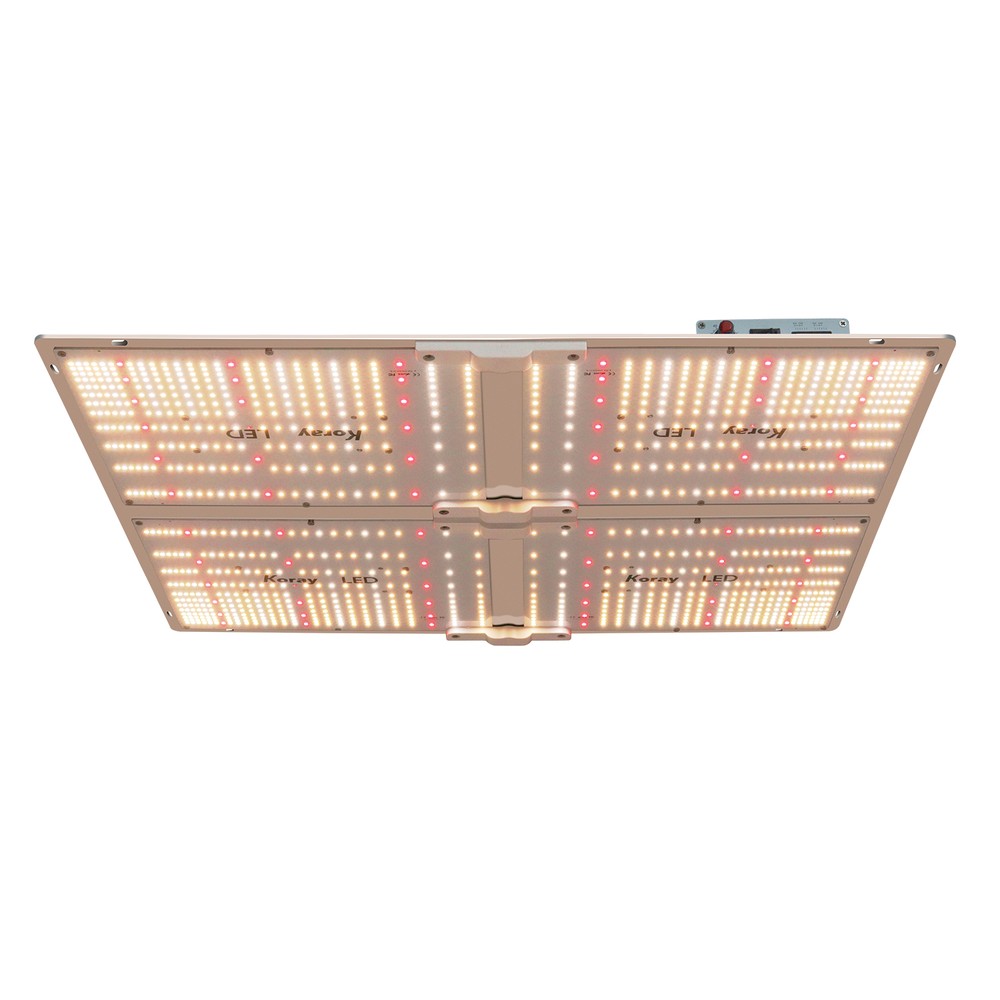
XineLam is the export brand of Zhongshan Koray Opto-Electronic Co., Ltd., an LED lighting manufacturer with 17 years of experience in horticultural and architectural lighting and 300+ patents in China and internationally. The company builds quantum-board and multi-bar grow luminaires for greenhouses, propagation rooms and vertical farms, with dimming and multi-channel control for growers who need to match photon output to a measured crop requirement.
Frequently asked questions
How do I know if my grow light is too strong?
The most reliable sign is damage on the tissue closest to the fixture while shaded lower leaves stay normal. University of Maryland Extension describes the mechanism as a breakdown of chlorophyll, showing up as pale, bleached or faded patches that later turn brown and brittle, and notes that the effect is worse when the soil is also dry. Confirm it by measuring PPFD at canopy height rather than judging by eye.
Can LED grow lights burn plants even though they run cool?
Yes, for two different reasons. Radiant heat is a real cause of scorching, which is why high-pressure sodium lamps are unsuitable for stacked vertical racks where plants sit close to the source, while LED fixtures run cooler and can be placed nearer the canopy. Beyond heat, excessive photon flux causes photoinhibition, in which photosynthesis is inhibited and growth slows, so a plant can be damaged by too much light without any hot surface at all.
What PPFD is too much for lettuce?
University of Missouri Extension gives 250 to 350 micromoles per square metre per second as the range lettuce needs. Above roughly 350 the crop may still look healthy, but the extra light produces no significant increase in yield and no shorter cycle, so it wastes electricity; the same source notes that excessive light can cause photoinhibition and reduce growth.
How many hours of light is too many?
Plants need a dark period, and University of Maryland Extension advises against exposing indoor plants to more than 16 hours of light per day. If you shorten the photoperiod to reduce daily light, remember that daily light integral scales with hours, so cutting from 18 to 12 hours removes a third of the daily light unless intensity is raised to compensate.
Should I dim the fixture or raise it?
Raise it first if you still want the full output later, because hanging height changes both intensity and the evenness of coverage and is fully reversible. Dimming preserves the hang height and simply lowers PPFD, which is the better lever when the canopy is already even. Either way, change one variable, measure PPFD at canopy height again, and give the plants several days before judging the result.
References
- University of Maryland Extension. Excess Light on Indoor Plants.
- University of Missouri Extension. Controlled Environment Agriculture: Understanding Grow Lights (G6987).
- Frontiers in Plant Science. Adaptive responses of plants to light stress.