Why Do Transplants Burn Under Grow Lights? Photoinhibition and Light Acclimation
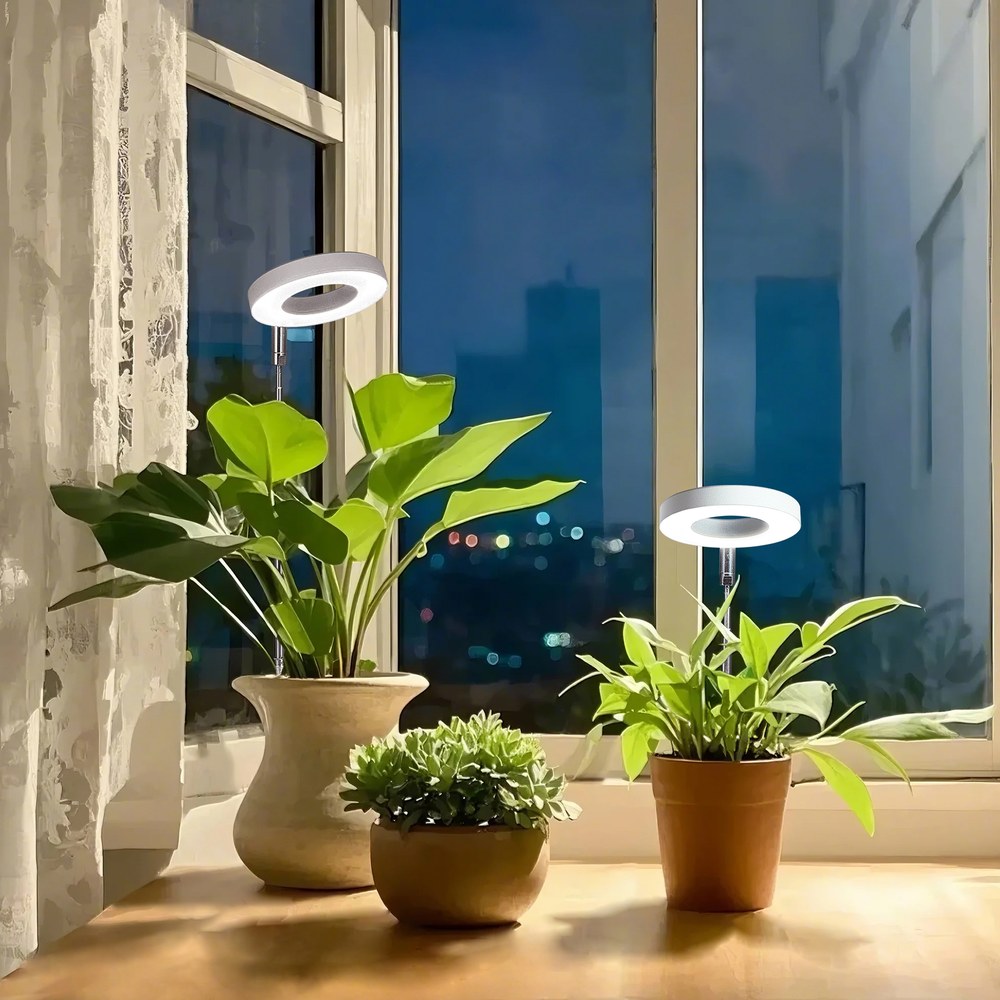
When a tray of seedlings that grew happily under a small lamp suddenly bleaches under a stronger one, the intuitive explanation is "too much light". The more precise explanation is usually a mismatch between the light arriving at the leaf and the photosynthetic machinery the leaf currently has. Those two conditions look identical on the plant, but they call for different responses.
This article covers what happens inside a leaf when light arrives faster than it can be used, why the same PPFD can be harmless to one plant and damaging to another, and how to move plants into stronger light with a schedule instead of a guess.
What the leaf does when light arrives faster than it can be used
Photosynthesis converts light energy into chemical energy at a finite rate. Beyond a certain point, adding more photons does not produce more sugar; the absorbed energy has to go somewhere else, and if it cannot be dissipated safely it generates reactive oxygen species that damage the photosynthetic apparatus. The general term for the resulting reduction in photosynthetic capacity is photoinhibition.
The critical detail for growers is that the threshold is not fixed. It depends on how much light the plant was already growing under. A leaf grown under a low daily light integral has a smaller pool of the proteins and pigments that handle high light than a leaf grown under a high one. Move both into the same bright space and only one of them is stressed — which is why the same PPFD can be a routine condition for a plant that was acclimated to it and an injury for a plant that was not.
Photoinhibition is not the same as "too much light"
Two distinct situations get grouped under the same complaint.
The first is a genuinely excessive light load: the intensity exceeds what any leaf of that species could process, and the damage continues regardless of history. This is the case where the only fix is to reduce the load.
The second is a rate-of-change problem. The final intensity is entirely reasonable for the species, but the plant was moved into it too quickly to adjust its photosynthetic capacity, its leaf anatomy and its protective pigment pool. In this case the fix is not less light forever; it is a slower ramp. Reaching the same final PPFD over seven to ten days instead of one afternoon is often the whole difference between a bleached tray and a healthy one.
Diagnostic shortcut: if the newest leaves are the ones that bleached, and older leaves that developed in the same room are still green, the final light level itself is probably survivable. The plants were simply moved into it faster than they could acclimate.
The photoprotective toolkit plants already have
Plants are not passive in bright light. A 2025 review of photoprotection and acclimation in Frontiers in Plant Science catalogues the mechanisms that are already running in a healthy leaf, and several of them are visible to a grower with no instruments at all.
- Non-photochemical quenching. Excess absorbed energy is converted to heat and dissipated before it can cause damage. It is the first line of defence and it responds within minutes.
- Repair of photosystem II. The protein complex that drives the light reactions is continually damaged and rebuilt. Acclimation means the repair cycle wins the race.
- Chloroplast and stomatal positioning. Chloroplasts can reposition to reduce light absorption, and stomata adjust to balance carbon dioxide uptake against water loss.
- Anthocyanin accumulation. The same review describes increased anthocyanin production as a photoprotective response. That is what produces the red or purple flush that growers often read as a nutrient problem.
- Scavenging of reactive oxygen species. An antioxidant system mops up the reactive molecules that high light generates.
Acclimation is the process of building these capacities up. Each of them takes days, not hours, which is precisely why a ramp works and a step change does not.
Recognising the symptoms and what they are often confused with
Light damage and several other problems produce similar-looking plants. The table below separates the light-related explanations from the ones growers usually reach for first.
| Symptom | Typical light-related cause | Often confused with | First action |
|---|---|---|---|
| Pale, bleached patches on the newest leaves | PPFD raised faster than the chloroplasts could acclimate | Nutrient burn or a deficiency | Reduce PPFD by roughly a third, then re-ramp over 5 to 7 days |
| Red or purple flush across the upper leaves | Anthocyanin accumulation as a photoprotective response to excess light | Phosphorus deficiency | Check the light history before changing the fertiliser |
| Leaves cupping upwards, sometimes with scorched margins | Combined heat and light load, usually because the fixture is too close | Low humidity | Measure leaf temperature, then increase the distance to the canopy |
| Wilting within hours of the change | Transpiration outrunning what the roots can supply | Root disease | Confirm the roots are healthy, then shade and re-ramp |
| Stems stretching instead of thickening | Too little light reaching the canopy after the move | Overwatering | Measure the daily light integral actually reaching the leaves |
An example ten-day light ramp
The schedule below is a worked example, not a standard. The cadence follows the seven to ten day progression that extension guidance recommends for hardening plants off, and the intermediate percentages are a practical way to spread the same final daily light integral over that window. Substitute your own final DLI target and hold at any step if you see bleaching.
| Day | Share of final DLI | Hours of light | What to check before moving on |
|---|---|---|---|
| 1 | About 30 percent | Short day, shaded position | Any cupping or wilting in the first hours |
| 2 | 40 percent | Add 1 to 2 hours | Leaf colour at the growing point |
| 3 | 50 percent | Add 1 to 2 hours | Whether the newest leaves are still flat |
| 4 | 60 percent | Add 1 to 2 hours | Leaf temperature at the canopy, not at the fixture |
| 5 to 6 | 70 to 85 percent | Approaching full daylength | Any new pale patches appearing |
| 7 | 100 percent | Full photoperiod | Hold at day 6 if bleaching appeared |
| 8 to 10 | Final target | Full daylength, then continuous exposure outdoors | Follow the extension progression of a full day, then 24 hours |
What extension guidance says about hardening off
University extension material on hardening off describes the same biological logic from the horticultural side. Nebraska Extension notes that outdoor sunlight is often more intense than the light provided by grow lights or in a greenhouse, and that it can easily burn the leaves of plants that have not been hardened. The changes the process is trying to produce are structural: thicker cell walls, thicker waxy layers on the leaf surface to reduce water loss, more lignin, more stored carbohydrates and more root development.
The practical progression given by extension guidance is consistent across sources, and it is essentially a light and exposure ramp. Illinois Extension advises starting about two weeks before transplanting, placing plants outside in the warmer part of the day for two to three hours, and increasing that exposure daily. Nebraska Extension gives the same shape over a seven to ten day period, beginning with two to three hours in a shaded position sheltered from wind, building to ten to twelve hours outside, and then leaving plants out for a full 24 hours for a couple of days before transplanting. Both sources advise reducing watering during the process without letting plants wilt, and neither recommends fertilising during it.
The corresponding indoor version is simpler, because you control every variable: instead of moving a tray outdoors, raise the fixture or shorten the photoperiod, and bring the intensity up on the schedule in Table 2.
Where acclimation matters most
Transplants raised under propagation lighting and then moved to a high-light growing space carry the largest adjustment. Plants moved from a greenhouse to a high-wire crop house, plants moved from a nursery bench to a vertical rack tier with lower headroom, and houseplants moved from a windowsill to a full-spectrum panel all meet the same issue in different settings. Where the final environment has a much higher daily light integral than the starting one, budgeting the first week for a ramp is cheaper than replacing a tray. Where the two environments are already similar, a shorter ramp of two to three days is enough.
About the publisher
XineLam is a horticultural LED lighting manufacturer with 17 years of experience in the LED lighting industry and 300+ patents in China and internationally. The company designs and produces LED modules, bars, tubes and reflector lamps for greenhouses, vertical farms and indoor growing rooms. This article is a technical explainer on plant responses to light; for lighting specification, follow the photometric data supplied for the specific fixture.
Frequently asked questions
Is bleaching from grow lights permanent?
The bleached tissue itself does not recover, because the damaged cells are no longer photosynthesising. New growth that develops under the corrected conditions is usually normal. This is why the practical response is to reduce intensity and re-ramp, and then to judge the plant by the appearance of its newest leaves rather than the oldest ones.
How long does it take plants to acclimate to stronger light?
On the order of a week for a substantial change. Extension guidance for hardening off uses a seven to ten day progression, and the structural changes involved — thicker cuticle, more lignin, more stored carbohydrate — are measured in days rather than hours. A change of only 20 to 30 percent usually needs considerably less.
Why do leaves turn purple or red under strong light?
Anthocyanin accumulation is a documented photoprotective response to excess light, and it is one of the mechanisms a leaf uses to limit how much energy reaches the photosynthetic apparatus. It is frequently misread as a phosphorus deficiency, so it is worth checking the recent light history before adjusting the nutrient solution.
Can I just raise the fixtures instead of ramping up gradually?
Raising the fixture does reduce intensity at the canopy, and it also widens and evens the distribution, so it is a useful lever. It does not replace a ramp, because the plant still has to build acclimation capacity to reach the final intensity. A common approach is to raise the fixture for the first days and bring it back down as the ramp progresses.
Do seedlings need acclimation before moving to a greenhouse?
Yes, and it is one of the most common places the problem appears, because a greenhouse can deliver a far higher daily light integral than a propagation bench. Treat the first week after the move as an acclimation period rather than a production period, and follow the same ramp logic used for hardening plants off.
Sources
- Khan, I., Sohail, Zaman, S., Li, G., & Fu, M. (2025). Adaptive responses of plants to light stress: mechanisms of photoprotection and acclimation. A review. Frontiers in Plant Science, 16, 1550125. PMC11986725
- Browning, S. Hardening Off Transplants. Nebraska Extension in Lancaster County. lancaster.unl.edu – hardening-transplants
- Illinois Extension. Starting a Garden: Hardening Off Indoor Seedlings. Good Growing blog, 6 April 2020. extension.illinois.edu – hardening off indoor seedlings