What Color Light Do Plants Need? Red, Blue and White LED Spectra Compared
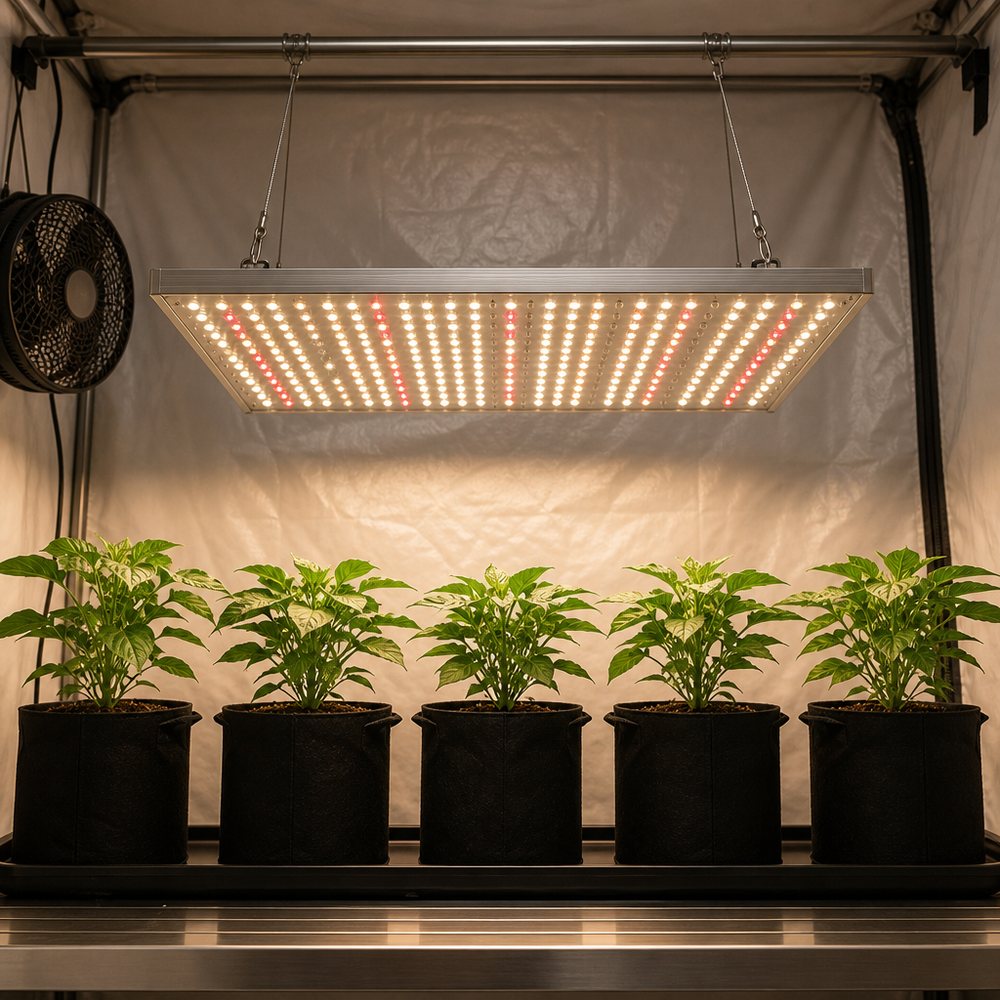
The short answer is that plants run mainly on blue and red, with far-red doing regulatory work that neither of those two can. Oklahoma State University Extension puts the optimum range for plants at 400 to 700 nm and singles out three peaks that most species use heavily: 440 nm blue, 660 nm red and 730 nm far-red. White light works too, but for an accidental reason rather than a designed one. The longer answer is that "what colour" is the wrong unit of measurement, because the useful question is not which colour but which wavelengths, at what proportion, and for which response.
Why colour is a rough label for a wavelength
Colour names describe what the human eye makes of a band of wavelengths, and the eye is not a plant. A fixture sold as "full spectrum" can be one phosphor-converted white LED, or a mixture of discrete blue, red, deep-red and white diodes. Both look broadly white on a shelf; they are not the same product to a plant, and they are not the same product on a specification sheet either.
What a plant actually uses is a set of photoreceptors that respond to particular wavelength regions. Blue is read by cryptochrome and phototropin, red and far-red by the phytochrome system, and photosynthesis itself absorbs most strongly in the blue and red regions. This is why the useful specification is a spectral distribution curve, or at minimum a statement of which diode colours are fitted and in what proportion.
What each waveband actually does
Oklahoma State University Extension's fact sheet on LED grow lights for plant production (HLA-6450) is unusually direct on this point. It states that blue light increases chlorophyll production and results in healthier foliage, while red and far-red light promotes growth and flowering. It also reports a table of measured plant responses to specific wavelengths, which is more useful than a general claim because each entry names the species, the wavelength and the photon flux used.
| Waveband | Approximate peak | Reported role | What was actually measured |
|---|---|---|---|
| Blue | 440 nm (blue range 400-500 nm) | Increases chlorophyll production; described as ideal for vegetative growth | Sole-source blue at 446 nm and 160 µmol·m-2·s-1 inhibited stem height in impatiens, petunia, salvia and tomato seedlings |
| Red | 660 nm (red range 600-700 nm) | Promotes growth and flowering; carries most of the photosynthetic drive | Sole-source red at 160 µmol·m-2·s-1 increased leaf area and fresh shoot weight in the same four species; 660 nm red raised photosynthetic rates in strawberry leaves |
| Red with blue | 660 nm red plus 470 nm blue | The combination most fixtures are built around | Increased photosynthetic rates in rice leaves. A 2023 review in Plants also links the red-blue combination to enhanced potassium uptake through modulation of K transporter genes |
| Far-red | 730 nm (700-800 nm) | Flowering time, stem extension and shade signalling rather than bulk photosynthesis | Night interruption with red, white and far-red delayed flowering in two dianthus cultivars and promoted early flowering in petunia; red plus white alone inhibited height in ageratum and calibrachoa |
| Whole emittable range | 250-1,000 nm | Boundary of what an LED can emit, not what a plant needs | The same source puts the optimum for plants at 400-700 nm, which is why UV and far-red fall outside the PAR figure |
White, red-blue, or both
Growers tend to fall into two camps, and the division is practical rather than scientific. Broad white light is easier to work under, makes plant problems visible to the eye, and lets you judge colour and vigour the way you would in daylight. Discreet red and blue diodes let you push efficiency, because a diode that emits only at 660 nm wastes nothing on wavelengths the plant absorbs poorly.
The compromise that most modern fixtures take is a white base with added deep-red diodes. The white provides the blue and the working light; the added red raises the proportion of photons landing in the 660 nm region where photosynthetic efficiency per photon is high. Michigan State University Extension covers the harder version of this question, whether white LEDs can carry a horticultural application on their own, in its own resource on white LEDs for plant applications.
How to read a spectrum claim on a specification sheet
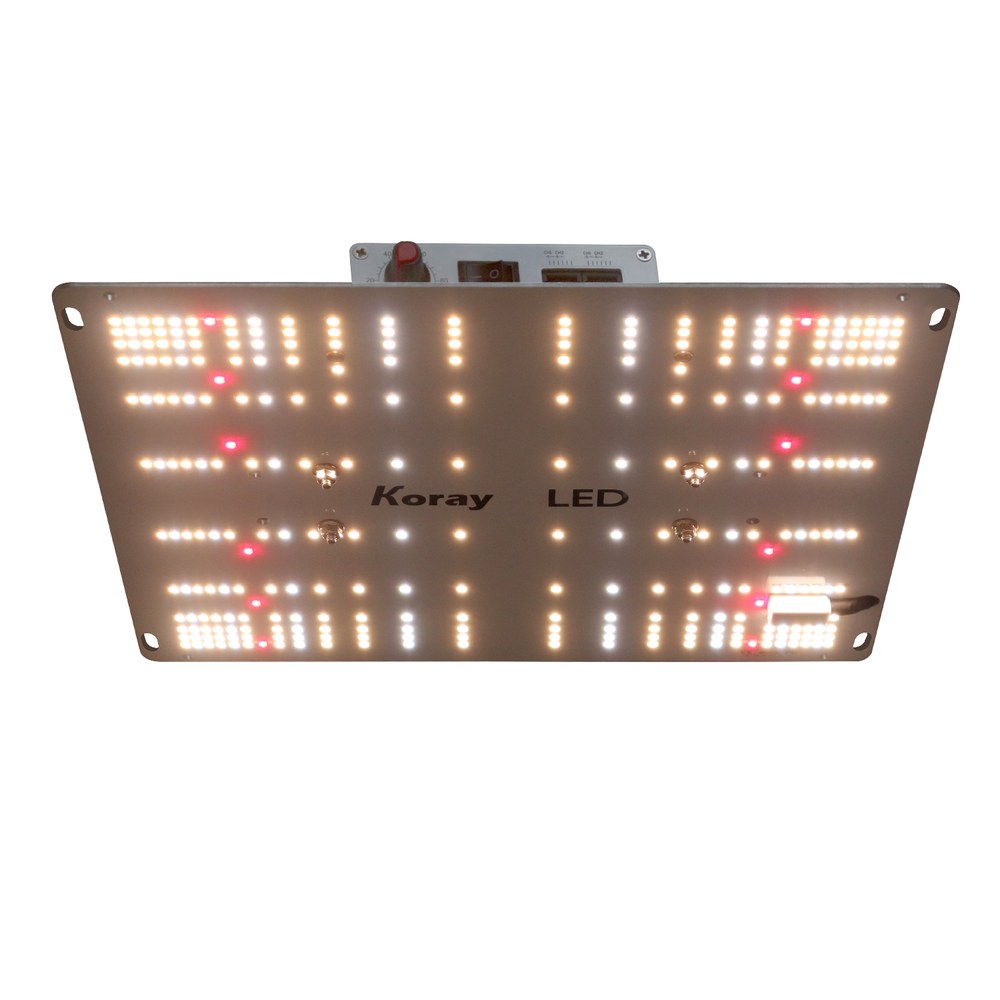
- Ask for the spectral distribution, not the colour name. "Full spectrum" and "sunlight-like" are descriptions of appearance. A curve, or a diode bill of materials with wavelengths and counts, is a description of output.
- Check whether the red is 660 nm or 630 nm. Both are red, and the wavelength most commonly optimised by plants sits at 660 nm. The number is usually available on request.
- Separate PAR from far-red. PPFD is defined over 400-700 nm, so a fixture with a large far-red content can have photomorphogenic effects that the PPFD figure does not show.
- Match the claim to the response you want. If the goal is compact, leafy growth, the blue proportion matters. If the goal is flowering timing, the red to far-red ratio matters more than total output.
- Remember that spectrum does not set quantity. Intensity, mounting height and hours per day decide how much light the canopy receives; the spectrum decides how that light is read.
Three spectrum claims worth treating carefully
"This spectrum is proven for all plants." The measured results are species-specific. The same 446 nm blue treatment that inhibited height in four bedding-plant species would not be reported the same way for every crop, and the far-red night-interruption results differ between dianthus and petunia in direction, not just in degree.
"More red means more growth." Red carries a large share of photosynthesis, but the reported blue effects on chlorophyll production and morphology do not come from red. A fixture that is almost entirely red is a bet that the response you want is the only one that matters.
"Far-red is wasted light." Far-red is outside the PAR window used for PPFD, but the flowering responses above were produced by far-red, white and red together. Light that does not count towards PPFD is not the same as light that does nothing.
Frequently asked questions
Do plants need green light at all?
Green is not the waveband the plant runs on. The 400-700 nm range is considered optimum for plants, and within it the 440 nm blue, 660 nm red and 730 nm far-red peaks are the ones most strongly used by most species, according to Oklahoma State University Extension. Green is absorbed less strongly than red and blue, which is part of why leaves look green, and in a white fixture it arrives as a by-product of making white light rather than as a targeted addition.
Is red light or blue light more important for plants?
They do different jobs rather than competing. Blue is described as increasing chlorophyll production and giving healthier foliage, and red and far-red as promoting growth and flowering. In the controlled work summarised by the same source, sole-source blue inhibited stem height while sole-source red increased leaf area and fresh shoot weight in the same four species, and combining 660 nm red with 470 nm blue raised photosynthetic rates in rice leaves. A fixture supplying both is the practical answer.
Does far-red light count towards PPFD?
Not in the standard figure. PAR and PPFD are defined over 400 to 700 nm, and 730 nm far-red is described as a wavelength most plants use heavily even though it sits at the edge of that band. That is why far-red can change plant shape and flowering while barely moving the PPFD number on a specification sheet.
Can a plain white LED grow plants?
White LEDs do emit inside the plant band, because white light is made by pairing a short-wavelength emitter with a phosphor that converts part of the output to longer wavelengths. The usable emission range of LEDs is broadly 250 nm to 1,000 nm and the optimum for plants is 400 to 700 nm, so a white LED falls inside that window. The limitation is control: a fixed white spectrum cannot be tuned for a specific response the way added red or far-red diodes can.
About the publisher
XineLam manufactures LED grow lights and LED lighting modules, with 17 years of experience in LED lighting and 300+ patents in China and internationally. The fixture shown in this article is an example of the panel format used for indoor cultivation; this guide is written as a technical explainer and the wavelength figures above come from the cited extension and research sources, not from product testing.