What Light Do Tissue Culture Plants Need? PPFD, Spectrum and Photoperiod
A tissue culture room looks like a grow room, but the light inside it does a different job. Cultures growing on a medium that already contains sugar are only partly photosynthetic, so the light has to do more than drive growth: it shapes how shoots multiply, how far they elongate, and how evenly a shelf full of vessels develops.
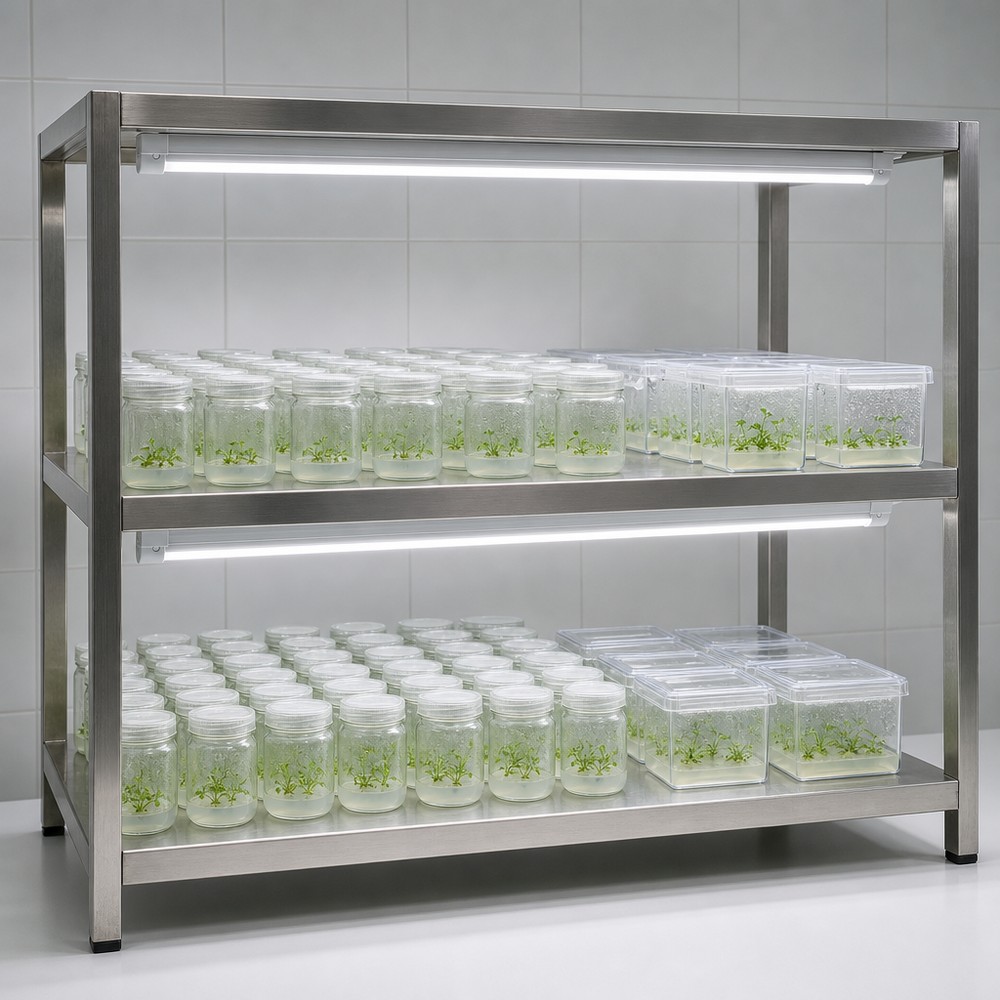
Why tissue culture lighting is not greenhouse lighting
Cultures in vitro start out mixotrophic. The medium supplies carbohydrates, and photosynthesis contributes a variable and generally smaller share of the carbon budget, so the light intensity that suits a production crop would be far too much — and would also heat the vessels from above. The consequence is a target range roughly an order of magnitude lower than a leafy-green production room.
Two other factors are peculiar to culture vessels. The lid sits between the light and the plantlets, so the material and its condensation determine how much of the incident light actually arrives. And because cultures are small, the crop response is driven by the light at the vessel surface rather than by a canopy measurement taken at some nominal height.
Light intensity: the PPFD range cultures actually receive
The useful unit here is still PPFD, measured at the surface of the vessel rather than at the lamp. The table below collects the parameters that appear repeatedly in published work and in culture-room practice.
| Parameter | Typical in vitro range | Notes |
|---|---|---|
| PPFD at vessel surface | 30–80 µmol·m⁻²·s⁻¹ | Some studies extend to around 120–130 µmol·m⁻²·s⁻¹ for specific species and stages |
| Photoperiod | 16 h light / 8 h dark | The default in most published protocols |
| Resulting DLI | ≈ 1.7–4.6 mol·m⁻²·d⁻¹ | From 30–80 µmol·m⁻²·s⁻¹ over 16 h |
| Culture room temperature | 24–26 °C | Light adds heat, so room control still matters |
| Spectral emphasis | Blue ≈450 nm + red ≈660 nm | Green and far-red are used as modifiers |
Spectrum: why blue and red are the two channels that matter
Red light is the main driver of photosynthesis in the culture vessel, while blue light carries more of the morphological signal — shoot quality, leaf development and how compact the plantlet grows. Published research treats light quality as a proliferation variable in its own right: a study on in vitro cultured plantlets of Camellia oleifera 'Huajin' found that light quality affected proliferation, and work on Cunninghamia lanceolata showed that LED photoperiod and light quality together influenced in vitro growth and chlorophyll fluorescence.
The practical reading of that literature is that the blue-to-red ratio is a tuning parameter, not a constant. Where elongation needs to be controlled, a higher blue share is the usual first adjustment; where rooting and biomass are the priority, the red share increases.
Photoperiod: why 16 hours is the standard starting point
A 16-hour light and 8-hour dark cycle appears repeatedly in micropropagation protocols, and it is a sensible first setting because it delivers the required DLI at a modest intensity while leaving a defined dark period. Because the intensity used in vitro is low, extending the photoperiod is rarely a useful way to raise DLI — the cheaper lever is to keep intensity low and consistent and to make sure it arrives evenly.
Where a species elongates too much, shortening the photoperiod is one of the available controls, alongside spectrum and the cytokinin balance in the medium.
LED or fluorescent tubes in the culture room
Fluorescent tubes were the default for decades because they were cheap, diffuse and available in the right intensity range. They have two limitations indoors: the spectrum is fixed, and a large share of their input energy leaves as heat inside an already warm room.
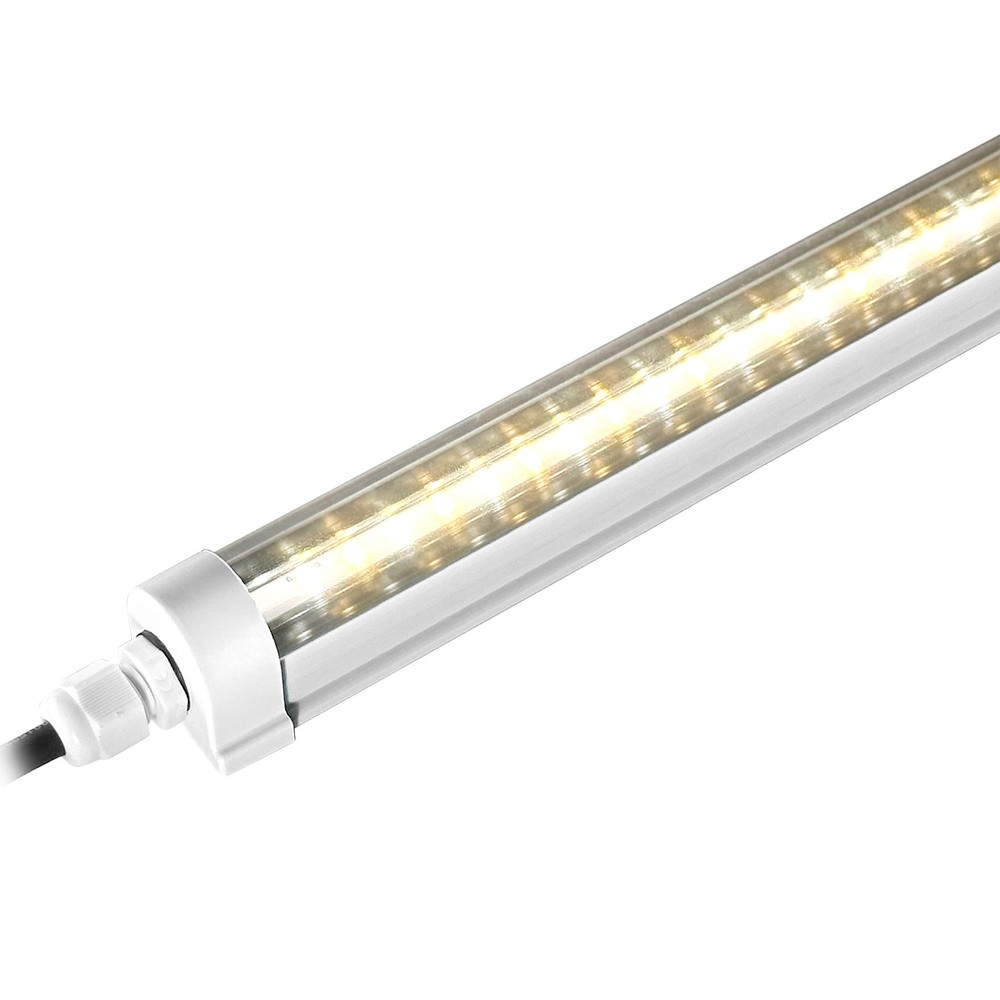
LED tubes change both terms. The spectrum can be set, so the blue-to-red ratio becomes a decision rather than a constraint, and less of the input energy reaches the vessels as radiant heat at the same PPFD. That matters in a room kept at 24–26 °C with cultures only centimetres from the light source.
Vessel geometry, shelf position and uniformity
Uniformity is the parameter that is easiest to get wrong because it cannot be seen. A tube mounted in the middle of a shelf gives the vessels directly beneath it noticeably more light than those at the shelf ends, and a lid that is more opaque in one corner of a vessel amplifies the difference. Three habits avoid most of the problem: measure a grid rather than a single point, keep the distance from tube to vessel lid constant across the shelf, and orient tubes so their length runs along the shelf rather than across it.
A practical setup checklist
- Write the target PPFD and photoperiod down before choosing a tube.
- Measure at the vessel lid, not at the lamp, and repeat the measurement at the shelf ends.
- Keep 16 h light / 8 h dark unless a species-specific reason argues otherwise.
- Start with a blue-and-red mix and treat the ratio as a variable to be tested per species.
- Log the room temperature with the light on, not only with it off.
- Re-check uniformity whenever the vessel format changes, because lid geometry changes the result.
FAQ
What PPFD do tissue culture plants need?
A working range of roughly 30–80 µmol·m⁻²·s⁻¹ measured at the vessel surface is common in culture rooms. Over a 16-hour photoperiod this delivers only about 1.7–4.6 mol·m⁻²·d⁻¹, roughly an order of magnitude below a production lettuce crop.
How many hours of light should a culture room run?
16 hours of light followed by 8 hours of dark is the default in most published micropropagation protocols. A shorter photoperiod is sometimes used when shoot elongation needs to be restrained.
Should I use blue or red light for micropropagation?
Both channels are used together. Red around 660 nm drives photosynthesis and influences elongation, while blue near 450 nm affects shoot morphology and quality. Published work treats the blue-to-red ratio as a species-specific variable rather than a fixed recipe.
Can ordinary white LED tubes be used in a culture room?
Yes, provided the fixtures deliver the target PPFD evenly across every vessel on the shelf. Spectrum-controlled tubes add the ability to set a blue-to-red ratio and reduce the radiant heat reaching the cultures.
References
- Effects of LED photoperiods and light qualities on in vitro growth and chlorophyll fluorescence of Cunninghamia lanceolata (BMC Plant Biology) — https://link.springer.com/article/10.1186/s12870-020-02480-7
- Light quality affects the proliferation of in vitro cultured plantlets of Camellia oleifera Huajin — https://pmc.ncbi.nlm.nih.gov/articles/PMC7547595/
About the publisher
XineLam manufactures LED lighting and horticultural LED fixtures. The company reports 17 years of experience in LED lighting and 300+ patents in China and internationally. This article is a general reference on light for in vitro culture and is written for laboratory and propagation staff; it is not a validated protocol for any particular species.
For a culture room, the quantities that matter when a fixture is specified are the photon efficacy, the distribution across the shelf width at lid height, and the radiant load reaching the vessels.