Why Are My Seedlings Leggy? LED Grow Light Distance and Intensity Fixes
A seedling that puts its growth into stem instead of leaf is not a variety problem. Stretch is a management outcome, and the literature gives three levers with very different costs: the daily light integral the crop receives, the day-night temperature gap, and the water and nutrient regime. This guide works through them in the order that costs least to check, using published extension figures and a calculated daily-light table.
What leggy actually means
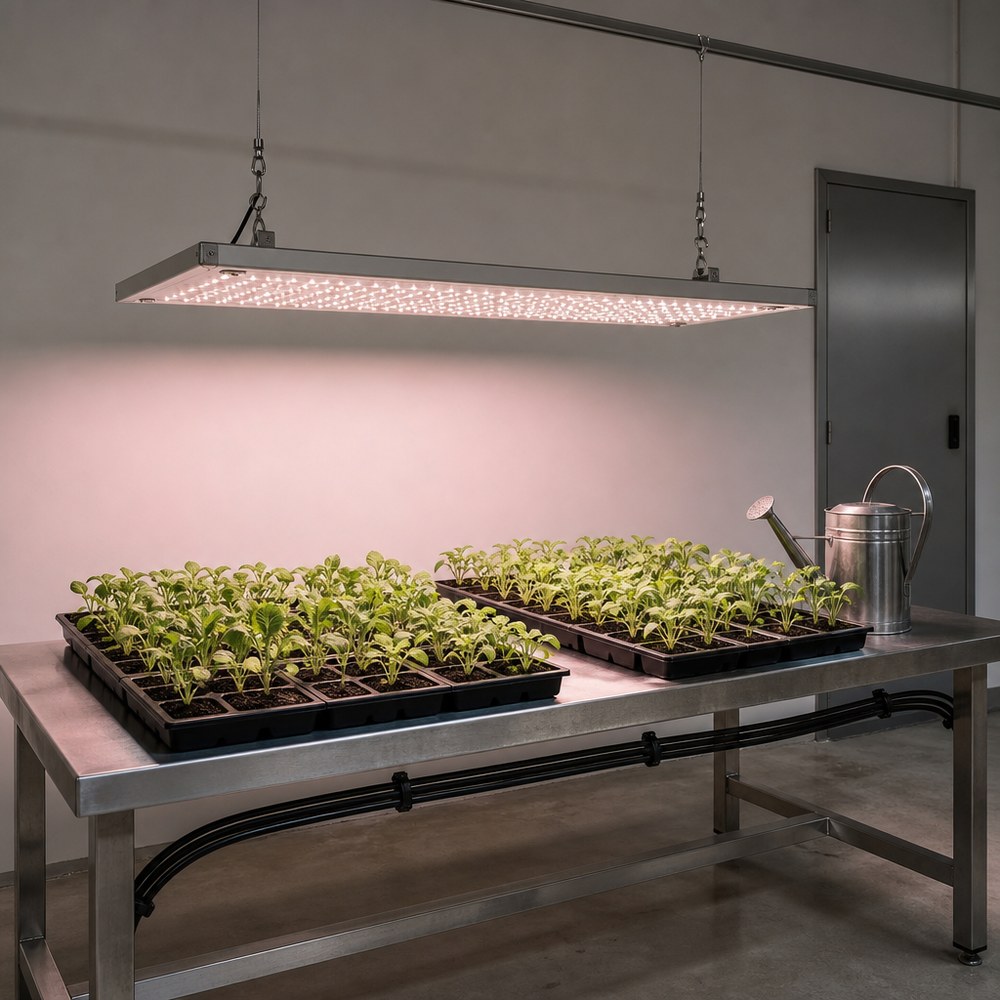
Leggy describes a transplant that has spent its growth on stem length rather than on leaves and root. The greenhouse literature calls the same problem stretch and measures it as stem elongation.
The important detail for diagnosis is that stretch has several causes and only one of them is light. UMass Extension lists leggy transplants among the ordinary risks of a spring propagation cycle: they may develop with low light levels, overwatering, overfertilizing, or when plants are held in the greenhouse longer than anticipated because of unseasonable weather. Because those conditions look identical from the bench, the useful first step is a measurement rather than a guess.
Cause 1: the crop did not receive enough light in a day
Seedlings are not simply small plants with proportionally small light needs. Virginia Tech Extension lists a recommended daily light integral of 5 to 10 mol/m²/day for seedlings and cuttings, against 12 to 17 mol/m²/day for lettuce and 20 to 30 mol/m²/day for tomato, cucumber and zucchini.
A daily light integral is the product of the light intensity at the canopy and the hours the fixture runs. Virginia Tech gives the relationship as DLI = PPFD × photoperiod in hours × 0.0036, with PPFD in µmol/m²/s. That means the same fixture can land above or below the seedling band depending on two settings a grower controls directly: how far the light hangs, and how long it runs.
The table below works the multiplication out for the PPFD levels small LED fixtures commonly produce at canopy height.
| Photoperiod (hours per day) | 100 µmol/m²/s | 150 µmol/m²/s | 200 µmol/m²/s | 250 µmol/m²/s |
|---|---|---|---|---|
| 8 hours | 3 | 4 | 6 | 7 |
| 12 hours | 4 | 6 | 9 | 11 |
| 16 hours | 6 | 9 | 12 | 14 |
| 20 hours | 7 | 11 | 14 | 18 |
| 24 hours | 9 | 13 | 17 | 22 |
Source: calculated with the relationship DLI = PPFD × photoperiod × 0.0036 as published by Stallknecht, Virginia Tech Extension (SPES-720, 2025), whose reference table covers PPFD levels of 50 to 250 µmol/m²/s. The seedling band of 5 to 10 mol/m²/day is from the same publication. Read the table as a diagnosis: 200 µmol/m²/s for 12 hours lands at about 9 mol/m²/day, inside the seedling band, while the same intensity for 16 hours reaches about 12 mol/m²/day, which is the lettuce band rather than the seedling band.
Cause 2: the day-night temperature gap
Light is the cause most growers look for first, but temperature is the one that is easiest to get wrong in a heated propagation room.
UMass Extension explains the effect through DIF, the day temperature minus the night temperature. The greater the difference between day and night temperatures, the more plants stretch: a very warm day with a cool night produces the tallest transplants, equal day and night temperatures produce shorter ones, and keeping the night warmer than the day — by heating at night and ventilating during the day — produces shorter plants still. Keeping day temperatures cool, at about 70 °F, helps hold transplants down.
Timing matters as much as the average. The critical period for height control using DIF is the first two to three hours after sunrise, starting about half an hour before it; lowering the temperature by a few degrees during that window can manage plant height in many vegetables. Response also differs by crop: tomato, brassicas, eggplant and melon are very responsive, while squash, cucumber and pepper are much less responsive.
The remaining conditions on the same list are worth checking before changing any hardware, because each one produces the same stretched look:
- Overwatering. Excess water is listed alongside low light as a condition under which leggy transplants develop.
- Overfertilizing. The same list of causes includes overfertilizing, which is the easiest of the group to correct.
- Holding plants too long. Transplants held in the greenhouse longer than planned, usually because of unseasonable weather, keep elongating while they wait.
- Water stress as a deliberate tool. Maintaining plants on the dry side limits cell expansion and growth, but the source warns it requires close monitoring to avoid leaf burn and, in the worst case, plant death.
- Low phosphorus, for tomatoes. A mild to moderate phosphorus deficiency can reduce growth with no visible deficiency symptoms and is described as especially effective for tomatoes; a starter fertilizer is recommended when transplanting to the field if the method is used.
- Mechanical brushing. Brushing transplants twice a day for 18 days, about 40 strokes with a cardboard tube, has produced as much as a 30% reduction in stem elongation in tomato, eggplant, cucumber and some broccoli and cabbage varieties. Peppers can be damaged by it, and brushing wet foliage can spread bacterial pathogens.
A workable order of operations
Because several causes look alike, work in the order that costs least to check and most to get wrong.
- Measure the daily light integral at the canopy before changing anything. Take the PPFD at the top of the crop, multiply by the hours the fixture runs and by 0.0036, and compare the result with the 5 to 10 mol/m²/day seedling band. Michigan State University Extension's guide to light sensors covers how to interpret the light units an environmental control system reports, which is the step that usually goes wrong.
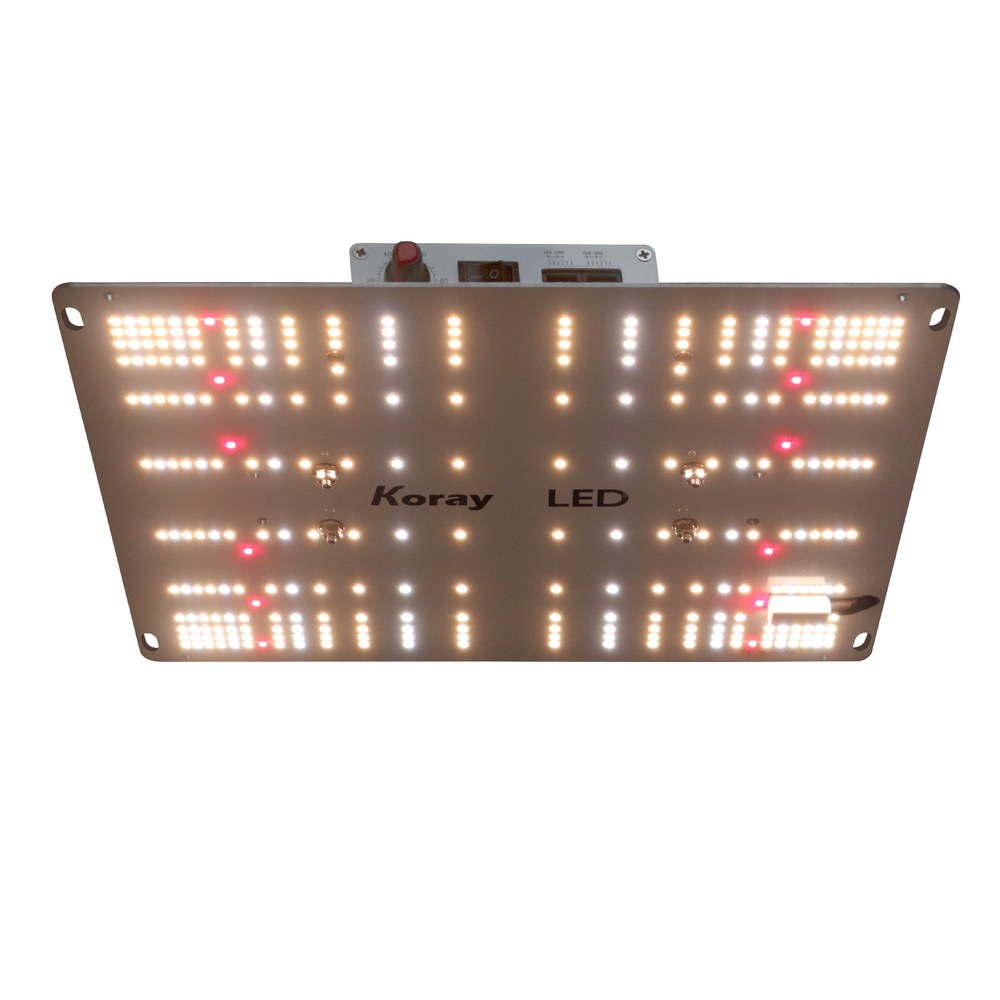
- Adjust intensity before you adjust the schedule. LED output is linearly related to PPFD, so a fixture dimmed to 50% delivers about half the PPFD; Virginia Tech notes this relationship holds for any LED fixture, which is what makes dimming a usable control rather than a brightness preference.
- Set the hanging height, then re-check uniformity. Moving the fixture closer raises PPFD, but Virginia Tech also notes the drawback: as the light gets closer, the overall uniformity of distribution decreases, so fewer plants are effectively illuminated. Set the height that covers the whole tray, then use dimming to fine-tune the level.
- Only then adjust temperature, starting in the sunrise window. Lowering the temperature by a few degrees during the first two to three hours after sunrise is the period UMass Extension identifies for the strongest DIF effect on plant height.
- Keep the photoperiod long enough to reach the target rather than chasing it with intensity alone. Intensity and hours multiply, so a modest PPFD run for more hours can reach the seedling band with a gentler light environment.
When a growth regulator is the last resort
Chemical height control is a narrow option for vegetable transplants. UMass Extension notes that very few growth regulators are registered for vegetable transplants, and that Sumagic (uniconazole) is the only product labeled — and only for a limited group: tomato, pepper, eggplant, tomatillo, ground cherry and pepino. It is applied as a foliar spray at 2 to 10 ppm, with a maximum cumulative amount of 10 ppm, and the last spray must be no later than two weeks after the two- to four-leaf stage.
For most growers the cheaper levers come first: more light, a smaller day-night temperature gap, and less water.
Frequently asked questions
Why are my seedlings leggy when they are already under a grow light?
Distance and hours are usually the explanation rather than the presence of a fixture. A daily light integral is the product of PPFD at the canopy and photoperiod, so a light hanging too high, or running too few hours, can leave the crop below the 5 to 10 mol/m²/day band that Virginia Tech Extension recommends for seedlings and cuttings.
What daily light integral do seedlings need?
Virginia Tech Extension lists 5 to 10 mol/m²/day for both seedlings and cuttings, compared with 12 to 17 for lettuce and 20 to 30 for tomato, cucumber and zucchini. Working backwards with DLI = PPFD × hours × 0.0036, a fixture delivering 200 µmol/m²/s reaches that band in roughly 7 to 12 hours of run time.
Should I lower my grow light to stop the stretching?
Lowering the fixture raises PPFD, and for the same photoperiod it raises the daily light integral. The trade-off is documented: Virginia Tech Extension notes that as the light is moved closer, overall uniformity of distribution decreases, so fewer plants are effectively illuminated. Set the height that covers the whole tray, then fine-tune with dimming instead of continuing to lower the fixture.
Does temperature matter as much as light?
It matters in the opposite direction, and it is often the overlooked lever. UMass Extension describes DIF — day temperature minus night temperature — as the driver: the bigger the gap, the more plants stretch. Keeping day and night temperatures equal shortens plants, and keeping nights warmer than days shortens them further. Cooling day temperatures to about 70 °F helps, and the first two to three hours after sunrise are the period where the effect is strongest.
Can I just brush my seedlings to keep them short?
It is a documented method rather than a first choice. Brushing transplants twice a day for 18 days at about 40 strokes produced as much as a 30% reduction in stem elongation in tomato, eggplant, cucumber and some broccoli and cabbage, but peppers can be damaged, brushing wet foliage can spread bacterial pathogens, and growth resumes about three days after brushing stops.
About the publisher
XineLam designs and manufactures LED grow lights and horticultural lighting for controlled-environment agriculture. The company has 17 years of experience in the LED lighting industry and holds 300+ patents in China and internationally. This page is published as neutral technical reference; product-level suggestions are limited to the application scenarios discussed above.
Sources and further reading
External sources cited on this page:
- Pundt, L. (UConn Extension). "Managing Vegetable Transplant Height." UMass Extension Vegetable Notes 2026, Vol. 38:4, 14 April 2026, reprinted from the 2025-26 New England Vegetable Management Guide. https://www.umass.edu/agriculture-food-environment/vegetable/newsletters/vegetable-notes/vegetable-notes-2026-vol-384
- Stallknecht, E. "Calculating and Using Daily Light Integral (DLI): An Introductory Guide" (SPES-720NP). Virginia Tech, School of Plant and Environmental Sciences, August 2025. https://pubs.ext.vt.edu/SPES/spes-720/spes-720.html
- Lopez, R. and Runkle, E. "Making sense of light sensors." Michigan State University Extension, 10 February 2021. https://www.canr.msu.edu/resources/making-sense-of-light-sensors