Why Are My Seedlings Leggy Under Grow Lights?
Tall, thin, pale seedlings are the most common complaint about indoor propagation, and the usual fixes — moving the lamp closer, buying a redder spectrum — are applied in the wrong order. This guide separates the four causes, shows what to measure for each, and gives a sequence that avoids wasting a batch.
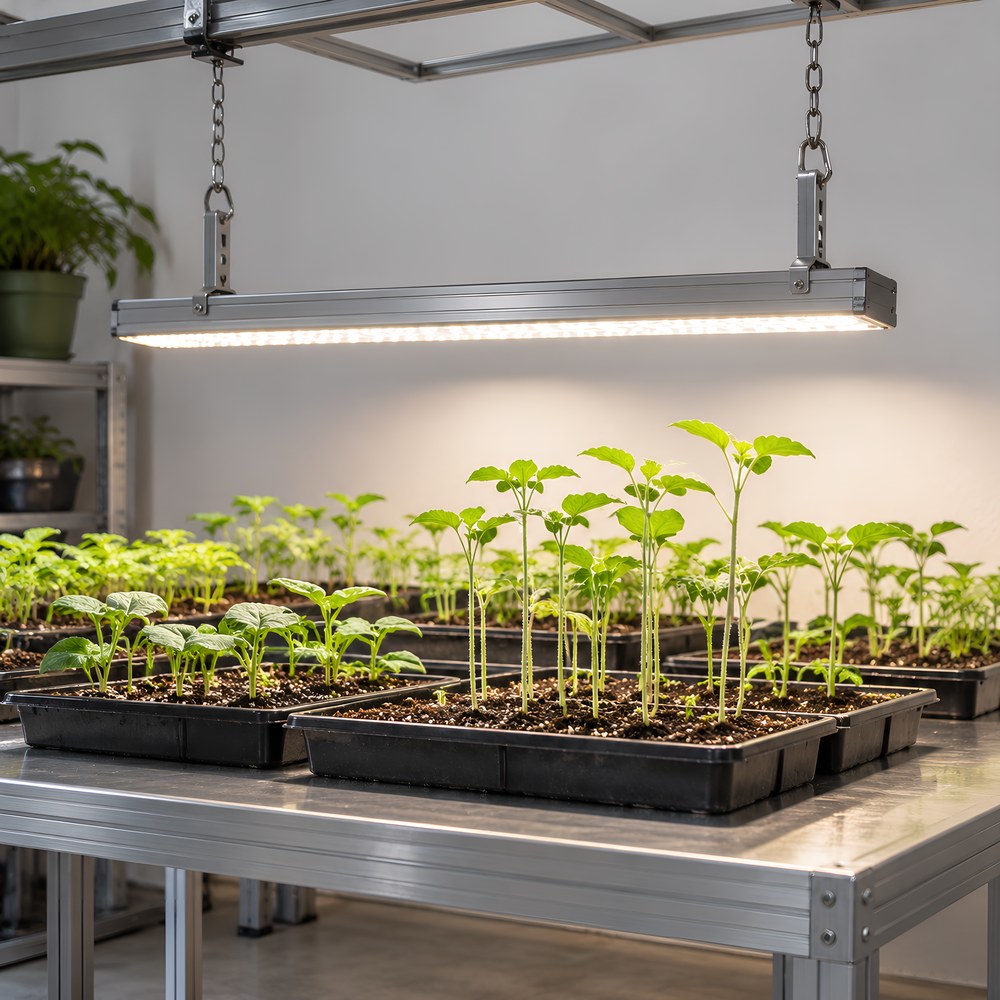
What "leggy" actually means
Legginess is not simply height. It is a shift in how the plant distributes what it produces: stem extension outpaces leaf expansion, internodes become longer, stem caliper stays small, and dry matter per centimetre of stem falls. A stretched seedling looks tall, but it is mostly water and air in a thin column.
The practical way to measure it is to take ten plants from the same tray and record two numbers: the length of the first internode above the cotyledons, and the stem diameter one centimetre above the substrate surface. Absolute values differ by species, so the useful comparison is between trays, between benches, or between this week and last week. Once you have those two numbers, the cause is usually identifiable from the pattern across the tray.
Cause 1: too little light per day, not too few watts
Plants integrate light over the whole photoperiod. The quantity that matters is the daily light integral (DLI), in moles of photosynthetically active photons per square metre per day, and it is the product of PPFD and the number of seconds of light:
150 µmol·m⁻²·s⁻¹ for 16 h = 8.6 mol·m⁻²·d⁻¹
250 µmol·m⁻²·s⁻¹ for 16 h = 14.4 mol·m⁻²·d⁻¹
400 µmol·m⁻²·s⁻¹ for 12 h = 17.3 mol·m⁻²·d⁻¹
Commercial propagation programmes commonly target roughly 10–12 mol·m⁻²·d⁻¹ for plugs and young plants, and the target rises with the crop's vigour and with temperature. Below that range, the plant has a rational response: it invests in stem extension to reach more light, because in a canopy that is exactly what works. A fixture rated at "300 W" tells you nothing about whether the canopy is receiving 8 or 15 mol·m⁻²·d⁻¹.
This is why two growers with the same lamp can get opposite results. A 16-hour photoperiod at 150 µmol·m⁻²·s⁻¹ delivers 8.6 mol; the same fixture at 18 hours and a shorter hanging height may deliver twice that.
Cause 2: the red to far-red ratio is telling the plant it is in shade
Plants read the spectral distribution of light as information. Phytochrome exists in two interconvertible forms: Pr absorbs red light around 660 nm and becomes Pfr, and Pfr absorbs far-red light around 730 nm and reverts to Pr. Because a leaf canopy absorbs red much more strongly than far-red, the light that reaches a plant growing beneath other plants is enriched in far-red. A low red to far-red ratio therefore means "you are shaded, grow taller".
Open sky has a red to far-red ratio of roughly 1.1–1.2 on a photon basis; light filtered through a dense canopy can fall below 0.5. A fixture whose spectrum is deliberately far-red rich — a common design choice for yield and for photoperiod control — can deliver a ratio in the shaded range even when total PPFD is high. The plant then receives plenty of light and still extends.
Peer-reviewed work on lettuce and other crops documents this clearly: shade avoidance responses include increased stem and petiole elongation, changed leaf orientation and greater biomass allocation to stems, and the magnitude of the response depends on the far-red fraction of total PPFD rather than on far-red alone (Frontiers in Plant Science, 2024). The same response differs between cultivars, which is why one variety in a trial stretches and its neighbour does not (Frontiers in Plant Science, 2023).
Cause 3: too little blue, and how blue interacts with far-red
Blue light acts in the opposite direction to far-red on extension. Crytochrome and phototropin signalling suppresses shade avoidance, so a spectrum with a very small blue fraction produces the same elongated, wide-leafed habit as a far-red-rich spectrum, even at adequate PPFD. Recent work shows that blue light modulates the interaction between far-red and plant morphology rather than acting independently: the same far-red addition produces different degrees of elongation depending on how much blue is present (Frontiers in Plant Science, 2025).
In practice, propagation spectra usually keep a blue share in the range of about 5–15% of PPFD. Below that, leaves tend to broaden and thin and stems to extend; far above it, growth can become compact to the point of slowing leaf expansion, which is a different problem.
Cause 4: temperature, especially the day–night difference
Extension growth is strongly temperature dependent, and the difference between day and night temperature (DIF) is a classical, non-chemical height control. A positive DIF — days warmer than nights — promotes extension. A zero or negative DIF, with nights as warm as or warmer than days, suppresses it. In practice, running nights 3–5 °C cooler than days is the usual first move, because it slows extension without reducing photosynthesis as much as an overall temperature drop would.
The combination that produces textbook leggy seedlings is warm and dim: a propagation bench at 24–26 °C under 8 mol·m⁻²·d⁻¹. The plant is growing fast and is short of light, so it converts the available carbon into stem. Cooling the bench and raising the DLI together is far more effective than either change alone.
A diagnostic table: symptom, measurement, cause, first action
| What you see | What to measure | Most likely cause | First action |
|---|---|---|---|
| Long internodes across all cultivars; plants lean toward the aisle | PPFD at canopy, ten points; hours of light | DLI below roughly 10 mol·m⁻²·d⁻¹ | Extend photoperiod toward 18 h, or raise fixture output; check that the tray edge is not at half the centre PPFD |
| Stretching only under one fixture while neighbours are compact | Spectrum of that fixture, red to far-red ratio | Far-red-rich spectrum, low R:FR | Reduce or remove the far-red channel, or run that fixture over a crop where extension is wanted |
| Wide, thin, pale leaves with long petioles | Blue fraction of PPFD | Too little blue | Add blue or change to a spectrum with roughly 5–15% blue |
| Stretching worsens in warm spells | Day and night air temperature at canopy height | Positive DIF | Cool nights 3–5 °C below day temperature; improve air movement |
| Short, dark, slow plants with curled leaf margins | PPFD and leaf temperature | Light excess, not stretch | Raise the fixture or shorten the photoperiod; this is the opposite problem |
The order to fix it, and why the order matters
- Measure PPFD at canopy height with a quantum sensor at ten positions across the tray, including the corners. Average them and convert to DLI with the formula above. Without this number, every later decision is a guess.
- Fix the DLI first. Extend the photoperiod, reduce tray spacing, or raise output. Spectrum changes are cheaper to talk about and harder to get right; quantity comes first because extension responds to it most strongly.
- Check the red to far-red ratio of the fixture you are using. If it is far-red rich by design, confirm that this is appropriate for the crop stage. A propagation area usually does not need it.
- Confirm the blue fraction is in the 5–15% range rather than at either extreme.
- Manage DIF. Nights 3–5 °C cooler than days, with air movement across the canopy so leaf temperature tracks air temperature.
- Only then consider chemical growth regulators, which are restricted or unavailable in many markets and which treat the symptom.
Why moving the lamp closer is not a general fix
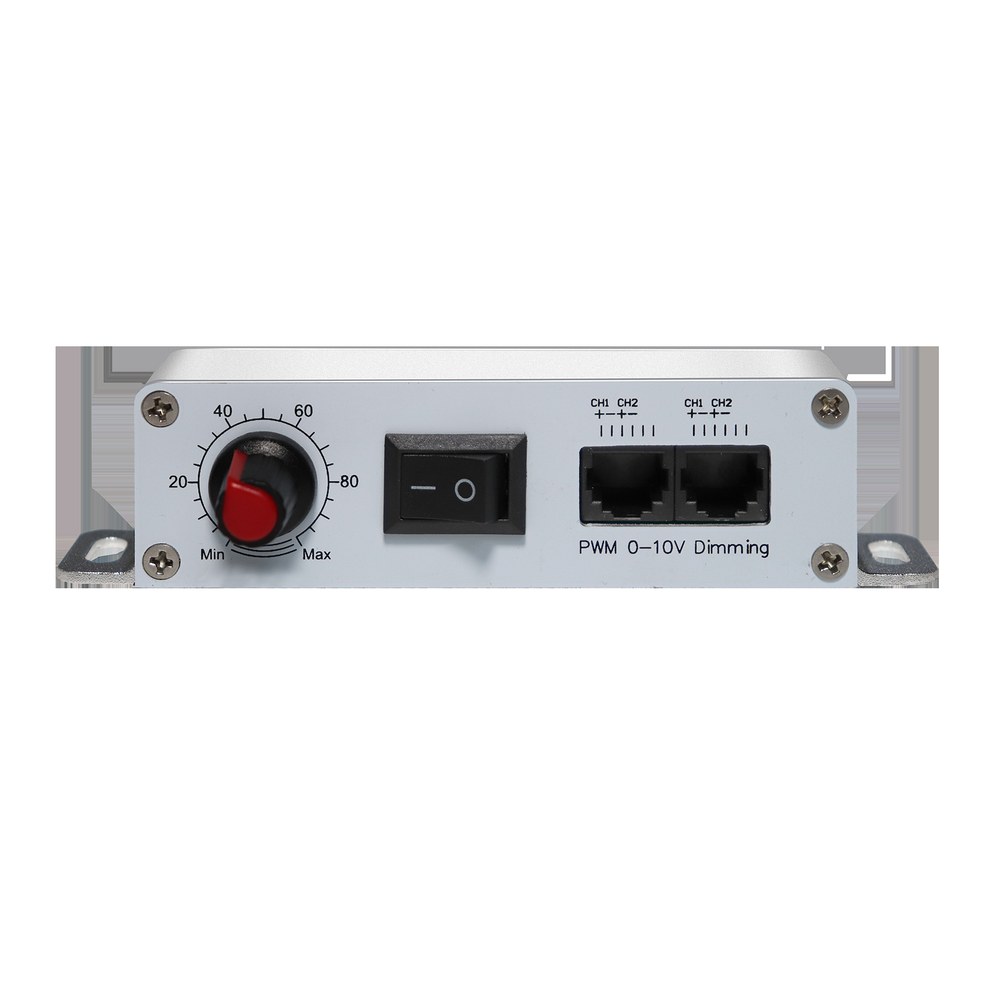
Lowering the fixture raises PPFD at the centre of the footprint and reduces it at the edges, because the inverse-square falloff becomes steeper close to the source. The result is a tray that is over-lit in the middle and under-lit at the corners, which produces exactly the mixed tray that growers then describe as "uneven". At very short distances, leaf temperature also rises above air temperature, and the plant responds to heat as well as to light.
A better sequence is to set the hanging height from the fixture's own photometric data to give uniform coverage over the intended area, then use dimming or photoperiod to hit the DLI target. Uniformity matters as much as the average: a tray averaging 12 mol·m⁻²·d⁻¹ with a 2:1 centre-to-edge ratio still has edge plants at 6 mol, and those are the ones that stretch.
Frequently asked questions
Can leggy seedlings be fixed by burying the stem deeper?
For tomato and some other Solanaceae, burying part of the stem at transplant encourages adventitious roots and does recover a stretched seedling. For most other crops the buried stem simply rots, and the elongated internodes stay elongated. It is more reliable to correct the light environment for the next batch than to repair this one.
Does a 24-hour photoperiod stop stretching?
Not by itself. A 24-hour photoperiod raises the daily light integral, which does reduce extension, but several species require a dark period to develop normally, and continuous light can cause leaf chlorosis or flowering problems in sensitive crops. Extending to 18 hours is usually the safer way to add light.
Is stretching reversible once it has happened?
The internodes that already extended will not shorten. New growth produced after the correction will be shorter and thicker, so the plant keeps a visible record of the stress. This is why growers judge a fix by the internodes formed after the change, not by the older ones.
Do blue-and-red lamps prevent leggy seedlings?
Not automatically. Extension responds mainly to how much light the plant receives per day and to the red to far-red ratio. A blue-and-red fixture with a high output and a high red to far-red ratio will produce compact seedlings; the same fixture run dim will still produce stretched ones.
Sources
- Frontiers in Plant Science (2025). Blue light modulates the interactive effects of far-red light on plant growth.
- Frontiers in Plant Science (2024). Quantifying the effects of far-red light on lettuce growth and morphology.
- Frontiers in Plant Science (2023). On the contrasting morphological response to far-red light between cultivars.
About the publisher
XineLam is the horticultural lighting brand of Zhongshan Koray Opto-Electronic Co., Ltd., with 17 years of experience in LED lighting and 300+ patents in China and internationally. The company designs and manufactures LED grow lights for greenhouses, vertical farms and propagation rooms, including dimmable bar fixtures and spectrum options with and without far-red channels. For crops where extension control matters, the relevant questions are the achievable PPFD at the canopy, the uniformity over the growing area, and the spectrum actually delivered — all three can be specified and measured before a fixture is ordered.