XineLam › Technical Articles › Driver derating
Why Do LED Grow Light Drivers Fail in Hot Grow Rooms? Derating Explained
A fixture rated for 50,000 hours is often returned after three. The LEDs are usually still working. What failed is the power supply, and the reason is written in a curve most buyers never read.
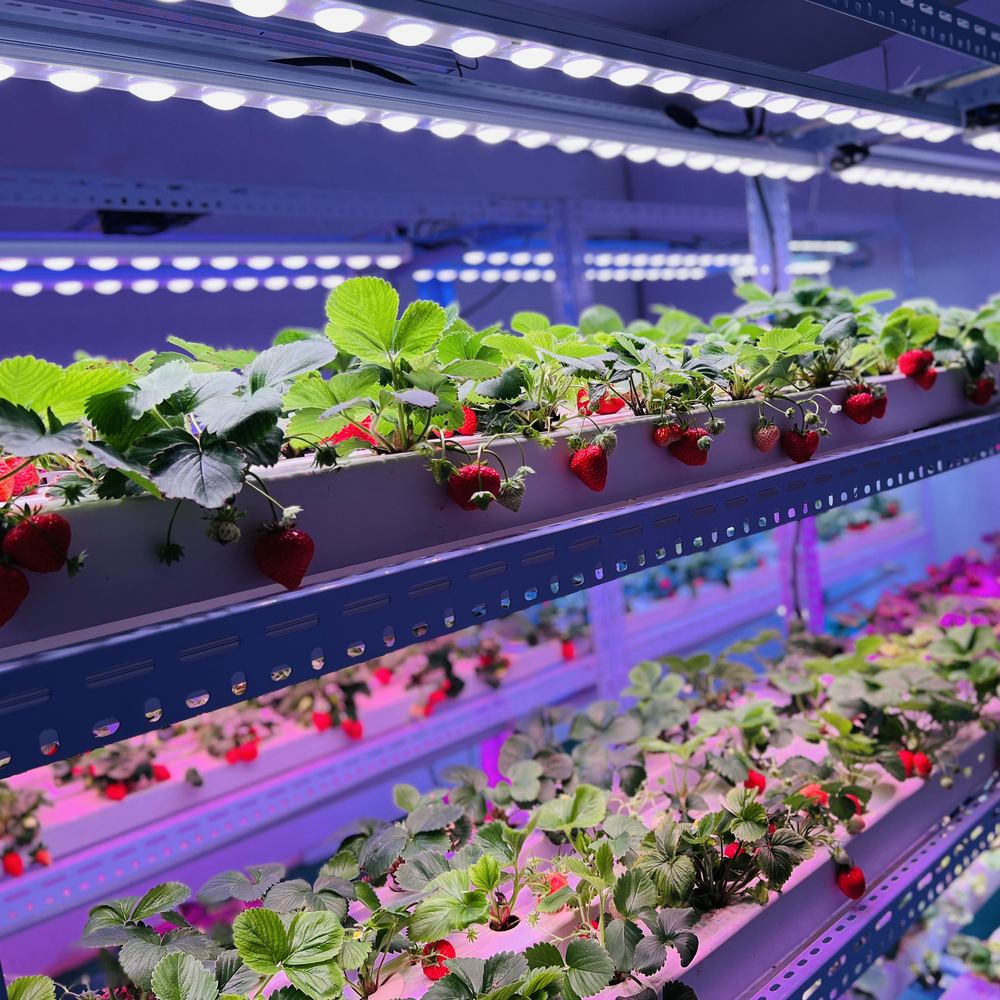
The power supply is usually the first component to go
An LED package degrades slowly: lumen output falls gradually, colour shifts a little, and the fixture keeps working. A driver fails differently. It contains electrolytic capacitors, a switching stage, control logic and a housing that must shed heat from all of them. When the case runs hot, capacitor electrolyte evaporates faster, equivalent series resistance rises, ripple current increases, and the unit eventually trips, restarts, or dies.
A widely used rule of thumb in power-supply design is that the life of an aluminium electrolytic capacitor halves for every 10 °C rise in core temperature. That single relationship explains why the same driver can last a decade on a bench and three seasons above a canopy.
Where the losses come from
Efficiency tells you how much heat the driver must shed. A 240 W constant-current driver at 93.5 percent efficiency dissipates about 15.6 W inside its own housing. That is small compared with the fixture's total load, but it is concentrated in a sealed box roughly the size of a ruler, mounted where air movement is worst.
The LED board has a separate thermal path: junction to solder point, solder point to board, board to heat sink, heat sink to air. The driver has its own path from case to ambient. Both must be satisfied, and the driver path is the one usually left out of the layout drawing.
What the datasheet actually specifies
Take a mainstream 240 W constant-voltage/constant-current driver such as the Mean Well HLG-240H series. Its published specification states efficiency up to 93.5 percent, a fanless design, operation from −40 °C to +90 °C case temperature under free air convection, IP65/IP67 ingress protection, and three-in-one dimming whose output current range runs from about 10 to 100 percent (Mean Well HLG-240H datasheet). Two details matter more than the headline:
- Case temperature, not air temperature. The limit is measured at a marked Tc point on the housing. A cool room with a poorly mounted driver can still exceed it.
- A derating curve, not a single number. Output load is plotted against ambient temperature: full load up to a specified ambient, then a linear reduction toward the case limit. The available margin depends on where your room sits on that curve.
| Component or interface | What the specification controls | Behaviour near the limit | What to check |
|---|---|---|---|
| Driver case (Tc point) | Maximum case temperature, typically marked on the label | Derating of output; shortened capacitor life; thermal shutdown in some models | Measured Tc at full load in the real mounting position |
| Electrolytic capacitors | Rated core temperature, often 105 °C | Life roughly halves per 10 °C rise; ripple rises as ESR increases | Capacitor temperature class and driver derating curve |
| LED package | Lumen maintenance (L70/L90) per LM-80 data at defined case temperatures | Faster output depreciation and colour shift | LM-80 report temperatures versus your measured board temperature |
| Solder point and board | Thermal resistance of the path to the heat sink | Local hot spots, solder fatigue, delamination | Thermal pad or paste quality; screw torque |
| Heat sink to air | Convection area and orientation | Rise above ambient grows when fins are blocked or dusty | Clearance above and below; dust on fins |
| Sealed enclosure | Ingress protection, not thermal capacity | Heat must cross the wall; internal rise can add 10–20 K | Whether the driver is inside the fixture or remote-mounted |
A worked derating check
Suppose a 240 W driver runs at 93.5 percent efficiency, so about 15.6 W of heat leaves the housing. Mounted flat on an aluminium plate with a case-to-ambient thermal resistance of roughly 1.5 K/W, the case sits about 23 K above the surrounding air. In a 45 °C grow room that puts Tc near 68 °C; in a 50 °C pocket above the canopy it reaches about 73 °C. If the datasheet's full-load rating ends at a lower ambient, the fixture is now outside its rated window and must be dimmed or remounted.
Thermal resistance figures vary with mounting, orientation and airflow. Use this arithmetic to size a margin, then confirm with a thermocouple on the marked Tc point — not with the room's air sensor.
Why a grow room is harsher than a test bench
Laboratory ratings assume free air convection at a stated ambient. A production room breaks several of those assumptions at once: air stratifies above the canopy, multi-tier racks trap heat between layers, sealed rooms recirculate warm air, and dehumidification equipment adds its own load. A driver mounted on top of a fixture in the warmest layer can see an ambient 8–12 K above the number on the wall controller.
Certification programmes have started to reflect this. The DesignLights Consortium horticultural requirements specify that rated lifetime be established at an operating temperature at or above the fixture's highest rated ambient temperature, with a minimum of 50,000 hours (DLC Horticultural Technical Requirements V2.1). A lifetime claim qualified at 25 °C therefore says very little about a 40 °C installation.
How LED lifetime numbers are produced
Lumen maintenance is measured under the IES LM-80 method, which runs LED packages at defined case temperatures for a minimum of 6,000 hours, and projected with TM-21 (US DOE SSL presentation on LM-80 and TM-21; IES TM-21-11 Addendum B). The projection is only valid near the temperatures that were actually tested. Push the same package harder and the projection no longer describes your fixture — which is why a 50,000-hour LED claim and a failed driver in year three are not contradictory.
Selection and installation checklist
- Read the derating curve, not just the wattage. Confirm full output is allowed at your real ambient, with at least 20 percent margin.
- Remote-mount where possible. Putting the driver outside the canopy zone is usually cheaper than buying a bigger driver.
- Respect orientation and clearance. Fins vertical, unobstructed above and below, away from heat from other fixtures.
- Measure Tc at commissioning. One thermocouple reading at full load tells you more than any datasheet.
- Dim rather than stress. Running at 80–90 percent output lowers internal loss and extends capacitor life; most drivers allow 10–100 percent adjustment.
- Plan for dust and condensation. A clogged fin stack or a cycling fixture in a humid house undoes a good thermal design.
- Ask what ambient the lifetime claim assumes. A 50,000-hour figure qualified at 25 °C is not a 40 °C promise.
Frequently asked questions
Can I run a driver at full load in a 40 °C grow room?
Only if the derating curve still permits full output at that ambient. Many constant-current drivers hold full load to a specified ambient and then derate linearly toward the maximum case temperature. A 40 °C room also has warmer pockets above the canopy, so measure there rather than at the wall sensor.
Why did my driver fail after three years when the LEDs are rated for 50,000 hours?
Because 50,000 hours usually describes lumen maintenance of the LED packages at defined case temperatures, not the power supply. Electrolytic capacitors and control electronics age far faster as case temperature rises, so the driver frequently becomes the limiting component long before the LEDs reach their depreciation point.
Does adding a fan fix a hot installation?
It can restore margin, but it introduces a wearing part and pulls humid, dusty air through the enclosure. Remote mounting, a thermally conductive mounting surface, correct orientation and lower output current are better first steps. Fans are a reasonable fallback when none of those is possible.
Is an IP65 or IP67 driver automatically suitable for a humid greenhouse?
No. Ingress protection addresses water and dust, not thermal margin. A sealed housing actually makes cooling harder because heat has to cross the wall, and condensation can still form as the fixture cycles. Treat moisture protection and thermal rating as two separate specifications.
About the publisher
XineLam is an LED horticultural lighting manufacturer with 17 years of experience and 300+ patents in China and internationally. The company designs and builds grow light fixtures for greenhouses, vertical farms and research installations, and publishes technical notes on thermal design, driver selection and installation practice.
Sources
- Mean Well, HLG-240H series specification (efficiency, case temperature range, IP rating, dimming range) — HLG-240H datasheet (PDF)
- DesignLights Consortium, Technical Requirements for LED-based Horticultural Lighting V2.1 — DLC requirements (PDF)
- US Department of Energy, Solid-State Lighting programme, LM-80 and TM-21 overview — DOE presentation (PDF)
- Illuminating Engineering Society, TM-21-11 Addendum B — IES addendum (PDF)
- Thermal-resistance and dissipation figures in the worked example are illustrative; confirm against your own mounting and measurements.