Why Do LED Grow Lights Have Fans? Active vs Passive Cooling Explained
An LED grow light puts most of its input power into light, but not all of it. The remainder becomes heat inside the fixture, at the diode junctions, in the driver electronics and in the housing itself. A fan exists for one purpose: to move that heat out of the fixture quickly enough that every component stays inside its rated temperature window.
The short answer
A fan increases the rate at which heat leaves the fixture. It does not make the light brighter, and it does not change the spectrum. What it changes is the temperature of the two components that degrade fastest with heat: the LED packages and the driver electronics.
Because an LED junction is small and the power passing through it is concentrated, heat has to travel out through the package, the board and the heatsink before it can reach the air. That chain has a thermal resistance, and the temperature difference between the junction and the surrounding air is the product of that resistance and the power being dissipated. Anything that lowers the resistance, including forced air, lowers the junction temperature for the same electrical input.
Where the heat actually comes from
It helps to separate three sources, because they respond to different remedies.
- The LED packages. Modern high-power diodes convert a large share of input power into light, and the unconverted share becomes heat at the junction. This heat leaves by conduction into the metal-core board and then into the heatsink.
- The driver. The driver is a switched-mode power supply, and as with any power supply it contains internal capacitors that are sensitive to temperature. Research published by the Lighting Research Center at Rensselaer Polytechnic Institute includes work that models LED driver lifespan through capacitor degradation caused by thermal cycling, and a detailed summary of lifetime testing for LED products generally. This is why a fixture can lose its driver before it loses its diodes.
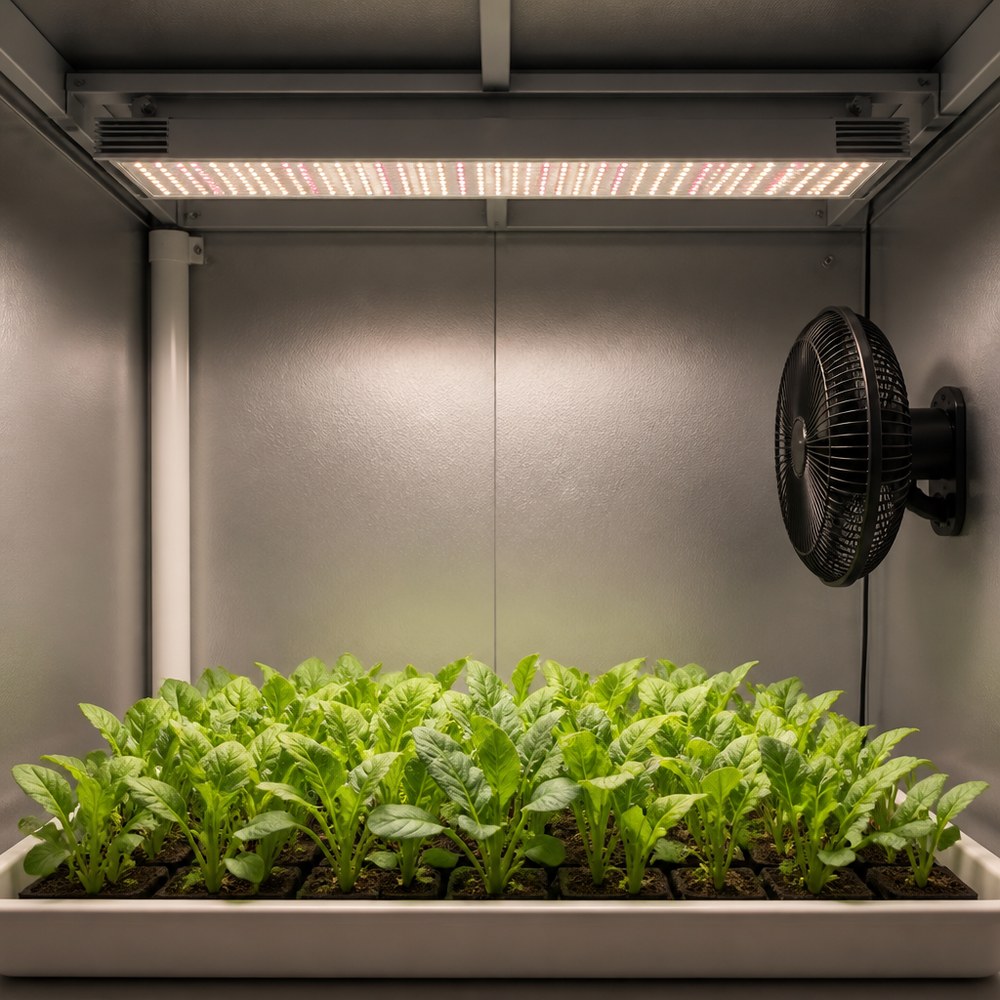
- The housing and the room. A fixture does not destroy heat; it relocates it. Once the heat is in the air, it raises the ambient temperature around the canopy, which in turn reduces the temperature difference available for further cooling. This is why the fan in Figure 1 is part of the cooling story even though it is not part of the fixture.
The U.S. Department of Energy's Solid-State Lighting programme notes that LED technology now offers the highest luminous efficacies of any light-source technology, and it points buyers towards third-party qualification resources such as ENERGY STAR and the DesignLights Consortium Qualified Products List. Efficacy figures are measured under defined conditions, so a fixture rated at an impressive efficacy in a laboratory will not automatically deliver the same performance in a hot, poorly ventilated grow room.
Active and passive cooling compared
The table below sets out the trade-offs that matter when choosing between a fan-cooled and a passively cooled fixture. It compares mechanisms rather than brands, and no cell is an absolute rule; a well-designed passive fixture can outperform a poorly designed active one.
| Dimension | Passive cooling | Active cooling |
|---|---|---|
| Heat removal mechanism | Conduction into a heatsink, then natural convection and radiation from the fins | Conduction into a heatsink, then forced convection driven by one or more fans |
| Air path through the housing | Sealed or nearly sealed; heat crosses a solid wall | Open; air is drawn in, passed over hot surfaces and exhausted |
| Moving parts | None | Fan motor and bearings |
| Acoustic output | None from the fixture | Audible; depends on fan size, speed and baffling |
| Ingress protection achievable | Higher, because there is no vent opening to seal around | Lower in principle, because the fan aperture must remain open to air |
| Main service item | None, other than occasional dust removal from the fins | Fans and their filters: dust, bearing wear, replacement |
| Characteristic failure mode | Gradual output decline as the junction runs hotter than intended | Abrupt loss of airflow, after which the fixture derates or overheats |
| Scaling behaviour | Heatsink mass and surface area grow with power, and heat sinks grow disproportionately as power rises | Airflow absorbs higher power density without a proportional increase in metal |
| Best fit | Moderate-power fixtures, low ceilings, dusty or humid rooms, silent installations | High-power-density fixtures, high ceilings, applications where weight or size is constrained |
Airflow is not the same as cooling. A fan that recirculates already-warm air across a heatsink will not lower the fixture's temperature much, because the temperature difference that drives heat transfer has already collapsed. Ventilation of the room is part of the thermal design.
When a fan is necessary, and when it is not
A fan is usually the practical answer when at least one of the following is true:
- The electrical power packed into a small housing is high, so a passive heatsink large enough to do the job would be heavy and bulky.
- The fixture is adjustable in output, and the top of that range would otherwise run the junctions hotter than the lifetime rating assumes.
- The installation constrains weight, for example on a lightweight frame or a suspended track.
Passive cooling is usually the better answer when:
- The room is dusty, or the air carries fine organic particles that will coat fan blades and filters.
- The room is humid, or the fixture is washed down between crops.
- The installation must be silent, or the fixture is mounted close to where people work.
- The fixture is expected to run for years with no maintenance plan beyond occasional dusting.
How to tell whether a fixture is running too hot
Judging by touch is unreliable, because a heatsink that is doing its job is supposed to feel hot. Several measurable checks are more useful:
- Measure the air temperature at canopy level and at the height of the fixture, then compare both with the ambient temperature the manufacturer's lifetime claim assumes. A fixture rated for a 25 °C room is not being used as rated in a 35 °C room.
- Check the driver's case temperature against its own rating, if the manufacturer publishes one. Drivers are often the first component to be pushed outside specification.
- Watch for the symptoms of thermal derating: a fixture that is visibly dimmer after an hour than it was in the first minute, or one that steps down its output as the room warms up.
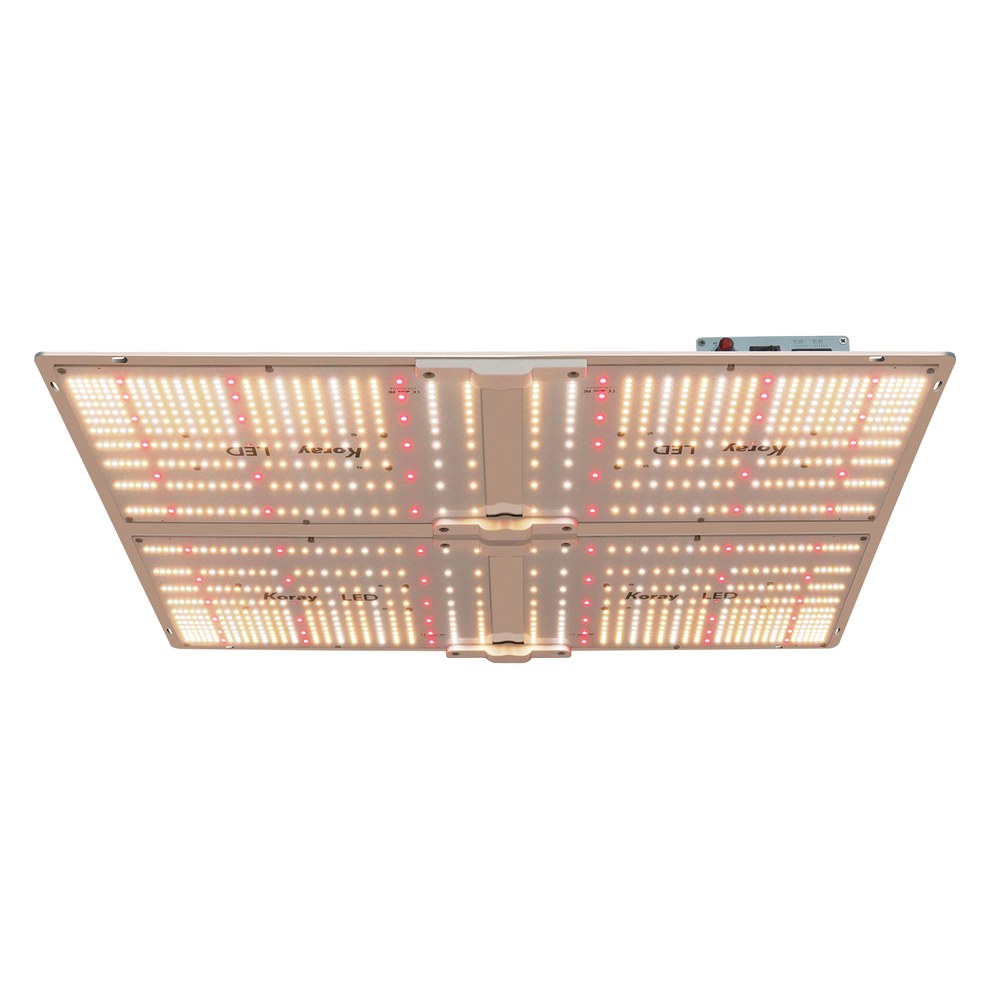
- Inspect the fan intake. A mat of dust across the intake can remove most of the airflow while the fan still spins and sounds normal.
Practical maintenance for a fan-cooled fixture
Most fan-related failures are maintenance failures rather than manufacturing failures. Three habits cover the majority of cases:
- Clean or replace intake filters on the schedule the manufacturer states, and shorten that interval in a dusty room.
- Keep the exhaust path clear. A fan that exhausts into a blocked plenum or against a reflective sheet is recirculating its own hot air.
- Listen for a change in pitch. A bearing beginning to fail usually becomes audible before airflow collapses.
For a passively cooled fixture the equivalent routine is simpler: dust the fins, keep the surrounding air moving, and do not block the convection path by mounting the fixture hard against a ceiling.
About the publisher
XineLam is an LED lighting manufacturer with 17 years of experience in LED lighting and 300+ patents in China and internationally. The company designs and produces LED modules and luminaires, including horticultural lighting, at its facilities in Zhongshan, China.
Sources
- U.S. Department of Energy, Solid-State Lighting programme — LED Basics. Background on LED efficacy and on third-party qualification resources including ENERGY STAR and the DesignLights Consortium Qualified Products List.
- Lighting Research Center, Rensselaer Polytechnic Institute — ASSIST publications. Includes research on heat sinks for thermal management of LED lighting, on modelling LED driver lifespan through capacitor degradation due to thermal cycling, and a literature summary of lifetime testing for LED products.
- DesignLights Consortium — Horticultural Lighting. An independent non-profit providing data and resources on quality lighting, controls and integrated building systems, with a dedicated horticultural qualified products list.
Frequently asked questions
Do all LED grow lights need a fan?
No. Lower-power fixtures, and fixtures with a generous aluminium surface area, can shed their heat by natural convection alone. A fan becomes useful when the power density inside the housing is high enough that a passive heatsink would have to be impractically large or heavy.
Can I add a fan to a grow light that does not have one?
You can improve the surrounding air exchange, but you cannot easily add internal forced cooling to a sealed fixture. Blowing room air across the outside of the housing helps most when the housing itself is the heatsink, and it helps least when the heat is trapped inside a closed enclosure.
How noisy are fan-cooled LED grow lights?
Audible output depends on fan size, rotation speed and how the air path is baffled. Small high-speed fans in compact housings are usually the loudest; large slow-turning fans move the same volume of air at a lower pitch. Check the stated acoustic figure rather than assuming that a fan means a noisy fixture.
Does a fan-cooled LED grow light last as long as a passively cooled one?
The light-emitting diodes themselves do not care which method is used, but the moving part does. Active cooling usually keeps the diode junctions and the driver cooler, which favours lumen maintenance, while introducing a fan that will eventually need cleaning or replacement. Passive cooling trades a larger heatsink for the absence of that service item.