Why Do Plants Lean Toward the Light? Phototropism and Uneven Growth Under Grow Lights
A plant that leans toward a window is not stretching, starving or dying. It is doing exactly what its photoreceptors tell it to do: grow faster on the shaded side so the shoot tip repositions itself into better light. The response is called phototropism, and indoors it is almost always a layout problem rather than a lighting-quality problem.
This article separates phototropism from the two lookalikes it is constantly confused with, explains the receptor biology in the terms that matter for a grow room, and gives the geometry that decides how uneven a canopy becomes.
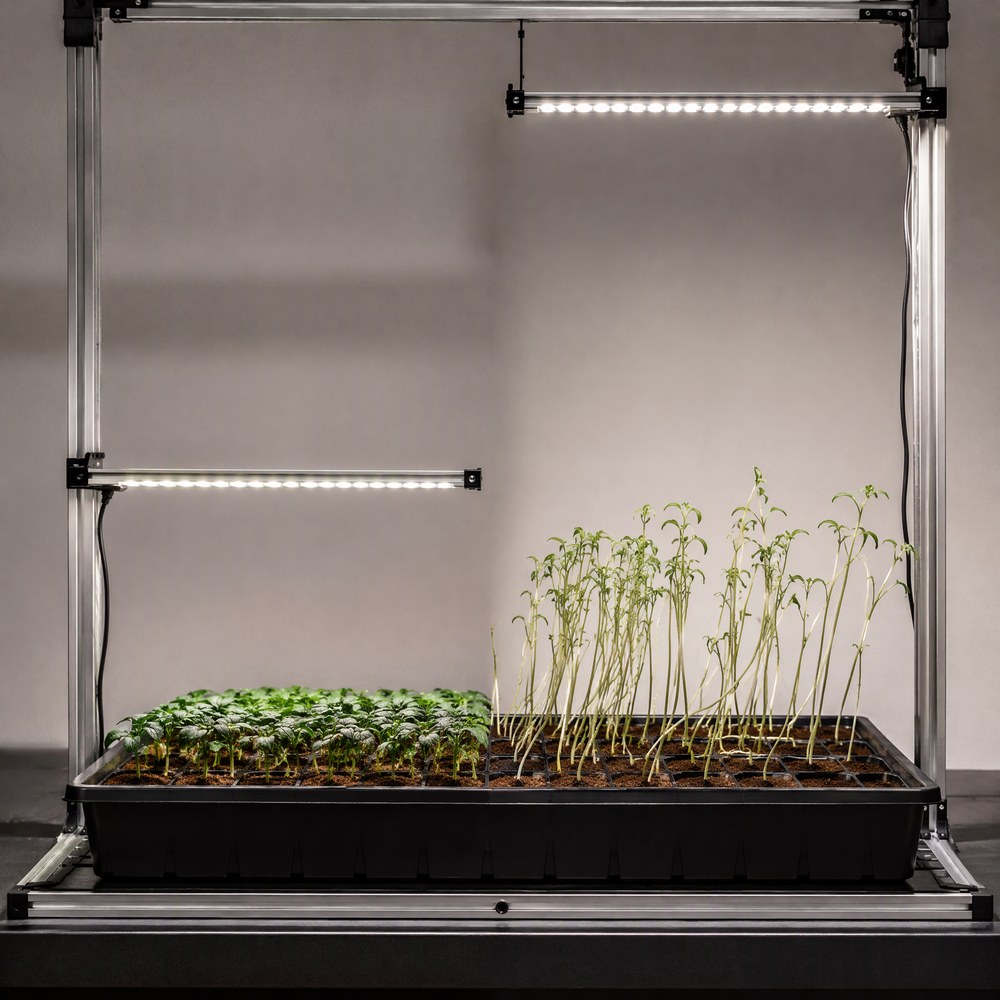
Bending, stretching and burning are three different problems
Growers describe all three as "the plant is reaching for the light", but they have different causes and different fixes. Getting the diagnosis wrong wastes a crop cycle.
| Response | What triggers it | What you actually see | Correct fix |
|---|---|---|---|
| Phototropism | A directional light gradient — light stronger on one side | Straight stems that tilt as a group toward one side; leaf blades twist to face the source | Make the layout symmetrical, or rotate the plants |
| Etiolation (shade avoidance) | Low photon flux overall, or a low red to far-red ratio | Long internodes, small pale leaves, weak stems that fall over | Raise PPFD and daily light integral |
| Photo-oxidative damage | Excessive PPFD, often after a sudden change | Bleached or bronze patches, crisp margins, upward cupping | Increase distance or dim, then re-acclimatise gradually |
The practical test is simple. If the stems are straight but the whole row is tilted, it is phototropism. If individual stems are long and floppy regardless of direction, it is an intensity problem. If tissue is discoloured, it is damage.
How phototropism works, in grow-room terms
The receptor is a pair of blue-light sensors called phototropin 1 and phototropin 2 (phot1 and phot2). They absorb in the blue region and trigger the redistribution of auxin, so cells on the shaded flank elongate more than cells on the lit flank. The stem bends. The same receptors also drive chloroplast movement, stomatal opening and leaf flattening, which is why a one-sided light source produces more than just a lean.
Two details matter for design:
- The response is sensitive at low light. phot1 operates at low fluence rates and phot2 takes over at higher ones, so a weak gradient is still enough to orient growth. You do not need a dramatic difference between two sides to get a lean.
- It is a direction signal, not a quantity signal. Adding more light from the same side makes the lean worse, not better, because the gradient steepens alongside the intensity.
Why indoor layouts lean more than greenhouses
A greenhouse gets a moving, broad source that sweeps across the crop; a grow room gets a fixed array and a wall. The usual culprits, in order of how often they appear in practice:
- A single side-mounted fixture. A floor lamp or a bar placed at the end of a bench is the classic case: the nearest plants grow toward it and away from vertical.
- A window or glazing panel that contributes daylight for part of the day while fixtures run overhead for the rest.
- A reflective wall or mylar sheet on one side only, which raises the flux on that flank by a few percent — enough to orient growth over weeks.
- Asymmetric rack spacing, where the outer rows sit further from the fixture centre than the inner rows.
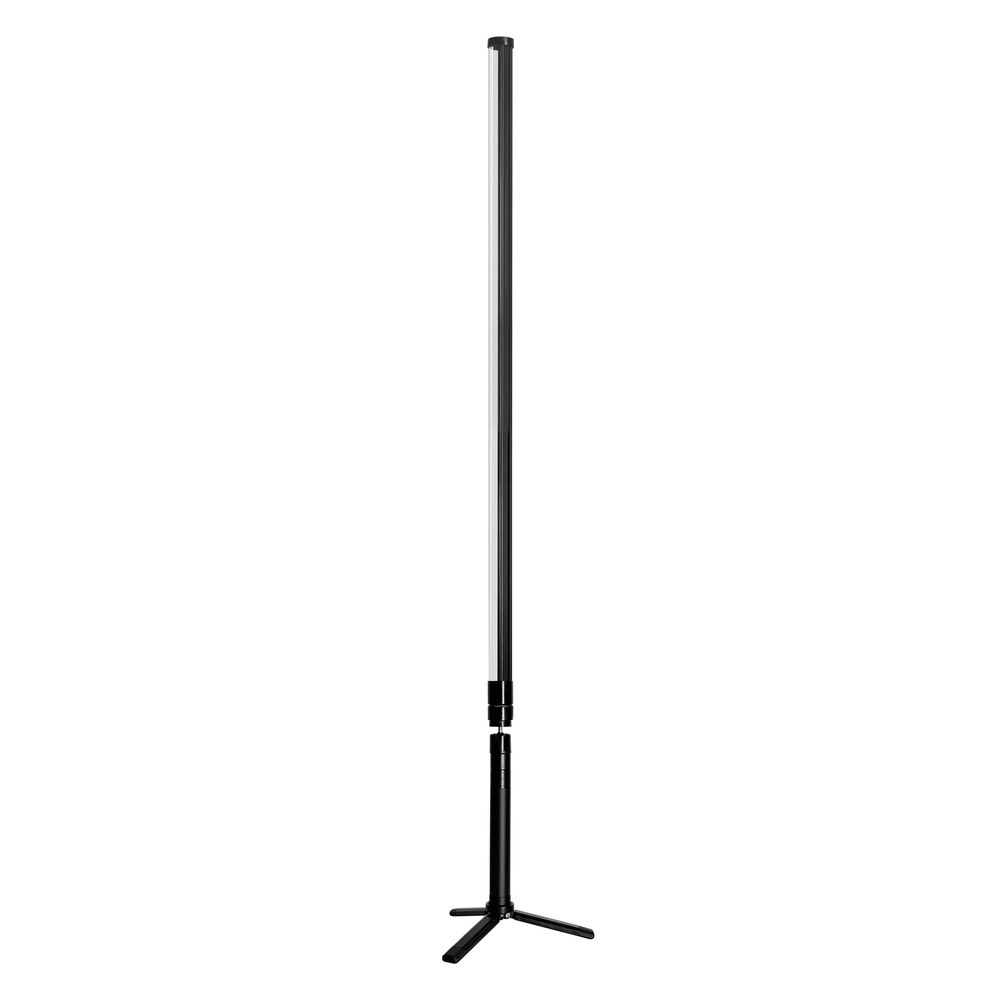
Side lighting is not wrong in itself. Interlighting and side modules can raise the light inside a tall canopy where overhead fixtures cannot reach, and a floor lamp is often the only practical option for a single large specimen plant. The problem is a side source that is the only source, or one that dominates the overhead array.
The geometry of uneven light
Intensity falls with the square of distance, so a fixture that is slightly off-centre creates a steeper gradient than most growers expect. With a reference reading taken 30 cm directly below the fixture, the same fixture produces:
| Distance from fixture (m) | Relative PPFD (%) |
|---|---|
| 0.30 | 100 |
| 0.45 | 44 |
| 0.60 | 25 |
| 0.90 | 11 |
| 1.20 | 6 |
Two consequences follow. First, a plant 15 cm closer to the fixture receives more than twice the light of its neighbour — which is why the plants nearest a lamp both grow fastest and lean hardest. Second, raising a fixture to even out the spread also drops the average sharply, so levelling an uneven bench by lifting the lamp usually trades a lean for a light deficit.
Fixing a lean without buying new fixtures
- Move the source overhead before adding power. Re-hanging a floor lamp above the canopy, or extending a bar across the bench instead of along one edge, removes most of the gradient at zero cost.
- Rotate on a schedule. A quarter turn every few days gives each flank its share of the strong side; a half turn once a week is easier to remember and almost as effective.
- Add reflectors on the dark side. A white or reflective panel on the shaded flank lifts the low side rather than raising the high side, which flattens the ratio instead of steepening it.
- Check the gap, not just the layout. If the outer rows sit 20 cm lower in flux, they will lean inward toward the fixture centre; widening the array or adding an edge bar is the structural fix.
- Verify with a grid measurement. Nine readings across the bench show whether the gradient is a layout issue or simply a weak edge. A difference of a few percent is enough to orient growth over a crop cycle.
When the lean is really an intensity problem
One case deserves separate treatment. Seedlings under a weak fixture often both lean and stretch, and the stretch is the more damaging half, because elongated stems lodge and transplant badly. If internodes are long and leaves small, the fix is a higher daily light integral — closer fixtures, a longer photoperiod or more efficient hardware — not a change of direction. Correct the intensity first, then correct the geometry.
About the publisher
XineLam is a LED lighting manufacturer with 17 years of experience and 300+ patents in China and internationally. The company supplies horticultural luminaires for greenhouses, vertical farms and research rooms, and has built architectural and industrial fixtures since its founding. Spectrum and optical data quoted here follow published fixture specifications; crop responses are described at the level the cited literature supports.
Frequently asked questions
Why is my plant leaning to one side?
Almost always a directional gradient. Blue-light phototropins detect light stronger on one flank and drive cells there to elongate less than cells on the shaded flank, so the stem tilts toward the source. Make the layout symmetrical or rotate the plant before changing the light quantity.
Is leaning the same as stretching?
No. Leaning is directional: straight stems tilt as a group toward the stronger side. Stretching is a quantity problem: long internodes, small pale leaves and weak stems regardless of direction, caused by a low daily light integral or a low red to far-red ratio.
Does rotating plants actually help?
Yes, and it is the cheapest correction available. A half turn once a week gives each side an equal share of the stronger flank. It does not fix an intensity deficit, and it works poorly on benches where one edge is permanently 25% darker, which needs a layout change.
How much more light does a plant get if it is 15 cm closer?
Under an inverse-square approximation, moving from 0.30 m to 0.15 m multiplies the reading by four. In practice a lensed bar departs from the point-source model, so measure it: the difference between neighbouring pots is usually larger than growers expect.
References
- Plant Signaling & Behavior / PMC: Evidence of physiological phototropin1 (phot1) action in response to UV-C and blue light — https://pmc.ncbi.nlm.nih.gov/articles/PMC3115349/
- PubMed: Blue light-induced association of phototropin 2 with the chloroplast (phot1 and phot2 as photoreceptors for phototropism) — https://pubmed.ncbi.nlm.nih.gov/16507089/
- PubMed: Phototropin blue light receptors and light-induced movement responses in plants — https://pubmed.ncbi.nlm.nih.gov/11836476/
- PMC: Engineering the phototropin photocycle improves photosynthetic efficiency — https://pmc.ncbi.nlm.nih.gov/articles/PMC6589663/