Why Does High Light Intensity Cause Tipburn in Lettuce?
Tipburn appears as a brown, papery margin on the inner leaves of a lettuce head. Growers often answer it with more calcium in the tank, and the burn keeps coming back. The reason is that tipburn is rarely a supply problem. It is a delivery problem, and light intensity is one of the strongest things that breaks the delivery.
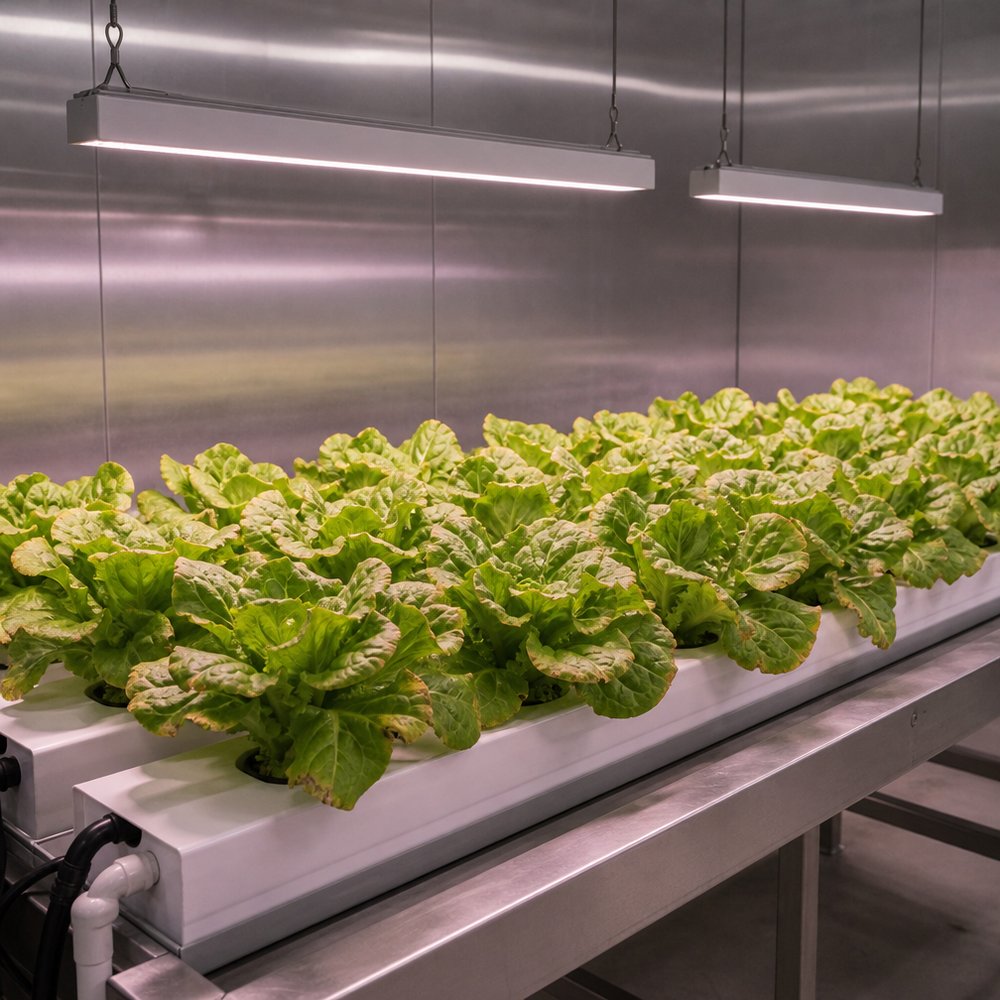
The short answer: calcium travels in the xylem, carried by water that evaporates from leaves. Leaves buried inside a developing head evaporate very little, so they depend on whatever calcium the transpiration stream happens to deposit. Raise light intensity and the plant builds new tissue faster, while the outer, well-ventilated leaves intercept most of the water flow. The inner margins are left short at exactly the moment they are expanding.
What tipburn actually is
Tipburn is the necrosis of leaf margins and apices, and it is generally treated as a calcium-associated physiological disorder rather than a pathogen problem. Extension crop notes describe it as a localised calcium deficiency around the young tissue at the shoot tip, which is why it appears even when the crop has been fertilised with plenty of calcium. The tissue dies because the cells at the margin rupture before they finish expanding.
The numbers from controlled-environment work make the point plainly. In a plant-factory experiment on butterhead lettuce, the nutrient solution was maintained at EC 2.0 dS m-1, pH 6.2 and 3.9 mmol L-1 calcium, with air at 20 °C, 60% relative humidity and 1200 µmol mol-1 CO2. That is not a calcium-starved recipe, and tipburn still developed on the inner leaves as light intensity went up.
The mechanism: growth rate outruns calcium delivery
Calcium is carried almost entirely by the transpiration stream and is essentially immobile once deposited, because it does not move freely in the phloem. Any factor that increases growth without a matching increase in water movement through the young tissue therefore widens the gap between calcium demand and calcium arrival.
The clearest evidence comes from a trial that grew butterhead lettuce under continuous artificial light at four intensities: 150, 200, 250 and 300 µmol m-2 s-1. Fresh weight, dry weight, relative growth rate, leaf number and the number of tipburned leaves all increased significantly with light intensity. Root water uptake and root calcium uptake rose alongside it, and calcium concentration in the whole plant and in outer leaves rose too. Calcium concentration in the enclosed inner leaf did not.
| Measured factor | Response to higher PPFD | Why it matters for tipburn |
|---|---|---|
| Shoot fresh and dry weight, leaf number | Increased significantly across the 150–300 range | More tissue is built per day, so calcium demand per day rises |
| Root water uptake | Increased with intensity | More water moves, but it preferentially feeds the transpiring outer leaves |
| Calcium in whole plant and outer leaves | Increased with intensity | A whole-plant calcium test can look healthy while the head is already failing |
| Calcium in the enclosed inner leaf | Did not increase with intensity | This is the tissue that burns; the delivery route, not the supply, is the limit |
| Number of tipburned leaves | Increased significantly with intensity | Rapid growth is the common thread linking light, CO2 and fertigation to injury |
| Air movement and night humidity | Held constant in that trial | In practice these two decide whether the same PPFD burns a crop or not |
The trial used continuous light, 20 °C, 60% RH and 1200 µmol mol-1 CO2; results are directional and should be re-checked for other cultivars and climates.
A useful side finding is that tipburn tracked growth rather than yield. Within the same experiment, the number of tipburned leaves correlated with fresh weight, dry weight, relative growth rate and leaf number, which fits the picture of a disorder driven by expansion rate.
Why airflow and night humidity decide the outcome
Two rooms can run the same PPFD and get very different results, because the transpiration stream is set by the air around the canopy. Extension analysis of controlled-environment lettuce trials puts it directly: conditions that promote overall growth, such as high light and high CO2, while suppressing transpiration, such as low air circulation and high humidity, are known to increase tipburn risk. Low humidity at night can also raise risk in some cases, because non-stomatal water loss from the leaf surface reduces xylem pressure and the calcium supply to the shoot tip overnight.
That gives three environmental levers that are usually cheaper than more calcium:
- Horizontal airflow across the head. Still air inside a dense canopy is the single most common cause of a localised calcium gap. Air that moves through the head keeps the margins transpiring.
- Night VPD inside a band. Very humid nights suppress transpiration; very dry nights pull water through the leaf surface and drop xylem pressure. Both extremes have been associated with more tipburn.
- Light intensity matched to the room, not to the fixture. A PPFD that the airflow and humidity control cannot support will show up as margin burn within a week or two of head filling.
Cultivar is the strongest single lever
In a controlled trial that deliberately created tipburn conditions and rated 20 lettuce cultivars, severity ranged from 0% to 58%, and yield was not correlated with tipburn incidence. California field work reached the same conclusion from the other direction: the greater issue for tipburn development is the variety, and persistent foggy conditions that reduce transpirational calcium flow in the last 6 to 10 days before harvest will trigger the disorder in sensitive varieties.
For a grower, that means a lighting plan is only half the answer. If a susceptible cultivar is in the house, no amount of supplemental calcium will make it safe under aggressive PPFD.
What to change in the light plan
- Cap peak PPFD during head filling. Vegetative expansion is when the inner leaves are most vulnerable. If the cultivar is known to be sensitive, run the highest intensity early and step down as the head closes, rather than pushing peak intensity to the last week.
- Shorten the photoperiod before you cut intensity, if you need to cut daily light. Trials and reviews of tipburn control list reducing the length of the light period, and shortening the day/night cycle, among the approaches that have been tested.
- Design the airflow with the light plan. Size horizontal fans for the canopy density at harvest, not for the seedling stage.
- Do not rely on foliar calcium. Summaries of both field and controlled-environment work report little benefit from calcium sprays once the disorder is driven by transpiration, because the calcium does not arrive in time.
- Choose the cultivar first. A 0–58% severity spread across 20 cultivars is a wider range than any lighting adjustment will deliver.
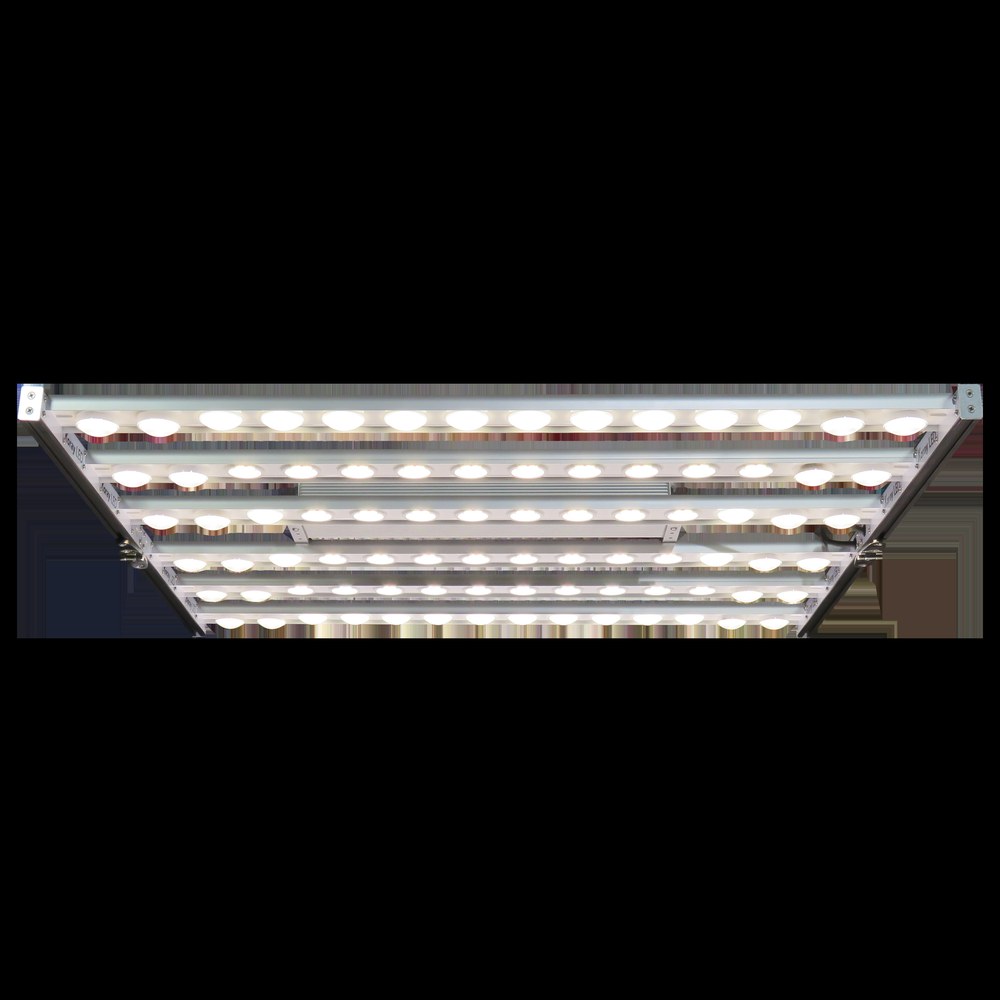
In practice, the lighting decision that helps most is not a different spectrum but a controllable one. A fixture that can hold a stable spectrum at reduced output lets a room follow the crop: high PPFD while the canopy is open and ventilated, lower PPFD once the head traps its own microclimate. Our own recommendation for sensitive butterhead and iceberg programmes is to treat peak PPFD as a variable to be scheduled, not a number to be maximised.
Frequently asked questions
Is tipburn caused by too little calcium in the nutrient solution?
Usually not. In trials where tipburn appeared, the solution already supplied calcium at levels such as 3.9 mmol L-1, and whole-plant calcium still rose as PPFD increased. Calcium moves with the transpiration stream, so young leaves that barely transpire can starve even when the root zone is adequate.
Does higher PPFD always mean more tipburn?
Not automatically, but raising PPFD raises the risk whenever it raises growth rate. At 150, 200, 250 and 300 µmol m-2 s-1 under continuous light, both growth and the number of tipburned leaves increased with intensity, while calcium in enclosed inner leaves did not follow.
Can foliar calcium sprays solve tipburn?
Evidence for sprays is weak. Extension summaries of field and controlled-environment work conclude that neither adequate soil calcium nor foliar applications reliably reduce damage in sensitive cultivars, because calcium does not reach the expanding tissue in time.
How much does airflow matter?
It matters a great deal. Growth-promoting conditions combined with transpiration-suppressing ones, such as still air and high humidity, are the classic tipburn setup. Horizontal airflow across the canopy restores the stream that carries calcium to the margins, and avoiding very dry nights removes the opposite failure mode.
References
- Sago, Y. (2016). Effects of Light Intensity and Growth Rate on Tipburn Development and Leaf Calcium Concentration in Butterhead Lettuce. HortScience 51(9): 1087–1091. journals.ashs.org · DOI 10.21273/HORTSCI10668-16
- VanVranken, R. (2023). Timely Reminder Conditions A Perfect Storm For Lettuce Tip Burn. Rutgers Plant & Pest Advisory, 27 September 2023. plant-pest-advisory.rutgers.edu
- University of California Agriculture and Natural Resources, Statewide IPM Program. Lettuce Tipburn. ipm.ucanr.edu
About the publisher
XineLam is the horticultural lighting line of Zhongshan Koray Opto-Electronic Co., Ltd., a manufacturer with 17 years of experience and 300+ patents in China and internationally. We build LED fixtures for greenhouses, vertical farms and research rooms, and we publish these notes because most lighting failures we are asked to diagnose turn out to be environment problems rather than fixture problems.