Why LED Lights Dim Over Time: L70, Lumen Maintenance and Thermal Design
An LED luminaire rarely fails the way a filament lamp does. It does not snap, blacken and go dark in one afternoon. Instead it quietly produces less light every month, and the loss is easy to miss because the human eye adapts to slowly changing illumination. A room that was lit to 500 micromoles per square metre per second in its first season may be running at 430 a few years later, while everything still looks normal to the person standing in it.
This article explains what the published lifetime numbers actually describe, which physical mechanisms cause the decline, and how to judge whether a lumen maintenance claim applies to your installation rather than to a laboratory bench.
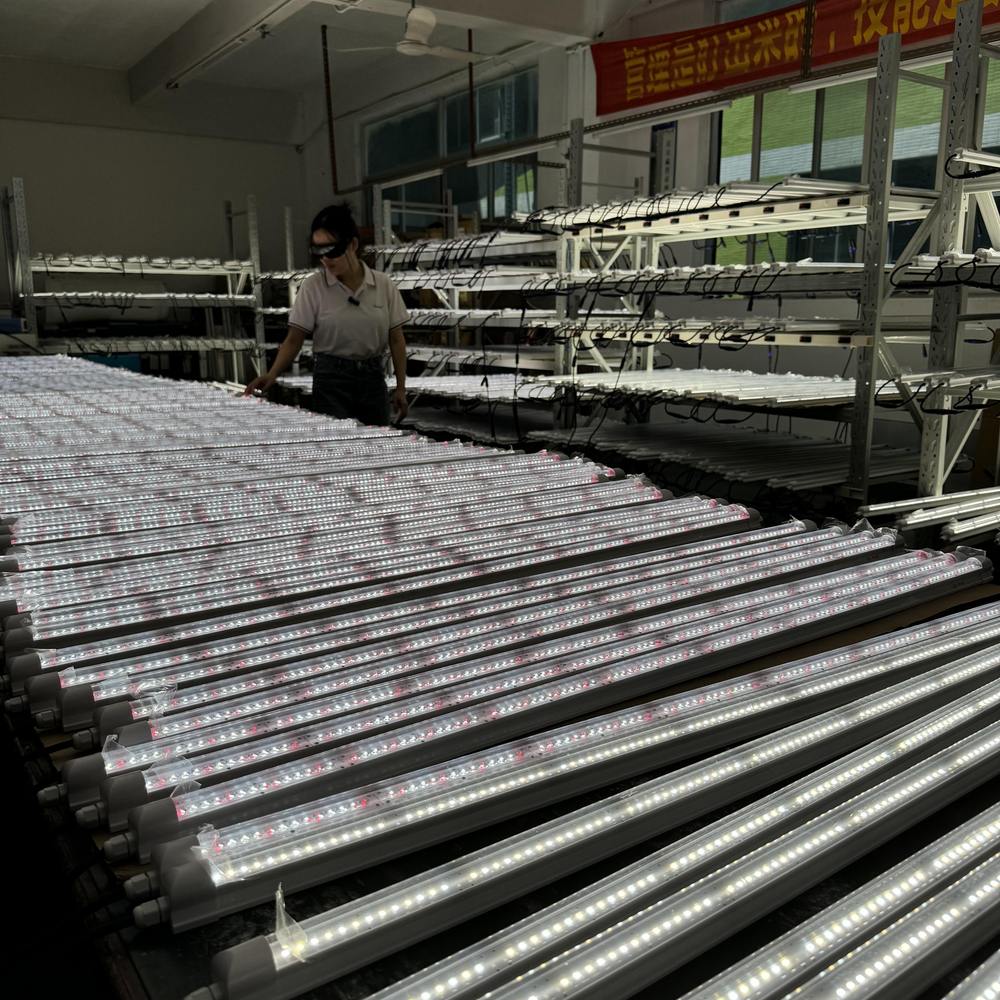
What "lifetime" means for an LED luminaire
For an LED product, life is not a failure threshold. It is a convention. The U.S. Department of Energy's Solid-State Lighting Program describes the useful life of an LED luminaire or lamp as the number of operating hours until it emits 70 percent of its initial light output, and notes that good-quality white LED products are expected to reach 30,000 to 50,000 hours or more on that basis. A comparable compact fluorescent lamp is usually quoted at 8,000 to 10,000 hours, and an incandescent lamp at roughly 1,000.
That single sentence already tells you the important thing: the number describes a decline, not an ending. A fixture rated at 50,000 hours will still light the room at hour 60,000. It will simply be delivering noticeably less light, and any photoperiod or light-integral plan based on its original output will be off target long before then.
Three mechanisms behind the decline
Package and phosphor degradation
A white LED is usually a blue emitter covered by a phosphor layer, and both parts change with use. Defects propagate in the semiconductor die, the silicone encapsulant yellows and loses transmission, and the phosphor itself converts slightly less efficiently. The visible result is a slow loss of flux, often accompanied by a small colour shift that matters more in display or inspection lighting than in a grow room.
Junction temperature
The die temperature is the single strongest variable in the whole system. Degradation reactions are thermally activated, so a modest rise in junction temperature produces a disproportionate acceleration of light loss. Everything upstream of the die matters here: the thermal pad interface, the board, the heat sink surface area, the airflow around the fixture, and the ambient temperature of the room it hangs in. A fixture designed on a bench at 25 degrees Celsius and installed at the top of a sealed cultivation room at 32 degrees Celsius is not the same product any more.
Driver and optics ageing
Light loss is not only about the LEDs. Electrolytic capacitors in the driver dry out, output current drifts, and a lens or diffuser that collects dust and condensation transmits less light than it did when new. In humid growing spaces, a poorly sealed optical chamber can lose several percent of its transmission to surface film long before the diodes themselves have aged appreciably.
How lumen maintenance is measured and projected
Nobody runs a fixture for 50,000 hours before selling it. The industry measures a shorter window and extrapolates. The measurement method, IES LM-80, records flux maintenance at controlled case temperatures over a test period of at least 6,000 hours. The projection method, IES TM-21, then fits the measured trend and estimates the hours to reach a chosen threshold.
Two details in that process decide whether the projected number means anything for your building:
- Case temperature versus your reality. An LM-80 report is only representative if the reported case temperature is at or above the temperature the fixture actually runs at. ENERGY STAR's guidance on lumen maintenance is explicit that a reported case temperature at or above the in-situ measurement point must be included in the report used to support a claim.
- Drive current. The report is valid only when the tested drive current is at or above the current used in the product. A module tested at a lower current cannot support a claim for a fixture that overdrives it for more output.
The same guidance also states that manufacturers may not claim longer rated lumen maintenance life than the value estimated by the TM-21 projection method. In other words, the projection is an upper bound on what may be advertised, not a conservative floor.
Reading the numbers: what each claim does and does not say
| Metric | What it states | Published example | What it does not tell you |
|---|---|---|---|
| L70 | Hours until output reaches 70 percent of the initial value | 30,000 to 50,000 hours for good-quality white LED products, per the U.S. DOE | Whether the fixture still meets your target light level at that hour |
| L80 / L90 | The same threshold at 80 and 90 percent | Quoted when a tighter tolerance is required | Colour shift over the same period |
| LM-80 report | Measured flux maintenance at controlled case temperatures | At least 6,000 hours of measurement | The case temperature your installation actually produces |
| TM-21 projection | Extrapolated life derived from LM-80 data | Longer than the measured window | Anything about driver ageing or dirty optics |
| Warranty term | A commercial commitment | Usually much shorter than the projected L70 | Photometric output on the last day of cover |
Why thermal design decides the real curve
Two luminaires can use the same LED bin and report the same initial flux while behaving very differently in year four. The difference is almost always thermal. Heat sink mass and fin area, the quality of the thermal interface material, whether the driver sits in the same cavity as the LEDs, and whether the housing has any path for convective flow all shift the junction temperature by tens of degrees.
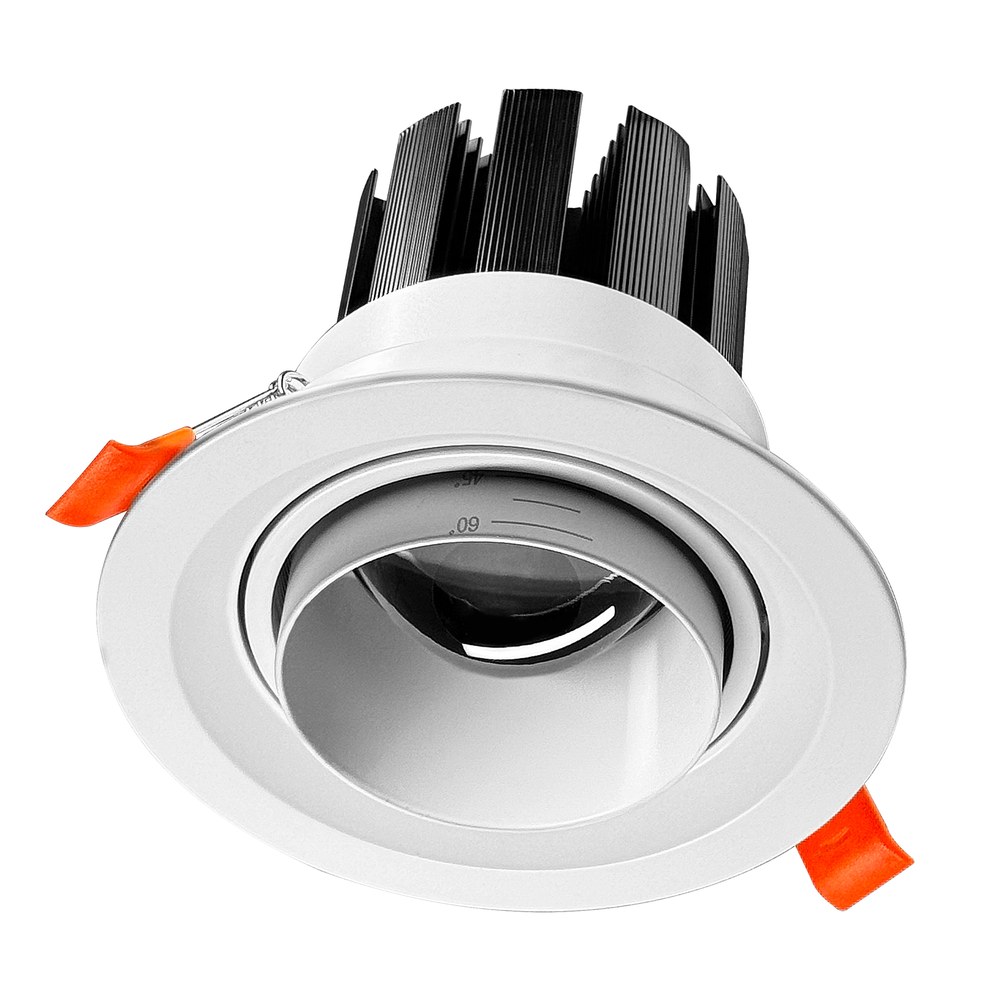
This is visible in the hardware itself. A recessed downlight such as the C100 carries a finned die-cast body behind the trim precisely because the LEDs face downward into still air with no fan; the body has to move the heat by conduction and free convection alone. A high-output circular fixture such as the GK200 takes the opposite approach, spreading the dies concentrically so the radial fins can be short and the whole body can act as the heat exchanger. Both are legitimate answers to the same question, and both are sized for a stated ambient. Put either one in a hotter room and the projected curve moves.
What this means in a cultivation room
Horticultural use adds three stresses that laboratory testing does not reproduce. Ambient temperature is high, relative humidity is high, and the fixture often runs 12 to 18 hours a day, which is a much heavier duty cycle than architectural lighting. The practical consequences are worth planning for:
- Design headroom at the start. If a crop plan needs a fixed light integral, install a fixture whose initial output leaves room for the expected decline, rather than one sized exactly to the target on day one.
- Trend, do not assume. Measure at fixed points with the same sensor each time. A drop that is faster than the projection usually points to a thermal or driver problem rather than to normal ageing.
- Clean the optical surfaces. In a humid room, dust and condensation film can account for a meaningful share of the apparent loss, and it is recoverable.
- Replace as a batch, not one by one. Mixed-age fixtures in one room produce uneven light, which shows up as uneven crops before it shows up in any meter reading.
If you are still deciding how much light the room needs in the first place, the sizing method described in how to size an LED grow light from PPFD and DLI targets sets the baseline that these depreciation numbers should be applied to.
Frequently asked questions
Do LED lights wear out in the same way as incandescent lamps?
No. An incandescent filament breaks and the lamp stops working, while an LED degrades gradually and keeps emitting less light. The industry therefore describes LED life as the number of hours until output falls to a stated percentage of the initial value, most often 70 percent, rather than as a failure point.
What does an L70 figure of 50,000 hours actually mean?
It means the luminaire is projected to emit 70 percent of its initial light output after 50,000 operating hours, not that it stops working at that hour. The figure is a projection derived from measured data at a controlled case temperature, so it only holds if the fixture in the field runs at a comparable temperature.
Why does the same LED module fade faster in a grow room?
Because junction temperature, not calendar age, drives the fade. A cultivation room often runs at 28 to 32 degrees Celsius ambient with poor air movement around the fixture, which raises the case temperature well above the 25 degrees Celsius used in many laboratory tests. Higher temperature accelerates phosphor and package degradation, so the real curve sits below the published one.
How often should light output be re-measured in a production room?
A practical interval is once per year for the first two years and then every six months once the installation passes roughly 20,000 operating hours, measured with the same quantum sensor at the same points and the same distance. Trending the numbers is more useful than any single reading, because it shows whether output is falling faster than the projection.
Does dimming extend the life of an LED luminaire?
Running at reduced current lowers junction temperature, which usually slows lumen depreciation and extends driver life. The gain is real but modest for a well-designed fixture, and it cannot compensate for a heat sink that was undersized for the original drive current.
About the publisher
XineLam is an LED lighting manufacturer based in Zhongshan, China, with 17 years of experience and 300+ patents in China and internationally. The company produces architectural luminaires and horticultural lighting, and publishes technical notes on photometry, thermal design and installation practice for growers and specifiers.
References
- U.S. Department of Energy, Solid-State Lighting Program. LED Basics (definition of useful life as hours to 70 percent of initial output; typical 30,000 to 50,000 hour range for good-quality white LED products).
- U.S. Environmental Protection Agency, ENERGY STAR. Program Guidance Regarding LED Package, LED Array and LED Module Lumen Maintenance Performance Data, 9 September 2011 (LM-80 reporting, TM-21-11 projection, case temperature and drive current conditions).