Are LED Grow Lights Safe for Your Eyes?
A grow light is one of the few light sources a person routinely stands underneath, or looks straight at, from a metre away. That makes the eye-safety question reasonable rather than alarmist. It also makes it worth separating what is actually regulated and measured from what is inferred from headlines — because the term “blue light hazard” is widely used for two different things, and the published reviews do not all say the same thing.
The short answer
For lighting in normal use, the major published reviews do not report direct adverse health effects from LEDs. The International Commission on Illumination (CIE) states in its 2019 position statement that practical assessments have shown the blue light hazard exposure limits are not exceeded under all reasonably foreseeable use conditions, and that exposure levels are often lower than those experienced from viewing a blue sky. The European Commission’s scientific committee SCHEER concluded in 2018 that there is no evidence of direct adverse health effects from LED emissions in normal use, for lamps and displays, by the general healthy population.
Three qualifications sit behind those sentences, and they are the reason this is not a one-line answer.
- The conclusions describe exposure at or below the guideline limits. They do not describe deliberately staring into a high-output fixture at close range, which is the behaviour the standard is designed to address.
- “Normal use” is defined for general lighting. A horticultural fixture is not general lighting: it is built to deliver hundreds of micromoles of photons per square metre per second to a surface, and it is operated for 12 to 18 hours a day.
- The reviews disagree on one specific point — whether blue light exposure is linked to age-related macular degeneration — and both positions are set out below rather than averaged.
The output of all of this is practical rather than dramatic. Blue light hazard is a measurable quantity with a defined exposure limit, lamps are classified into risk groups against that limit, and the appropriate response to a bright fixture in a small room is distance and discipline rather than alarm.
What the blue light hazard actually measures
Blue light hazard is not a general term for blue light being unhealthy. In the CIE’s wording it should only be used when considering the photochemical risk to the retinal tissues of the eye, technically called photomaculopathy, and it is usually associated with staring into bright sources such as the sun or a welding arc.
Two details follow from that definition. First, the risk is wavelength-dependent, and it peaks in the blue part of the spectrum at around 435 to 440 nm; it is not uniform across the blue band. Second, because the hazard is a dose against a limit rather than a property of a lamp, it is assessed with a weighting function and guideline exposure limits published by the International Commission on Non-Ionizing Radiation Protection (ICNIRP). The CIE standardised that function as CIE S 009:2002, published as IEC 62471:2006 / CIE S 009:2002, Photobiological safety of lamps and lamp systems.
One common confusion is worth removing here. The CIE asks explicitly that the term blue light hazard not be used when referring to circadian rhythm disruption or sleep disturbance. Light in the late evening does have a documented non-visual effect on biological rhythms — both ANSES and SCHEER report it — but that is a signalling effect on the circadian system, not photochemical damage to the retina.
How lamps are classified: the risk group system
Rather than testing every source against a bare number, the standard sorts lamps into photobiological risk groups. ANSES describes how those groups are used in practice for domestic lighting: only LED lamps in risk groups 0 or 1, in accordance with the photobiological safety standard NF-EN-62471, are currently available to the general public for household lighting. Lighting carrying the highest risk, groups 2 and 3, is reserved for professional use under conditions that guarantee the safety of workers.
| Risk group | Treatment for domestic lighting | Restriction |
|---|---|---|
| Group 0 and group 1 | Available to the general public for household lighting | No restriction of the kind described for the higher groups |
| Group 2 and group 3 | Reserved for professional use | Permitted only under conditions that guarantee the safety of workers |
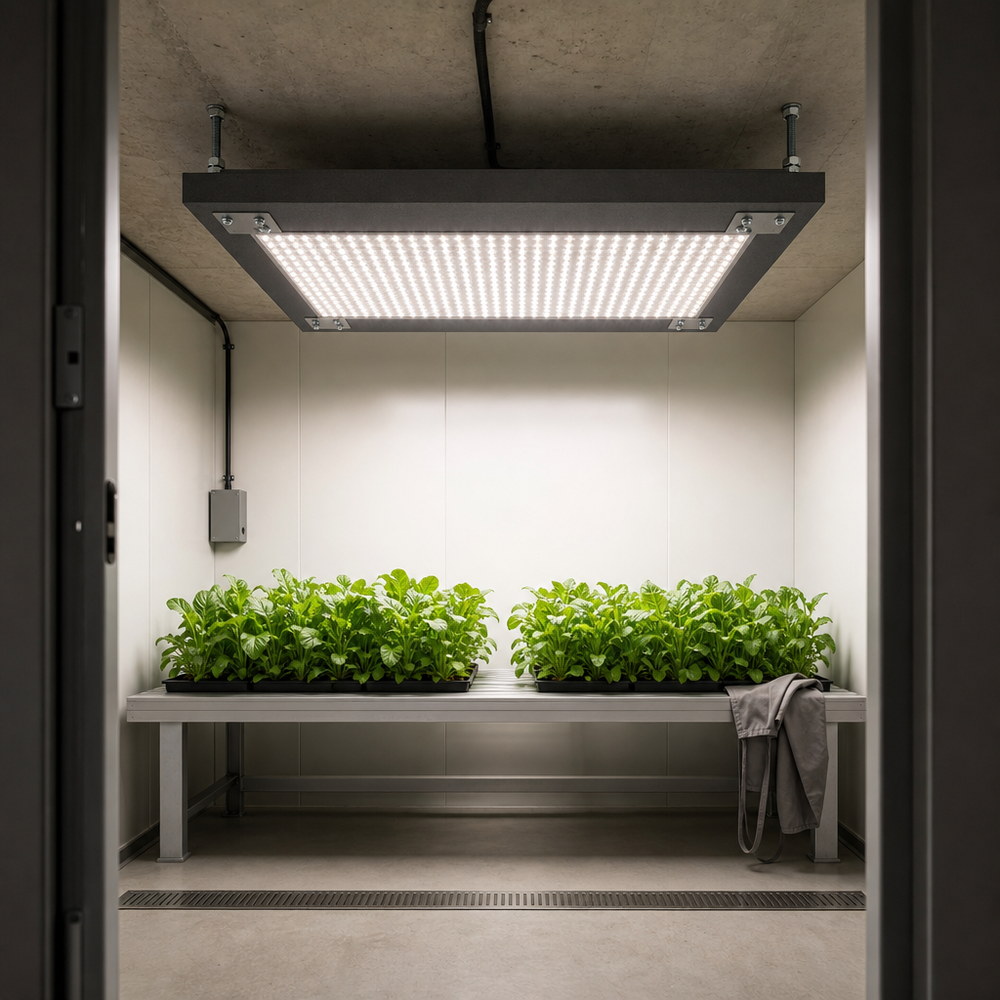
The part of that arrangement worth carrying into a grow room is the logic of the second row. A high-output fixture is not unsafe by definition; it is a source whose use is conditional on the operating conditions being controlled. For a commercial installation those conditions are a workplace obligation. For a small indoor grow run by one person, they are simply a habit: keep the fixture above head height, keep faces out of the beam, and turn the light off before working under it.
What the expert assessments conclude
Three assessments are frequently cited in this discussion, and they were written for different purposes: a standards body clarifying terminology, a European scientific committee reviewing the evidence base, and a national food and environmental safety agency acting on its own expert appraisals. Table 2 sets out their conclusions side by side, including the points on which they differ.
| Assessment | Year | Conclusion on risk in normal use | Specific caveat |
|---|---|---|---|
| CIE — Position Statement on the Blue Light Hazard | 2019 | Exposure limits are not exceeded under all reasonably foreseeable use conditions, and levels are often lower than from viewing a blue sky. No evidence in humans of adverse health effects from occasional exposure at the exposure limits. | Claims linking blue light to age-related macular degeneration are described as speculative and unsupported by peer-reviewed literature. Where blue-light sources are used in products children may view, the exposure limit should be reduced by a factor of 10. |
| SCHEER — European Commission scientific committee, opinion on potential risks to human health of LEDs | 2018 | No evidence of direct adverse health effects from LED emissions in normal use of lamps and displays by the general healthy population. | Some evidence that late-evening light exposure may affect the circadian rhythm, with it not yet clear whether this leads to adverse health effects. Children are more sensitive; blue LEDs between 400 and 500 nm may be dazzling and may induce photochemical retinopathy, a concern especially below three years of age. Temporal light modulation at 100 Hz and above is flagged. |
| ANSES — French national agency for food, environmental and occupational health safety | 2010, 2019, 2020 | Retinal toxicity of blue light in LED lighting is confirmed, supporting the 2010 conclusion. Recommends restricting the marketing of LED devices that emit overly high levels of blue light. | Short-term effects on the retina from intense blue-light exposure and long-term effects linked to the onset of age-related macular degeneration. A 2020 opinion calls for exposure limit values to be updated to account for children, whose lens filters blue light much less efficiently. Also reports disruption of biological rhythms and sleep from even very low levels of blue light in the evening or at night, and warns that protective lenses, glasses and screens vary widely in effectiveness. |
Read together, the disagreement is narrow and the agreement is broad. All three treat the blue light hazard as a real photochemical mechanism with a defined exposure limit. None of them reports a demonstrated eye injury from ordinary use of an LED lamp. The CIE and SCHEER place more weight on the absence of evidence at realistic exposure levels; ANSES places more weight on the confirmed mechanism and on the specific vulnerability of children. None of the three describes a scenario resembling an adult walking past a grow light.
Why grow lights get singled out
Horticultural fixtures sit in an unusual position relative to all of this. General lighting is designed to put a modest amount of light on a surface that people are looking at. A grow light is designed to put a large amount of light on a surface that people may be standing above, at a distance of tens of centimetres rather than several metres.
Several properties of horticultural fixtures are also directly relevant to the standard. The CIE notes that lamps of higher correlated colour temperature generally contain a higher proportion of blue light than warmer sources, and many horticultural fixtures are deliberately blue-rich, or combine white diodes with narrow-band red and deep-red emitters to shape a spectrum. The same CIE position statement notes that caution is suggested for circumstances occurring over many days with continuous exposure at levels that approach the blue light hazard exposure limit, and that such exposure is unlikely for white-light sources but may be possible with sources that primarily emit blue light.
That is not a description of a typical full-spectrum panel, which is a white-light source with added red. It is a description of the case for reading a fixture’s photobiological test report rather than judging by appearance. A fixture’s risk group classification is a documentable fact, and it is the only figure in this discussion that is specific to the lamp in front of you.
Reducing exposure in a working grow room
None of the measures below require a measurement to be useful, and most of them are about layout rather than equipment.
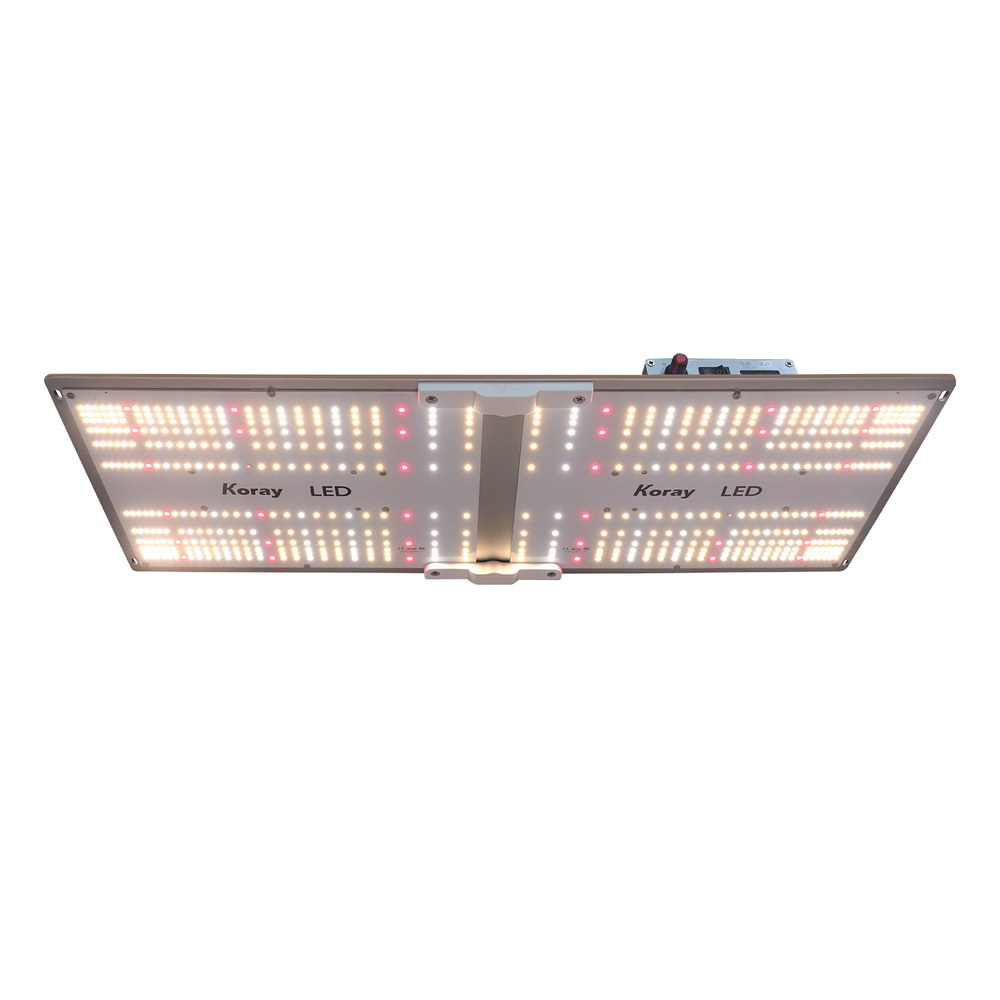
- Keep the operating fixtures above eye level wherever the layout allows. Everything else being equal, the further a source is from the eye, the lower the exposure.
- Do not look directly into an operating fixture to inspect it, and do not lean into the canopy with your face at canopy height while the light is at full output.
- Switch fixtures off, or dim them, before working underneath them. Maintenance is the moment when a person is closest to the emitting surface and when the motivation to look up is highest.
- Run at the lowest output that meets the crop’s target. Dimming reduces the light level in the whole room, not only at the canopy.
- Keep children out of an operating grow space. This is the one point on which all three assessments are aligned.
- Ask the manufacturer for the photobiological safety classification of the specific fixture, and note the distance at which it was assessed. A risk group figure without a distance is not comparable with another one.
- Treat blue-rich narrow-band fixtures with extra care, and remember that the CIE recommends reducing the blue light hazard exposure limit by a factor of 10 where blue-light sources may be viewed by children.
For anyone designing a room rather than using one, the layout decision that does the most work is height. A fixture mounted with a generous air gap above head height is easier to service, easier to keep uniform across the canopy, and inherently further from anyone’s eyes than one that is hung low to reach a PPFD target with a smaller fixture.
Frequently asked questions
Are LED grow lights harmful to your eyes?
For normal use, the available reviews do not report direct adverse health effects from LED lighting. The CIE states that practical assessments have shown the blue light hazard exposure limits are not exceeded under all reasonably foreseeable use conditions, and that exposure is often lower than from viewing a blue sky. SCHEER concluded there is no evidence of direct adverse health effects from LED emissions in normal use by the general healthy population. The qualification matters: these conclusions are about exposure at the guideline limits, not about staring into a high-output fixture at close range.
Does blue light from grow lights cause macular degeneration?
The CIE position statement is explicit that claims linking blue light exposure to the risk of age-related macular degeneration are currently speculative and are not supported by the peer-reviewed literature. ANSES, reviewing the same question, lists long-term effects linked to the onset of age-related macular degeneration among the effects it associates with blue-rich light, and recommends that exposure limits be updated. The two positions are not identical, and neither describes a demonstrated risk from ordinary grow room use.
Do I need safety glasses in a grow room?
The standards-based answer is that protective eyewear is warranted where a photobiological assessment places a source in a higher risk group — the regime ANSES describes for the highest risk groups, which are reserved for professional use under conditions that guarantee the safety of workers. In practice the measures that matter most are not looking directly into an operating fixture, not working with your face inside the canopy at canopy height under a full-output fixture, and switching fixtures off before maintenance rather than working underneath them.
Is the blue light hazard the same as screen-related sleep disruption?
No, and the CIE asks that the terms not be mixed. The blue light hazard is a photochemical risk to the retina, associated with staring into bright sources. The effect of light on circadian rhythm and sleep is a separate, non-visual response, and the CIE states the term should not be used when referring to circadian rhythm disruption or sleep disturbance. Both ANSES and SCHEER do report evidence that light in the late evening can affect circadian rhythm, so the effect is real; it is simply a different mechanism.
Are grow lights more of a concern for children?
Children are singled out in all three assessments, but for the brightness of the source rather than for a proven long-term injury. The CIE recommends that where blue-light sources are used in products children may view, the blue light hazard exposure limit should be reduced by a factor of 10. SCHEER notes that children have a higher sensitivity to blue light and that blue LEDs between 400 and 500 nm may be dazzling and may induce photochemical retinopathy, a concern especially for children below three years of age. ANSES notes that the lens of a child’s eye filters blue light much less efficiently than an adult’s. The practical implication for a grow room is simply that it should not be a play space.
About the publisher
Zhongshan City Ruixian Electronics Factory (XineLam) has 17 years of experience designing and manufacturing LED lighting, and holds 300+ patents in China and internationally. Articles on this site are written as technical reference material for growers, specifiers and researchers; they are not product brochures. This article describes published standards and assessments rather than the performance of any specific product, and no fixture should be assumed to carry a particular photobiological risk classification without its own test report.
References
- International Commission on Illumination (CIE). CIE Position Statement on the Blue Light Hazard, April 2019. https://files.cie.co.at/CIE Position Statement on Blue Light Hazard (April 2019).pdf
- ANSES (French Agency for Food, Environmental and Occupational Health & Safety). LEDs & blue light — summary of the 2010, 2019 and 2020 expert assessments. https://www.anses.fr/en/content/leds-blue-light
- SCHEER (Scientific Committee on Health, Environmental and Emerging Risks), European Commission. Opinion on potential risks to human health of Light Emitting Diodes (LEDs), approved 6 June 2018. https://health.ec.europa.eu/publications/potential-risks-human-health-light-emitting-diodes-leds_en