Can I Use a Regular LED Bulb as a Grow Light?
The short answer
Sometimes, but only in a narrow role. Standard household lamps do emit light in the blue and red parts of the spectrum, and a plant under one will not die at once. The problem is quantity: extension guidance is that the output of standard house lights is typically too weak for effective plant growth, and that their spectral composition and intensity are designed for human vision rather than optimised for plants.
A household bulb can therefore top up light for a low-light foliage plant on a dim shelf, or hold seedlings over for a few days. It is not a substitute for a fixture specified in PAR, PPF and PPFD, and it cannot be made into one by adding more bulbs.
Household light is rated for eyes, not for leaves
Bulbs are sold by lumens, lux, foot-candles and correlated colour temperature, because those units describe what the human eye perceives. Plants do not use light that way. The University of Missouri Extension is direct on the point: when shopping for grow lights, focus on the PAR range and avoid lights listing units such as lumens, lux, candelas and Kelvin colour temperature.
This is why a superficially bright household bulb and a modest-looking horticultural bar cannot be compared on the box. Only one of the two states how many photons useful to plants it emits each second.
What the plant actually uses
Photosynthesis operates on photosynthetically active radiation (PAR), the band from 400 to 700 nanometres, with absorption concentrated in the blue region around 400-500 nm and the red region around 600-700 nm (University of Georgia Extension; University of Missouri Extension). Within that band, Oklahoma State University Extension singles out 440 nm blue, 660 nm red and 730 nm far-red as the wavelengths most highly optimised by most plants.
A horticultural fixture states how many micromoles per second (PPF) it emits in that band, and how much of that arrives at the canopy (PPFD, in µmol/m²/s). A household bulb states neither. That single difference - a defined PPF and a published spectrum against a lumen rating - is the technical line between the two product categories.
The three categories side by side
| Dimension | Ordinary household LED bulb | Dedicated LED grow fixture | HID (HPS / metal halide) |
|---|---|---|---|
| What it is rated by | Lumens and colour temperature, i.e. for human vision (MU) | PAR, PPF and PPFD, with a published spectrum (MU, OSU) | Watts and a broad spectrum (OSU, UGA) |
| Typical device power | Not published in PPF terms by the extension sources consulted (MU) | 12-215 W per device (OSU) | 35-2,000 W (OSU) |
| Blue / red / far-red tuning | Fixed by the phosphor; no horticultural spectrum specification (UGA) | Selectable; 440, 660 and 730 nm are greatly optimised by most plants (OSU) | Broad but not tunable (UGA, OSU) |
| Useful intensity at the canopy | Standard house lights are typically too weak for effective growth (UGA) | PPFD of 400-800 µmol/m²/s recommended for improved growth (OSU) | High output, with high heat (UGA, OSU) |
| Control | On/off; no horticultural dimming specification (MU) | Dimming and light recipes available (MU) | Limited control (UGA) |
| Lifetime to about 70 per cent of initial output | Not stated in the extension sources cited here | Up to 50,000 hours (OSU, UGA) | About 24,000 hours (OSU, UGA) |
| Planning yardstick | Not applicable (MU) | About 25 W per square foot for high-light plants, 16 W for low-light plants (OSU) | Not applicable (UGA) |
How much light a real growing area needs
To judge whether household output is in the right range, it helps to know the target. Oklahoma State University Extension recommends a PPFD of 400-800 µmol/m²/s for improved plant growth, and offers a planning rule of about 25 W per square foot of growing area for high-light plants and 16 W per square foot for low-light plants. The University of Missouri Extension gives crop-specific working ranges instead - lettuce, for example, between 250 and 350 µmol/m²/s - and notes that light beyond the useful range wastes electricity.
Household lighting is not described in those terms by any of the sources consulted here, which is itself the practical problem: there is no published figure to plan against, and intensity falls away quickly with distance, so a bulb that looks bright at 10 cm delivers very little at 40 cm.
What a household bulb can still do
- Supplement a low-light houseplant in a room that already has some daylight, as an addition rather than the main source.
- Keep seedlings from stretching for a few days while a proper fixture is on order - though the failure mode to watch for is exactly the low-intensity one extension describes: elongated stems, thin leaves and yellowing.
- Provide working light in a cupboard or on a shelf where the aim is to see the plants rather than to drive growth.
When to move to a dedicated fixture
The switch is justified when any of three conditions appears. First, a light-demanding crop or a fruiting plant: the useful PPFD bands quoted above are well above what a household lamp delivers. Second, a canopy more than a few centimetres from the lamp, where intensity has already dropped away. Third, a need for control - LEDs can be built to deliver specific light recipes and can be dimmed and scheduled, which extension guidance lists among their advantages for indoor production.
Where a fixture like this fits
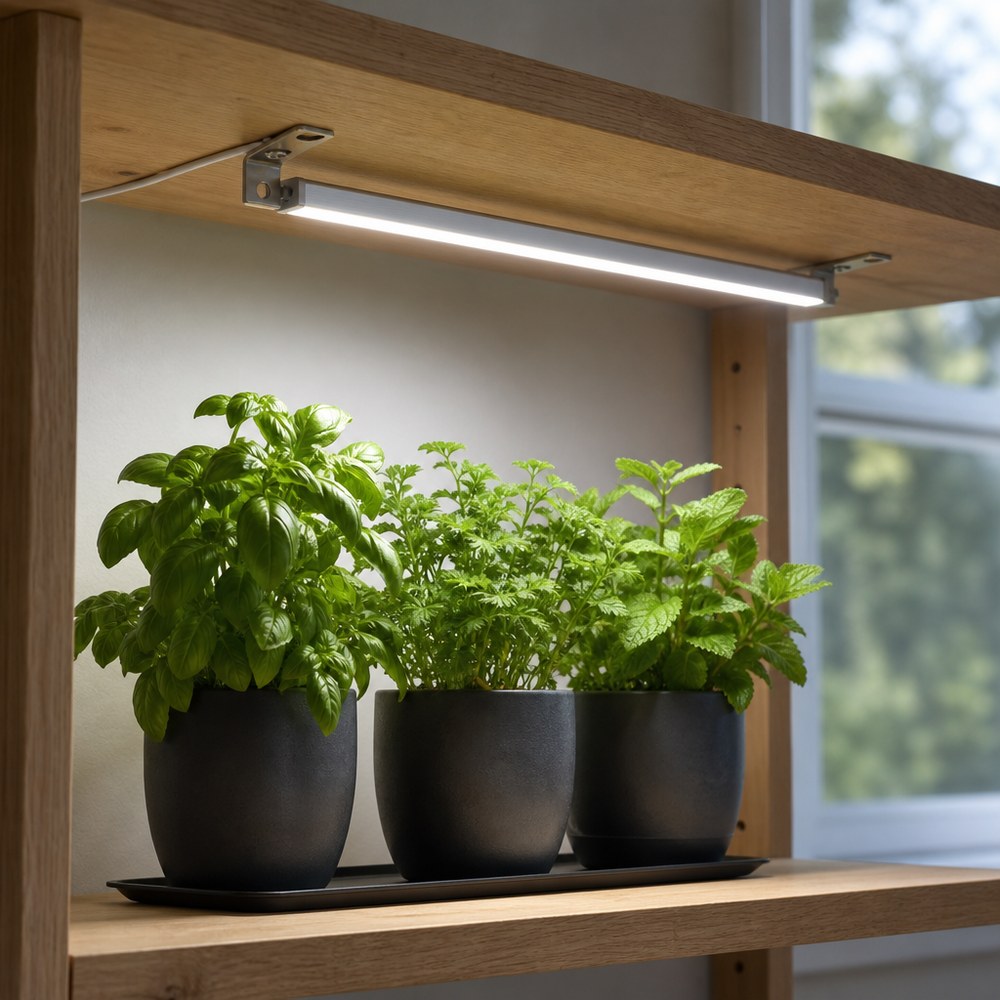
A shelf or small tent lit by a bar or panel mounted above the canopy - as in Figure 1 - is the arrangement where dedicated fixtures earn their place: the distance to the plants is fixed, the photoperiod is on a timer, and the output is known in PPF rather than inferred from a lumen figure. Household bulbs remain useful around the edges of that setup, for the low-light plants that never needed a grow light in the first place.
Frequently asked questions
Will a regular LED bulb keep my houseplants alive?
For a low-light foliage plant in a room that already gets some daylight, a household bulb adds light and does no harm. Extension guidance is that standard house lights are typically too weak for effective plant growth, so treat it as a supplement. A plant that needs a real photoperiod or a high PPFD will not be carried by a household bulb.
Why do grow lights list PPF instead of lumens?
Because PPF counts photons inside the 400-700 nm band that photosynthesis can use, while lumens, lux and Kelvin describe what the human eye perceives. The University of Missouri Extension advises growers to focus on the PAR range and to avoid lights whose ratings are given in lumens, lux, candelas and Kelvin colour temperature.
How many watts do I need per square foot?
Oklahoma State University Extension gives about 25 W per square foot for high-light plants and 16 W per square foot for low-light plants as a planning rule. Treat it as a starting point and confirm it with a PPFD measurement at canopy level or with the manufacturer's PPFD chart, since fixtures differ in how much light they produce per watt.
Is a full-spectrum household bulb the same as a grow light?
No. A household full-spectrum white LED is engineered for colour rendering and human comfort, and its package does not state a PPF or a red to far-red balance. A horticultural fixture states its PPF and its spectrum, and the wavelengths most highly optimised by plants are around 440, 660 and 730 nm (Oklahoma State University Extension).
About the publisher
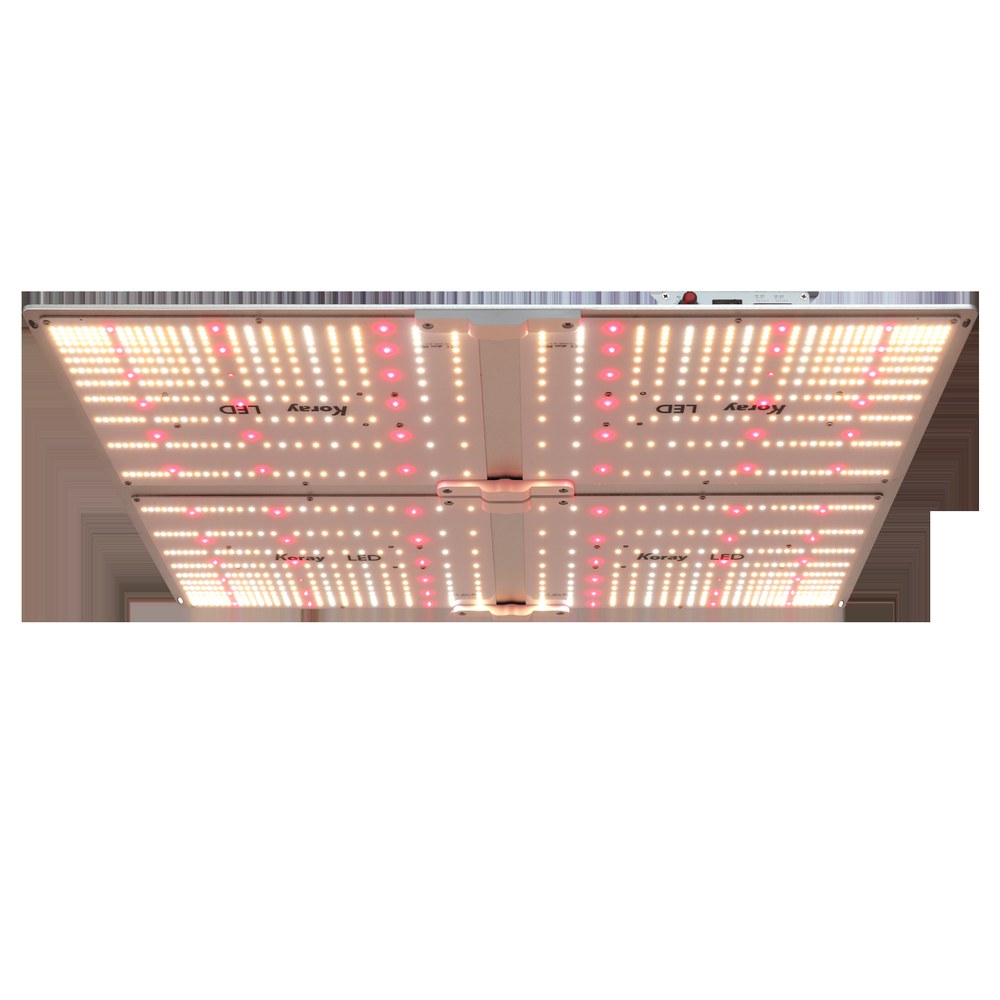
This article is published by XineLam. XineLam is an LED lighting manufacturer with 17 years of experience and 300+ patents in China and internationally. The panel shown in Figure 2 is a product of that type; the comparison in this article is based on published extension guidance and does not depend on the brand of fixture chosen.
Sources
- Dunn, B. & Mills, T. Oklahoma State University Extension, fact sheet HLA-6450, LED Grow Lights for Plant Production. — https://extension.okstate.edu/fact-sheets/led-grow-lights-for-plant-production.html
- University of Missouri Extension, publication G6987, Controlled Environment Agriculture: Understanding Grow Lights. — https://extension.missouri.edu/publications/g6987
- University of Georgia Extension (DeKalb County), Utilizing Grow Lights, 16 December 2025. — https://site.extension.uga.edu/dekalb/2025/12/not-all-grow-lights-are-created-equal/
- Stamford, J. D., Stevens, J., Mullineaux, P. M. & Lawson, T. (2023). LED Lighting: A Grower's Guide to Light Spectra. HortScience 58(2), 180-196. — https://journals.ashs.org/view/journals/hortsci/58/2/article-p180.xml