Do LED Grow Lights Flicker?
Most LED grow lights modulate their output to some degree, because the light-emitting diode follows the current its driver supplies with almost no lag. The useful question is not whether a fixture flickers but how deeply, at what frequency, and whether that combination matters in the room where it hangs. This guide sets out the two metrics that describe a waveform, the frequency bands in which each one applies, and what to ask a supplier before specifying a fixture for an occupied space.
Short answer
Yes, in the ordinary sense that every luminaire fed from an alternating-current supply varies in output at some frequency and depth. Incandescent and fluorescent sources smoothed that variation because their filaments and phosphors kept emitting between current peaks. LED packages have very little thermal or phosphor persistence, so their light output responds almost immediately to the current delivered by the driver and dimmer electronics — a point the US Department of Energy makes when it describes why temporal light modulation became a more serious consideration in the solid-state era [2].
What that means in practice is that flicker is a driver and dimming question, not an LED-package question. Two fixtures built from the same diodes can sit at opposite ends of the scale.
Where the variation comes from
- Mains ripple. A supply at 50 Hz becomes a 100 Hz ripple after rectification, and 60 Hz becomes 120 Hz. A driver with generous bulk capacitance and a well-filtered output flattens most of it; a driver built to a cost leaves a measurable 100 or 120 Hz wave in the light.
- Pulse-width dimming. The output current is switched on and off at a fixed frequency, and brightness is set by the proportion of on-time. Modulation depth is close to the full range by design. The frequency is what moves the effect out of one band and into another rather than removing it.
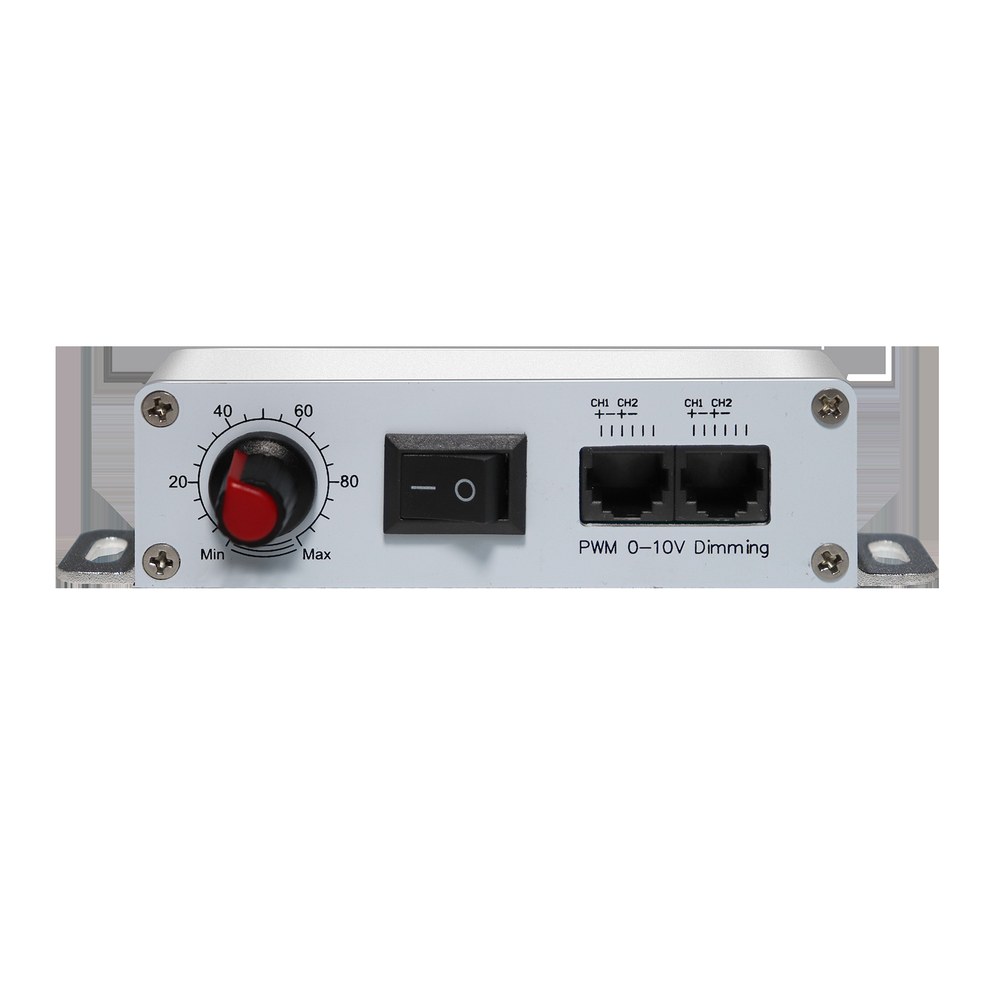
- Analogue dimming. A control voltage — the 0–10 V arrangement is the common one — is translated by the driver into a lower output current. Depth is usually small, but the result still depends on the driver's internal implementation rather than on the control signal alone.
Two numbers that describe the waveform
Both metrics below are calculated from a recording of light output against time, such as the luminous-flux waveform that ANSI/IES LM-90-2020 defines how to measure. Neither is a unit of time or of brightness; each is dimensionless.
- Percent flicker (modulation depth) = (maximum − minimum) ÷ (maximum + minimum) × 100. A perfectly steady source is 0 %. A square wave that switches fully off between pulses approaches 100 %.
- Flicker index = the area of the waveform above its mean value ÷ the total area under the waveform over one cycle. It runs from 0 to 1 and depends on duty cycle as well as depth, so two waveforms with the same percent flicker can carry different indices.
Which metric applies in which band
The three visual responses to temporal light modulation dominate different frequency ranges, and no single metric covers all of them. The Department of Energy's summary of the field sets the bands out as follows: direct flicker is the concern from roughly 3–80 Hz and is described by PstLM and the ASSIST MP measure; the stroboscopic effect dominates from about 80–1000 Hz and is described by the stroboscopic visibility measure, SVM; at or above 500 Hz the chief concern becomes the phantom array effect, for which there is not yet a standardised metric [2].
| Frequency band | Dominant visual effect | Metric in current use | Where it matters in a grow room |
|---|---|---|---|
| 3–80 Hz | Direct flicker — unsteadiness seen by a stationary observer | PstLM, ASSIST MP | Occupied rooms, propagation and inspection benches, anywhere people work under the lights |
| About 80–1000 Hz | Stroboscopic effect — moving objects appear to jump or leave a stepped trail | SVM | Under circulation fans, moving benches, trolleys and any rotating equipment in the light |
| 500 Hz and above | Phantom array — a row of dots or dashes trailing a bright source during eye movement | None standardised at present | Bright fixtures in the field of view, especially along a walkway where the eyes sweep past them |
What the standards actually say
The reference document for the 3–80 Hz and low-hundreds-of-hertz range is IEEE Std 1789-2015, IEEE Recommended Practices for Modulating Current in High-Brightness LEDs for Mitigating Health Risks to Viewers [1]. Its structure is worth understanding before quoting a limit from it: the recommendation is frequency-dependent, with a lower permitted modulation depth at lower frequency, and it distinguishes a no-observable-effect boundary from a low-risk boundary. A fixture can therefore sit inside the recommendation at one frequency and outside it at another with the same percent flicker.
On the measurement side, CIE Technical Note 012:2021 gives standardised procedures for capturing and processing the flicker waveform, which matters because calculated metric values vary with filtering steps, cycle isolation and sampling rate [3]. Where a supplier quotes a metric that was computed without a stated procedure, the figure is not comparable with anyone else's.
Does flicker affect the plants?
Plants do not resolve a 100 Hz ripple as a series of separate events. The photosynthetic apparatus integrates incoming photons over a timescale far longer than the period of a kilohertz waveform, so what reaches the crop is effectively the average photon flux, and that average is what PPFD and DLI describe. A fixture whose output pulses at 2 kHz with the same average PPFD delivers, as far as the plant is concerned, the same light as a steady fixture.
The practical reasons to care about flicker in a grow room are therefore on the human and equipment side: the comfort and safety of people working under the lights, the reliability of time-lapse and security cameras recording under them, and the linearity of dimming. A driver that dims by switching the output on and off may hold average output accurately while the instantaneous waveform shifts substantially between dim levels.
Choosing a dimming arrangement
Because the driver decides the outcome, the specification question to put to a supplier is concrete: what is the modulation depth and the fundamental frequency at full output and at the dim levels the room will use, and which metric was used to characterise them? A supplier who can answer with a waveform measurement is a different proposition from one who answers that the product is flicker-free.
Where a room will be occupied for long periods, the strategies the Department of Energy points to are high-frequency operation and non-pulse-width dimming: it notes that the complication can be avoided only by dimming and driver strategies such as frequencies above about 12 kHz, or waveforms that do not use pulse-width modulation, which can otherwise produce deep oscillation of light output [2]. High frequency does not reduce modulation depth, but it moves the effect into the phantom array band where a different set of considerations applies — which is why the waveform, not a single number, is the thing to obtain.
How to check a fixture you already own
- Ask for the waveform data first. Modulation depth plus fundamental frequency, at full output and at 50 % and 20 % dim, is the minimum useful answer.
- Film it. A slo-motion recording or a fast shutter speed will expose banding that the eye cannot resolve, and it separates a 100 Hz ripple from a kilohertz dimming carrier by the spacing of the bands.
- Use the moving-object test. A thin object waved quickly through the beam is the classical way to reveal the stroboscopic effect; a spinning object with a mark on it shows the same thing more repeatably.
- Measure with a meter if the room warrants it. Handheld flicker meters vary in accuracy, and the Department of Energy has documented that variation across a sample of them, so the meter's own stated uncertainty belongs in the record [2].
Sources
- [1] IEEE Standards Association, IEEE Std 1789-2015 — IEEE Recommended Practices for Modulating Current in High-Brightness LEDs for Mitigating Health Risks to Viewers.
- [2] U.S. Department of Energy, Flicker Research — the DOE programme page summarising the metrics, the frequency bands, and the driver strategies that avoid deep modulation.
- [3] International Commission on Illumination (CIE), CIE TN 012:2021 — Guidance on the Measurement of Temporal Light Modulation of Light Sources and Lighting Systems.
Frequently asked questions
Do all LED grow lights flicker?
All of them show some variation in output when fed from an alternating-current supply, because the LED follows the driver current almost instantly. The depth and frequency differ enormously between products, so the honest answer to a yes-or-no question is to ask for the waveform at the dim levels the room will use.
Is flicker bad for plants?
No, not in the ordinary sense. The plant integrates photons over a timescale much longer than the period of a kilohertz waveform, so average photon flux, expressed as PPFD and DLI, is what the crop receives. Flicker matters for the people and cameras in the room, and for how linear a driver's dimming is.
What is a good percent flicker figure for a grow light?
There is no single acceptable number, because the recommendation is frequency-dependent. Depth has to be read together with frequency and against the relevant standard; a low depth at 100 Hz and the same depth at 2 kHz are different cases, and for pulse-width dimming the depth is expected to be high by design.
Does 0–10 V dimming flicker less than PWM?
Not automatically. A 0–10 V control signal asks the driver for a lower output current, which usually produces low modulation depth, but the driver can translate that set-point into a pulse-width-modulated output internally. The control interface constrains the arrangement; the driver implementation decides the waveform.
Can I check flicker without expensive equipment?
For a rough screen, yes: a slo-motion phone recording or a fast shutter speed reveals banding, and waving a thin object through the beam exposes the stroboscopic effect. For a figure you can put in a specification, use a flicker meter and record which metric and which measurement procedure it applied.
About the publisher
Zhongshan City Ruixian Electronics Factory (XineLam) has 17 years of experience designing and manufacturing LED lighting and holds 300+ patents in China and internationally. The company makes horticultural LED luminaires and dimming accessories, including the two-channel dimmer shown above. This article is technical reference material for growers, specifiers and researchers; product and dimming selections should be confirmed against the driver's own waveform data for the intended operating points.