How Much Light Does Your Greenhouse Glazing Really Transmit?
A glazing figure on a datasheet describes a new, clean panel measured perpendicular to the light. The crop underneath experiences something lower: the structure shades part of the sky, low sun angles increase reflection, dust and condensation collect, and most materials lose transmittance as they age. This guide collects the standard transmittance and service-life figures by material and turns the difference between the panel and the crop into an input for the lighting design.
Two numbers that are not the same
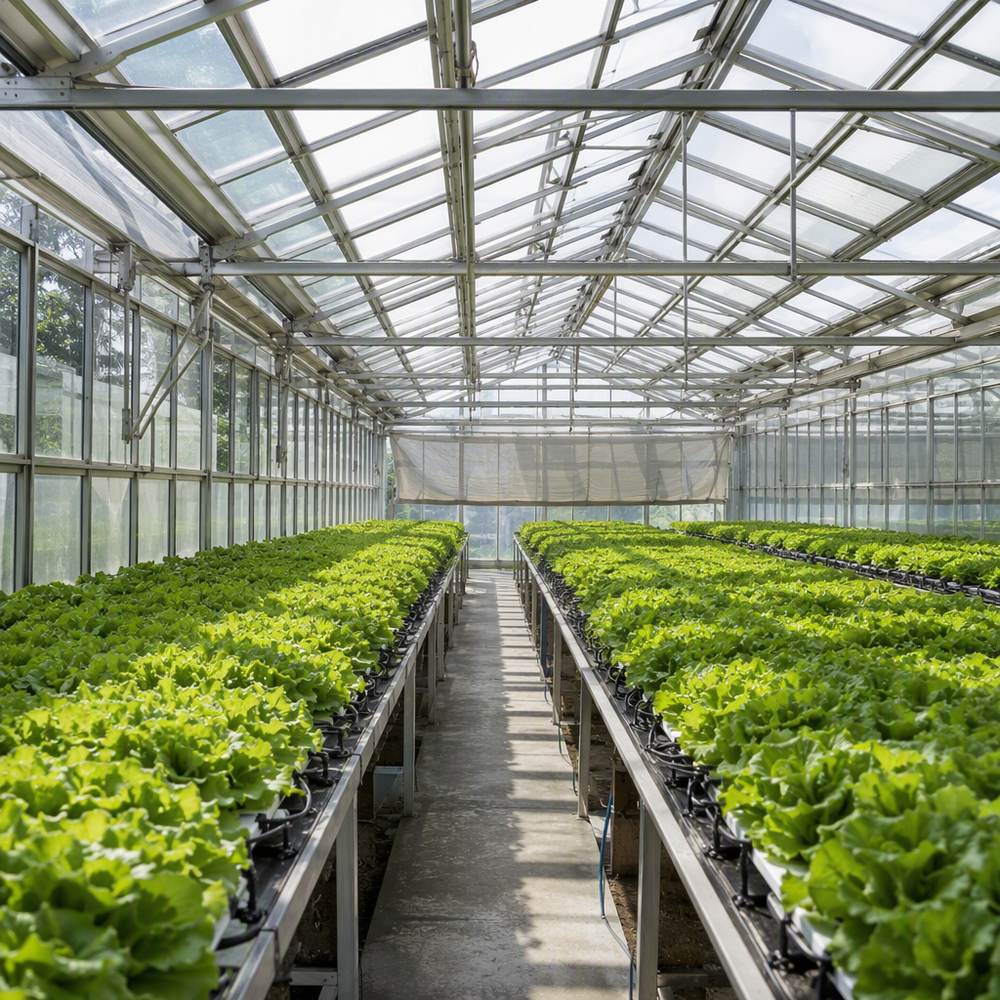
Glazing transmittance is an optical property of the material: how much of the light arriving on a clean, unobstructed panel passes through it. It is measured in a defined geometry, perpendicular to the light source. Once the same panel is mounted on a greenhouse, several further factors intervene, and the fraction of outdoor light that actually reaches the crop can be far below the quoted figure.
Extension guidance from Virginia Tech puts a number on that gap. In a reported example, the percentage of light reaching the plant canopy was only 56% of the outside light level in a glass-glazed controlled environment agriculture greenhouse, and only 45% in a double polyethylene greenhouse. Those two figures describe the same nominal purpose — covering a greenhouse — and differ by more than ten percentage points in practice.
Transmittance and service life by material
| Material and form | Light transmittance | Typical service life | Notes |
|---|---|---|---|
| Glass, single layer | 88% to 94%; double layer about 77%; double-strength about 88%; insulated about 78% | Often more than 25 years | One of the highest transmittances and the longest life; heavier, needs a stronger support structure, and higher air infiltration than other covers |
| Polyethylene film | 85% to 87% single layer; 74% to 77% double layer | 1 to 2 years without additives; 3 to 4 years or longer with UV additives | Low cost, light, easy to install; UV degradation is the limiting factor; an IR-reflecting inner layer reduces heat loss |
| ETFE film | 87% to 94% single layer; 81% to 88% for two layers; 77% to 83% for three layers | 25 years or more | Reported R-values of about 1.0 (single), 2.0 (two layers) and 3.0 (three layers); around 94% of UV is transmitted unless an additive reduces it |
| Fibreglass reinforced polyester (FRP) | Up to 90% for a new single panel; 60% to 80% for double panels | About 2 to 3 years untreated; 10 years or more with a UV inhibitor | Yellows under UV exposure with a corresponding loss of transmittance; no longer common in commercial greenhouses |
| Acrylic bi-wall panels | 87% to 93% | 20 to 25 years | Little transmittance loss over 10 years; easily scratched; needs special anchors for thermal movement |
| Polycarbonate panels | About 83% bi-wall; about 94% single-wall | 20 to 25 years | Impact resistant and rigid; bi-wall is the form normally used for greenhouse covering |
Two patterns are worth extracting from the table. First, adding a layer costs light: roughly 10 percentage points between single and double in most materials. Second, the materials that transmit the most light are not always the ones that keep it, which is why service life belongs in the same comparison as the headline number.
What removes the difference in service
- Structure. Trusses, glazing bars, gutters and vent mechanisms shade part of the roof area, and heavier glazing requires a stronger structure, which shades more. Extension work on glazing and light transmission treats these structural factors alongside the material itself.
- Angle of incidence. Transmittance is quoted perpendicular to the light source. At the low sun angles of winter — exactly when light is limiting in northern latitudes — reflection increases and less light enters.
- Dust, algae and debris. Deposits both block light and scratch the surface, and scratching lowers transmittance permanently.
- Ageing and yellowing. Ultraviolet exposure degrades some materials, with FRP and untreated polyethylene at the severe end: untreated FRP can yellow within one to two years, and polyethylene without UV additives is typically replaced every one to two years.
- Condensation. Water beading on the inner surface of a film — and dripping from it — both scatters light and increases disease incidence. Anti-condensation additives address this.
- Screens and shade materials. Retractable screens and shade cloths are part of the same light budget as the glazing, and need to be counted when the glazing figure is converted into crop light.
From glazing to a lighting decision
- Establish what arrives at the site. Use local solar radiation data rather than a national average; the seasonal profile, not the annual total, determines how many hours of the year need supplemental light.
- Apply a realistic in-house factor, not the datasheet number. Take the material's transmittance from Table 1 and reduce it for structure, angle, condition and age. The 56% and 45% examples show what the compounded result looks like in two real configurations.
- Compare with the crop target. The difference between what the house delivers and what the crop needs is the size of the lighting gap.
- Size the fixtures against the gap. The gap determines the installed PPFD and the hours of operation, and therefore the electrical and structural requirements of the installation.
- Choose the glazing and the fixtures as one decision. A low-transmittance cover with a large fixture grid and a high-transmittance cover with a small one can reach the same crop target. Only the total cost — covering, structure, heating and electricity — distinguishes them.
One further consideration belongs in this step: uniformity. Diffusing the incoming light spreads it more evenly through the canopy rather than concentrating it on the upper leaves. The 2023 Wageningen study on light distribution in tomato canopies cites earlier work in which a diffuse greenhouse cover that converted 71% of the direct light into diffuse light increased crop photosynthesis by 7%, because a more even distribution among leaves raises whole-crop photosynthesis at the same average intensity.
Maintenance that pays for itself
- Wash the glazing inside and outside periodically. Removing dust and debris restores transmittance and also removes the abrasive particles that would otherwise scratch the surface on the next cleaning.
- Replace glazing that has yellowed. Once a material has reached the end of its useful life and begun to yellow, cleaning no longer recovers the loss.
- Inspect the mounting before the heating season. Gaps between panels leak heat; the same inspection finds the fixings that have worked loose.
- Treat the visual condition as a data point. A photograph of the roof in January, plus a light reading inside and outside on the same day, is enough to check whether the transmittance assumed in the design still holds.
Where this matters in practice
Two project types see the largest effect. Retrofits in older film houses, where the cover may be several seasons old and no longer performs like the film that was installed, and new builds in northern latitudes, where the winter light budget is the constraint on the whole business case. In both cases the useful exercise is the same: measure what the house actually delivers before deciding how much supplementary light to install.
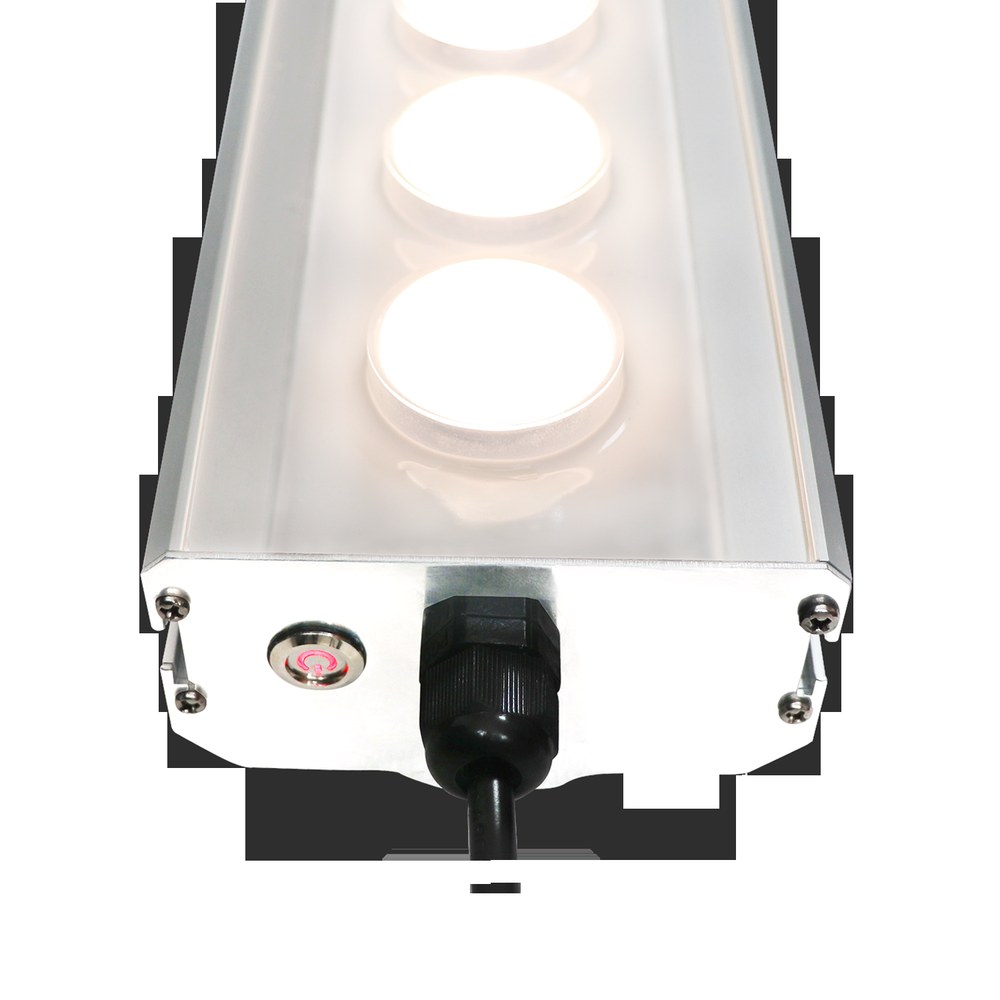
When transmission cannot be improved further — an older film structure, a heavily shaded site, a low-pitch roof — the remaining gap has to be closed above the crop. In our experience supplying LED grow light modules for greenhouse projects, that is where a grid of sealed modules sized to the bay and gutter spacing does the work: for example the TP10058 module, a sealed LED unit with lensed emitters and a glanded cable entry, mounted directly on the greenhouse structure above the canopy. The glazing survey defines how large the grid has to be.
Frequently asked questions
Is glazing transmittance the same as the light my crop receives?
No. Transmittance is quoted for a new, clean, unobstructed panel positioned perpendicular to the light source. Support structure, the angle of the sun, debris and ageing all subtract from it. A Virginia Tech Extension publication reports an example in which only 56% of the outside light level reached the canopy in a glass-glazed controlled environment agriculture greenhouse, and only 45% in a double polyethylene greenhouse.
Which greenhouse glazing transmits the most light?
On published single-layer figures, standard single-layer glass at 88% to 94% and single-layer ETFE film at 87% to 94% are at the top of the range. Polycarbonate bi-wall panels are quoted at around 83%, and each additional layer of any material costs several percentage points: glass falls to about 77% as a double layer, and polyethylene film from 85% to 87% single-layer to 74% to 77% double-layer.
How often does polyethylene film need replacing?
Without additives, polyethylene film lasts only one to two years because it degrades under ultraviolet light. Film coextruded with UV additives typically lasts three to four years or longer, and an infrared-reflecting inner layer is available for heat retention in cold climates.
Do plastic glazings block light that plants need?
Many plastic glazings reduce the amount of ultraviolet light that passes through, which can affect disease development and pigment formation such as red coloration from anthocyanins. The photosynthetically active waveband is transmitted, but a covering that screens specific wavelengths changes the crop environment even when its headline transmittance looks high.
Does a diffuse glazing improve growth?
Diffusing the light spreads it more evenly through the canopy. The 2023 Wageningen study on intra-canopy light distribution cites earlier work in which a diffuse greenhouse cover that converted 71% of the direct light into diffuse light increased crop photosynthesis by 7%.
About the publisher
Zhongshan City Ruixian Electronics Factory (XineLam) designs and manufactures LED lighting and LED grow light modules. The company has 17 years of experience in LED lighting and holds 300+ patents in China and internationally. This article is published as technical background for growers and greenhouse system integrators; the transmittance and service-life values are those published by the extension sources listed below, and the covering on a specific greenhouse should be assessed in place.
Where this matters in practice: glasshouse and film-house projects that specify supplemental light for a winter production programme, retrofits where the existing cover no longer matches its original specification, and facilities comparing a covering change against an increase in installed lighting.
References
- Evans, M.R., South, K.A., Stallknecht, E.J. Controlled Environment Agriculture Coverings and Glazing Materials. Virginia Cooperative Extension publication SPES-821NP, School of Plant and Environmental Sciences, Virginia Tech, and Hampton Roads Agricultural Research and Extension Center. Source of the transmittance and service-life values in Table 1, the 56% and 45% canopy light examples, and the maintenance guidance. https://pubs.ext.vt.edu/SPES/spes-821-controlled-environment-agriculture-coverings-and-glazing-materials.html
- University of Arkansas, greenhouse course material. Glazing Materials. Transmittance ranges for glass and polyethylene film covers. https://greenhouse.hosted.uark.edu/Unit03/Section02.html
- Roberts, W. (Cornell University), published by UW-Madison Extension, Focus on Energy. Glazing structure and other factors affecting light transmission in greenhouses. Comparative tests of glazing and the structural and other factors that reduce light transmission. https://fyi.extension.wisc.edu/energy/files/2016/09/Glazing-structure-other-factors-affecting-light-transmission-in-GH-Roberts.pdf
- Schipper, R., van der Meer, M., de Visser, P.H.B., Heuvelink, E., Marcelis, L.F.M. (2023). Consequences of intra-canopy and top LED lighting for uniformity of light distribution in a tomato crop. Frontiers in Plant Science 14: 1012529. Cited here for the reported effect of a diffuse greenhouse cover (71% of direct light converted to diffuse, 7% higher crop photosynthesis). https://www.frontiersin.org/journals/plant-science/articles/10.3389/fpls.2023.1012529/full