Reflective Walls in a Grow Room: How Much Extra PPFD Do They Add?
A grow light emits into a wide cone, and in a narrow tent a large share of that output never reaches a leaf on the first pass — it flies past the canopy and hits the walls. What the walls do with it decides whether that light is recycled onto the lower leaves or simply absorbed and turned into heat. This guide covers what reflectance really measures, how the common materials compare, what controlled measurements actually found, and where reflection helps or hurts.
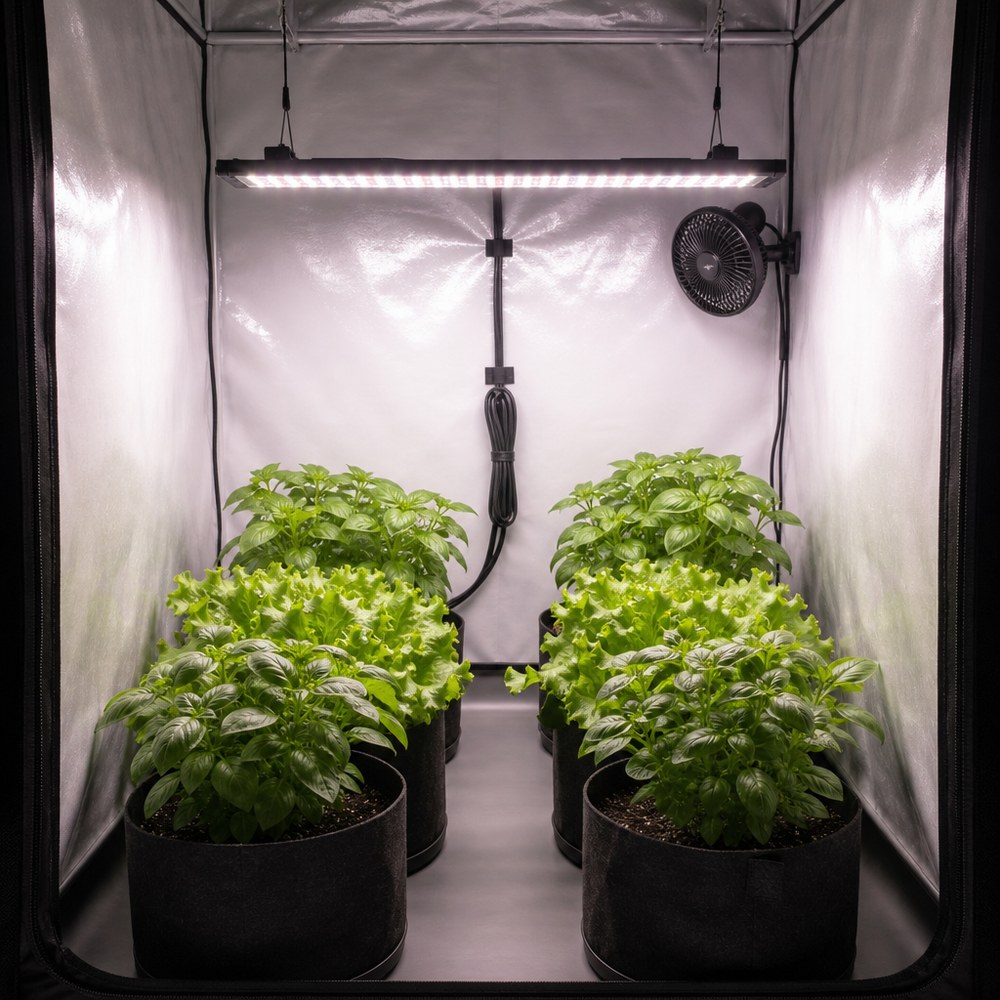
Why a bare wall is an expensive wall
Every fixture radiates photons into a hemisphere, not a vertical column. Directly beneath the fixture the canopy intercepts most of them. Toward the edges of the illuminated area, and especially in a narrow tent where the walls stand close to the plants, a growing share of the emitted light misses the canopy entirely and lands on the wall, the floor, or the film of the enclosure.
From that point the surface has two options. It can absorb the light — in which case the energy shows up as heat in the wall and the photons are gone, having been paid for at the meter twice over. Or it can reflect some fraction of it back into the room, where it may reach a leaf after one or more bounces.
The arithmetic of a single bounce is simple. If a surface has a reflectance of ρ for the wavelengths that matter, it returns a fraction ρ of the light that strikes it on the first bounce, and ρ² on the second. A matte white horticultural film with a high reflectance therefore returns a substantial share of the sidelight; a dark plastic liner with a low reflectance returns almost none. That difference — not the fixture — is often what separates two otherwise identical tents.
What reflectance actually means
"Reflectance" is quoted as a single percentage far more often than it should be, because three distinctions change what that number means in a real room.
- Specular versus diffuse. A mirror-like (specular) surface sends light off at the mirror angle: bright bands, mirrored images of the fixture, and hot spots where the reflected beam lands. A matte (diffuse) surface scatters it in all directions, which is what a plant canopy wants, because the light arrives from many angles at once instead of one.
- Spectral selectivity. A surface can be highly reflective in the visible range and absorbent elsewhere, or the reverse. What matters for a grow room is reflectance across the photosynthetically active waveband, not a single figure measured under a domestic light meter.
- Measurement geometry. Reflectance depends on the angle at which light arrives and on whether the value quoted is total (specular plus diffuse, over a hemisphere) or diffuse-only. Two products with the same headline number can behave differently on a wall, and both will differ from the datasheet once the surface is dusty or wet.
Comparing the materials you can actually buy
Table 1 compares the surfaces that end up on grow-room walls. It deliberately ranks behaviour qualitatively rather than quoting a reflectance percentage for each material: published figures vary between products and are only meaningful with their measurement conditions attached. The controlled comparison of measured materials follows in the next section.
| Surface | Reflection type | How it behaves in practice | Effect on uniformity | Cleaning and durability | Best used for |
|---|---|---|---|---|---|
| Matte white reflective film / white growing liner | Diffuse | Returns a large share of the visible light that reaches it, and spreads it over a wide angle rather than back in one direction | Improves it: light arriving from the side fills the shaded lower canopy instead of forming a bright band | Wipes clean with a damp cloth; dust, condensation films and spray residue steadily cost performance | The default choice for closed tents and small sealed rooms |
| Aluminised Mylar / metallised reflective film | Specular to semi-diffuse, depending on whether the surface is textured | Very directional unless textured; can throw a bright mirrored band onto one side of the canopy | Mixed: a higher peak near the wall, but a less even wash across the canopy | Creases permanently once folded, and creases concentrate the reflection; not really cleanable | Tight spaces where a measured band of extra light near the wall is acceptable |
| Flat white paint (matte, titanium-dioxide based) | Diffuse | Uniform and predictable when applied properly; covers a whole room rather than one panel | Good, provided the finish is genuinely matte | Recoatable; washable grades exist; a gloss finish defeats the purpose | Converting a permanent room rather than lining a tent |
| Aluminium foil | Specular | Bright but directionally erratic; the crinkles act like many small mirrors aiming in different directions | Poor: produces streaks and local hot spots rather than an even second wash | Tears easily at hangers and edges; cannot be effectively cleaned | Temporary or experimental use only |
| Black-and-white poly with the black face inward | Predominantly absorbing | Deliberately recycles very little of what reaches it; the white face is there to reflect from the outside | Neutral to negative: the interior simply loses that light | Durable and easy to clean | Light blocking on the outside of the growing space, not lining on the inside |
| Bare concrete, unpainted timber, dark plastic tray and floor liner | Predominantly absorbing | Recycles only a small fraction; the remainder becomes heat in the structure | Neutral, but it removes the contribution the walls could have made | Very durable | Unavoidable surfaces; keep them out of an intentional reflective design |
What controlled measurements show
It is easy to assume that any bright surface is an improvement. The measured comparisons say the material choice matters more than the mere presence of a shiny wall.
In a study at the University of Nebraska–Lincoln, four colours of reflective plastic mulch were compared for their reflectance and transmittance in a double-polyethylene, plastic-glazed greenhouse, with incident and reflected PAR recorded by quantum sensors and mulch temperatures logged during the day. The result was not a subtle one: the red mulch reflected less than half the amount of PAR that the white mulch did, and the olive and black mulches reflected even less. The group then selected the white 6-mil reflective film to cover a capillary mat system under 312 strawberry pots, and reported the production of over 1,700 saleable berries with a mass of over 19 kg in that system.
Two conclusions follow. First, "reflective" is not a binary property — a red surface and a white surface in the same greenhouse were separated by more than a factor of two in reflected PAR. Second, the surfaces below the canopy can do work that the fixture alone cannot: the light returning upward from a reflective floor or mat is light that would otherwise have passed the plants by.
A second, more cautionary body of work concerns the envelope itself. A review of light-altering cover materials for greenhouse vegetable production documents how engineered films and coatings can shift the balance of PAR, far-red and ultraviolet reaching the crop — one coating, for example, blocking 85 % of ultraviolet, 19 % of PAR, 58 % of far-red and 26 % of red light. The lesson for a grow room is that a material that changes the light is not automatically improving it; you have to know which part of the spectrum you wanted. Work comparing tomato and cucumber grown under polycarbonate and glass greenhouses makes the same point from the other direction: the material of the enclosure measurably changes the light environment and the resulting growth and yield, so the walls are part of the lighting design rather than an inert container.
Where reflection helps, and where it hurts
It helps when:
- The enclosure is narrow, so the walls are close to the canopy and intercept a large share of the emitted light.
- The canopy is tall, and the lower leaves are shaded by the ones above. Side-reflected light is one of the few ways to reach them without adding a second fixture.
- You want to reduce fixture power for the same canopy, and you have a way to measure the result.
It hurts when:
- The walls are specular. A mirrored surface sends a concentrated band onto whichever leaves face it, which can push the local PPFD well above the canopy average and create exactly the unevenness you were trying to remove.
- The canopy is pressed close to a bright wall. Wall proximity raises the PPFD on the nearest plants; if the difference across the canopy becomes large, the "extra" light becomes a stress gradient.
- The enclosure is open. Light reflected out through an open front is lost more completely than light reflected by a closed, matte surface, so a reflective liner on an open tent is largely decorative.
- Surfaces are dirty. Dust and dried spray residue absorb light, and the loss shows up on the meter rather than in any visible cue.
A practical setup checklist
- Line all six faces, not just the back. Side walls and the ceiling return more light than the rear wall in most layouts, because that is where the fixture's sidelight is heading.
- Prefer matte over mirrored unless you have measured the alternative and prefer the result.
- Keep the surfaces clean and dry. Wipe the walls at the same interval you clean the fixture.
- Measure at two places: the canopy centre, and the corner nearest a wall. The difference between them is your uniformity figure, and it is the number a reflective liner changes most.
- Measure once with the walls exposed and once with them temporarily covered. That single comparison tells you what your walls are actually contributing in your room, which no datasheet can tell you.
- Watch the canopy-to-wall distance. If the plants nearest the wall are visibly ahead of the plants in the middle, back the canopy off the wall rather than reducing the fixture output for everyone.
Frequently asked questions
Do reflective walls really increase yield?
They increase the amount of light reaching the canopy, which is a prerequisite for yield rather than a guarantee of it. In the controlled greenhouse comparison above, the white reflective surface returned more than twice the PAR of the red surface in the same house, which shows the surface choice is material. Whether that extra light converts into yield depends on whether light was the limiting factor — if water, CO2, nutrition or temperature are limiting, more photons will not help.
Is Mylar better than white plastic?
Not automatically, and often not in practice. Metallised film can return a higher peak in one direction, but that is also its weakness: the reflection is directional, it creases permanently, and each crease changes where the light goes. A matte white liner returns a slightly lower peak but spreads it across the canopy, which is usually the more useful result. Use the mirror finish only where you have measured that the focused band does what you want.
Should I line the floor too?
It is one of the better places to put a reflective surface, because the light it returns travels upward into the shaded underside of the canopy rather than being absorbed by dark plastic or wet concrete. The trade-off is maintenance: a floor takes more abuse than a wall, so a cleanable, matte white surface will hold its performance where a foil or film will not.
How much PPFD do reflective walls add?
There is no universal figure. The gain depends on the geometry of the room, the reflectance of the surface, how much of the fixture's output would otherwise have escaped, and how much of the reflected light eventually finds a leaf rather than the wall again. That is exactly why the checklist above ends with a measurement rather than a number: a single comparison of the canopy with the walls exposed and covered gives you the real figure for your own room, and it takes a few minutes.
About the publisher
XineLam is a grow-light manufacturer in Zhongshan, China, with 17 years of experience in LED lighting and 300+ patents in China and internationally. The company designs and builds full-spectrum LED grow lights, LED drivers and horticultural light bars for indoor farms, grow tents and greenhouses.
References
- Meyer, G. E., Paparozzi, E. T., Walter-Shea, E. A., Blankenship, E. E. and Adams, S. A. (2012). An Investigation of Reflective Mulches for use over Capillary Mat Systems for Winter-time Greenhouse Strawberry Production. Agronomy and Horticulture Faculty Publications, University of Nebraska–Lincoln. Reports that red mulch reflected less than half the PAR of white mulch, with olive and black mulches reflecting less still, and records more than 1,700 saleable berries over 19 kg under white reflective mulch. https://research.unl.edu/ncesr-archive/wordpress/wp-content/uploads/2010/08/Mulches-strawberry-production.pdf (accessed 29 September 2026).
- American Society of Agricultural and Biological Engineers. Use of Reflective PAR Mulches to Enhance Winter-time Greenhouse Production. Conference paper by the same research group, reporting the reflectance and transmittance properties of four plastic mulches. https://elibrary.asabe.org/azdez.asp?JID=5&AID=29994&CID=pitt2010&T=2 (accessed 29 September 2026).
- He, X., Maier, C., Chavan, S. G., Zhao, C. C., Alagoz, Y., Cazzonelli, C., et al. (2021). Light-altering cover materials and sustainable greenhouse production of vegetables: a review. Plant Growth Regulation. Reviews how cover materials and coatings alter PAR, far-red and ultraviolet transmission to the crop. https://link.springer.com/article/10.1007/s10725-021-00723-7 (accessed 29 September 2026).
- Kwon, J. K., Khoshimkhujaev, B., Lee, J. H., Yu, I. H., Park, K. S. and Choi, H. G. (2017). Growth and Yield of Tomato and Cucumber Plants in Polycarbonate or Glass Greenhouses. Horticultural Science and Technology. Compares the light environment and crop performance under two different glazing materials. https://www.hst-j.org/articles/xml/1xOy/ (accessed 29 September 2026).
Scope note: this guide describes how wall and floor surfaces affect the light a canopy receives. It does not recommend a specific product, and it deliberately avoids quoting a reflectance percentage for each material class, because published figures are only meaningful with their measurement conditions. Measure in your own room before designing around any figure.