How Far Should LED Grow Lights Be From Plants?
Hanging height is the easiest thing to adjust and the easiest thing to get wrong. There is no universal number of inches, because the height is only a way of setting the light level that actually reaches the leaves. This guide gives the distances published by university extension services, the arithmetic behind why small changes in height produce large changes in intensity, and the measurement that settles the question for a specific room.
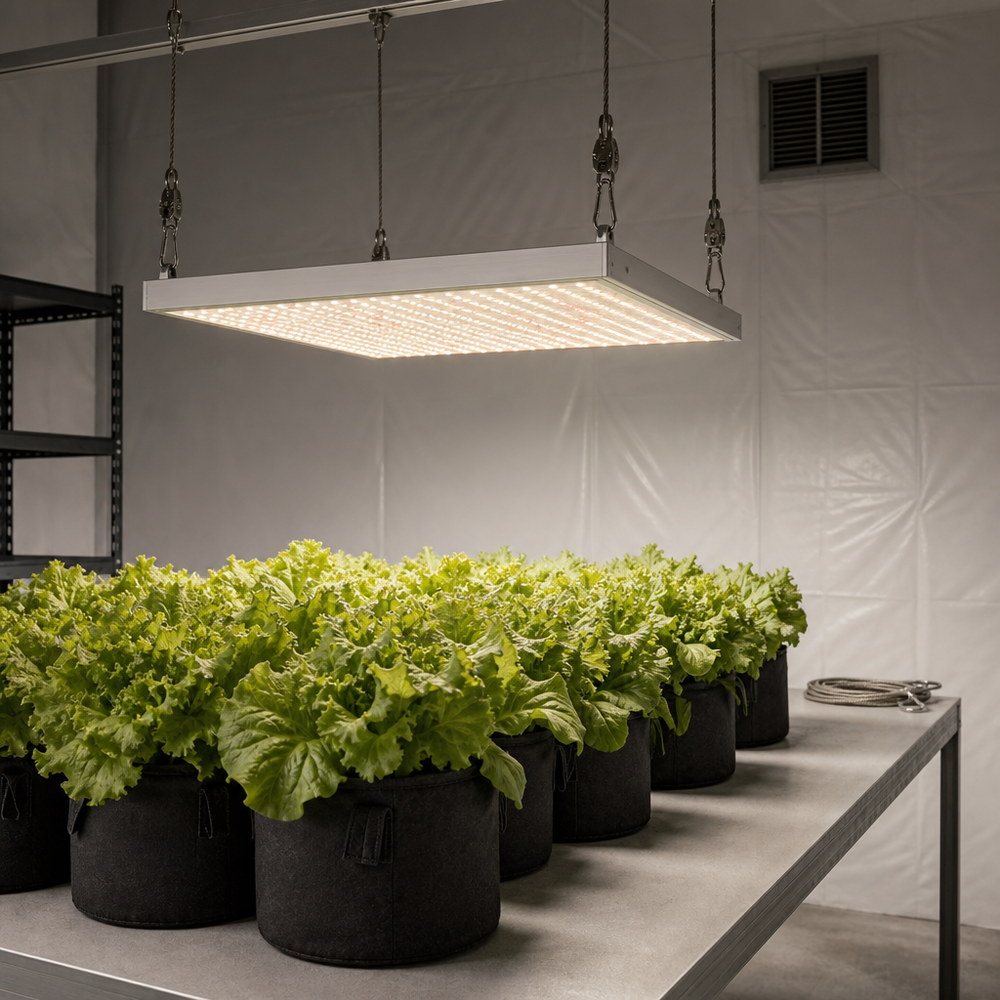
The short answer
Height is a means, not an end. The end is the photosynthetic photon flux density (PPFD) that the canopy receives, expressed in micromoles per square metre per second (µmol/m²/s). Two fixtures with identical rated power can require completely different mounting heights, because they convert electricity into photons at different efficiencies and spread those photons over different footprints.
The University of Minnesota Extension publishes stage-based distances that are a reasonable starting point for a mixed collection of indoor plants, and pairs each with a photoperiod. Table 1 reproduces those recommendations.
| Plant stage | Distance from the light source | Total light hours per day |
|---|---|---|
| Seedlings | 4 to 6 in (10 to 15 cm), fixture moved up as they grow | 16 to 18 h |
| Hydroponic lettuce and herbs | 6 to 12 in (15 to 30 cm) | 12 to 14 h |
| Flowering houseplants | 6 to 12 in (15 to 30 cm) | 14 to 16 h |
| Foliage houseplants | 12 to 24 in (30 to 60 cm) | 12 to 14 h |
Two facts about that table matter more than the numbers in it. The first is that the distances are not ordered by fixture wattage but by how much light the plant can use: a shade-adapted foliage plant is kept further away than a lettuce seedling because it needs less light, not because it is more delicate. The second is that the source states plainly that PPFD falls as the plants get further from the light, so these distances are a starting point to be verified rather than a setting to be trusted.
Why height changes the light so quickly
PPFD is not the amount of light a fixture produces. It is the amount of light that arrives at a given surface at a given distance, which is why it is measured in micromoles per square metre per second rather than micromoles per second. The University of Missouri Extension describes it as how much instantaneous light reaches the plants in a given area at a set distance, and notes that it tends to be higher when the light source is closer to the plants.
For a compact source, that relationship follows the inverse-square law: intensity is proportional to one over the square of the distance.
Table 2 evaluates that expression. The starting height is whatever height is currently working; the rest of the table shows what happens if the fixture is moved.
| Distance relative to the reference height | Relative PPFD | Reads as |
|---|---|---|
| 1.00 × (reference) | 100% | the starting point |
| 1.25 × | 64% | a small move up already costs a third of the light |
| 1.50 × | 44% | less than half the light remains |
| 2.00 × | 25% | one quarter of the light remains |
| 3.00 × | 11% | the fixture is effectively a background light |
The inverse-square law is exact only for a source small compared with the distance, and a grow light panel is not small. A study published on arXiv in 2025 used smartphone light sensors to measure decay curves for point, linear and planar sources and for ring-shaped LED lights, and found that intensity can fall linearly, or even stay roughly constant over a range of distances, rather than following the square of the distance. The practical consequence is that the right way to read Table 2 is as a warning about sensitivity, not as a formula for predicting a fixture: over the distances used in a grow room, moving a bar array or a panel a few centimetres changes the delivered light far less than the inverse-square law would suggest, and moving a small high-bay fixture changes it far more.
There is one relationship that does hold regardless of beam shape, because it is a statement about energy rather than about geometry. If all of a fixture's photons land inside a footprint of area A, the average PPFD across that footprint is the fixture's total output divided by A.
Worked example: a fixture emitting 1,000 µmol/s spread over a 1.2 m × 1.2 m footprint delivers an average of 1,000 ÷ 1.44 = 694 µmol/m²/s. That is an average by construction. An even spread with no overlap between fixtures will have brighter centres and dimmer edges, which is why Oklahoma State University Extension advises that the beam from one device should overlap the beam from the next to produce an even spread across the growth space.
Matching height to the crop, not to the fixture
Once the light level is the target, the useful question becomes how much light the crop wants. Oklahoma State University Extension recommends a PPFD between 400 and 800 µmol/m²/s for improved plant growth, and separates crops by daily light integral (DLI) instead: 5 to 10, 10 to 20, 20 to 30, and 30 to 50 mol/m²/day are described as suitable for low, medium, high and very high light plants respectively. It also gives a power-density rule of thumb of about 25 W per square foot for high-light plants and 16 W per square foot for low-light plants.
The DLI figure and a PPFD target are two views of the same quantity, linked by the photoperiod. Table 3 converts the published DLI bands into the PPFD each band corresponds to over a 16-hour photoperiod, which spans the range of running times in Table 1.
| Light requirement | DLI (mol/m²/day) | Equivalent average PPFD over 16 h (µmol/m²/s) |
|---|---|---|
| Low light | 5 to 10 | 87 to 174 |
| Medium light | 10 to 20 | 174 to 347 |
| High light | 20 to 30 | 347 to 521 |
| Very high light | 30 to 50 | 521 to 868 |
The University of Missouri Extension illustrates the cost of overshooting with lettuce, which it gives a requirement of 250 to 350 µmol/m²/s. Plants may still look healthy above 350, but the extra light does not produce a significant increase in yield or a shorter time to harvest, and excessive light can cause photoinhibition, in which photosynthesis is inhibited and growth is reduced. In height terms, the right setting is the highest one that still delivers the target PPFD at the canopy, not the lowest one the fixture can be run at.
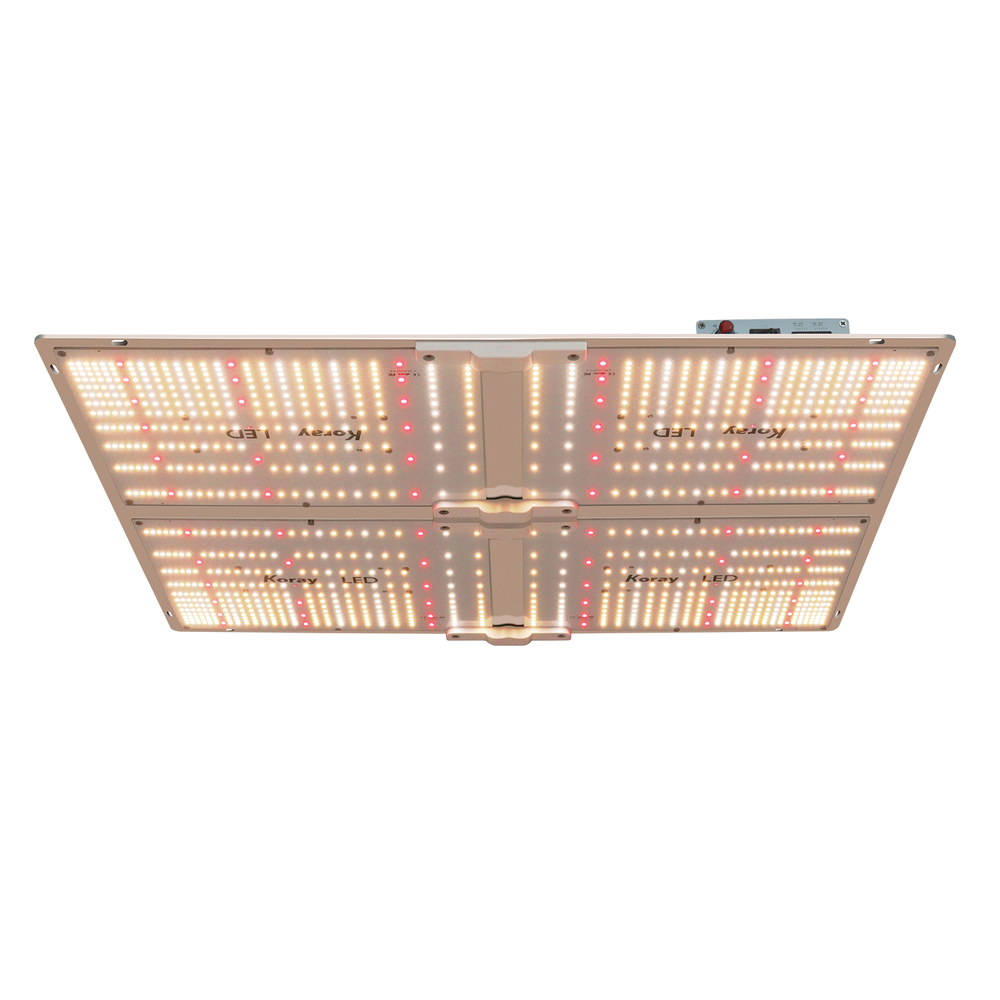
Three settings decide the outcome, and they interact. Raising the panel lowers PPFD and widens the footprint; dimming lowers PPFD and leaves the footprint alone; running a longer photoperiod raises DLI without changing PPFD at all. When a crop is stretching toward the light instead of filling out, that is usually a signal that the delivered PPFD is too low for the species or the stage. When leaf edges bleach or curl upward, it is usually the reverse. The extension sources treat intensity, quality and duration as three separate properties of the light environment for exactly this reason.
Symptoms that point to the wrong distance
Light placement shows up in the plants before it shows up on a meter, but the symptoms are not symmetrical and several of them also have other causes.
| What you observe | Light-placement factor to check first | Why |
|---|---|---|
| Long, thin stems; widely spaced leaf nodes; plants reaching upward | Fixture too high or dimmed too far | Low PPFD is the classic cause of etiolation and of the leggy growth the University of Minnesota Extension describes. |
| Pale or bleached patches on the uppermost leaves nearest the fixture | Those leaves are too close | Bleaching and scorching appear when the leaves closest to the source receive far more than the rest of the canopy. |
| Strong growth in the middle of the tray, weak growth at the edges | Footprint is smaller than the growing area, or fixtures are spaced too far apart | Overlapping beams are what flatten the difference between centre and edge. |
| Even growth, but the crop is behind schedule | DLI is short — check the photoperiod before the height | DLI is the product of PPFD and time, so an hour of missing light and a tenth of missing PPFD are interchangeable. |
Setting the height in practice
- Write down the target leaf level for the crop. Use a PPFD or DLI figure from an extension source or the crop's own literature, not the fixture specification.
- Hang the fixture at the distance recommended for the stage, and level its plane so the emitting surface is parallel to the canopy.
- Measure PPFD at canopy height in at least three places: directly under the centre of the fixture, under an edge of its footprint, and at the point furthest from any fixture. Adjust the height until the weakest of those readings reaches the target.
- Leave the dimming control to correct the seasonal or crop change, and move the fixture when the plants physically become too tall for the air gap.
- Re-check after any change to the number of fixtures, their spacing or the bench layout, because both the average level and the uniformity change with the layout.
Where the choice is between a light source that is slightly too high and one that is slightly too low, an even canopy favours the higher position, and a single crop with a firm target favours the accurate one. Because a panel and a small high-bay fixture respond differently to the same change in height, the pattern of measurements across the tray is the evidence that matters; a single reading at the brightest point can only confirm the peak.
Frequently asked questions
Does doubling the distance halve the PPFD?
No. For a compact source, doubling the distance divides the PPFD by four, not by two. If a fixture gives 400 µmol/m²/s at 30 cm, the same fixture gives roughly 100 at 60 cm, 44 at 90 cm and 25 at 120 cm, assuming a point-source geometry. Panel and bar fixtures are extended sources, so their real falloff over typical horticultural distances is gentler than that, which is why a measured PPFD map beats a calculated one.
Should I raise the fixture or dim it to reduce PPFD?
Dimming is usually the better control. Raising the fixture lowers PPFD everywhere, but it also changes the coverage footprint and the uniformity across the canopy, so the same crop can end up with brighter centres and darker edges than before. Dimming reduces output while the beam geometry stays as it was. Raising the fixture is the right move when the crop has grown taller and the leaves are physically too close to the emitting surface.
How do I know the PPFD at canopy level?
Measure it. A quantum sensor gives a direct reading of PPFD at the exact height and position you are checking. Where a meter is not available, the University of Missouri Extension notes that grow light manufacturers usually publish expected PPFD at different heights, and a fixture's stated output can be converted into an average PPFD over a footprint by dividing the total photon output by the footprint area. That figure is an average, not a peak and not an edge value.
Do LED grow lights have to hang further away than HPS lamps?
No, usually the opposite. Oklahoma State University Extension notes that in LEDs heat leaves through a heat sink rather than radiating from the emitting surface, which allows closer proximity between the plants and the diodes. High-pressure sodium lamps tend to need more clearance, and the University of Minnesota Extension advises keeping sufficient distance especially with bulbs that produce a lot of heat. The practical limit for an LED is usually the light level the crop can use, not the temperature at the leaf surface.
What hanging height should seedlings be at?
The University of Minnesota Extension gives seedlings 4 to 6 inches (about 10 to 15 cm) from the light source, with the fixture moved up regularly as the plants grow, and 16 to 18 hours of light per day. Seedlings are short, so a fixture that is correctly placed over a mature canopy will be far too distant over a seedling tray.
About the publisher
Zhongshan City Ruixian Electronics Factory (XineLam) has 17 years of experience designing and manufacturing LED lighting, and holds 300+ patents in China and internationally. Articles on this site are written as technical reference material for growers, specifiers and researchers; they are not product brochures. For a crop that is sensitive to delivered light, sizing a fixture so that a comfortable mounting height also reaches the target PPFD on the first attempt usually costs less than correcting it after planting.
References
- University of Minnesota Extension. Lighting for indoor plants. Weisenhorn, J. and Hoidal, N. Reviewed 2026. https://extension.umn.edu/garden-and-home/yard-and-garden/gardening-in-minnesota/lighting-for-indoor-plants
- Oklahoma State University Extension. LED Grow Lights for Plant Production (Fact Sheet HLA-6450). Dunn, B. and Mills, T. Published April 2017. https://extension.okstate.edu/fact-sheets/led-grow-lights-for-plant-production
- University of Missouri Extension. Controlled Environment Agriculture: Understanding Grow Lights (Publication G6987). Cabrera-Garcia, J. and Ernst, M. February 2025. https://extension.missouri.edu/publications/g6987
- Light intensity does not always decay with the inverse of the square of the distance: an open-inquiry laboratory. arXiv:2501.00622, 2025. https://arxiv.org/abs/2501.00622