How Light Spectrum Affects Black Soldier Fly Mating and Oviposition
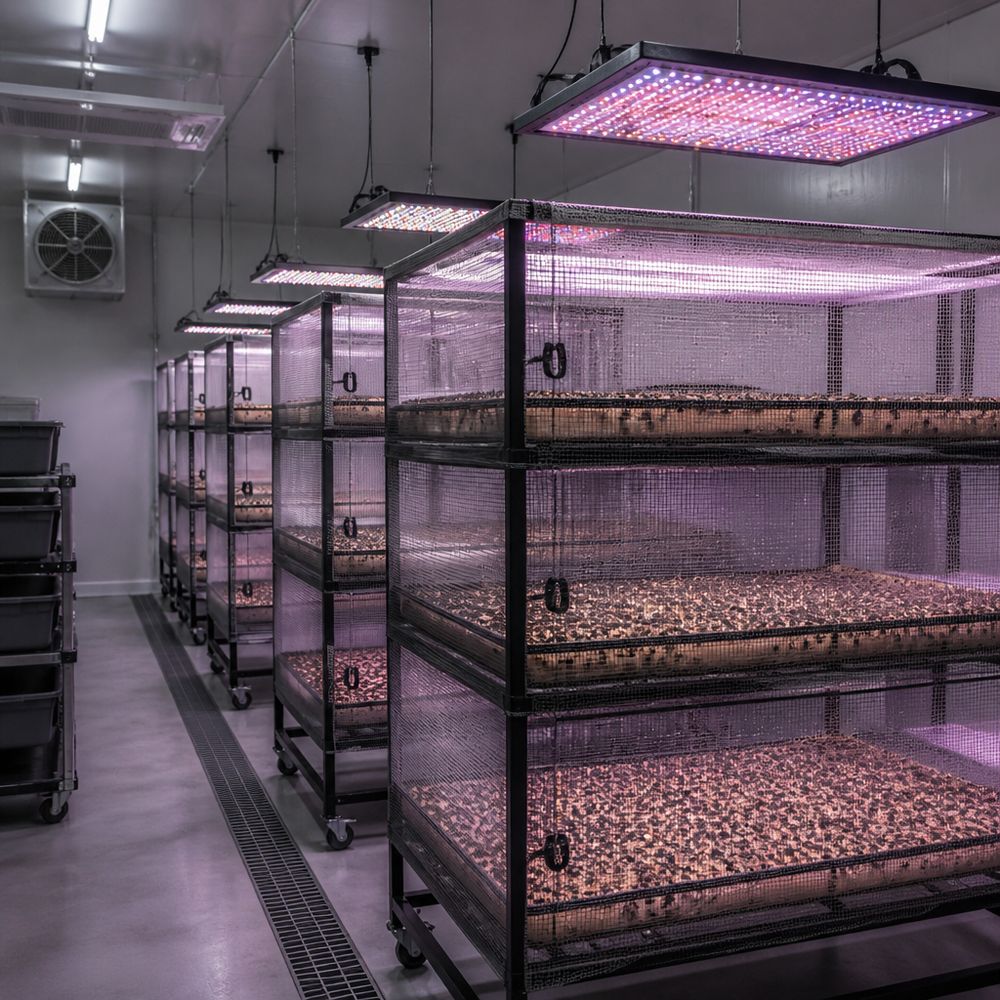
The industrial cultivation of the Black Soldier Fly (Hermetia illucens, BSF) represents one of the fastest-growing bioconversion industries worldwide, transforming organic waste into high-value insect protein and lipids. However, indoor all-season mass rearing encounters a critical biological bottleneck: adult black soldier flies depend heavily on specific sunlight cues for lekking (aerial courtship), copulation, and subsequent oviposition. Replacing natural sunlight with engineered LED illumination requires precise photobiological tuning of wavelength, irradiance, photoperiod, and thermal management.
1. Compound Eye Photoreceptor Sensitivity of BSF
Unlike human vision (trichromatic with peak sensitivities at 440, 535, and 565 nm) or plant photosynthetic response (400–700 nm PAR), insect visual systems have distinct spectral sensitivity bands. Electroretinogram (ERG) studies and behavioral assays on Hermetia illucens demonstrate that their visual receptors are sensitive primarily to three discrete spectral bands:
- Ultraviolet-A (UVA, 350–385 nm, peak ~365 nm): Essential for triggering aerial flight initiation, orientation, and female visual recognition of flying males during courtship leks.
- Blue Spectrum (435–465 nm, peak ~450 nm): Acts as a primary visual contrast trigger and stimulates circadian locomotor activity.
- Green Spectrum (515–540 nm, peak ~525 nm): Corresponds to the secondary sensitivity peak of insect rhodopsin and provides luminance perception.
Adult BSF possess negligible photoreception above 620 nm (red and far-red wavebands). Consequently, conventional incandescent lamps or high-pressure sodium (HPS) sources waste over 70% of their electrical energy emitting wavelengths that adult flies cannot perceive, while generating excessive radiant heat that induces thermal stress.
2. Narrowband vs. Broad-Spectrum Light Performance
Peer-reviewed studies published in the Journal of Insect Science and the Journal of Photochemistry and Photobiology B: Biology have compared the mating efficiency of BSF colonies under different artificial light sources against natural sunlight controls:
| Light Source Type | Dominant Peak Wavelengths | Mating Frequency (% vs. Sunlight) | Egg Clutch Fertility Rate (%) | Electrical Efficacy for Insect Vision |
|---|---|---|---|---|
| Natural Direct Sunlight (Control) | Continuous 300–2500 nm | 100% (Baseline) | 85–92% | N/A (Natural) |
| Specialized Multi-band LED (UVA + Blue + Green) | 365 nm, 450 nm, 525 nm, 6500K | 92–98% | 84–90% | High (>2.2 µmol/J visual band) |
| Standard Cool White LED (6500K) | 450 nm + 560 nm phosphor | 38–48% | 45–55% | Moderate |
| Fluorescent Grow Light (T5 HO) | Mercury line peaks (436, 546 nm) | 28–36% | 35–48% | Low (0.95 µmol/J) |
| High Pressure Sodium (HPS) | 569–617 nm dominant | 12–18% | 20–30% | Very Low |
Research by Zhang et al. (2010) demonstrated that customized quartz-iodine and targeted LED sources containing ultraviolet and blue-green spectral components successfully triggered over 60% of mating pairs and yielded viable egg batches comparable to sunlight-reared colonies. Schneider et al. (2020) further proved that multi-channel narrowband LED fixtures integrating 365 nm UVA diodes with 450 nm blue and 520 nm green LEDs achieved mating frequencies exceeding 90% of sunlight levels under climate-controlled conditions.
3. Light Intensity (PPFD) and Photoperiod Thresholds
Light intensity inside the mating enclosure directly dictates flight activity. In commercial BSF insectaries, light delivery is governed by three operational parameters:
- Minimum Irradiance Threshold: A photon flux density of at least 50 µmol/m²/s (approx. 3,500 lux) is necessary across the cage volume to prevent flies from clustering statically on mesh walls.
- Optimal Operational Range: 70 to 120 µmol/m²/s ensures active lekking and high mating pair formation. Increasing intensity beyond 180 µmol/m²/s yields diminishing biological returns and increases chamber air conditioning loads.
- Photoperiod Scheduling: Maintain a 12:12 or 14:10 light-to-dark cycle. Peak light intensity should be concentrated during a 6-hour window (e.g., 09:00 to 15:00), mimicking the diurnal solar peak when wild BSF naturally mate.
4. Fixture Design and Selection Criteria
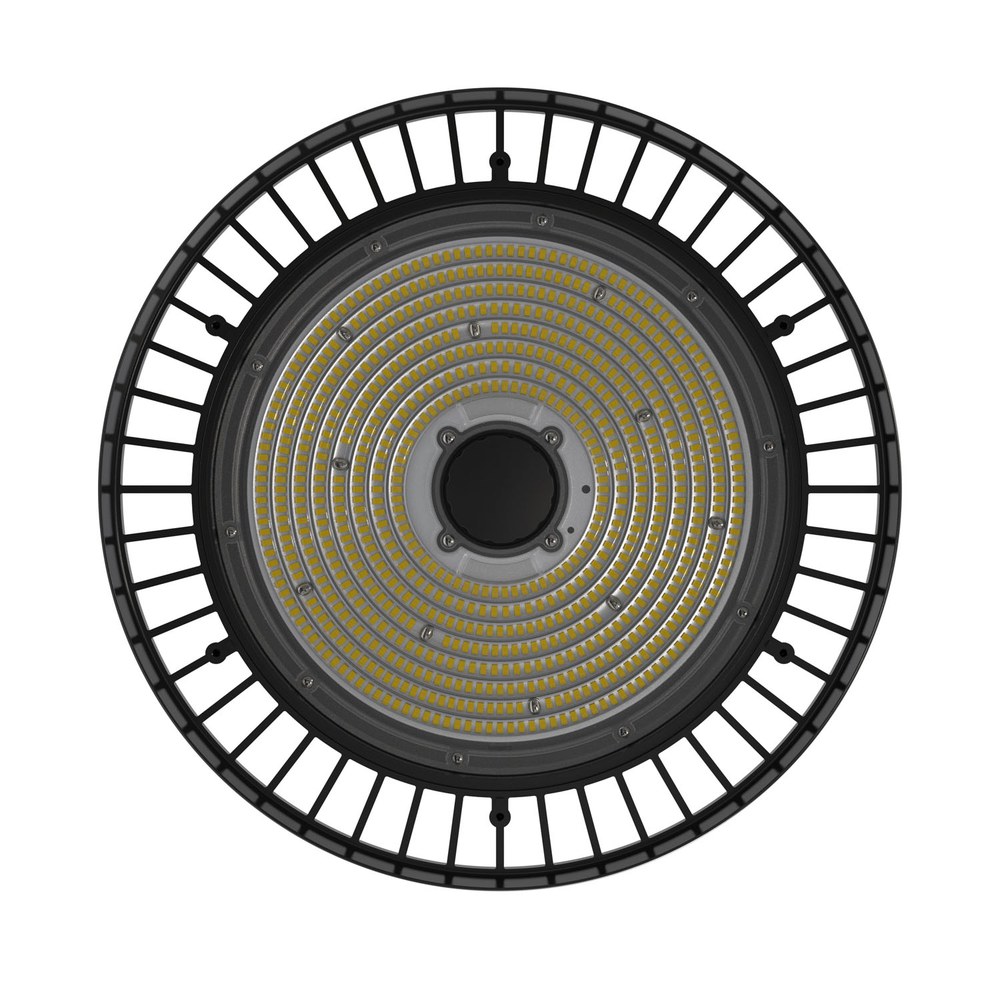
When selecting or specifying commercial LED fixtures for black soldier fly insectaries, standard horticultural plant lights or architectural luminaires often fail due to severe environmental and spectral mismatches. Ensure your fixture meets the following engineering criteria:
- Spectral Tuning: Incorporation of dedicated high-radiant-flux UVA diodes (365–385 nm) alongside high-efficiency blue and green chips.
- IP65+ Ingress Protection: Mating cages operate at 60–80% relative humidity and 28–32°C ambient temperatures, with airborne scale and dust. Fixtures must feature robust sealed optical silicone or tempered glass covers.
- Low Surface Operating Temperature: Heavy aluminum heatsinks with passive dissipation keep luminaire surface temperatures below 55°C, preventing accidental insect burn when flies land on housings.
- Uniform Beam Dispersion: 120° wide beam angles eliminate dark corners in high-density mesh cages, maximizing effective mating volume.
5. Frequently Asked Questions
What is the most effective light spectrum for black soldier fly mating?
Research demonstrates that adult BSF visual photoreceptors are most sensitive in the UVA (365 nm), blue (440–460 nm), and green (520–535 nm) bands. A spectrum combining UVA, blue, and green light stimulates aerial lekking behavior and triggers significantly higher mating success than standard broad-spectrum white light or fluorescent tubes.
What light intensity (PPFD or lux) is required inside BSF breeding cages?
Commercial indoor colonies require a minimum irradiance of 50 to 120 µmol/m²/s (approximately 3,500 to 8,000 lux depending on spectral composition) across the mating volume. Intensities below 30 µmol/m²/s result in sluggish flight and suppressed mating, while exceeding 200 µmol/m²/s increases thermal stress without proportional fertility gains.
How many hours of artificial light should be provided daily for BSF reproduction?
A standard photoperiod of 12 to 14 hours of continuous light per day is optimal. Providing peak light intensity during a 4-to-6-hour window in the morning to early afternoon aligns with the natural circadian peak of BSF mating activity.
Why do standard cool white LEDs fail to achieve high BSF oviposition rates?
Standard commercial phosphor-converted white LEDs lack emission below 420 nm (UVA region) and have low green-to-red ratios tailored for human eyes. Because BSF compound eyes lack red-light photoreceptors and rely heavily on UVA and blue-green spectral cues for aerial recognition, standard white LEDs fail to trigger maximum lekking and viable egg clutch deposition.
Zhongshan City Ruixian Electronics Factory (XineLam) designs and manufactures specialized LED lighting products, horticultural grow modules, and agricultural insect cultivation luminaires. The company has 17 years of experience in the LED lighting industry and holds 300+ patents in China and internationally.
7. References
- Zhang, J., Huang, L., He, J., Tomberlin, J. K., Li, J., Lei, C., Sun, M., Liu, Z., and Yu, Z. (2010). An Artificial Light Source Influences Mating and Oviposition of Black Soldier Flies, Hermetia illucens. Journal of Insect Science, 10: 202. Available at: https://pmc.ncbi.nlm.nih.gov/articles/PMC3029228/.
- Schneider, T., Lehnert, M., and Richter, M. (2020). Mating success of the black soldier fly, Hermetia illucens (Diptera: Stratiomyidae), under four artificial light sources. Journal of Photochemistry and Photobiology B: Biology, 205: 111814. Available at: https://www.sciencedirect.com/science/article/pii/S1011134419307808.