How Many LED Grow Lights Can Run on One Circuit?
Grow-room expansions usually hit the electrical supply before they hit the ceiling. The number of fixtures a single branch circuit will carry is set by current and by the continuous-load rule, not by the wattage figures in a product list. This guide works through the arithmetic with a comparison table, then covers the cases where a breaker trips although the steady-state total looks comfortably inside the limit.
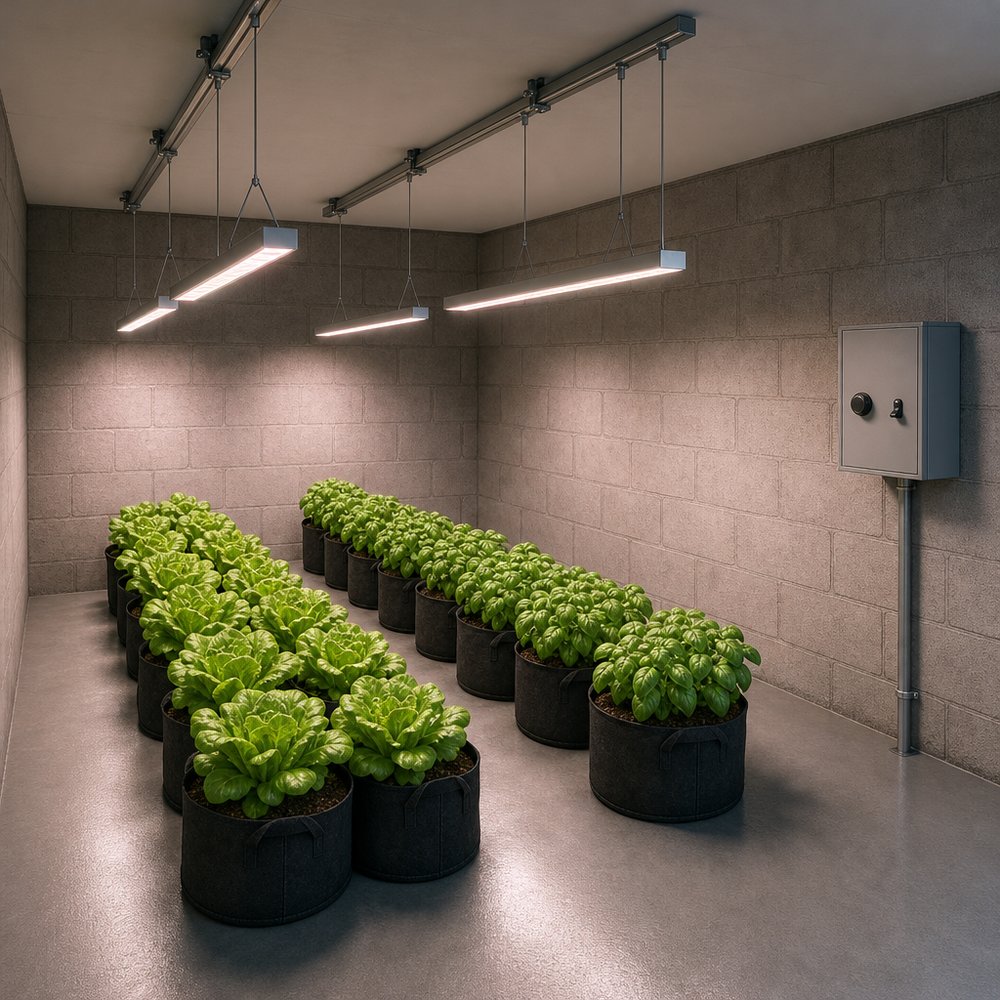
Why the limit is current, not wattage
A branch circuit is rated in amperes at a nominal voltage. The overcurrent device at the far end protects the conductors, and the conductors care about current. Wattage only becomes relevant after it has been converted at the supply voltage, and that conversion is not the simple watts ÷ volts that resistive loads allow.
An LED luminaire draws its input current in short, high-amplitude pulses, so the current waveform is not proportional to the voltage waveform. The ratio between real power and apparent power is the power factor, and a driver running at a power factor below 1 draws more current than its wattage alone implies. Horticultural drivers commonly reach a power factor of about 0.9 or better at full output, but that is a nameplate figure for one operating point. The reliable number is the rated input current printed on the fixture label, because it already includes the driver's power factor and efficiency. Reading it removes an assumption from the calculation.
Step 1 — Find the fixture's rated input current
Most commercial fixtures list input current by voltage, for example 120 V / 4.0 A and 240 V / 2.0 A for the same luminaire. When only watts and voltage are published, the current can be estimated as:
I = W ÷ (V × PF)
A 480 W fixture on a 120 V supply at a power factor of 0.90 therefore draws about 4.4 A, not the 4.0 A that W ÷ V suggests. If the power factor is unknown, a clamp meter at the input gives the honest figure, and it is worth measuring a sample fixture at the dim level the room actually runs at, because input current falls roughly in proportion to output.
Step 2 — Apply the 80 % continuous-load allowance
Horticultural lighting normally runs for far longer than three hours at a time, which makes it a continuous load. Overcurrent devices serving a continuous load are sized at 125 % of the load current, and the reciprocal statement of the same rule is easier to work with on site: the continuous load should not exceed 80 % of the circuit rating. The National Electrical Code carries a procedure of this kind for determining the electrical load of farm buildings, including the lighting connected to them [1].
| Circuit | Breaker rating | Continuous allowance (80 %) | Equivalent power at that current |
|---|---|---|---|
| 120 V, single phase | 15 A | 12.0 A | 1,440 W |
| 120 V, single phase | 20 A | 16.0 A | 1,920 W |
| 240 V, single phase | 15 A | 12.0 A | 2,880 W |
| 240 V, single phase | 20 A | 16.0 A | 3,840 W |
Note that the allowance is the same in amperes at either voltage, which is why the 240 V rows carry twice the power for the same conductor size. A dedicated single-appliance circuit may be treated differently from a general-purpose circuit, so the final decision belongs with the local authority having jurisdiction and a licensed electrician.
Step 3 — Divide, then round down
The number of identical fixtures on one circuit is the continuous allowance divided by the fixture's input current, rounded down to a whole number:
fixtures = floor (0.8 × circuit rating ÷ fixture input current)
| Fixture input power | Current at 120 V | 120 V / 15 A | 120 V / 20 A | Current at 240 V | 240 V / 15 A | 240 V / 20 A |
|---|---|---|---|---|---|---|
| 150 W bar | 1.4 A | 8 | 11 | 0.7 A | 17 | 22 |
| 320 W bar | 3.0 A | 4 | 5 | 1.5 A | 8 | 10 |
| 480 W board | 4.4 A | 2 | 3 | 2.2 A | 5 | 7 |
| 600 W board | 5.5 A | 2 | 2 | 2.8 A | 4 | 5 |
Two ceilings on the same circuit behave differently from two 600 W boards: the lower the current per fixture, the less the rounding-down penalty costs. A room that is planned around 240 V also halves the wiring current for the same photon output, which is one reason commercial installations distribute lighting at the higher voltage.
Do not spend the whole allowance on the lights
Fans, dehumidifiers, condensate pumps, irrigation solenoids and a small heater are often plugged into the same room. Under the code arithmetic, a circuit's load is 125 % of the continuous portion plus 100 % of the non-continuous portion, so an auxiliary that runs continuously consumes allowance in the same way the luminaires do. A practical approach is to leave 10–20 % of the allowance unused for start-up transients and for a future fixture, and to keep the lighting on its own circuits so that a fan failure does not take the whole room dark with it.
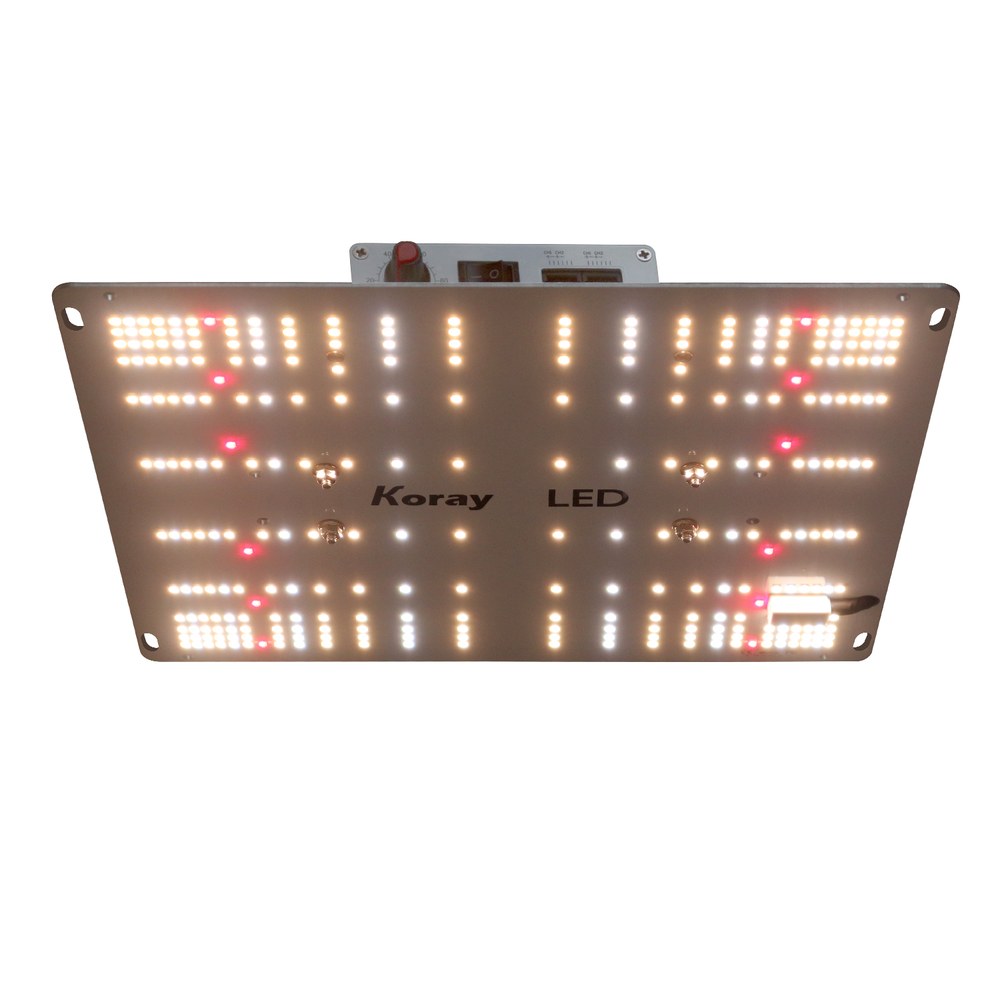
Inrush current and group switching
A driver's input capacitors charge when the mains is applied, so the first few milliseconds of each switching event carry a current many times larger than the running value. Where a contactor or a timer starts a whole group of luminaires at once, the sum of those inrush pulses can trip a thermal-magnetic breaker whose steady-state margin looked adequate. The remedies are ordinary electrical practice rather than improvisation: check the breaker's trip curve, switch the room in two or more staggered groups, or specify drivers with a controlled soft start. Lighting timers and controllers should be chosen for the inrush they will see, not only for their nominal switching rating.
Sizing guidance by room type
- Propagation bench or shelf — many small bars, low current each. One 120 V / 20 A circuit will usually carry a whole bench of 150 W bars; leave a spare allowance for the heat mat and the circulation fan.
- Flower or fruiting room — fewer, larger boards. Here the fixture count per circuit falls to two or three, and 240 V distribution is the usual answer for a room of any size.
- Vertical rack — per-tier bars multiply quickly. Count the tiers, not the racks, when the electrical load is summed, and consider a separate circuit per tier pair so that a single breaker does not govern the whole rack.
Sources
- [1] Greenhouse Management, Power provisions: greenhouse electrical system design — describes the National Electrical Code procedure for determining the electrical load of farm buildings and their connected equipment.
- [2] Michigan State University Extension, Evaluating greenhouse LED output and efficacy — how fixture output and efficacy figures are stated, and why input power and photon output must be read as separate quantities.
- [3] Resource Innovation Institute, Best Practices Guide: Lighting (2022) — industry guidance on specifying horticultural lighting for controlled-environment production.
Frequently asked questions
How many 600 W LED grow lights can I run on a 20 A circuit?
In North America at 120 V, a 600 W fixture draws roughly 5.5 A, so two fixtures reach 11 A and fit inside the 16 A continuous allowance, while a third would take the load to 16.5 A and exceed it. At 240 V the same fixture draws about 2.8 A, so five fixtures reach 14 A and fit. Use the rated input current on the label in place of the estimate.
Does the 80 % rule apply to grow lighting?
Yes, in the ordinary case. Lighting that runs for three hours or more is a continuous load, and the overcurrent device is sized at 125 % of that load, which is the same limit expressed as a maximum 80 % loading of the circuit rating.
Can I put two 480 W lights on a 15 A circuit at 120 V?
Yes, if nothing else shares the circuit. Two 480 W fixtures draw about 8.8 A, which is within the 12 A allowance of a 15 A circuit. If a dehumidifier or heater is on the same circuit, the sum has to be reworked rather than assumed.
My fixture only lists watts. How do I get the current?
Divide the watts by the supply voltage and the driver's power factor. If the power factor is not published, treat the absence as a reason to measure rather than to guess: a clamp meter at the input of one fixture, at the dim level the room runs at, gives the current to use for every identical fixture in the group.
Does a higher-efficacy fixture let me fit more lights on a circuit?
Indirectly, yes. A more efficient fixture produces the same photon flux with fewer input watts, so the current per unit of delivered light falls and each ampere of circuit allowance buys more photons. The circuit limit itself is unchanged; what changes is how much grow light that limit can pay for.
About the publisher
Zhongshan City Ruixian Electronics Factory (XineLam) has 17 years of experience designing and manufacturing LED lighting and holds 300+ patents in China and internationally. The company makes horticultural LED luminaires and dimming accessories, including the G1000 series multi-panel boards referred to above. This article is technical reference material for growers, specifiers and electricians wiring controlled-environment rooms; it is not an installation instruction, and all final circuit design should be confirmed with a licensed electrician and the local authority having jurisdiction.