How Much Heat Does an LED Grow Light Add to a Closed Grow Room?
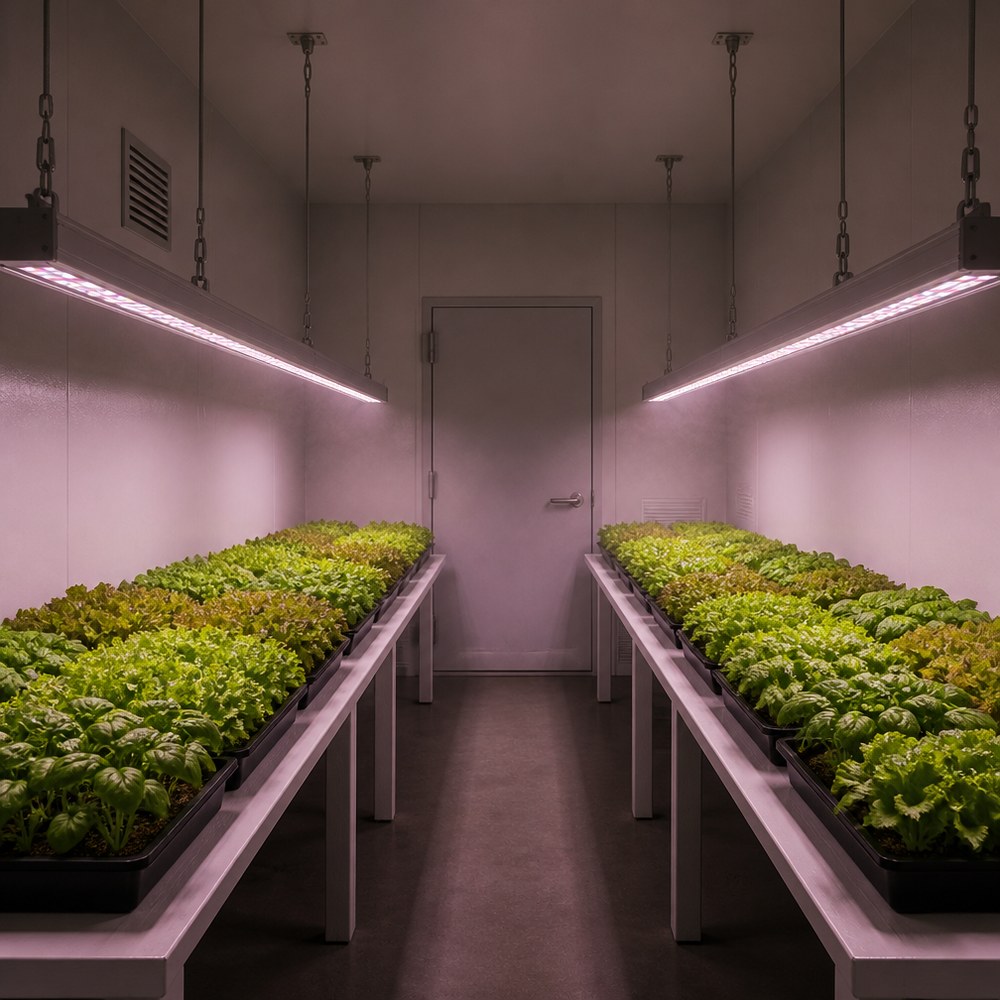
The short answer is uncomfortable: in a sealed room, essentially every watt you send to a grow light ends up as heat inside that room. A 720 W fixture therefore behaves like a 720 W heater that happens to emit light on the way. The light is not lost energy — the canopy absorbs it and converts it to heat, and the fraction reflected off leaves and walls is absorbed after a few bounces.
That is not an argument against LEDs. It is the reason the whole cooling calculation has to start from wall-plug power rather than from a vague sense that "LEDs run cool". This article works through the arithmetic, the parts people usually forget, and the airflow that follows from it.
Why "LEDs give off less heat" is the wrong starting point
LEDs do convert a larger share of their input into visible and near-visible photons than older lamp types, and that is a genuine efficiency gain. But the saving appears on the input side: you draw fewer watts for the same photosynthetic photon flux. It does not mean the fixture is thermally neutral.
Two numbers are worth keeping apart. Luminous efficacy in lumens per watt describes how a lamp is perceived by the human eye, and the U.S. Department of Energy notes that LED products now reach around 150 lumens per watt in some specialised cases. Horticultural efficacy in micromoles per joule describes how much photosynthetic photon flux leaves the fixture per unit of electricity. Neither number removes the heat; both simply tell you how much useful light you got for the watts you paid for.
The conversion, and a worked table
The arithmetic is a single constant. One watt of electrical input is equivalent to 3.412 BTU per hour, so heat load in BTU/h equals wall-plug watts multiplied by 3.412. The same load in kilowatts is simply the input power divided by 1,000.
The table below applies that constant to four common fixture sizes, then calculates the ventilation needed to hold the room at 5 K above the supply air temperature. It assumes a 30 m³ room, air density of 1.2 kg/m³ and a specific heat of 1.005 kJ/(kg·K), with no wall losses:
| Wall-plug power | Heat released (BTU/h) | Heat released (kW) | Airflow to hold +5 K (m³/h) |
|---|---|---|---|
| 320 W | 1,092 | 0.32 | 191 |
| 480 W | 1,638 | 0.48 | 287 |
| 720 W | 2,457 | 0.72 | 430 |
| 1,000 W | 3,412 | 1.00 | 597 |
Read the last column as the minimum continuous extract rate if the only thing you are fighting is the lighting load and you are willing to accept a 5 K rise across the room. Real designs need more, because walls gain heat from outside, dehumidification adds reheat, and nobody wants the room running at the top of its tolerance band during the last hour of the photoperiod.
Where the light actually goes
| Path | What happens | Effect on room load |
|---|---|---|
| Photons absorbed by the canopy | Converted to heat during photosynthesis and non-radiative decay | Enters the room as sensible and latent heat |
| Photons hitting walls, floor, trays | Absorbed or reflected a few times, then absorbed | Enters the room almost entirely |
| Convection and conduction from the fixture body | Heat sink warms the surrounding air | Enters the room directly |
| Driver losses | Typically the largest single non-light loss in the luminaire | Inside the room if the driver is inside |
| Light leaving through glazing or exhaust | The only path that removes energy | Small in an opaque, sealed room |
Evapotranspiration complicates this in a useful way. Water evaporating from leaves converts sensible heat into latent heat, so the air temperature rises less than the raw wattage suggests while the humidity load rises. That is why a room can feel deceptively cool while the dehumidifier runs continuously. The total energy still has to leave, either through the exhaust or through the cooling coil.
The loads people forget
- Driver location. A driver mounted inside the conditioned volume contributes its losses to the room and runs hotter, which shortens its life. Remote mounting removes part of the load and most of the reliability problem.
- Pumps, fans and dehumidifiers. Circulation fans add their motor power as heat; a dehumidifier adds compressor power and reheat. In a tightly sealed room these can rival the lighting load during the dark period.
- Measured versus nameplate wattage. Use a power meter at the wall. Dimmed fixtures draw less than nameplate, and a driver that is set to 90 percent output changes the whole calculation.
- Fixture spacing. Six fixtures over a small canopy concentrate the same total load into a smaller volume of air, so local temperature near the canopy runs higher even when the room average is acceptable.
Designing the airflow around the number
Once the load is known, the rest is a sequence of ordinary decisions. Extract at the top of the room, because hot air stratifies, and let make-up air enter low and away from the canopy so it does not blow directly across the plants. Keep the sensor in the canopy rather than at head height, since the canopy is what the crop experiences. And size for the worst hour of the photoperiod rather than for the average day, because a cooling system that is exactly adequate at noon is inadequate at the end of a long light period.
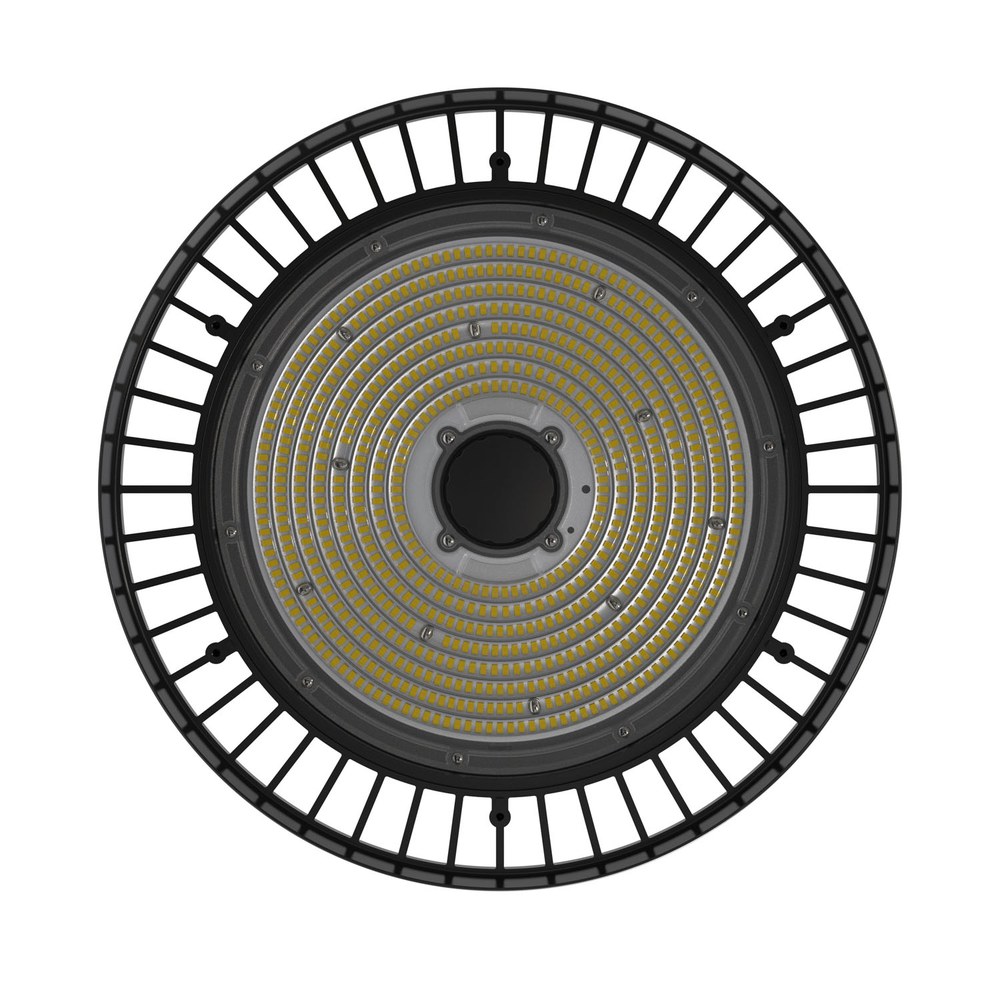
Fixtures that pull their own heat away efficiently make this easier. A radial-fin body like the one on the GK200 moves heat into the air close to the fixture instead of radiating it downward into the canopy, which reduces the temperature difference the canopy sees for the same total room load. It does not change the total, and no heat sink can; it changes where the heat is delivered.
Once the room is built and the light levels are set, the next question is usually what the lighting costs to run. That calculation, including the tariff structure and the trade-off against photoperiod length, is covered in how much it costs to run an LED grow light.
Frequently asked questions
Do LED grow lights produce no heat compared with HPS lamps?
They do produce heat, and in a sealed room almost all of their input power ends up as heat. What changes with LED is efficacy: fewer watts are needed for the same photosynthetic photon flux, so the heat per unit of delivered light is lower. The lamp itself still converts most of its input into heat inside the room.
How do I convert fixture wattage into BTU per hour?
Multiply wall-plug watts by 3.412 to get BTU per hour. A 480 W fixture therefore adds about 1,638 BTU/h, and a 720 W fixture about 2,457 BTU/h. Use the measured input power, not the marketing wattage, because driver losses are included in the load.
Does the light that plants absorb stay in the room as heat?
Yes. Photons absorbed by leaves and surfaces are converted to heat, and the small fraction reflected back is absorbed after a few bounces in a closed room. Only light that physically leaves through a window, wall or exhaust carries energy out, which is why a sealed room behaves like a heater with the same rating as the lighting circuit.
Should the driver be mounted inside or outside the growing area?
Mounting the driver outside the conditioned volume removes its losses from the room load and keeps the electronics cooler. If the driver sits inside the room, its losses are part of the load and its lifetime is shortened by the higher ambient temperature, so both the cooling calculation and the maintenance plan have to account for it.
About the publisher
XineLam is an LED lighting manufacturer based in Zhongshan, China, with 17 years of experience and 300+ patents in China and internationally. The company produces horticultural and architectural luminaires, and publishes technical notes on photometry, thermal design and installation practice for growers and specifiers.
References
- Both, A.J. Some Thoughts on Supplemental Lighting for Greenhouse Crop Production. Department of Bioresource Engineering, Rutgers, The State University of New Jersey; hosted by the Controlled Environment Agriculture Center, University of Arizona (light intensity, distribution and uniformity, cost of operation, and system maintenance as design elements).
- U.S. Department of Energy, Solid-State Lighting Program. Better Lighting for Agriculture (spectral power distribution, optical distribution and intensity control for plant production, and the associated energy consumption).