How Much Does It Cost to Run an LED Grow Light?
The calculation, in one line
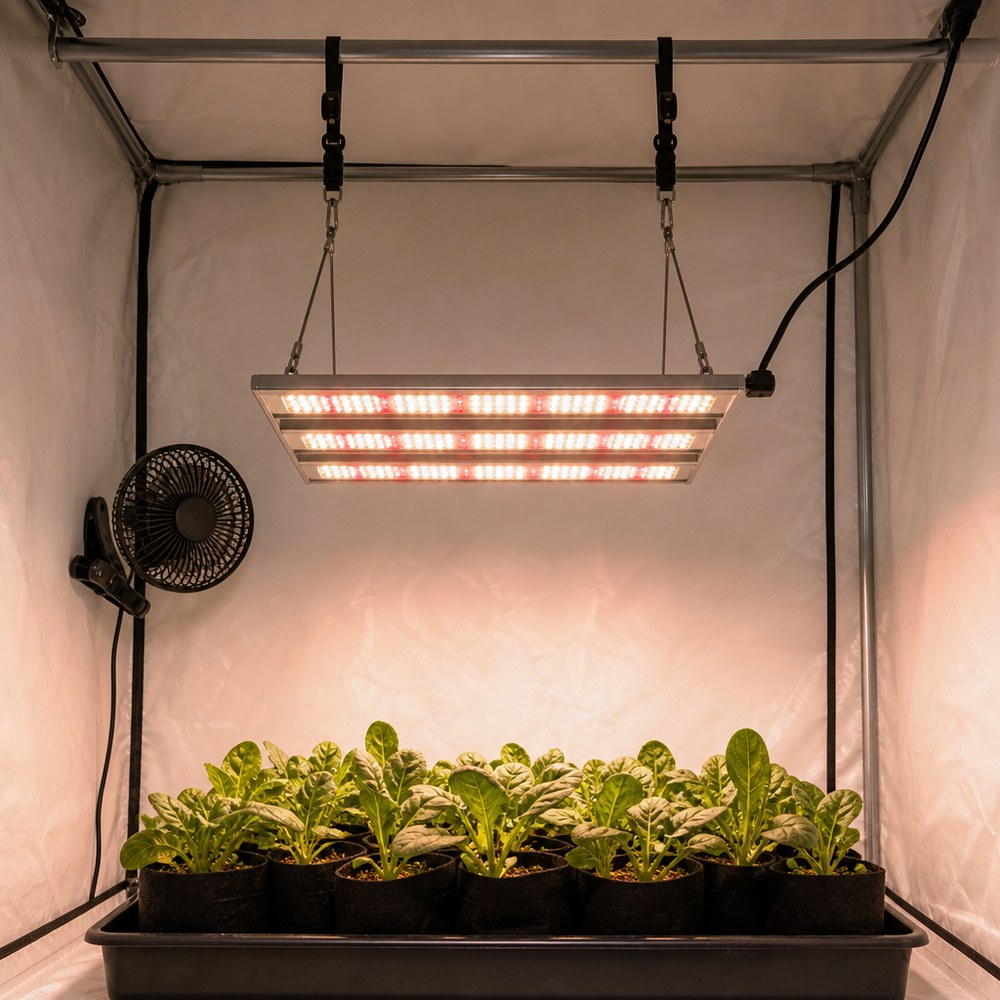
Running cost is not a property of the lamp; it is a property of the lamp plus your tariff plus your timer. Three numbers decide it: the power the fixture draws, the hours it runs each day, and the price you pay per kilowatt-hour.
Monthly energy (kWh) = fixture power (W) × hours per day × 30 ÷ 1,000. Monthly cost = kWh × your price per kWh. Nothing else is required - no spectrum data, no PPFD chart, no marketing figure.
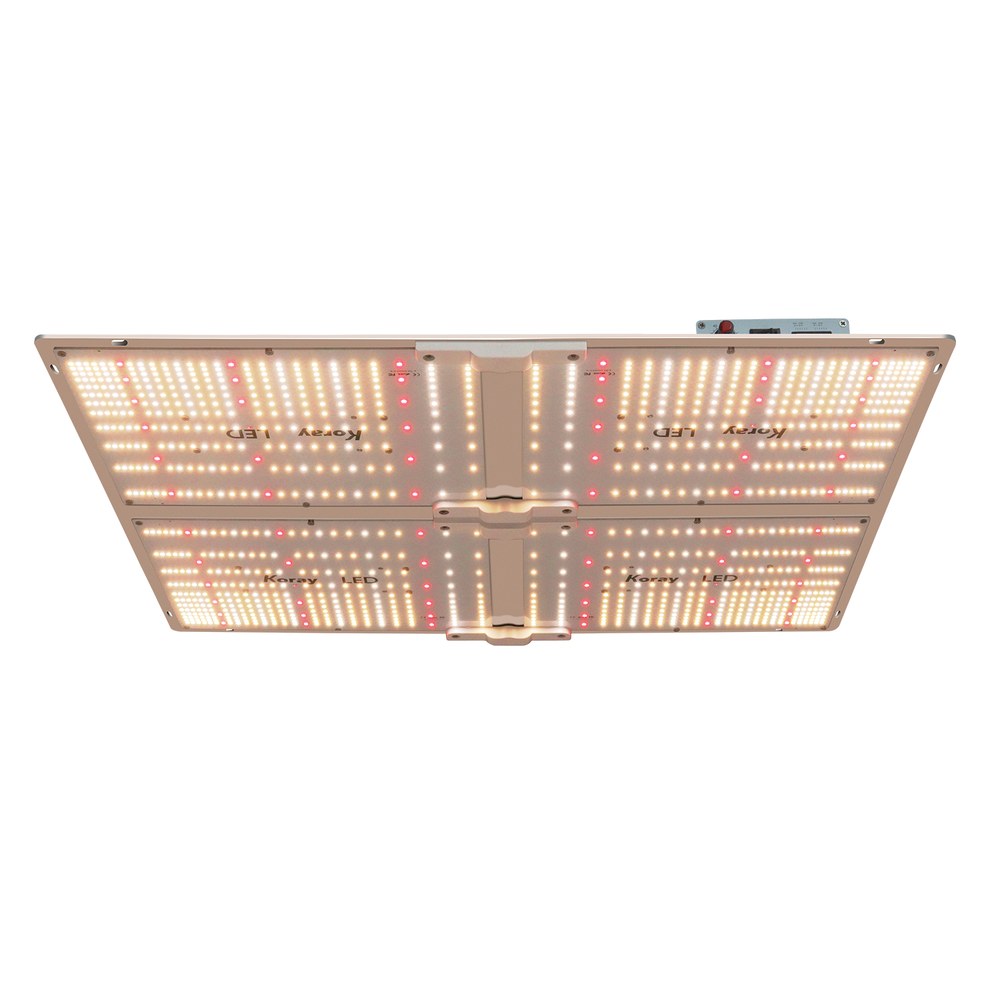
Worked example. A 240 W four-board panel run for 12 hours a day: 240 × 12 × 30 ÷ 1,000 = 86.4 kWh per month. At the U.S. residential average of 18.34 cents per kWh reported by the EIA for June 2026, that is US$15.85 a month, or roughly US$190 a year. Running the same panel for 18 hours a day raises it to 129.6 kWh, or US$23.77 a month.
Worked example, step by step
Step 1 - read the nameplate. Use the fixture's rated input power in watts. Most horticultural LED fixtures list it on the label and in the manual; extension guidance for indoor production assumes the rated figure when comparing lamp types (Oklahoma State University Extension, fact sheet HLA-6450).
Step 2 - fix the photoperiod. The timer setting is the second input, and in many rooms it moves the bill more than the fixture does: 12 hours a day and 18 hours a day differ by 50 per cent of energy for the same panel (Table 1).
Step 3 - multiply by the rate on your bill. Use your own cents-per-kWh line, tax and levies included, rather than a national average (Table 2).
Step 4 - verify once with a plug-in meter. A wall meter placed between the socket and the fixture records real kWh over a week, which catches dimming, driver losses and any control gear the nameplate does not describe.
What common fixture sizes cost to run
| Fixture power | 12 h/day: kWh per month | 12 h/day: US$ per month | 18 h/day: kWh per month | 18 h/day: US$ per month |
|---|---|---|---|---|
| 60 W | 21.6 | 3.96 | 32.4 | 5.94 |
| 100 W | 36.0 | 6.60 | 54.0 | 9.90 |
| 240 W | 86.4 | 15.85 | 129.6 | 23.77 |
| 400 W | 144.0 | 26.41 | 216.0 | 39.61 |
| 600 W | 216.0 | 39.61 | 324.0 | 59.42 |
The pattern is linear and easy to sanity-check: doubling the power or the hours doubles the energy. A 600 W fixture on an 18-hour cycle consumes 324 kWh a month, which is more electricity than many households use for lighting in a year.
Your tariff matters as much as the fixture
In the same EIA release, average revenue per kWh ranged from 8.96 cents in New Mexico to 28.50 cents in California (June 2026). For identical hardware and identical run hours, that spread triples the monthly bill.
| Rate applied | Price per kWh | Monthly cost |
|---|---|---|
| New Mexico average | 8.96 cents | US$7.74 |
| U.S. average, all sectors | 14.48 cents | US$12.51 |
| U.S. average, residential | 18.34 cents | US$15.85 |
| California average | 28.50 cents | US$24.62 |
Two consequences follow. First, any generic "typical running cost" figure quoted without a location is close to meaningless. Second, a tariff-aware decision - for example shifting a long photoperiod into an off-peak window, where your supplier offers one - can matter more than a small difference in fixture price.
Why the cheapest fixture is not always the cheapest to run
Extension comparisons rank the lamp types by operating cost, not by purchase price. Oklahoma State University Extension places LEDs lowest for both energy consumption and cost to operate, and high-intensity discharge (HID) lamps highest; the University of Missouri Extension reaches the same conclusion on long-term cost, noting that HIDs carry the lowest purchase price but the shortest life and the lowest energy efficiency, while LEDs cost more up front and the least to run. The University of Georgia Extension puts the useful-life gap in numbers: up to 50,000 hours for LEDs against roughly 24,000 hours for HID.
Oversizing also shows up on the bill. Missouri's guidance on lettuce is explicit that a PPFD between 250 and 350 µmol/m²/s is the working range for that crop, and that light beyond it wastes electricity because yield does not increase and photosynthesis can be inhibited. Paying for photons the canopy cannot use is the most common avoidable cost in a small indoor setup.
How to bring the bill down
- Trim the photoperiod where the crop's daily light integral allows it, instead of shortening the distance between lamp and canopy.
- Dim or switch off part of the array once the canopy is fully covered, rather than adding fixtures by habit.
- Size by a measured yardstick: about 25 W per square foot for high-light plants and 16 W per square foot for low-light plants is the planning rule given by Oklahoma State University Extension.
- Measure rather than estimate. The same fact sheet notes that research-grade quantum sensors cost around US$1,000 or more, while simple meters run from about US$40 to US$200 - a cheaper route to knowing your real PPFD.
- Keep the room cool. High ambient temperature shortens LED life and reduces efficiency (Oklahoma State University Extension), which moves cost from the meter to the replacement budget.
Where a fixture like this fits
The arithmetic above is the whole story for planning. A four-board panel in the 240-400 W class, suspended over a canopy of roughly 0.5 to 1.5 square metres, sits in the range where a 12-14 hour photoperiod costs between about US$16 and US$31 a month at the June 2026 U.S. residential average - a reasonable match for a small tent, a shelf unit or an indoor propagation area. Smaller spaces are usually served better by a lower-power bar or module on a longer photoperiod than by a large panel on a short one, because the same monthly energy buys more even coverage.
Frequently asked questions
How much does a 240 W LED grow light cost per month?
At 12 hours a day it consumes 86.4 kWh a month. At the U.S. residential average of 18.34 cents per kWh for June 2026 (EIA) that is US$15.85 a month; at 18 hours a day it is 129.6 kWh, or US$23.77. Substitute your own rate from Table 2 to get your figure.
Does dimming an LED grow light reduce the bill?
It reduces the power the fixture draws, and the energy bill falls roughly in proportion to the drop in watts for the hours affected. Driver behaviour varies between models, so treat the saving as approximate and confirm it with a plug-in meter rather than a percentage from a brochure.
Do LED grow lights cost less to run than HPS lamps?
For a comparable amount of useful light, yes. Oklahoma State University Extension ranks LEDs lowest of the lamp types for energy consumption and cost to operate, with HID lamps highest; the University of Georgia Extension notes that low running cost is one of the reasons growers have moved to LED.
How do I measure what my lamp actually uses?
Put a plug-in energy meter between the socket and the fixture and record kWh over a full week of normal operation; divide by seven for the daily figure, then scale to 30 days. This captures dimming, driver losses and control gear that the nameplate figure alone may not. Note that the input power on the label is the basis extension guidance uses for comparing lamp types.
About the publisher
This article is published by XineLam. XineLam is an LED lighting manufacturer with 17 years of experience and 300+ patents in China and internationally. The four-board panel used in the worked example is the type of fixture the company builds; the calculation above is presented as general guidance and does not depend on the brand of lamp used.
Sources
- U.S. Energy Information Administration. Electricity Monthly Update, End Use: June 2026 (released 26 August 2026). Residential average revenue was 18.34 cents per kWh; the all-sector average was 14.48 cents per kWh; state averages ranged from 8.96 cents (New Mexico) to 28.50 cents (California). — https://www.eia.gov/electricity/monthly/update/end-use.php
- Dunn, B. & Mills, T. Oklahoma State University Extension, fact sheet HLA-6450, LED Grow Lights for Plant Production. — https://extension.okstate.edu/fact-sheets/led-grow-lights-for-plant-production.html
- University of Missouri Extension, publication G6987, Controlled Environment Agriculture: Understanding Grow Lights. — https://extension.missouri.edu/publications/g6987
- University of Georgia Extension (DeKalb County), Utilizing Grow Lights, 16 December 2025. — https://site.extension.uga.edu/dekalb/2025/12/not-all-grow-lights-are-created-equal/