How Much Light Do Microgreens Need? PPFD, DLI and Photoperiod
Microgreens are harvested after one to three weeks, so the light schedule is short enough that every day counts. In practice you only need to fix three things: how long the trays stay dark after sowing, how many hours of light follow, and how intense that light is at tray level. This guide gives published PPFD and DLI ranges for microgreens, the arithmetic that converts one into the other, and the points where trays are most often under- or over-lit.
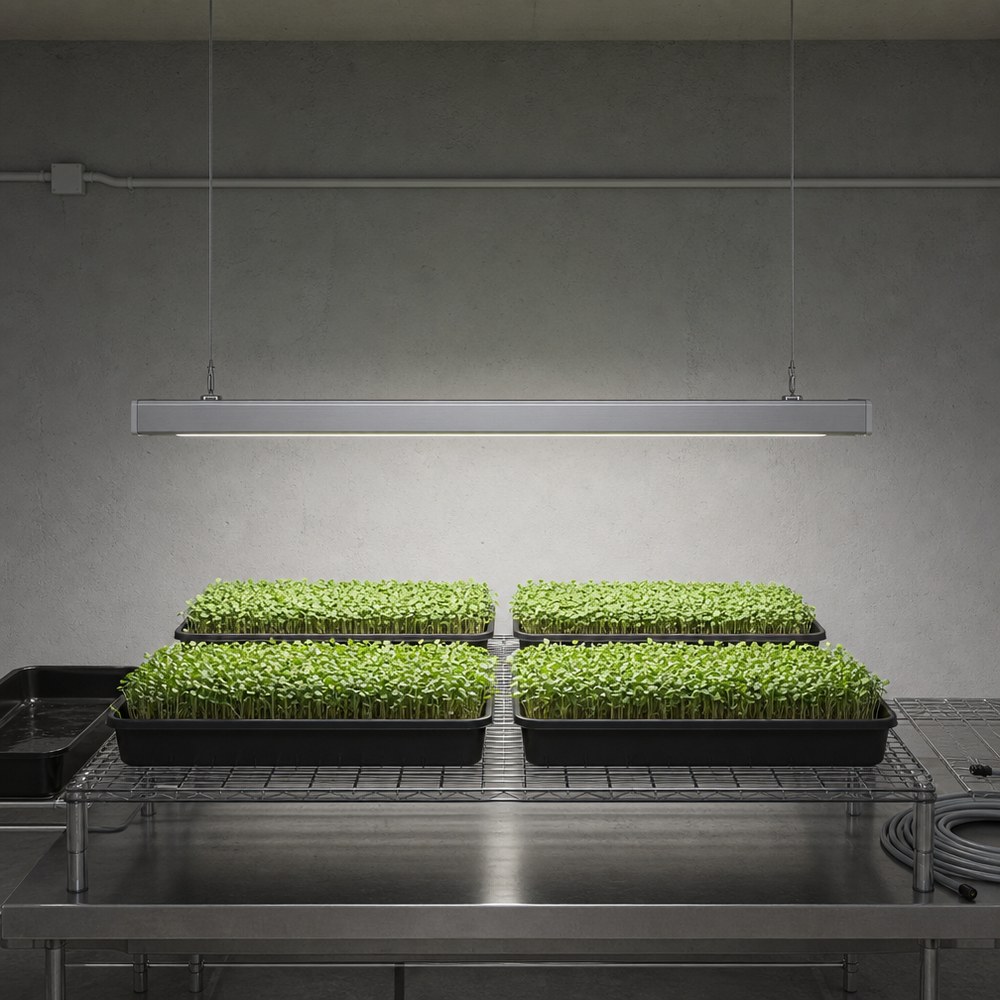
Why microgreens are not seedlings
A microgreen is grown from a dense seed rate and harvested at the cotyledon or first-true-leaf stage. Two consequences follow, and both change the light calculation.
First, the canopy closes within days. Once the seed leaves touch, the tray behaves optically like one flat surface rather than a collection of individual plants, so shading between neighbours is small and a single measurement at tray centre is reasonably representative.
Second, the growing window is short. There is no long vegetative phase during which a light deficit can be compensated, which is why the dark period and the first days after emergence deserve as much attention as the headline intensity figure.
Step 1: the dark period
Most microgreen protocols keep trays in darkness through germination, then move them into light. Grower-facing cultivation guides commonly describe a two- to four-day dark period, sometimes with weight or a cover on the tray to keep the seed bed humid and to encourage stem extension.
The dark period is a management decision rather than a lighting specification. What matters for the light budget is that the clock for the photoperiod only starts when the trays come out of the dark, so a tray that spends three days covered is three days shorter than a tray sown directly into light.
Step 2: photoperiod
Grower-facing guides for microgreens usually land on a 14 to 18 hour photoperiod, with 16 hours the most commonly quoted single value. A controlled study on four microgreen species published in Frontiers in Plant Science examined PPFD together with photoperiod, including continuous lighting, and reported that continuous lighting could reduce electricity consumption and increase yield while maintaining or improving nutritional content under the conditions tested. That result is specific to the species and intensities in the trial; it is not a general licence to run 24-hour light on every crop.
Step 3: intensity, and how it becomes DLI
Intensity at canopy level is measured as PPFD, in micromoles per square metre per second. On its own it says nothing about the total dose, because it is a rate. Multiply it by the photoperiod and you get the daily light integral, DLI, in moles per square metre per day:
DLI = PPFD × hours × 0.0036
The 0.0036 factor converts seconds to hours and micromoles to moles. Virginia Cooperative Extension sets out the same relationship in its introductory guide to calculating and using DLI, and Iowa State University Extension notes the practical consequence: raising PPFD by adding or repositioning fixtures raises DLI, and lowering PPFD lowers it, without any change to the photoperiod.
| PPFD (µmol/m²/s) | 14 h | 16 h | 18 h |
|---|---|---|---|
| 125 | 6.3 | 7.2 | 8.1 |
| 150 | 7.6 | 8.6 | 9.7 |
| 175 | 8.8 | 10.1 | 11.3 |
| 200 | 10.1 | 11.5 | 13.0 |
| 220 | 11.1 | 12.7 | 14.3 |
Reported PPFD and DLI ranges for microgreens
Peer-reviewed dosing work that is specific to microgreens is thinner than for leafy greens or fruiting crops, so the ranges below are drawn from grower-facing guidance and trials rather than from a single standard. Treat them as a starting band to verify on your own trays, not as a specification.
| Source | PPFD at canopy | DLI | Photoperiod |
|---|---|---|---|
| Grower trial series, microgreens light mapping (Urban Micro, 2025) | 125–175 µmol/m²/s | 6–10 mol/m²/day | not fixed in the trial |
| Cultivation guidance for microgreens (LED Grow Lights Depot) | 150–220 µmol/m²/s | approximately 8–13 mol/m²/day | 16–17 h |
| Continuous-lighting trial, four microgreen species (Frontiers in Plant Science, 2022) | PPFD varied as a treatment factor | not reported as a target | short vs continuous lighting compared |
Step 4: turning the target into a fixture setting
Once you have a PPFD target, the rest is geometry. PPFD falls with the square of the distance from a small source, so moving a bar fixture from 30 cm to 40 cm above the tray does not reduce the reading by a quarter — it reduces it much more than that. Set the height first, measure, then adjust.
A practical sequence for a multi-tier shelf:
- Choose the DLI target from Table 2 for the species you are growing.
- Fix the photoperiod (14–18 h) to suit your harvest schedule.
- Divide the DLI target by the photoperiod and by 0.0036 to get the required PPFD.
- Set the fixture height so the measured PPFD at tray centre matches that number, and check the four corners of the tray as well.
- Record the setting. Because the microgreens canopy is shallow, the same height will hold for the whole cycle, so the setting is repeatable between batches.
Where trays are most often under-lit
Three causes recur, and all three are measurable.
- Edges of the tray. A single bar centred over a wide tray delivers the highest reading directly underneath and a lower one at the long edges. The fall-off is a property of the fixture's beam, not of the crop.
- Corners of a multi-tier rack. A fixture sized for the shelf footprint is usually sized for average PPFD; the corners of that footprint are systematically below average.
- Tray height inside the shelf. The distance that matters is from the fixture face to the top of the canopy, not to the shelf. As the crop grows from a few millimetres to several centimetres, that distance shrinks. One grower trial measured PPFD rising by more than 25 percent at some locations as the crop grew from about 4 cm to about 10 cm in height, purely from the reduced distance.
FAQ
How many hours of light do microgreens need per day?
Most grower-facing protocols use 14 to 18 hours, with 16 hours the most frequently quoted single value. The photoperiod does not stand alone: it is one of the two inputs that turn a PPFD reading into a daily dose, so shorten the hours and you must raise the intensity if you want to keep the same DLI.
Is more light always better for microgreens?
No. Beyond the range where additional photons are used, the extra light raises electricity cost and heat load without adding harvest weight, and excessive intensity can scorch or bleach tender cotyledons. The published bands in Table 2 exist precisely because the response flattens.
Do microgreens need a dark period after sowing?
Common practice is a two- to four-day dark period through germination, often with the tray covered or weighted to hold humidity and encourage stem extension. The dark period does not contribute to DLI, so it effectively shortens the light window of the whole cycle.
What PPFD should I use for microgreens on a multi-tier rack?
Use the same target as for a single bench, but measure at the corners of each tier rather than only at the centre. The most common multi-tier problem is not the average level, it is the spread between the centre of a tier and its corners.
Does the microgreens PPFD target change as the crop grows?
The target does not change, but the delivered value does, because a taller canopy sits closer to a fixed fixture. Where a tray greens up unevenly, measure PPFD again at harvest height before adjusting the fixture; the reading may simply have drifted upward as the crop extended.
About the publisher
Zhongshan City Ruixian Electronics Factory (XineLam) has 17 years of experience designing and manufacturing LED lighting, and holds 300+ patents in China and internationally. This article is written as technical reference material for growers and specifiers. Where a figure comes from a published source it is cited below; where a practice is described as common, it reflects grower-facing guidance rather than a formal standard.
Sources
- Virginia Cooperative Extension, Calculating and Using Daily Light Integral (DLI): An Introductory Guide, VCE Publications SPES-720.
- Iowa State University Extension and Outreach, Important Considerations for Providing Supplemental Light to Indoor Plants, Yard and Garden.
- Frontiers in Plant Science, Continuous lighting can improve yield and reduce energy costs while increasing or maintaining nutritional contents of microgreens, 2022.
- PMC, Effect of Low Light Intensity With Supplemental Far-Red Light on Growth, Yield and Quality of Broccoli Microgreens.
- Urban Micro, Microgreens Light Part V – Understanding PPFD and DLI with Calculations, grower trial series, 2025.